What Is Ownership Depreciation on a Used Car?
Ownership depreciation on a used car is the value you are likely to lose from purchase to sale, minus any amount you recover at resale. Ignore it, and total ownership cost can miss by thousands of dollars. This guide explains the term and shows a simple way to estimate resale-value loss before you buy.
This guide is part of our Ownership depreciation for used cars explained series.
What ownership depreciation means
Ownership depreciation is the decline in a used car’s recoverable value while you own it. You see it in trade-in quotes and private-sale offers, and it changes total cost of ownership because part of the purchase price never comes back.
Where the loss shows up
In practical terms, a car that cost $24,000 and later sells for $17,000 reflects about $7,000 in value loss before fuel, repairs, insurance, and financing are counted. That loss is separate from monthly operating costs, but it belongs in the full ownership math.
It also affects loan equity. If the loan balance stays above market value, you are upside down. That gap matters most in the first years of ownership, when resale can fall faster than the loan balance.
How it differs from accounting depreciation
For a personal buyer, ownership depreciation is a cash-value issue, not a tax calculation. Accounting depreciation is used for books, business assets, and tax treatment. Those rules can matter for a business-use vehicle, but they do not tell a shopper what the car will likely bring at sale.
Why used cars still lose value
Used cars still depreciate because age, mileage, condition, and demand keep moving the price. The steepest drop often happened before you bought the car, which is why used vehicles usually lose value more slowly than new ones after the first owner takes the hit.
The steep drop already happened
Car depreciation is the decrease in a vehicle’s value over time, and cars often lose more than 10% in the first month. By the time a car is on the used market, much of that first drop is already behind it. That is why used-car curves often flatten compared with new-car curves.
Slower does not mean flat
Slower depreciation does not mean no depreciation. A two-year-old sedan with 38,000 miles, stained seats, and a weak service history can still lose a meaningful share of its value during the next 12 to 24 months. Local buyer demand still decides how much of that loss you recover.
What drives resale value down?
Resale value drops when age, mileage, condition, repair history, and market demand work against the car. Higher mileage usually means more wear and tear. Dents, scratches, torn upholstery, broken features, and accident repairs all reduce what a buyer is willing to pay.
Mileage and wear
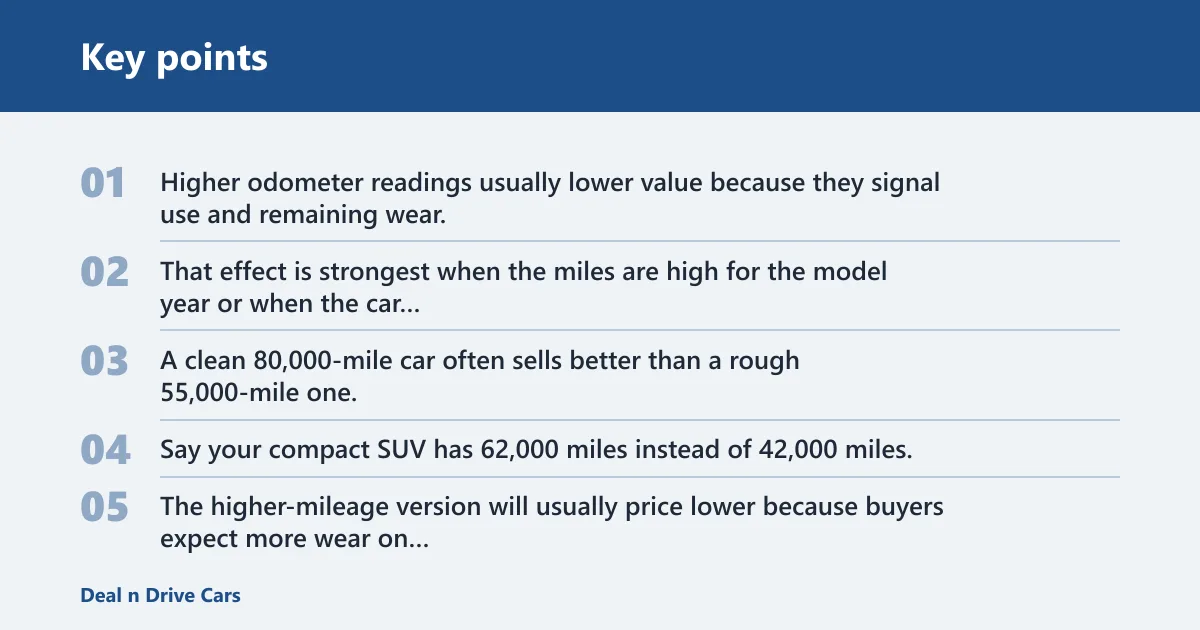
Higher odometer readings usually lower value because they signal use and remaining wear. That effect is strongest when the miles are high for the model year or when the car looks tired for its age. A clean 80,000-mile car often sells better than a rough 55,000-mile one.
Say your compact SUV has 62,000 miles instead of 42,000 miles, with the same trim and service record. The higher-mileage version will usually price lower because buyers expect more wear on tires, brakes, suspension parts, and interior surfaces.
Condition and repair history
A vehicle’s condition affects value if it has dents, scratches, worn upholstery, broken features, or missing maintenance records. Inspection reports and service receipts matter because they reduce uncertainty. A well-kept car with normal wear usually earns a better price than one with the same mileage but a rough cabin.
Vehicle history can also lower value after a major accident repair. Even when the repair is documented, buyers often discount the car because they cannot fully measure hidden structural or cosmetic risk. That discount is often larger when the damage touched frame, air bags, or multiple panels.
Trim, fuel type, and demand
Trim level matters because desirable equipment can help resale, while odd option mixes can hurt it. Fuel type matters too. Popular or fuel-efficient cars might hold value better, while weak-demand segments lose more. Brand reputation matters because buyers often pay for a history of reliable ownership costs.
That is why a well-specified mainstream trim can hold value better than a heavy, over-optioned version that few shoppers want. Buyer demand is the final filter. If shoppers want the model, the car usually loses value more slowly.
How much value do used cars lose?
Used-car depreciation varies by model, but the broad picture is clear: the loss is often steep early, then slower later. Carfax notes that cars often lose more than 10% in the first month, and around 40% or more within five years. That gives buyers a useful baseline.
Benchmark numbers to keep in mind
| Benchmark | Figure | What it helps you judge |
|---|---|---|
| First month | More than 10% | How fast value can drop right after purchase |
| First five years | 40% or more | The long-run scale of ownership depreciation |
| Average five-year depreciation rate | 41.8% | A market-wide reference point |
| Highest five-year depreciation rate listed | 63.1% | How hard some models can fall |
| Lowest five-year depreciation rate listed | 9.6% | How well a strong model can hold value |
Kelley Blue Book is commonly used as a benchmark in depreciation discussions and has cited up to about 60% five-year loss in some cases. iSeeCars analyzed a sample of more than 950,000 five-year-old used cars in a 2025-2026 window and reported a spread of roughly 9.6% to 63.1%. That spread is the key point: depreciation is not one-size-fits-all.
Ownership depreciation worksheet
This worksheet gives you a simple estimate range, not a guaranteed valuation. Start with purchase price, then adjust for mileage, condition, accident history, trim, fuel type, and demand. The goal is to estimate the resale value you are likely to recover, then subtract that from what you pay.
Simple estimate table
| Input | Example value | How to adjust resale value |
|---|---|---|
| Purchase price | $22,000 | Start here |
| Expected annual mileage | 12,000 miles | More miles usually mean a lower resale range |
| Condition | Average with minor wear | Minor wear may trim value slightly; visible damage reduces it more |
| Accident history | No major accident | Major repairs usually lower value |
| Trim | Mid-level preferred trim | Desirable trims can recover more value |
| Fuel type | Gasoline, efficient | Fuel-efficient models often hold value better |
| Market demand | Strong | Strong demand supports a higher resale range |
| Estimated resale range | $14,500 to $17,500 | Use the lower end for weak history or soft demand |
| Estimated ownership depreciation | $4,500 to $7,500 | Purchase price minus resale range |
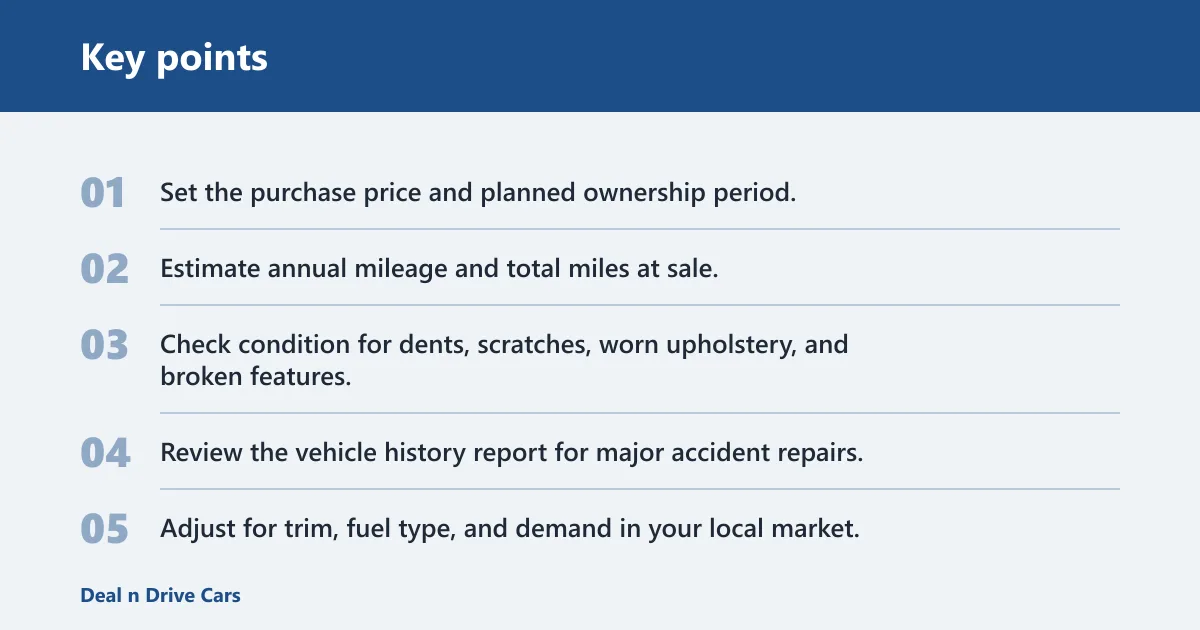
- Set the purchase price and planned ownership period.
- Estimate annual mileage and total miles at sale.
- Check condition for dents, scratches, worn upholstery, and broken features.
- Review the vehicle history report for major accident repairs.
- Adjust for trim, fuel type, and demand in your local market.
- Subtract the likely resale range from the price you expect to pay.
- Use the result as the depreciation portion of your ownership cost.
Which used cars hold value better?
Popular mainstream models usually hold value better because more buyers want them. Trucks and SUVs often do well in markets that favor utility, while some luxury cars fall faster because maintenance costs and option complexity narrow the buyer pool. EVs can be more variable because battery concerns and incentives affect demand.
Where different segments fit
Certified pre-owned cars can retain more value than similar non-certified cars because they often come with inspection standards, warranty coverage, and stronger buyer confidence. That does not stop depreciation, but it can soften the loss. The same is true for trims that sit in the sweet spot of features and price.
A common first-timer mistake is assuming a luxury badge always protects resale. A high-priced sedan with weak demand, costly repairs, and heavy mileage may lose value faster than a simpler truck or crossover with broad appeal.
How does depreciation affect your total cost?
Ownership depreciation changes total cost of ownership because it is the largest cost you do not see month to month. If resale value falls faster than you expected, your true cost rises even when fuel and repairs stay moderate. It also affects the risk of negative equity on a loan.
Loan balance versus resale value
If you finance a used car, the loan balance can stay ahead of the car’s value early on. That gap matters if you sell, trade, or total the vehicle. A lower down payment, longer term, or faster depreciation all increase the chance of owing more than the car is worth.
Timing matters
Trade-in timing changes the result. Selling when mileage is still moderate and the history is clean can preserve more value than waiting until repairs stack up. If you know the likely resale range before purchase, you can compare cars on real ownership cost rather than sticker price alone.
Frequently asked questions
What does car depreciation mean?
Car depreciation is the decrease in a vehicle’s value over time. In used-car ownership, it means the amount of recoverable value you lose between purchase and sale. Age, mileage, condition, and market demand drive that loss, and it shows up in resale value, trade-in value, and loan equity.
Can you depreciate a used vehicle?
You can track the value loss of a used vehicle, but that is not the same as accounting depreciation. For a personal buyer, the relevant issue is resale-value loss. For business use, tax treatment may involve accounting rules, but those rules are separate from what the car is likely to bring at sale.
How does mileage affect a used car’s depreciation?
Higher mileage usually lowers resale value because it signals wear and tear. Buyers expect more maintenance risk as the odometer rises, and that expectation is priced into the car. Mileage matters most when it is high for the model year or paired with rough condition and weak service records.
How do accidents affect a used car’s depreciation?
Accidents can lower a used car’s value even after repairs, especially if the damage was major or structural. A vehicle history report can make the event visible to buyers, and that history often reduces what they will pay. Documented repairs help, but they rarely erase the discount entirely.
How much value does a used car lose over time?
There is no single number for every model, but the broad benchmarks are useful. Cars often lose more than 10% in the first month and around 40% or more within five years. The average five-year depreciation rate was 41.8%, with a range from 9.6% to 63.1%.
When does used car depreciation slow down?
Used-car depreciation usually slows after the steep new-car drop has already happened. That does not mean the car stops losing value. It means the curve often flattens compared with the first owner’s loss, especially if mileage is moderate, condition is strong, and demand for the model stays healthy.
How does ownership depreciation affect total cost of ownership?
Ownership depreciation can be the largest single cost in used-car ownership because it is the value you do not recover when you sell. It affects trade-in value, private-sale proceeds, and loan equity. A car with a lower purchase price can still cost more overall if it loses value faster.