
Fair Price for a Used Car: How to Know It
A fair used-car price is often based on the market average for that year, trim, mileage, title status, and condition, then adjusted for fees and repairs; if the out-the-door total is more than about 5% above comparable listings, treat it as overpriced. Miss this and you can overpay by thousands, mistake a “deal” loaded with fees, or negotiate from the wrong baseline. This guide shows you how to price comps, adjust for mileage and condition, convert any listing into a fair out-the-door figure, and decide when to walk away.
What you’ll need
- Consumer Reports Car Value Estimator for a starting value check
- At least 3 to 6 comparable local listings with the same year, trim, drivetrain, mileage band, and seller type
- A vehicle history report such as Carfax or AutoCheck, used to verify title brands, accident entries, odometer readings, and ownership history against the listing
- A pre-purchase inspection plan with a trusted mechanic, including an appointment window, inspection fee, and a request for written estimates on tires, brakes, leaks, warning lights, and overdue maintenance
- A calculator or spreadsheet for out-the-door math
- The VIN, asking price, dealer fee sheet, and any add-on disclosure
- Tax, title, and registration estimates for the state where the car will be registered
- Repair estimates or parts-and-labor quotes for any needed reconditioning
📊 Consumer Reports notes that the average age of cars on the road in the U.S. has risen to nearly 13 years. Source: Consumerreports.
What fair price really means
Fair price is not the sticker on the windshield. It is the out-the-door number for that exact car after adding mandatory purchase costs and subtracting for mileage, condition, history, and repair needs.
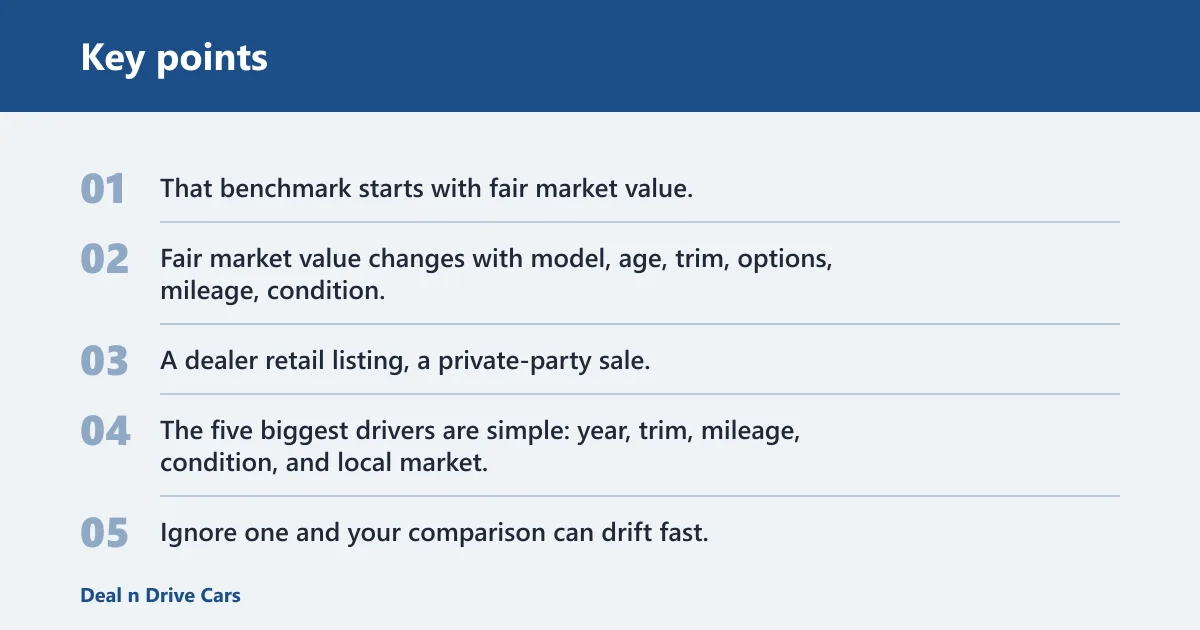
That benchmark starts with fair market value. Fair market value changes with model, age, trim, options, mileage, condition, and local supply. It also changes by seller type. A dealer retail listing, a private-party sale, and a certified pre-owned listing should not be compared as if they carry the same built-in costs or buyer protections.
The five biggest drivers are simple: year, trim, mileage, condition, and local market. Ignore one and your comparison can drift fast.
That matters more now because Consumer Reports says buying a used car is harder because fewer used cars are available now, and says price pressure is higher because of high new-car prices and market turmoil. It also says the average used-car price is just over $27,000, while vehicles under $15,000 are in short supply. In that market, a loose pricing method gets expensive.
Distinguishing negotiation targets from contextual worth
Fair value represents the objective market benchmark for a vehicle, while fair price is your specific target after accounting for negotiation levers. Confusing these two figures often results in overpaying for used cars or undervaluing trade-ins. To clarify which number applies to retail sales versus dealer listings, review this breakdown of fair price differences. This resource explains how condition and mileage shift the baseline value, whether taxes and fees are included in the final cost, and why dealer asking prices frequently exceed the standard fair market range. Using the correct benchmark ensures your out-the-door offer aligns with actual market conditions rather than arbitrary listings.
Price worksheet table
Used-car fair-price worksheet
Use one row per car. Put every listing into the same format before you compare it. The number that matters is the adjusted out-the-door total, not the ad price.
| Listing | Asking price | Dealer fees | Tax/title/registration | Reconditioning deductions | Accident/title deductions | Mileage adjustment | Condition adjustment | Final out-the-door fair price | Walk away? |
|---|---|---|---|---|---|---|---|---|---|
| 2019 compact SUV EX dealer listing | $21,400 | $699 | $1,620 | – $900 | – $1,200 | – $600 | – $450 | $20,569 | No |
| 2019 compact SUV EX CPO listing | $23,300 | $699 | $1,758 | $0 | $0 | $0 | $0 | $25,757 | Yes |
| Walk-away threshold | If final out-the-door fair price is more than 5% above your benchmark range, or title/history/inspection risk cannot be priced confidently | Yes | |||||||
In the first example, the car looks ordinary at the top line, but the deductions pull it below the advertised total because reconditioning, accident history, and above-market mileage all cost money. In the second, the CPO label cuts some risk, yet the final total still lands too far above the benchmark.
How do you find a fair market benchmark?
Start with the exact year, make, model, trim, drivetrain, engine, and key options, then check Consumer Reports Car Value Estimator and confirm with local comparable listings. Match seller type and title status before comparing prices, then build a range rather than betting on one number.
Price the exact car, not a close-enough version
Wrong trim means wrong benchmark. A mid-trim with driver-assistance features, leather, larger wheels, or all-wheel drive may sit in a different market band than the base model parked next to it.
Compare at least similar year, trim, mileage, title status, and seller type. If the target is a dealer-listed clean-title EX with 62,000 miles, do not anchor to private-party LX listings with 89,000 miles or to branded-title cars that look cheap for a reason.
Use a named pricing tool, then test it against live listings
Consumer Reports says to use its Car Value Estimator to make sure you’re getting a fair price. Use that first for a broad value check, then confirm it against current local inventory. The tool gives you a starting structure, while live listings show what sellers in your area are actually asking this week.
A solid benchmark range usually comes from about 3 to 6 strong comps. With fewer, one oddball listing can skew the result.
Match market segment before trusting the number
CPO cars often sell higher than non-CPO retail cars because they usually include manufacturer-backed warranty coverage, a dealer inspection that meets the brand’s program rules, and in some cases extras such as roadside assistance or exchange windows. Dealer retail cars often list higher than private-party cars because the package is different. The same source says used cars can be great value when they are 3 to 5 years old and older, which is often where the biggest spread appears between CPO and non-CPO versions of the same model.
Suppose two 2020 midsize sedans have the same mileage. One is CPO from a franchise dealer, the other is a private-party sale with no inspection records. Their fair prices are not equal even before fees, because the buyer is not getting the same verification or return options.
How do you turn a listing into a fair out-the-door price?
Pull the VIN and full listing details, price the exact trim, add every fee and tax, then subtract for mileage, condition, title issues, accident history, and needed repairs. Compare that adjusted out-the-door total with your benchmark range; if it lands beyond 5%, treat the listing as overpriced.
Step-by-step workflow
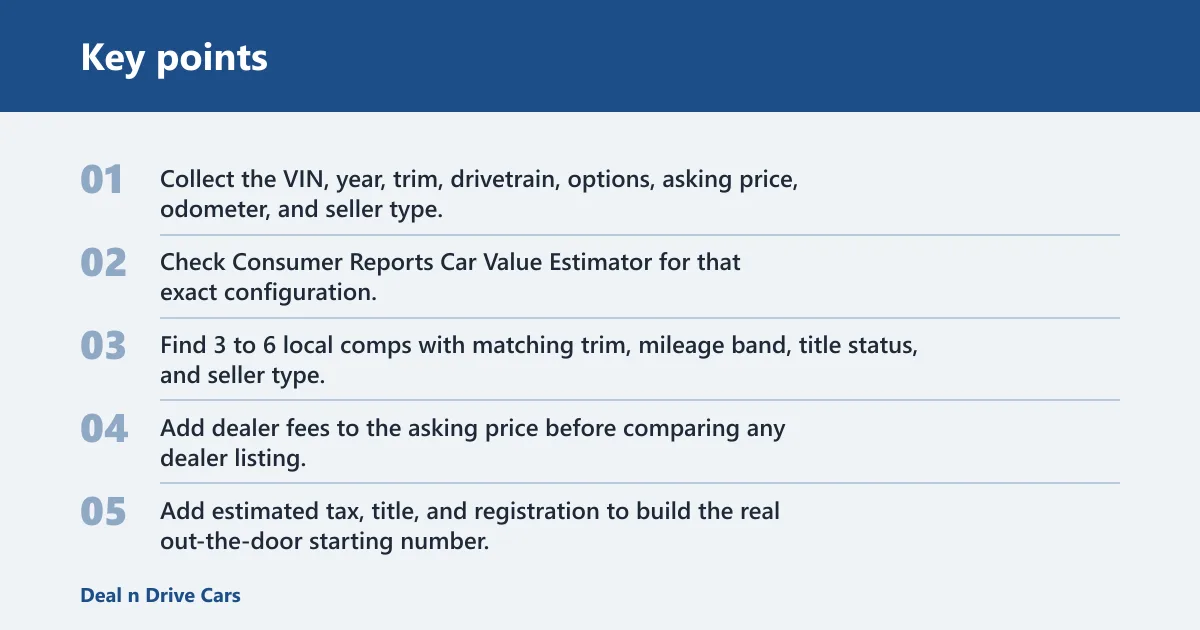
- Collect the VIN, year, trim, drivetrain, options, asking price, odometer, and seller type.
- Check Consumer Reports Car Value Estimator for that exact configuration.
- Find 3 to 6 local comps with matching trim, mileage band, title status, and seller type.
- Add dealer fees to the asking price before comparing any dealer listing.
- Add estimated tax, title, and registration to build the real out-the-door starting number.
- Remove optional add-ons such as paint protection, nitrogen, etch packages, and accessory bundles unless you truly want them.
- Pull a vehicle history report and note accidents, title brands, mileage inconsistencies, and ownership gaps.
- Adjust for mileage by comparing the target car against the average mileage in your comp set.
- Adjust for condition by checking tires, brakes, glass, paint, interior wear, warning lights, service records, and missing features.
- Book a pre-purchase inspection with a trusted mechanic and convert every near-term repair into a dollar deduction.
- Subtract reconditioning costs using written estimates, because worn tires and brakes are not cosmetic debate points.
- Set your offer from the adjusted total, then top up in $250 increments only if the car still stays inside your benchmark range.
- Walk away if the seller will not share fees, the history report conflicts with the listing, or the final number remains above your limit.
Which fees belong in the real price?
Dealer fees count because you have to pay them to buy the car. Tax, title, and registration count because they are part of your out-the-door total. Factory-backed CPO fees built into the advertised price may be acceptable if the car still prices fairly against other CPO examples.
Optional products are different. Window tint bundles, protection plans, wheel locks, prepaid maintenance, VIN etching, and alarm add-ons should be challenged, removed, or valued at zero in your worksheet unless you intentionally want them.
Keep finance cost separate from vehicle value
A fair vehicle price and a manageable monthly payment are not the same thing. Consumer Reports cites an average used-car loan interest rate of 11.43 percent. A long term can make an overpriced car look affordable on paper while leaving the vehicle itself above market.
Price the car first. Only after that should financing enter the conversation.
Building a Concrete Fair Price Offer
Determining a fair price requires moving beyond average list values to a specific, justifiable offer. This involves analyzing local market data for the exact year, trim, and mileage, then subtracting documented repair costs, title risks, and buyer-paid fees. A strong strategy starts your negotiation at the lower end of the market range rather than the average.
For a detailed breakdown on how to adjust your offer based on seller type, vehicle history, and inspection results, see fair price negotiation logic. This resource explains how to translate live listing comparisons into a final out-the-door figure that protects your budget and accounts for potential hidden issues.
How do mileage and condition change a used car’s fair price?
Mileage and condition change fair price by shifting the car away from your comp set’s average. Lower mileage can support a premium only when the rest of the car backs it up, while higher mileage, warning lights, worn tires, weak brakes, poor cosmetics, or missing records should reduce the number.
Mileage: premium or discount
Use local comps to see where the target sits. If your comparison group clusters around 55,000 to 65,000 miles and the target has 82,000, it needs a discount. If it has 38,000, a premium may be fair, but only if age, maintenance, and condition also check out.
Low mileage is not a free pass. A low-mileage car with old tires, a stale battery, fluid neglect, or crash repairs may still deserve deductions.
Condition: cosmetic wear versus mechanical cost
Cosmetic flaws matter, but mechanical faults matter more because they force spending soon after purchase. Price paint chips, curb rash, torn seat bolsters, or cracked trim lightly unless they are severe. Price tires, brakes, warning lights, leaks, suspension noise, AC faults, and overdue maintenance from actual repair quotes.
The same source recommends a trusted mechanic inspect any used car you are considering buying. That inspection is where vague condition talk turns into math. (Consumerreports)
Say your target hatchback has a fair benchmark of about $18,500 before fees. The mechanic finds front brakes due soon, two tires near replacement, and a cracked windshield. If local quotes total $1,150, subtract that amount rather than arguing in general terms about “some wear.”
Service records and missing features
Regular service records support the number because they reduce uncertainty. Missing records do not prove neglect, but they can justify caution if the car is already priced at the top of the market.
Missing features also affect value. If the listing was benchmarked against cars with navigation, sunroof, power liftgate, or a driver-assistance package, but the target lacks them, reset the comp set before doing anything else.
How do accident history and title status affect fair price?
Accident history and title status affect fair price because they change resale risk, repair confidence, and financing options. A clean-title car with verified minor damage is one thing; a branded title, structural damage note, airbag deployment, or seller-history mismatch usually requires a larger deduction or a walk-away decision.
Read the history report against the listing
A vehicle history report is not optional at this stage. Use it to check prior damage, title brands, odometer readings, registration pattern, and whether the seller’s description matches recorded events. If the listing says “no accidents” and the report shows a collision entry, price trust accordingly.
Accidents do not all hit value the same way. A minor bumper claim with proper repair documentation may need a modest deduction. Structural damage, repeated collision entries, flood branding, salvage history, or title washing concerns call for much bigger discounts and often make comparison with clean-title comps invalid.
Convert history findings into dollar adjustments
Do not use a fixed national penalty. Use a local market range. Check what similar cars with the same title status actually sell for, then back into a deduction.
Picture a clean-title dealer car listed at about $19,900 and a similar accident-history example nearby at about $18,400, both with similar miles and trim. That gap does not prove exact value loss, but it gives a market-tested starting point for your deduction range. If the seller refuses to price that risk in, move on.
When should you pay more for CPO or a dealer listing?
Pay more for CPO or a dealer listing only when the extra cost buys verified condition, a stronger inspection process, meaningful warranty coverage, and a final out-the-door price that still stays near market. If the premium pushes the adjusted total beyond your benchmark range, the extra badge is too expensive.
CPO: where the premium can make sense
Certified pre-owned inventory is often lower-mileage, just-off-lease stock. That usually means cleaner history, fresher condition, and some warranty support. Those benefits can justify a higher price than a non-CPO used car, especially if the non-CPO alternative will soon need tires, brakes, or deferred maintenance.
But CPO is not automatically fair. Compare CPO only with other CPO listings first, then test whether the premium over a similar non-CPO example is smaller than the value of the condition gap and included coverage.
Dealer lot versus private party
Dealer listings often start higher and carry fees. Private-party cars may skip the dealer fee, but the buyer usually takes on more homework and less recourse. Treat that difference as a market segment issue, not a moral one.
The same source says the average age of cars on the road in the U.S. has risen to nearly 13 years. On older cars, condition and maintenance history can matter more than whether the seller is a dealer or a private owner, because age widens the spread between “looks fine” and “actually needs work.”
When Does a Price Premium Cross the Line?
A used car listed above fair market value isn’t automatically a bad deal—but there’s a tipping point where overpaying erodes your budget and absorbs unnecessary risk. The supporting guide breaks down how far above market you can reasonably go before the deal stops making financial sense, and what factors like mileage, trim rarity, and vehicle history might justify pushing that boundary further.
With a straightforward decision table and clear thresholds, you can quickly determine whether a given premium is worth accepting or walking away from. This guide explains fair price premium limits so you leave the lot with confidence rather than regret.
Common mistakes
Comparing the wrong cars
Mixing trims, drivetrains, mileage bands, and title status wrecks the benchmark. A loaded all-wheel-drive trim cannot be priced against base front-wheel-drive ads and still mean much.
Focusing on the ad price alone
A low advertised number can lose its edge after dealer fees and add-ons. Always compare out-the-door to out-the-door. That is the only apples-to-apples view.
Skipping the history report or inspection
Vehicle history and a mechanic’s inspection change the number. They are not box-checking chores. They are where hidden accident repairs, warning lights, leaking shocks, old tires, and weak brakes turn into price deductions or a no-deal call.
Letting payment math hide an overpriced car
A stretched loan term can mask a high vehicle price. Keep the car’s fair value separate from rate, term, trade-in, and down payment.
Assuming every cheap listing is fair value
A cheap-looking car can still be expensive if it has branded title history, deferred maintenance, or mandatory dealer extras. A common shopper mistake is assuming an asking price below similar listings means a fair deal before comparing local market values, mileage, condition, and recent sale prices.
Ignoring safety content when comparing trims
If one car has safety gear the other lacks, price that difference honestly. The same source says AEB with pedestrian detection and blind spot warning are highly recommended safety features. That should not excuse overpaying, but it does affect trim-level comparisons.
If that didn’t work
Escalate the pricing check
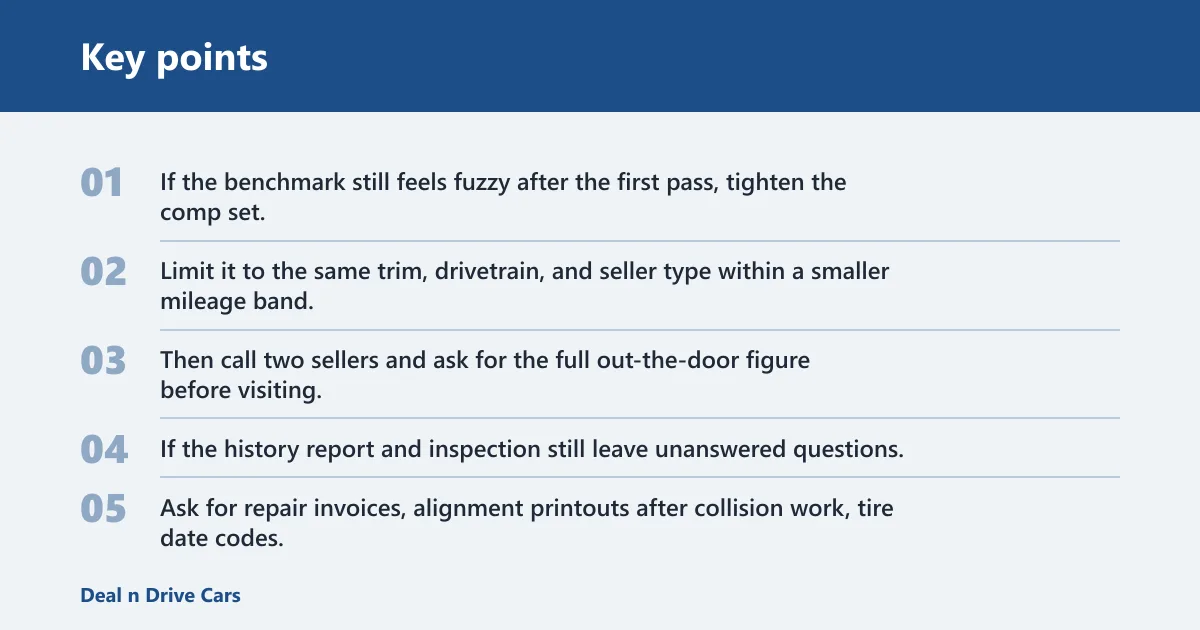
If the benchmark still feels fuzzy after the first pass, tighten the comp set. Limit it to the same trim, drivetrain, and seller type within a smaller mileage band. Then call two sellers and ask for the full out-the-door figure before visiting.
If the history report and inspection still leave unanswered questions, shift the burden to the seller. Ask for repair invoices, alignment printouts after collision work, tire date codes, brake measurements, and proof of recent service. No documents, no premium.
If the numbers still will not settle, walk away and price the next car. Used-car shopping rewards discipline more than speed.
Prevention
Build the worksheet before contacting sellers. That prevents emotional pricing, keeps each listing on the same scale, and makes it easier to reject fee-loaded cars early.
Frequently asked questions
How to find car fair market value
Check a pricing tool first, then test it against current local comps with similar mileage, trim, seller type, and title status. Fair market value is a range, not one magic figure, and it should be set before making an offer or discussing monthly payments.
What is my car’s fair market value?
For a shopper, the relevant figure is what the market supports for that exact car in local conditions. To estimate it, match year, make, model, trim, options, mileage, condition, and title status, then compare with similar sold or listed vehicles in the same market segment.
How much should I pay over fair price for a used car?
As a rule, treat anything more than 5% above comparable out-the-door pricing as too high unless the car has a clear and documented reason, such as true CPO coverage, unusually low mileage, or exceptional condition with records. Even then, recheck the comp set before agreeing.
What fees should be included in a fair used-car price?
Include dealer fees, tax, title, and registration every time because they change your real purchase cost. Exclude optional add-ons unless you want them. Compare dealer listings only after those charges are added, or one low sticker can look cheaper than it really is.