What Are the Best Used Car Sites to Buy From?
The best used car sites depend on your goal: start with AutoTrader or Cars.com for broad inventory, CarMax or dealer CPO sites for lower-risk buying, and Facebook Marketplace or Craigslist only if you can verify every detail yourself. The wrong site can lead to weak pricing, hidden fees, or a car with missed damage history. This guide ranks the main used-car sites by trust, price control, and fit for dealer, CPO, and private-party shopping.
This guide is part of our Used car sites: best places to find the right car series.
Feature comparison of major used car platforms

No single site wins for every shopper. The better question is which platform gives you the right mix of inventory, listing detail, history data, and buyer protection for your budget and risk tolerance.
| Site | Inventory depth | Seller mix | VIN/history transparency | Filtering strength | Buyer protections | Best for |
|---|---|---|---|---|---|---|
| AutoTrader | High | Dealer-heavy, some private-party | Often strong; VIN usually listed, history depends on seller | Strong | Depends on seller | Wide search and comparison shopping |
| Cars.com | High | Dealer-heavy, some private-party | Often strong; vehicle history may be shown by listing | Strong | Depends on seller | Cross-shopping local and national dealer stock |
| CarGurus | High | Dealer-heavy | Usually good listing detail; history varies | Strong price sorting tools | Depends on seller | Price comparison and deal screening |
| CarMax | Medium to high | Company-owned retail inventory | Clear listing detail; vehicle history typically presented | Good | Stronger than marketplace sites | Lower-risk dealer-style buying and home delivery options |
| Carvana | Medium to high | Company-owned retail inventory | Good listing detail; VIN and history info usually available | Good | Return and delivery policies vary by listing | Delivery-focused buying |
| Edmunds | Medium | Dealer marketplace | Useful research tools; listing history depends on seller | Strong | Depends on seller | Research-first shoppers who want pricing context |
| KBB Instant Cash Offer listings | Medium | Dealer network | Moderate; history usually comes from the dealer listing | Moderate | Depends on seller | Trade-in comparison and pricing benchmarks |
| Facebook Marketplace | High in local areas | Mostly private-party | Low unless the seller provides records | Basic | Low | Private-party deals and local negotiation |
| Craigslist | High in some areas | Mostly private-party | Low unless the seller provides records | Basic | Low | Local private-party shopping |
| Bring a Trailer | Low to medium | Auction-style private-party and specialty sellers | Often strong listing documentation | Moderate | Limited marketplace-style protections | Enthusiast cars and auction access |
How to read the matrix without overvaluing one feature
A large inventory helps only if the listings are easy to use and verify. A smaller inventory can be better when it comes with clearer photos, VIN visibility, and return or warranty terms.
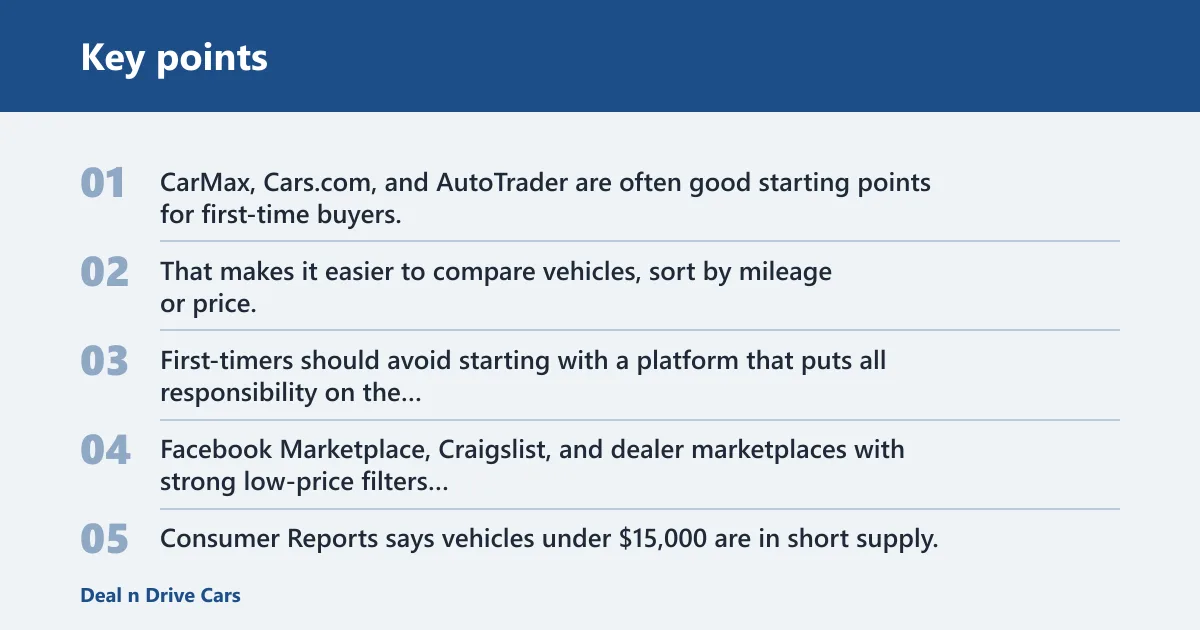
Also weigh total price, not sticker price alone. Consumer Reports says the average used-car price is just over $27,000, vehicles under $15,000 are in short supply, and the average used-car loan interest rate is 11.43 percent. Those figures change which site makes sense for you. (Consumerreports)
For example, a low-interest cash buyer may prefer a private-party site if the car checks out. A financed buyer may do better on a dealer platform with clearer pricing and lender options, even if the asking price is higher.
📊 Consumer Reports says the average used-car price is just over $27,000. Source: Consumerreports.
Which used car site fits your buying goal?
Match the site to the job in front of you. First-time buyers usually need clearer listing data and more safeguards. Shoppers under $10,000 need broad local reach and enough detail to avoid worn-out cars. Out-of-state buyers need delivery, distance filters, and paperwork support.
Best for first-time buyers
CarMax, Cars.com, and AutoTrader are often good starting points for first-time buyers. That makes it easier to compare vehicles, sort by mileage or price, and spot missing basics like VINs or service history.
First-timers should avoid starting with a platform that puts all responsibility on the buyer unless they already know how to verify title status, accident history, and ownership records.
Best for shoppers under $10,000
Facebook Marketplace, Craigslist, and dealer marketplaces with strong low-price filters are often the main places to look. The same source says vehicles under $15,000 are in short supply, so a narrow budget often means older cars, higher mileage, or more private-party listings.
At that price band, the site matters less than the listing quality. Ask for the VIN, run a history report, and arrange a pre-purchase inspection before you agree to buy.
Best for out-of-state or delivery buyers
Carvana, CarMax, and some dealer marketplaces work well for buyers who want delivery or a wider search radius. These sites often make it easier to shop outside your zip code, compare cars in nearby states, and handle paperwork remotely.
That convenience can cost more. Check delivery fees, reconditioning disclosures, return terms, and whether the car’s condition matches the photos and description before you commit.
Best for buyers who want dealer-backed coverage
Dealer certified pre-owned pages are the best fit if you want inspection standards and warranty coverage tied to the car. CPO listings are usually newer model years with lower mileage than average used cars, and they tend to include dealer-backed inspection and limited warranty terms.
That extra structure often reduces risk, but it can raise price. Use it when predictability matters more than squeezing every dollar out of the deal.
Used car marketplace types
Used-car sites do different jobs. Some are dealer marketplaces, some are private-party classifieds, some are CPO pages, and some add delivery, financing, or auction access. The best site depends on which of those categories you actually need.
Dealer marketplaces
Dealer marketplaces such as AutoTrader, Cars.com, CarGurus, and Edmunds give you broad access to dealer stock. They are usually strongest for filters, price comparison, and finding nearby inventory quickly.
They also tend to make financing easier because the seller is a dealership, not a private owner. That matters if you want to compare monthly payments or get pre-approved before shopping.
Private-party classifieds
Facebook Marketplace and Craigslist usually put you in direct contact with the seller. That can mean lower prices and more negotiation room, but it also means less protection, weaker listing standards, and more work on your side.
These sites make the most sense when you are prepared to verify the VIN, inspect the car carefully, and walk away from incomplete paperwork.
Certified pre-owned pages
Manufacturer and dealer CPO pages list vehicles that have passed a dealer-backed inspection and usually carry warranty coverage. They are often the most controlled used-car category for shoppers who want a newer vehicle with fewer surprises.
They are not the cheapest option. They are the option for buyers who want more process and fewer unknowns.
Auction-style and direct-buy platforms
Bring a Trailer is the clearest example here. Auction-style sites can provide detailed listings and enthusiast-grade documentation, but they also move fast and may reward buyers who already understand market pricing.
These platforms are better for specific vehicles than for casual browsing. They are less useful if you want broad commuter-car shopping with long filter lists and easy local comparison.
How much trust does each site give you?
Trust comes from three things: VIN access, vehicle history detail, and listing quality. A site can have thousands of cars and still be a weak choice if the listings are thin or the seller info is incomplete.
VIN lookup and history report access
A VIN-based lookup helps you confirm accident records, title issues, odometer checks, and ownership history. That information does not guarantee the car is good, but it can reveal red flags before you travel to see it.
Sites that surface the VIN clearly, or link to a vehicle history report, are easier to vet. If the VIN is missing, treat the listing as incomplete until the seller provides it.
Accident, title, and odometer checks
History reports are useful because they can reveal major damage, salvage or flood titles, mileage inconsistencies, and ownership changes. That matters most on older cars and private-party listings, where the seller may know less or disclose less.
Do not rely on a clean-looking ad alone. A polished listing can still hide a branded title or odometer problem.
Listing quality and scam-avoidance signals
Better sites make it easier to check photos, trim levels, features, price history, and seller identity. That helps you spot mismatches, like a listing that claims one trim but shows another in the photos.
Suppose a 9-year-old sedan is listed with about 62,000 miles, but the ad has two blurry photos and no VIN. That is not a bargain signal. It is a reason to slow down and verify everything before you meet the seller.
Used car site filters and price tools
Filters are not a convenience feature. They are part of risk control. The better the filters, the faster you can cut through cars that do not fit your budget, commute, parking space, or family needs.
Make, model, mileage, body style, and radius filters
Strong filters let you narrow by make, model, price range, mileage, body style, and location radius. Those controls matter because they keep you from comparing a high-mileage pickup to a low-mileage sedan and calling it a fair match.
Radius filters matter even more for private-party shopping, where a broad search can produce dozens of listings that are too far away to inspect efficiently.
Saved searches and price alerts
Saved searches help when inventory changes fast. Price alerts are useful when you are targeting a rare trim, a low-mileage commuter car, or a CPO vehicle in a crowded market.
They also help under budget pressure. If you are chasing a specific car under $10,000, alerts can surface a decent listing before someone else buys it.
Valuation tools for market price, trade-in, and fair price
Used-car valuation tools help you benchmark asking price against market price, trade-in value, and fair-price ranges in your area. That gives you a better check than a single listing or a dealer’s opening number.
Use the tool before you start negotiating. It is easier to spot an inflated price when you already know the local market adjustment.
Where certified pre-owned listings stand out
CPO listings are worth attention when you want a stronger process around inspection and warranty coverage. They are especially useful if you prefer dealer paperwork and want a newer used car with fewer miles than the average listing.
Inspection standards
CPO programs usually require a dealer inspection, though the exact checklist can vary by brand. That is different from a normal used-car listing, where inspection quality depends on the seller.
It does not remove the need for your own check. Even on a CPO car, review the maintenance history and the listing details carefully.
Warranty coverage
CPO coverage can include limited warranty protection, and sometimes powertrain coverage, depending on the program. That can reduce repair risk in the first ownership period.
Read the terms closely. Coverage length, deductible rules, and what counts as wear-and-tear can differ a lot by brand.
Typical mileage and model-year ranges
CPO vehicles are usually newer and lower mileage than average used cars. That does not make them perfect, but it often means less wear and a more predictable ownership profile.
If you want a car that feels closer to new without paying new-car pricing, CPO listings are worth a serious look.
Where CPO is worth the premium
CPO makes sense when you want warranty coverage, fewer unknowns, and easier financing through a dealer. It is also a smart fit if you plan to keep the car for several years and care more about risk control than the lowest possible price.
If you are mainly price-sensitive and comfortable checking everything yourself, a regular dealer listing or private-party ad may offer better value.
Choose dealer sites if you want… / Choose private-party sites if you want…

Dealer sites and private-party sites are often used for different needs. Dealer sites give you more structure, better financing access, and often more buyer protections. Private-party sites can offer lower prices and more room to negotiate, but they demand more caution.
| If you want… | Dealer sites | Private-party sites |
|---|---|---|
| Easier financing | Usually better | Usually harder |
| More listing structure | Usually better | Usually weaker |
| Lower asking prices | Often higher | Often lower |
| More negotiation room | Moderate | Usually wider |
| More buyer protection | Usually better | Usually limited |
Dealer sites for easier financing and more protections
Choose dealer sites if you want one place to shop, finance, and compare similar vehicles with consistent listing formats. That is especially useful if you are pre-approved, want a CPO car, or need home delivery.
Car and Driver advises getting pre-approved for a car loan before finding a used vehicle. That can help you judge whether a dealer’s financing offer is actually competitive.
Private-party sites for lower prices and wider negotiation room
Choose private-party sites if you are chasing the lowest price and can manage the verification work yourself. Car and Driver also notes that paying cash avoids interest and can reduce total cost, which matters more when the seller is not offering financing.
That said, lower sticker prices can hide repair costs. Car and Driver advises factoring in fuel, maintenance, insurance, and repairs in the budget.
How to decide between the two based on risk tolerance
If a bad title, hidden damage, or surprise repair would strain your budget, lean toward dealer inventory or CPO. If you can inspect carefully, verify paperwork, and handle more risk, private-party sites may save money.
A common first-timer mistake is sorting only by asking price and ignoring total cost of ownership. A $9,200 car with new tires, a clean title, and a dealer inspection may cost less over time than a $7,800 car that needs brakes, tires, and a timing belt soon after purchase.
Frequently asked questions
What is the best used car site to buy from?
There is no single best site for every buyer. AutoTrader and Cars.com are strong starting points for broad shopping, while CarMax and dealer CPO pages are better when you want more structure and buyer protection. Private-party sites can work, but they require more verification.
What is the best used car website to buy from?
The best website depends on whether you value inventory breadth, lower risk, delivery, or private-party pricing. If you want a balanced starting point, use a dealer marketplace first, then compare against CPO inventory and private-party listings before making a decision.
What are good websites to buy used cars?
Good websites include AutoTrader, Cars.com, CarGurus, CarMax, Carvana, Edmunds, Facebook Marketplace, Craigslist, and Bring a Trailer. Each fits a different buyer need, so the right choice depends on how much control you want over price, history checks, financing, and seller type.
Where to buy reliable used cars?
Dealer CPO pages and large dealer marketplaces are usually the safest places to start if reliability and paperwork clarity matter most. Reliable does not mean perfect, though, so you should still check the VIN, review the history report, and arrange a pre-purchase inspection by a trusted mechanic.
What’s the best used car to buy for under $10000
At under $10,000, the site matters less than the specific car’s condition, title, mileage, and maintenance record. Private-party listings can offer better pricing, but the strongest buys are usually the ones with a clean history report, clear service records, and a mechanic inspection before purchase.
How do I choose between used car sites and dealership websites?
Use used-car marketplaces when you want to compare many sellers quickly. Use dealership websites when you want more direct contact with one seller, clearer financing options, and often better warranty or return terms. The right choice depends on whether you value comparison range or transaction structure more.