Depreciation Red Flags to Check in a VIN Report
Treat a VIN report as a depreciation screen. Walk away or demand a steep discount for structural damage, airbag deployment, flood history, odometer issues, or repeated title brands. Cosmetic-only repairs usually matter less. Missing those red flags can lead to overpaying now and taking a bigger hit at resale. This guide shows which report items are cosmetic, which are price noise, and which will hurt future value.
What a VIN report can tell you before you buy
A VIN report helps you separate normal wear from history that can weaken resale. It can include many data points, along with market value, listing and price history, vehicle history, open recalls, a stolen car check, and projected depreciation for 1, 2, and 3 years where available.
What matters most for depreciation
Not every flagged item hurts value equally. A clean bumper repair is one thing; flood history, airbag deployment, odometer mismatch, or a branded title is a more serious concern. The right question is not “Is there any history?” but “Which history will a future buyer price out?”
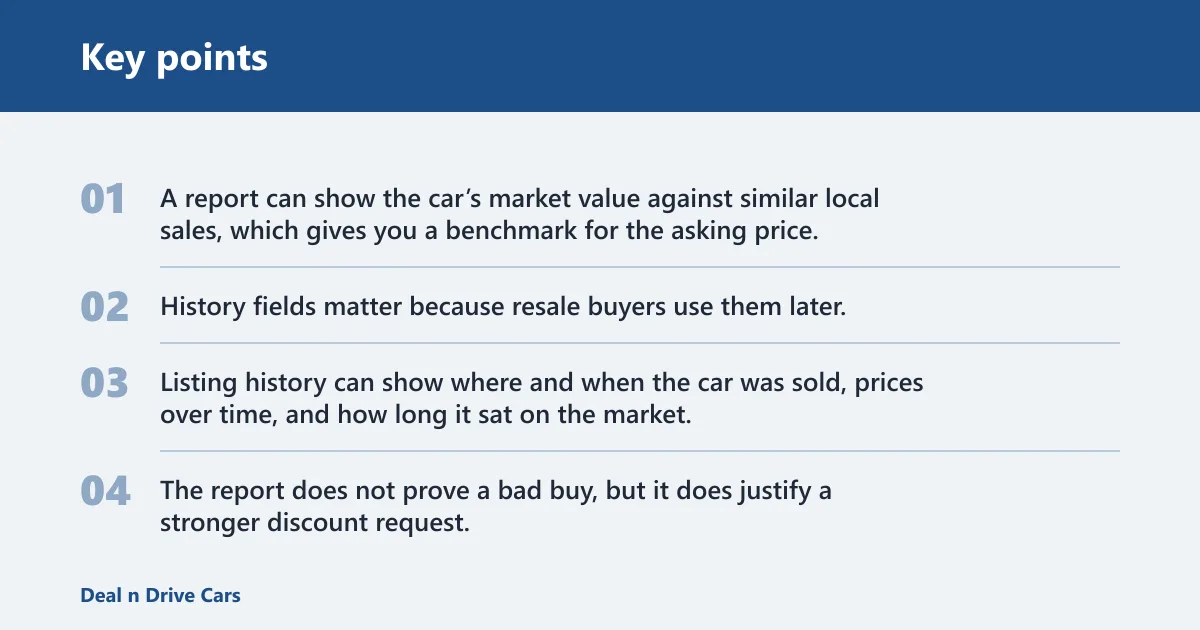
Start with the market context. A report can show the car’s market value against similar local sales, which gives you a benchmark for the asking price. If the asking price sits far below that local range, the gap may point to hidden damage, title issues, or weak demand rather than a bargain.
History fields matter because resale buyers use them later. Listing history can show where and when the car was sold, prices over time, and how long it sat on the market. That combination helps you spot repeated relistings, price drops, and stale inventory that often reflects a weak story or a hard-to-move vehicle.
Depreciation red flag scorecard
| Report item | Red-flag pattern | Why it hurts resale | Confidence level | Action |
|---|---|---|---|---|
| Market value | Priced dramatically below local similar sales | Can signal hidden history, weak demand, or a dealer trying to move a problem car fast | Medium | Inspect |
| Listing history | Repeated relistings, steady price cuts, long days on market | Suggests prior buyers passed, which can pressure future resale and bargaining power | Medium | Negotiate |
| Mileage history | Jumps, gaps, rollbacks, or mileage far above the average car in the same class | Raises odometer manipulation risk and signals harder use | High | Walk |
| Accident and damage records | Structural damage, airbag deployment, flood, frame repair, major repair estimates | These are the fastest routes to lower resale value | High | Walk |
| Accident and damage records | Minor cosmetic repairs with no structural clues | Usually hurts less, but the repair still needs verification | Low to medium | Inspect |
| Open recalls | Unrepaired safety recall on a major system | Can affect safety, saleability, and buyer confidence | High | Walk or delay |
| Ownership history | Many prior owners, rental use, taxi use, lien or restriction notes | Signals harder past use or a more complicated title trail | Medium to high | Negotiate |
| Stolen car check | Theft record or title ownership concern | Can create legal and title risk, which is a resale problem from day one | High | Walk |
| Projected depreciation | Weak 1-year, 2-year, and 3-year outlook versus similar cars | Shows the car may lose value faster than competitors | Medium | Negotiate |
Suppose two compact sedans share the same asking price, but one has two prior owners, a repeated price drop, and a mileage pattern that jumps irregularly. That car is harder to justify, even if the body looks clean. The report does not prove a bad buy, but it does justify a stronger discount request.
How do market value and listing history reveal depreciation risk?
Market value and listing history reveal depreciation risk by showing where the car sits versus similar local sales and how hard it has been to move. A car priced dramatically lower than the local benchmark may carry hidden history, and repeated relistings or long days on market can signal weak demand that follows the car into resale.
Market value and local benchmarks
Use the market value figure as a starting point, not a verdict. Compare the asking price with the report’s local-area benchmark and with similar vehicles in the same trim, mileage band, and model year. If the price is far below that range, ask why before calling it underpriced.
A very low number can be a red flag when it does not match the condition story. A dealer may price down a car with prior damage, title brands, or a tough color or trim to offset what the report already hints at. That kind of discount can look attractive and still leave little room for future resale strength.
Listing history signals
Repeated relistings and repeated price drops are not cosmetic. They often mean the market has already pushed back. Long days on market matter too, because stale inventory can create the impression that other shoppers saw the same issue and passed.
Picture a midsize SUV that appears three times in listing history over six months, each time with a lower price. That does not automatically mean a hidden defect, but it does mean the vehicle has not sold at the level the seller first wanted. Use that pattern to ask for inspection records, title details, and a firmer discount.
-
Compare local prices first.
Check the report’s market value against similar local sales, then compare trim, mileage, and drivetrain. A low asking price only matters if the car is also weak versus the local benchmark. -
Read the history trail.
Look for prior sale locations, price changes, and days on market. More than one relisting or a long sale history often suggests the market may already have priced in some risk. -
Match the discount to the risk.
Cosmetic history may justify a modest reduction. Structural damage, title branding, or mileage anomalies usually justify a much larger one, or a walk away.
Does accident history in a VIN report mean the car will depreciate faster?
Not always. Accident history can hurt resale most when it points to structural damage, airbag deployment, flood exposure, or expensive repairs that future buyers may see in the report. Minor cosmetic repairs can still matter, but they usually carry less resale penalty than frame, water, or safety-system issues.
Cosmetic damage versus value-damaging damage
Body work by itself is not the whole story. A repaired bumper cover or door skin may be mostly cosmetic if the inspection confirms the structure is straight and the paint match is acceptable. Damage that reaches the frame, suspension pickup points, airbags, or flood-damaged electrical systems is a different category entirely.
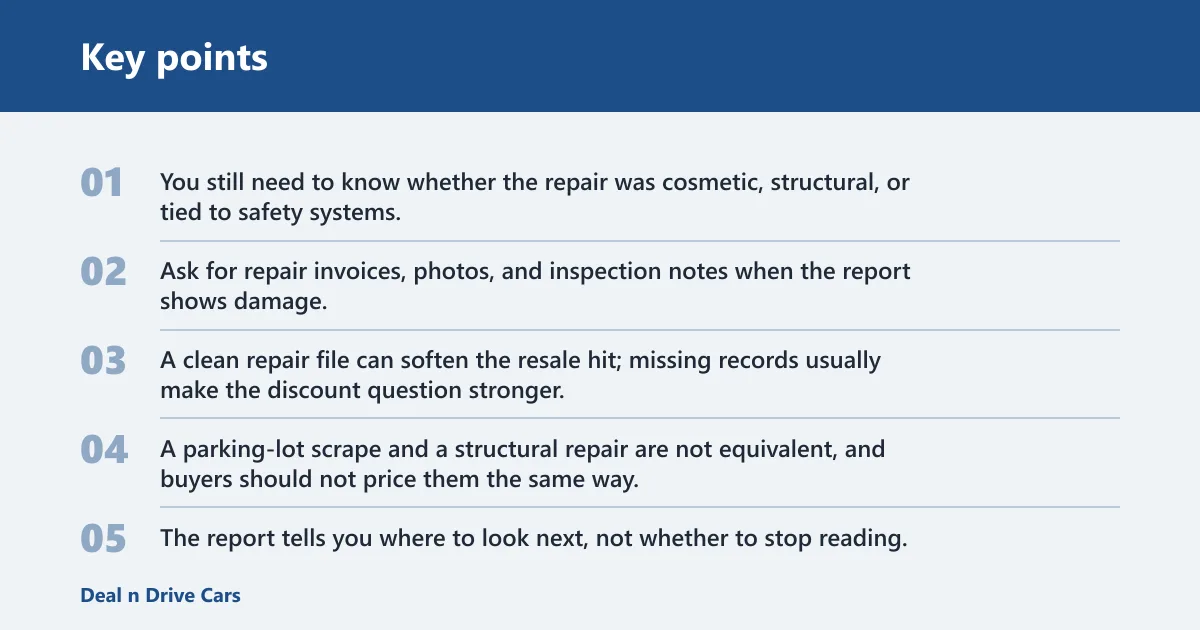
CARFAX says reports may include damage or accidents, estimated repair costs, and related history events in a database of more than 45 billion historical events. Those details are useful because repair cost alone is not enough. You still need to know whether the repair was cosmetic, structural, or tied to safety systems.
What to verify after a damage flag
Ask for repair invoices, photos, and inspection notes when the report shows damage. Then check panel gaps, paint texture, underbody corrosion, weld marks, and dash warning lights during an independent inspection. A clean repair file can soften the resale hit; missing records usually make the discount question stronger.
A common mistake is assuming every low-mileage VIN report hides the same depreciation risk, even when one shows repeated title brands and another shows only a minor parking-lot claim. A parking-lot scrape and a structural repair are not equivalent, and buyers should not price them the same way. The report tells you where to look next, not whether to stop reading.
What mileage patterns suggest hidden risk?
Mileage patterns matter because they can reveal odometer manipulation, irregular use, or a car that was driven harder than average. A normal upward trend is expected. Mileage gaps, rollbacks, sudden jumps, or mileage that is well above similar cars can weaken resale and raise questions about how the car may have been used.
Trend, not just the odometer
Look at the full mileage history, not the current odometer alone. A healthy record should move upward in a way that makes sense for the car’s age and sale dates. If the report shows a drop, a flat stretch that makes no sense, or a sudden swing between listings, treat it as a verification problem.
Mileage anomalies are serious because future buyers often check them too. The same source says reports may include mileage manipulations, which means the report can give you a warning before a test drive ever starts. If the trend looks off, ask for service records, inspection stickers, and prior title documents.
-
Map each mileage entry.
Line up every reading by date and compare the progression. A steady rise is normal; a reversal or unexplained gap needs explanation. -
Compare to similar cars.
Judge the car against the average car in its segment, not against a vague “low mileage” label. A commuter sedan can age differently from a weekend car or a delivery-focused vehicle. -
Verify the paper trail.
Match the VIN report to service invoices, registration records, and state inspection data when available. That reduces the chance of buying a car with hidden odometer issues.
How do ownership, recalls, and theft records affect resale?
Ownership history affects value when it shows many prior owners, rental or taxi use, liens, or restrictions. Open recalls add safety and saleability risk, while a stolen vehicle check protects you from ownership trouble. Any of those can lower future resale because buyers dislike uncertainty.
Prior owners and commercial use
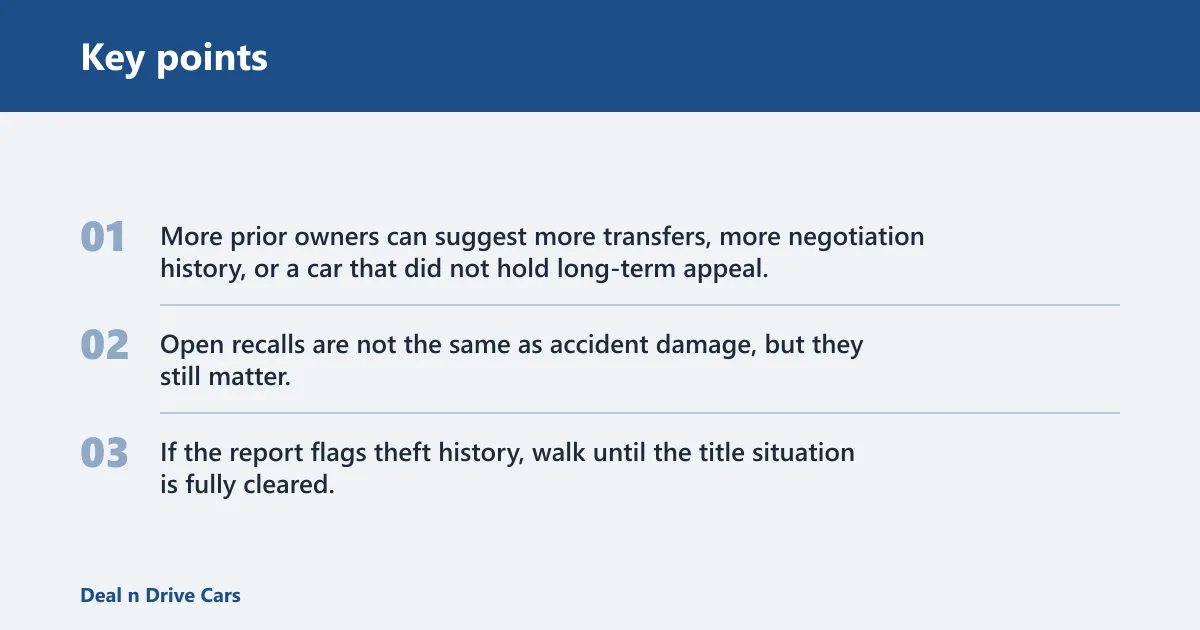
More prior owners can suggest more transfers, more negotiation history, or a car that did not hold long-term appeal. Rental or taxi use matters because those vehicles often face more frequent stops, heavier passenger turnover, and faster interior wear than a privately owned commuter car.
The same source says reports may include ownership history and taxi or rental car use, and the report can check vehicle history from Carfax or Autocheck in some cases. That is useful because ownership patterns often explain why one similar car holds value better than another.
Open recalls and theft checks
Open recalls are not the same as accident damage, but they still matter. If a major safety recall remains unrepaired, the car can be harder to sell, harder to insure in some cases, and less attractive to cautious buyers. The repair responsibility usually sits with the manufacturer, but you should still decide whether the timing works for your purchase.
A stolen car check is non-negotiable. Theft records or title ownership problems can create legal and resale risk that is much harder to fix later than a tire wear issue or a paint touch-up. If the report flags theft history, walk until the title situation is fully cleared.
When a recall pushes you to walk
Open recalls should push you to walk or delay when the affected system is safety-critical and the seller cannot show a scheduled repair. That is especially true for brakes, airbags, steering, fuel systems, or other major components. For smaller recalls, a holdback or repair appointment may be enough, but only if the title and inspection story are otherwise clean.
Should projected depreciation change your offer?
Yes, if the report includes projected depreciation, use it to shape the offer. The 1-year, 2-year, and 3-year estimates are not guarantees, but they can show whether the car is expected to lose value faster than comparable cars. That matters most when the current price already sits near the top of the local range.
How to compare forecast to competitors
Compare the projection with similar cars in the same segment, especially if the report shows a weaker outlook than the competition. A luxury sedan with a steep 2-year decline may deserve a deeper discount than a mainstream commuter car with a steadier curve. Segment matters because resale pressure is not equal across all vehicles.
Use the forecast as a negotiation tool, not a promise. If the report shows a weak outlook and the car also has accident history, rental use, or repeated relistings, the combined risk is stronger than any single item alone. That is when a firmer offer or a walk-away line makes sense.
-
Anchor the offer to market data.
Start with the local market value, then adjust for history flags and projected depreciation. The result should reflect both current condition and likely future resale. -
Compare against competitors.
Check similar vehicles with cleaner reports and steadier mileage histories. If those cars are only slightly more expensive, the lower-risk option may be better value. -
Set a walk-away limit.
If the car combines a weak forecast with structural damage, a mileage anomaly, or an open safety recall, stop negotiating and move on.
How to use the report to negotiate or walk away
Use the report as one part of a buying decision, not the whole decision. The right move depends on whether the red flags are cosmetic, pricing noise, or value-damaging history. Pair the report with an inspection and test drive so you can confirm what the data suggests and rule out what it cannot prove.
A simple decision path
-
Separate cosmetic from structural.
Cosmetic repairs can lead to a smaller discount request. Structural damage, flood history, airbag deployment, or odometer issues usually justify walking away. -
Check pricing against history.
If the car is priced low but the report shows repeated relistings, multiple owners, or weak depreciation forecasts, press for a larger reduction. -
Confirm with an inspection.
Use the report to target what the inspection should inspect first: frame, paint, glass, warning lights, tire wear, and evidence of uneven repair.
Say a crossover shows clean market value at first glance, but the report also shows two prior owners, a long time on the market, and a recall on a key safety system. That is not a guaranteed problem car. It is a car that needs a tougher inspection, a lower offer, or both.
Frequently asked questions
What depreciation red flags should I look for in a VIN report before buying a used car?
Focus on structural damage, flood history, airbag deployment, mileage anomalies, repeated relistings, open safety recalls, theft records, and branded title notes. Those items can hit resale the hardest. Cosmetic repairs and minor price noise matter less, but they still deserve verification before you commit.
How do market value and listing history in a VIN report reveal bad depreciation risk?
Market value shows what similar local cars are actually bringing, while listing history shows how long this car has needed to sell. A car priced far below local benchmarks, then relisted again and again, often has a history problem or weak demand that follows it into resale.
What mileage patterns in a VIN report suggest a car was driven harder than average?
Watch for irregular jumps, unexplained gaps, rollbacks, or mileage that sits well above similar cars in the same class. A steady climb is normal. Odd trends can point to odometer issues, heavier use, or a car that was driven in a way that may shorten its resale life.
How can open recalls affect resale value and future depreciation?
An open recall can make a car harder to sell because buyers worry about safety, repair timing, and inconvenience. If the recall involves brakes, airbags, steering, fuel, or another major system, delay or walk away until the repair is completed and documented.
What does a VIN report show about prior ownership or rental use that affects value?
It can show the number of prior owners, ownership changes, and in some cases rental or taxi use, plus lien or restriction notes where available. More owners or commercial use often means more wear, more uncertainty, and weaker future resale compared with a cleaner ownership trail.