How Long Does an Auto Preapproval Last?
An auto preapproval usually lasts about 30 to 60 days, though some lenders may set shorter or longer windows. Letting it lapse can mean a new credit check, a fresh application, and possibly a changed rate or amount. This guide explains what usually expires, what you can refresh, and how to protect your rate before you buy.
Auto preapproval basics
Auto preapproval is a lender’s early credit decision based on your application, income, and credit profile. It usually gives you a stated loan amount and an estimated APR, but it is still conditional. The final loan can change once the lender reviews the exact vehicle, purchase price, term, and documents. For a broader overview of the process, see this auto preapproval guide.
What lenders usually check
Most lenders ask for your identity, income, address, employment, and estimated monthly debt. They may also review credit score, credit history, and the type of vehicle you plan to buy. A dealer or direct lender can ask for pay stubs, bank statements, proof of residence, and insurance details before final funding. Federal guidance from the CFPB notes that lenders may review income, debt, and credit information when evaluating a loan application, and auto lenders often also need vehicle-specific information before finalizing terms. CFPB: what is a credit check?
Preapproval vs prequalification
Prequalification is usually an early estimate based on limited self-reported information. Preapproval is stronger because the lender has usually reviewed more documents and made a conditional decision. Still, preapproval is not a final loan, and the lender can change or withdraw it if key details change before signing.
How long does an auto preapproval last?
An auto preapproval usually lasts 30 to 60 days, but lender rules vary. Some lenders set shorter windows, while some credit unions may extend them longer. The clock can also depend on whether the lender treats the offer as an approval, a rate estimate, or both. Many lenders post the exact expiration in the approval letter or online portal; for example, Navy Federal and Capital One both direct borrowers to their current auto-finance program terms and offer materials for timing details. Capital One auto financing and Navy Federal auto loans.
Why lenders set expiration dates
Lenders set expiration dates because your credit file, income, market rates, and the car’s value can change quickly. The date keeps the offer tied to current risk, current pricing, and the vehicle you actually buy. It also keeps the lender from funding a loan on old information. If your purchase closes after the stated deadline, the lender may need to re-verify your file and the terms can change. That timing sensitivity is one reason rate holds are usually limited and disclosure-heavy. CFPB: credit score basics.
What lenders mean by a rate estimate
Many preapprovals include an estimated APR, not a guaranteed final rate. The rate can depend on credit profile, loan term, vehicle age, loan amount, and down payment. If the lender does not offer a formal rate lock, the APR can change before funding even if the approval itself is still active. That is why buyers should confirm whether the lender is quoting an estimate or a locked rate before they shop. CFPB: APR explained.
Preapproval expiry checklist
This checklist shows what tends to expire, what may reset the clock, and what action you should take next. Lenders do not all handle renewals the same way, so treat this as a buyer checklist, not a promise from every lender.
| Validity period | Common validity | What usually expires | Can rate change? | Likely new hard pull? | Best next action |
|---|---|---|---|---|---|
| 14 days | Short shopping window or fast-moving lender offer | Approval window, estimated APR, and sometimes the document review | Yes, if no rate lock is stated | Often yes if the file is reopened or relined | Choose the car quickly and submit the deal terms before day 10 |
| 30 days | Common for many online, bank, and dealer-backed approvals | Approval amount, rate estimate, and any rate hold tied to the offer | Yes, unless the lender specifically locked it | Possible, depending on lender policy and file age | Finalize vehicle choice, VIN, and out-the-door price early |
| 45 to 60 days | Often enough for a slower search or credit-union review | Approval terms and possibly the credit decision if income or debt changed | Yes, especially if market rates or borrower profile changed | Possible if documents are stale or the lender needs a refresh | Update documents before the last week and sign before the deadline |
| 90 days | Less common, but some lenders or programs use longer windows | Usually the rate estimate and approval terms, unless the lender updates them sooner | Yes, unless the offer has a written lock | More likely if the lender treats long delays as stale files | Reconfirm the deadline, then submit final deal terms as soon as the car is chosen |
What expires when preapproval runs out
When preapproval expires, the approval amount, estimated APR, and document review often expire with it. Some lenders may keep a record of your file, but that does not mean the old offer is still usable. You may need a new application, and a new credit pull may be required if the lender wants a fresh decision. Rate-lock caveats matter here: unless the lender clearly says the rate is locked for a stated period and a specific vehicle, a lapsed approval can come back with a different APR. CFPB: hard inquiry basics.
Approval amount and terms
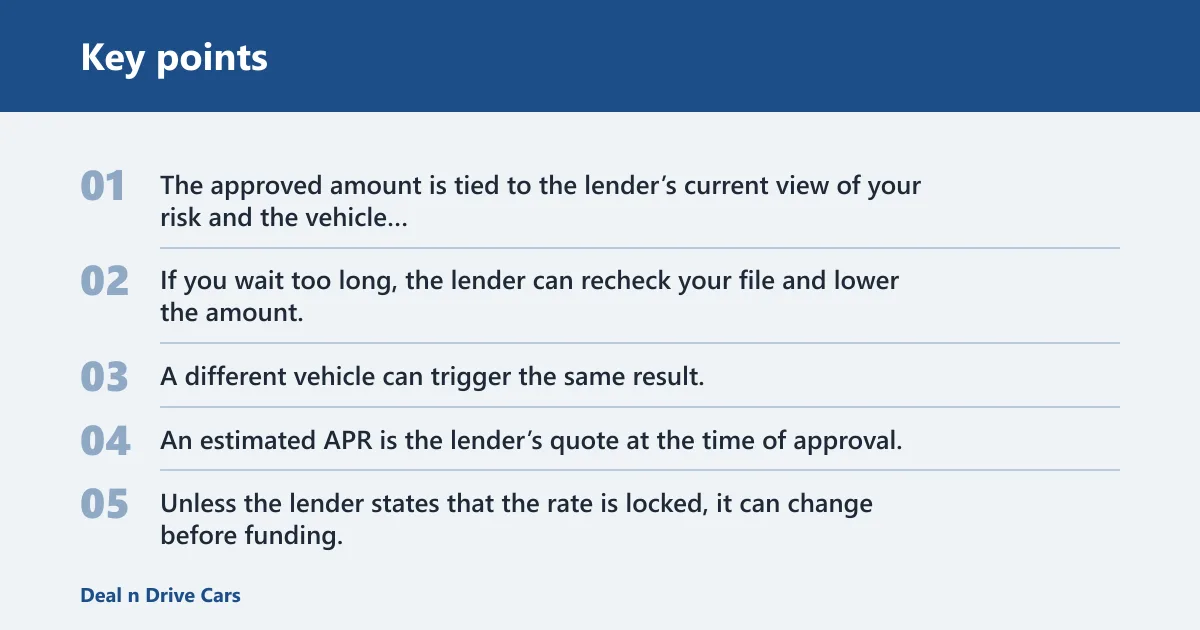
The approved amount is tied to the lender’s current view of your risk and the vehicle you plan to buy. If you wait too long, the lender can recheck your file and lower the amount, shorten the term, or ask for a larger down payment. A different vehicle can trigger the same result.
Estimated APR and rate locks
An estimated APR is the lender’s quote at the time of approval. Unless the lender states that the rate is locked, it can change before funding. A rate hold or rate lock may exist, but the rules are lender-specific and often tied to a single vehicle, a single term, and a set expiration date. If you want the details in plain language, the related soft inquiry and auto preapproval page explains how lenders may start with a soft pull but still reserve the right to do a hard inquiry later.
Say your lender approves you for $28,000 at an estimated 6.9% APR for 45 days. If you return after day 46, the lender may still approve you, but the new offer can carry a different APR or a lower amount.
Credit pull and document review
Whether a new credit inquiry is needed depends on the lender’s policy and how long the file has been idle. Some lenders can refresh the offer with updated documents, while others treat an expired file as a new application. A soft inquiry may be used for an initial preapproval, but some lenders switch to a hard inquiry at some stage in underwriting. The CFPB distinguishes soft and hard inquiries, and the effect on your score depends on the type of pull and the scoring model. CFPB: soft inquiry basics and CFPB: hard inquiry basics.
How to keep your offer usable while shopping
To keep the offer usable, shop inside the approval window and line up the vehicle before the lender’s deadline. The safest path is to get preapproved, compare cars quickly, and submit the dealer or direct-lender final application before the window closes. Waiting until the last few days adds avoidable risk.
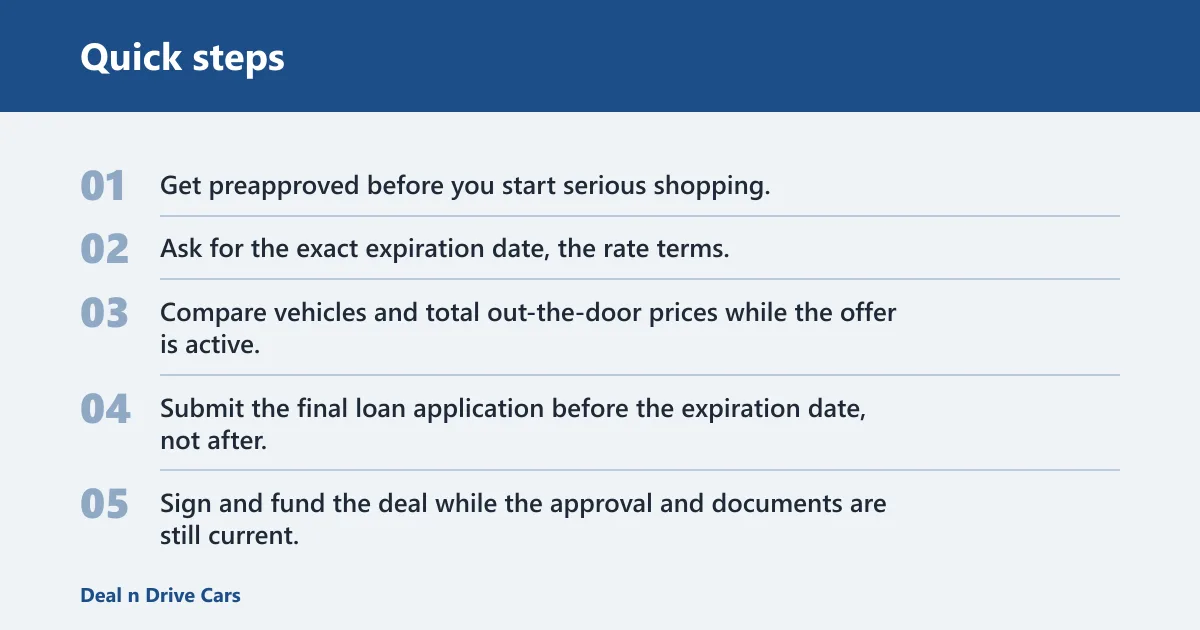
- Get preapproved before you start serious shopping.
- Ask for the exact expiration date, the rate terms, and whether the quote is a rate lock or only an estimate.
- Compare vehicles and total out-the-door prices while the offer is active.
- Submit the final loan application before the expiration date, not after.
- Sign and fund the deal while the approval and documents are still current.
Buyer timeline: 7-day, 14-day, and 30-day plan
Use this timeline to keep the approval active, avoid stale documents, and finish before expiration. The key is to move from preapproval to vehicle selection to final contract without letting the lender’s deadline sneak up on you.
- 7-day plan: Day 1, apply and confirm the expiration date. Day 2-3, compare lenders, vehicles, and out-the-door prices. Day 4-5, choose the car and confirm insurance, documents, and payment. Day 6, submit the VIN and deal terms. Day 7, sign if the lender’s conditions are met and the approval is still active.
- 14-day plan: Days 1-3, apply and gather documents. Days 4-7, shop and narrow the vehicle list. Days 8-10, select the car, send the VIN, price, taxes, and fees. Days 11-14, complete underwriting, sign, and fund before expiration.
- 30-day plan: Week 1, get preapproved and verify whether the rate is estimated or locked. Week 2, compare vehicles and total costs. Week 3, choose the car and submit the VIN, purchase agreement, and supporting documents. Week 4, finish the lender review, sign, and fund before the approval expires.
When to submit a dealer application
For dealer financing, submit the final application as soon as you have narrowed the vehicle choice and agreed on the purchase terms. Dealers can move fast, but the lender still needs the exact VIN, sale price, taxes, fees, and term. A dealer application filed too late can run into the preapproval deadline.
Dealer financing vs direct lender timing
Direct lenders usually process the preapproval first and then finalize the loan after you pick a car. Dealers may send your application to several lenders, which can add extra steps and timing changes. If the dealer is replacing your preapproval with a new finance offer, ask whether the old approval is still in force.
Suppose you find a used SUV on day 12 of a 30-day approval. If you wait until day 29 to sign, any missing pay stub or title detail can push you past the deadline. Signing a day or two earlier reduces the chance that the offer expires during final paperwork.
Can a new car change your approval?
Yes. A different vehicle, loan amount, term, or down payment can change the approval before purchase. Final approval is tied to the exact car and exact deal structure, so a swap from a 2021 sedan to a 2024 SUV can produce a different APR, amount, or lender decision.
Vehicle changes that can void the offer
Changing the VIN, vehicle age, mileage, body style, or purchase price can void the original terms. Some lenders also limit financing by model year or mileage. If the new vehicle falls outside those rules, the old approval may no longer apply.
Price, term, and down payment changes
A higher price can push the loan-to-value ratio up and change the offer. A longer term can affect the APR and total interest. A smaller down payment can also shift the lender’s risk, which may lead to a new rate or a request for more documentation.
Income and employment updates
Income, job status, and debt obligations can change between preapproval and signing. If your hours drop, you switch jobs, or new debt appears, the lender may ask for updated proof or reopen the file. That is one reason shoppers should avoid waiting until the very end of the approval window.
How long does a preapproval take for car loan?
Initial preapproval can take minutes to a few business days, depending on the lender and how complete your documents are. Online lenders often return a fast decision, while banks and credit unions may take longer if they need manual review. Final approval can take longer because the vehicle and contract details must be checked.
How long does auto pre approval take? For a complete online application with clear income documents, the first decision is often quick. Final funding is slower because the lender still has to verify the car, the purchase contract, insurance, and any missing underwriting items.
Capital One and Navy Federal timing
Capital One and Navy Federal can both offer auto preapproval, but their timing and renewal rules are lender-specific. That means you need to check the exact expiration date, whether the offer can be refreshed, and whether the lender wants a new credit pull or only updated documents. For current program details, use the lender pages directly: Capital One auto financing and Navy Federal auto loans.
Capital One auto preapproval
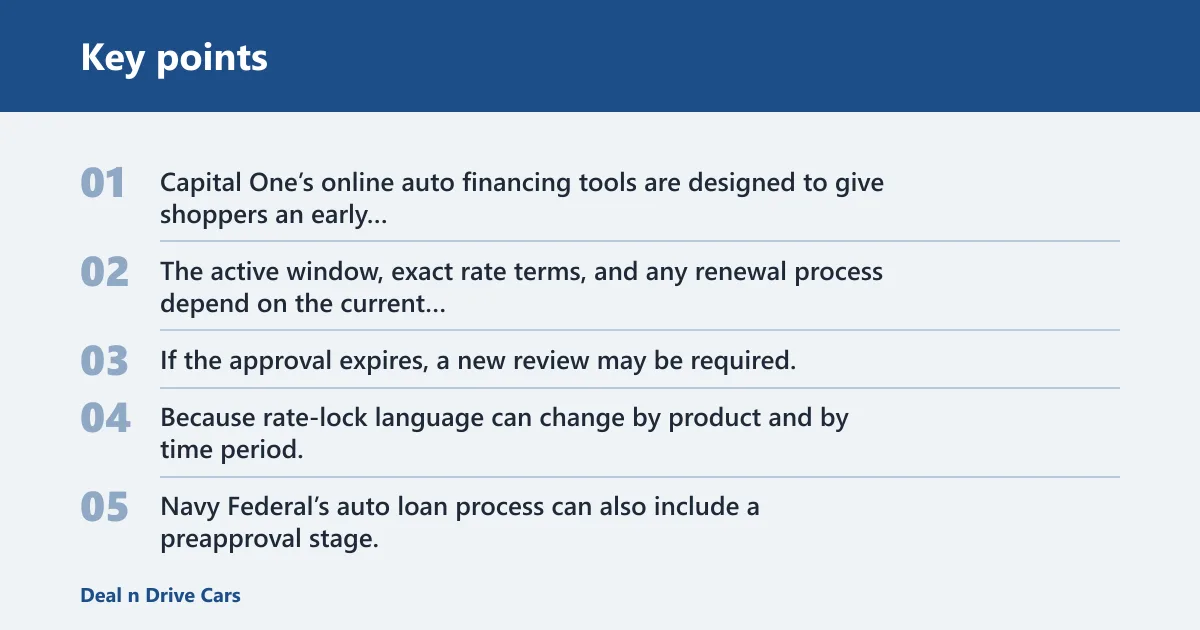
Capital One’s online auto financing tools are designed to give shoppers an early decision and a lender-backed offer on eligible vehicles. The active window, exact rate terms, and any renewal process depend on the current program rules shown at application time. If the approval expires, a new review may be required. Because rate-lock language can change by product and by time period, buyers should rely on the disclosure attached to the specific offer rather than a general rule.
Navy Federal auto preapproval
Navy Federal’s auto loan process can also include a preapproval stage, but the validity period and renewal rules are set by the credit union’s own policies. Credit unions sometimes rely more heavily on member relationship details and updated documents, so the renewal path may differ from a bank or online lender. Check the member-facing loan page and the approval notice for the exact expiration date and any document refresh requirements.
Bank vs credit union differences
Banks, credit unions, and online lenders do not all handle expired offers the same way. A bank may ask for a fresh application, while a credit union may renew after updated documents. An online lender may let you re-enter the portal and submit a new request, which can trigger a new credit review. If the borrower’s income, debts, or vehicle choice changed, the lender may need to re-underwrite the file regardless of institution type.
Frequently asked questions
How long does an auto pre approval last?
An auto preapproval usually lasts 30 to 60 days, but lender rules can shorten or extend that window. Some approvals expire in 14 or 30 days, while others last 90 days. Always check the expiration date on the approval letter or portal before you shop.
How long does an auto loan pre approval last?
An auto loan preapproval usually lasts long enough for a focused car search, then it expires if you do not finalize the purchase. A common range is about 30 to 60 days, though the exact term depends on the lender. If the window closes, the lender may need to make a new decision.
How long is a preapproval valid for?
Most auto preapprovals are valid for a limited window set by the lender, often 30 to 60 days. Some lenders use shorter or longer periods. The approval letter should list the end date, and that date controls the offer more than any general rule of thumb.
How long does Capital One auto pre approval last?
Capital One’s auto preapproval timing depends on the current offer terms shown when you apply. The lender sets the expiration date in the approval materials, and that date can vary. If the approval lapses, Capital One may require a new review before issuing a fresh offer.
How long does Navy Federal auto pre approval last?
Navy Federal’s auto preapproval window depends on the credit union’s current policy and the offer details tied to your file. The expiration date can vary, so the approval notice is the best source. If the deadline passes, the credit union may ask for updated information or a new application.
Can you get auto preapproval without a hard inquiry?
Sometimes, yes. Some lenders start with a soft inquiry, which usually does not affect your score the way a hard inquiry can. But lender rules vary, and a later stage in underwriting may require a hard pull. Check the lender’s disclosure before you apply again. The CFPB explains that soft inquiries are generally not visible to lenders in the same way as hard inquiries and usually do not affect your score, while hard inquiries can matter more. CFPB: soft inquiry basics.
What happens if you buy a different car after preapproval?
If you switch vehicles, the old approval may no longer match the new deal. The VIN, mileage, age, purchase price, and lender program rules all matter. In practice, you may need the lender to re-check the file, update the rate, or issue a new approval for the new car.
What if multiple auto-loan inquiries happen while shopping?
Credit scoring models often group multiple auto loan inquiries made within a short shopping period so they count less than separate unrelated inquiries. That window depends on the scoring model, but consumers are generally encouraged to shop within a focused period rather than spread applications over many weeks. The CFPB explains that shoppers can compare loan offers and that multiple inquiries for the same type of loan may be treated as one when done within the scoring window. CFPB: rate shopping and credit.
What if your income or debt changes before funding?
If your income drops, your job changes, or new debt appears before funding, the lender may ask for updated proof or reopen the file. That can lead to a new approval amount, a new APR, or a delay while the lender rechecks affordability. If the change is material, the lender may decline the deal even if the original preapproval had not yet expired.
What should you do if the offer is close to expiring?
If the offer is close to expiring, stop shopping for a moment and fix the exact vehicle, price, term, and documents. Then submit the final application quickly. If you cannot finish in time, ask whether the lender can renew the file with updated documents or a new credit check.
Sources
CFPB: what is a credit check?
CFPB: APR explained
CFPB: soft inquiry basics
CFPB: hard inquiry basics
CFPB: rate shopping and credit
Capital One auto financing
Navy Federal auto loans