Trade-in Value: How to Value Your Car
A realistic trade-in value often starts with the average of three current quotes, then shifts about 10% to 20% for mileage, condition, tires, warning lights, title status, and local demand. Miss the mark and you can give up hundreds or thousands, or walk in with a number no dealer can defend. This guide lays out a dealer-style checklist so you can build a believable trade-in range and compare online estimates.
Trade-in value is the amount a dealer is willing to credit toward your next vehicle after appraising the vehicle you bring in. Consumer Reports says trade-in value is the price a dealer would offer for a consumer’s vehicle, and that figure is often lower than other valuation types and usually below what a seller could get in a private sale. The gap exists because the dealer has to price in reconditioning, transport, resale risk, time to sale, and margin.
The useful move is to stop chasing one optimistic number. Start with benchmark price types, check the exact inputs that move an offer up or down, then turn those findings into a low, mid, and high trade-in range you can defend when the appraisal sheet comes back.
What trade-in value actually means
Trade-in value is the amount a dealer is willing to credit on your next vehicle after taking ownership of your current one. It is a dealer acquisition number, so it sits below most consumer sale prices. Dealers review age, mileage, cosmetic condition, and service history before deciding what they can pay.
Dealer offer amount versus consumer sale price
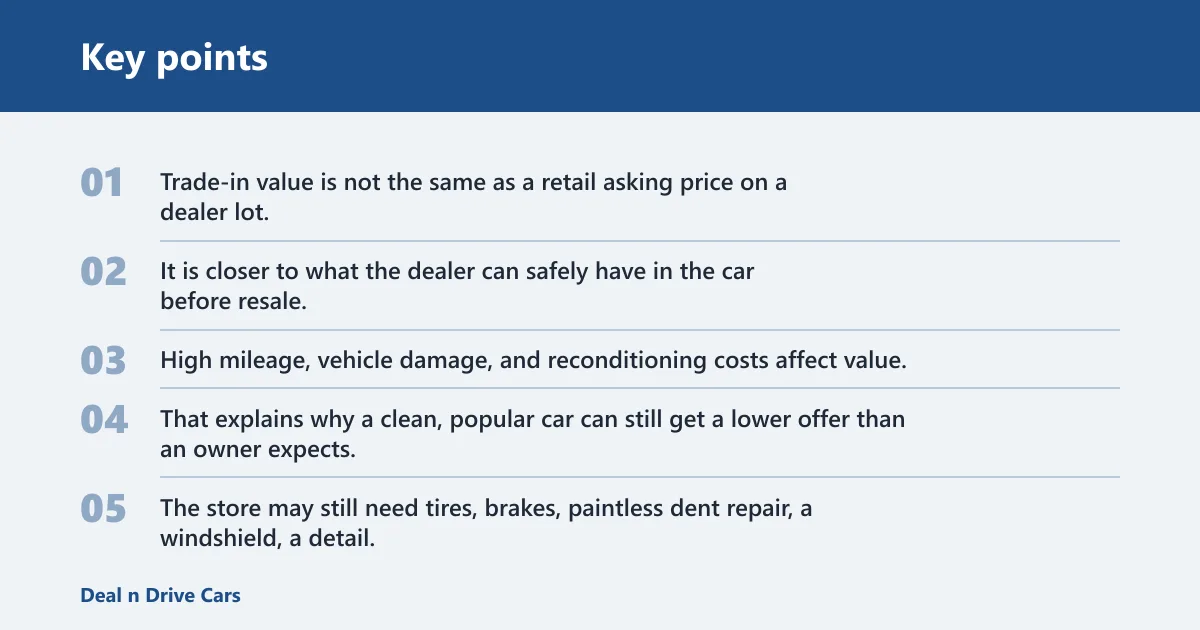
Trade-in value is not the same as a retail asking price on a dealer lot. It is closer to what the dealer can safely have in the car before resale. High mileage, vehicle damage, and reconditioning costs affect value, and accident and repair history can affect trade-in pricing.
That explains why a clean, popular car can still get a lower offer than an owner expects. The store may still need tires, brakes, paintless dent repair, a windshield, a detail, inspection labor, and a reserve for anything found after intake.
Why the offer is applied to another purchase
A trade-in is part of a transaction, not a separate consumer sale. The dealer acquires your car and applies that amount as a credit against the next vehicle price. For negotiating, that means the trade-in number, purchase price, and finance terms should be discussed separately so each piece stays clear.
Why trade-in value is usually lower than private-party value
Private-party value is the price one consumer may pay another in a direct sale, after ads, calls, test drives, and paperwork. It usually runs higher because it does not include dealer overhead, resale risk, or a resale margin. Trade-in value is often lower than other car valuation types, and that is normal rather than proof that every offer is unfair.
Is trade-in value the same as fair market value?
No. Fair market value is a benchmark for comparison, while trade-in value is the amount a dealer is likely to offer in a real appraisal. Wholesale value sits closer to dealer acquisition cost, and private-party value usually sits higher because it excludes dealer reconditioning and resale risk.
Where fair market value helps
Use fair market value as a reasonableness check. If a trade offer is far below the general market for similar cars in similar condition, that signals a problem to investigate. It does not mean the dealer must match a broad market figure, because trade-in value and fair market value are not identical.
Where wholesale value fits
Wholesale value is an auction-based reference. Consumer Reports ties trade-in value closely to auction wholesale value, and Black Book says trade-in value is near the wholesale price at auction. That is why Black Book-based numbers often feel more conservative than consumer-facing listing prices.
Trade-in value versus private-party value
Private-party value reflects what another consumer might pay if the car is marketed, shown, test-driven, and sold directly. Trade-in value strips out that retail upside and applies dealer costs instead. Dealer retail asking prices are a different number again, because they include reconditioning and margin on top.
How to use each number
- Trade-in value: use it to judge a real dealer offer.
- Fair market value: use it as a broad benchmark.
- Wholesale value: use it to sense the dealer’s acquisition logic.
- Private-party value: use it to decide whether selling yourself is worth the time.
What information do you need before you value your car?
You need the exact car, the exact history, and the exact condition. That means VIN if available, year, make, model, trim, factory options, mileage, ZIP code, title status, loan payoff, accident history, service records, recall status, and clear notes or photos of anything a dealer will spot.
Identity and configuration
Start with VIN, plate, or both. If VIN is missing, year, make, model, trim, drivetrain, engine, and major packages can still get an estimate, but precision drops. Optional equipment and trim level matter because estimate tools need correct inputs, even though many options add less resale value than owners expect.
MotorTrend says VIN is not necessary for an estimate. That helps for a quick baseline, but missing VIN can hide equipment differences, accident-report matches, and title data that later change the real offer.
Mileage, location, and paperwork
Exact odometer entry matters. Mileage is one of the first numbers an appraiser checks, and every extra 10,000 to 15,000 miles above what buyers typically expect for that model year can pull the offer down. Enter the real number, not a rounded guess. ZIP code matters too because local demand differs by region and season. Trucks, AWD vehicles, and hybrids can trade differently depending on climate, fuel prices, and local inventory.
Also gather title status, registration, keys, lien information, and payoff amount. A clean title and a simple payoff process reduce friction. Title brands, payoff delays, or missing paperwork can narrow the buyer pool for the dealer and lower the offer.
History and condition notes
Dealers look for service history, accident history, warning lights, odors, stains, glass damage, tire wear, brake wear, and signs of fleet or heavy commercial use. Unresolved manufacturer recalls can lower the offer or need to be fixed, even when the repair itself is no-cost to the owner.
Picture a three-year-old crossover with average mileage, clean paint, and one feature difference: one has a complete folder of oil-change, tire-rotation, and brake-fluid records, the other has none. The cars may drive the same, but the documented one gives the appraiser more confidence and usually a firmer number.
How do you figure out your car’s trade-in value?
Start with three current estimates from major tools, average them, then adjust that baseline for actual condition, mileage, history, and local demand. The result should be a low, mid, and high trade-in range, not a single target. That range is much closer to how dealer appraisers think.
Step 1: Pull three baseline estimates
Use Kelley Blue Book, Black Book, Consumer Reports estimator, and MotorTrend estimator. MotorTrend’s estimator uses Black Book data, and MotorTrend says values are updated daily with transaction data. That does not make any tool exact, but it does make them useful starting points. (Motortrend)
- Enter the exact mileage.
- Select the exact trim and drivetrain.
- Add major factory options and packages.
- Use your ZIP code.
- Save each result with the same condition grade if the tool asks.
If one estimate is far above the others, do not anchor to it. Check for a bad trim selection, wrong mileage, or an unrealistically high condition grade.
Step 2: Grade condition the way a dealer will
Condition needs more than “good shape.” Break it into cosmetic condition, mechanical defects, cleanliness, and odor. A practical grading frame is often excellent, good, fair, and poor.
- Excellent: clean body and interior, no warning lights, strong tires and brakes, no odor, no obvious repair needs.
- Good: minor chips or wear, small interior marks, routine wear items partly used, no major mechanical faults.
- Fair: visible cosmetic damage, worn tires or brakes, warning lights, deferred maintenance, odor, or missing items.
- Poor: significant body damage, major mechanical issues, severe odor or stains, title or history trouble.
Say your sedan has one estimate based on “good” condition. Change only one variable: the check-engine light is on for an emissions fault. That single issue can pull the car from a mid-range offer to the low end because the dealer now has diagnostic and repair risk before resale.
Step 3: Compare the estimates with wholesale logic
If your tool results are close to wholesale-oriented references, the numbers are probably grounded. If they sit near private-party asking prices, the estimate may be too optimistic for a trade. Consumer Reports ties trade-in value closely to auction wholesale value, so wholesale logic should always be part of the check.
Step 4: Build a low, mid, and high range
Use the average of three quotes as the midpoint. Then move down for negatives and up for positives. A common rule of thumb is that the total adjustment band often lands around 10% to 20%, though the exact spread depends on how many deductions are found.
- Low: assume the strictest but still reasonable appraisal.
- Mid: assume your documented, supportable condition case.
- High: assume strong dealer fit, clean history, and no surprise deductions.
Which factors change a dealer offer the most?
Accident history, warning lights, engine or transmission issues, smoke or pet odor, worn tires or brakes, and title problems usually do the most damage. Mileage and condition still matter every time, but large deductions usually come from items that raise reconditioning cost or resale risk fast.
Mileage and age
Age matters, but mileage often moves the number more. A newer car with very high mileage can appraise below an older car with lower mileage and better history. Enter exact mileage in every estimator. Rounded figures can place the car in the wrong bucket and distort the baseline.
Condition grade
Cosmetic flaws are usually easier for a dealer to price than unknown mechanical faults. Small scratches and one curb-rashed wheel hurt less than a transmission flare, coolant leak, or active warning light. Odor also matters more than many owners expect because smoke and heavy pet odor can be expensive to remove and can limit retail appeal.
Service history and accident history
Maintenance records signal consistency. A stack of dated invoices can support stronger appraisal confidence, especially on cars that need careful upkeep. Accident and repair history matter because prior damage, poor repairs, paint mismatch, or structural concerns increase resale risk. Clean history can raise offers, prior damage can lower them.
Trim, options, local demand, and dealer fit
Exact trim affects market position. Factory options can help, but many add little at trade-in compared with what they cost new. Local demand is bigger. A truck may be stronger in one region, a hybrid may be stronger where fuel prices are high, AWD can matter more ahead of winter.
Dealer fit is another quiet swing factor. One store may bid more because your vehicle matches what that store retails well, needs for used inventory, or can certify. Another may send the same car to auction, which pulls its offer closer to straight wholesale logic.
How vehicle condition changes your offer
Vehicle condition can move your trade-in offer by hundreds or even thousands of dollars because dealers adjust for what they can see, what they can safely resell, and what they may need to repair. The biggest hits usually come from mechanical faults, accident damage, worn tyres, and missing service records, while smaller cosmetic issues tend to matter less unless they add up. Understanding these differences helps you decide which fixes are worth making before you shop your car.
The supporting guide on vehicle condition impact explains how dealers price different issues, which problems hurt value most, and when a repair is likely to pay off versus when it is better to trade as-is.
Car value worksheet
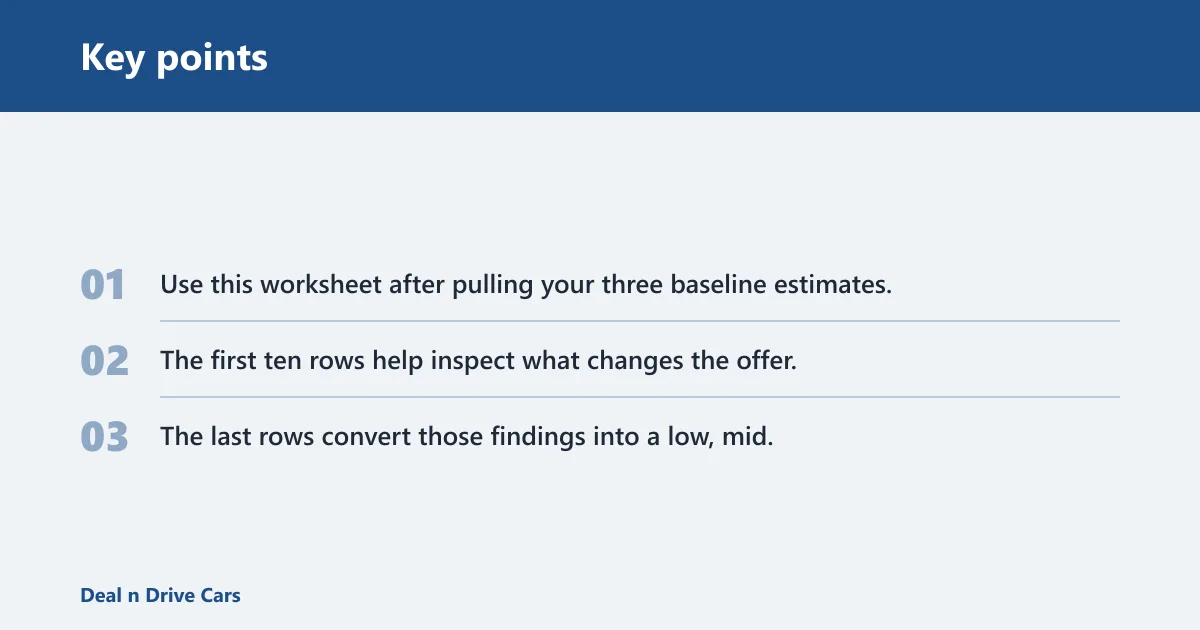
Use this worksheet after pulling your three baseline estimates. The first ten rows help inspect what changes the offer. The last rows convert those findings into a low, mid, and high trade-in range you can carry into three dealer appraisals.
| Factor | What to inspect | Likely value impact |
|---|---|---|
| Mileage | Exact odometer reading; compare with expected miles for the car’s age; confirm estimator inputs match | Higher-than-expected mileage usually lowers value; lower mileage can support the high end of the range |
| Condition grade | Body dents, paint chips, cracked glass, interior wear, warning lights, leaks, drivability, cleanliness | Excellent or good supports mid to high range; fair or poor pushes the offer down fast |
| Service history | Oil changes, major services, brake work, tires, fluid services, timing belt or spark plug records if applicable | Complete records can support confidence; missing or stale maintenance can weaken the appraisal |
| Accident history | Vehicle history report, panel gaps, paint mismatch, airbag history, structural repairs, flood or salvage brands | Clean history can help; prior damage, poor repairs, or title brands can cause large deductions |
| Trim and options | Exact trim name, drivetrain, engine, factory packages, safety tech, sunroof, premium audio, tow package | Correct trim matters; many options add little, but the wrong trim selection can distort estimates |
| Tires and brakes | Tread depth, uneven wear, brake pad life, rotor condition, tire brand mismatch | Near-term replacement lowers offers because the dealer prices reconditioning immediately |
| Odors and stains | Smoke smell, pet odor, heavy air freshener masking, headliner stains, carpet stains, mold signs | Persistent odor or staining can cause sharper deductions than minor cosmetic marks |
| Outstanding recalls | Open manufacturer recalls and whether repair parts are available now | Open recalls can lower the offer or delay saleability until resolved |
| Local demand | Regional strength for trucks, AWD, hybrids, convertibles, colors, and seasonal demand swings | Strong local demand can lift the top quote; weak regional demand can cap it |
| Dealer fit | Whether the store retails your model often, needs similar used inventory, or can certify the vehicle | Good fit can produce a stronger bid than a store that plans to wholesale it |
| Mid range | Average the three current estimates from your chosen tools | This is the starting point for your realistic trade-in range |
| Low range | Subtract for each meaningful negative you found: history issues, warning lights, worn tires or brakes, odor, recall delays, weak demand | Use this as the walk-away floor if a dealer appraises strictly but fairly |
| High range | Add only for documented positives: clean history, complete records, strong tires and brakes, strong local demand, strong dealer fit | Use this as the ceiling for a well-matched store, not as a guaranteed outcome |
Why is your trade-in offer lower than expected?
Most disappointing offers trace back to one of four things: the baseline was too optimistic, the condition grade was too generous, history or title issues were missed, or the dealer does not want that car in its used inventory. Reconditioning cost and resale risk sit behind nearly every deduction.
Reconditioning cost and margin
Even a decent car can need money. Tires at the wear bars, thin brake pads, bumper scuffs, a cracked windshield, or overdue service all come off the offer. The dealer must leave room to make the car sale-ready and still price it competitively.
History issues that trigger bigger deductions
Fleet use, repeated accident entries, poor repair quality, unresolved recalls, warning lights, and stale maintenance records all change the risk calculation. They can also change where the dealer routes the vehicle. A car sent straight to auction will usually draw a lower bid than a car the store wants to retail.
Why one dealer may beat another
Appraisals vary materially across stores because dealer fit varies. A brand dealer that can certify your model may bid higher than an independent store. A truck-heavy store may pay more for a clean half-ton pickup than a luxury-focused store that has no retail lane for it.
When online estimates overshoot
Online tools are directionally useful, not exact. They may miss local demand, dealer inventory needs, odor, worn brakes, warning lights, weak repairs, or how harshly a title issue will be treated. If an online number and a live appraisal are far apart, the car’s actual condition is usually the first place to check.
Should you fix your car before trading it in?
Fix low-cost presentation items first, but be selective with expensive repairs. Cleaning, replacing a broken bulb, or correcting an easy trim issue can help. Large mechanical work, bodywork, or cosmetic reconditioning rarely returns full value unless the defect blocks saleability or causes a steep dealer deduction.
Low-cost fixes that usually help
Wash the car, remove clutter, vacuum the interior, wipe down surfaces, replace missing mats if inexpensive, fix simple lighting issues, and gather all keys and records. These steps reduce friction and support a stronger condition grade without large spend.
Repairs that often do not pay back fully
Major paintwork, dent repair on several panels, transmission work, and expensive tire upgrades often return less than they cost. Dealers buy at scale and can often repair more cheaply than a retail customer can. That is why “fix everything first” is weak advice for most trade-ins.
A simple repair rule
Spend before trade-in only when one of three things is true: the fix is cheap and obvious, the problem creates a saleability issue, or the deduction is likely larger than the repair bill. Warning lights deserve extra attention because they signal unknown risk, which dealers price aggressively.
How many quotes should you get, and how should you use them?
Three quotes are a practical minimum because one store’s inventory need or appraisal policy can swing the number. Use the same mileage, condition description, keys, and paperwork each time. Then compare the offers separately from the purchase price and finance terms so the trade figure stays clean.
Why three is the minimum
One quote can be an outlier. Two may still leave doubt. Three starts to show a market pattern and fits the opening method of averaging three current quotes. If one store is much higher, ask why. The answer is often dealer fit, stronger local demand, or a different plan for the car.
How to compare apples to apples
Request offers close together in time, with the same mileage and condition disclosure. Bring the same records, keys, and payoff information. If one dealer bakes the trade number into a discount on the next car, ask for a clear written breakout so each piece can be compared on its own.
How to negotiate the trade-in
Use your range, not a single number. If your worksheet supports a mid range of one figure and a low range only slightly below it, a much lower offer needs a reason tied to condition, history, or market fit. If the explanation does not hold up, move to the next quote.
Frequently asked questions
Can I get a trade-in estimate without a VIN?
Yes. MotorTrend says VIN is not necessary for an estimate, so year, make, model, trim, mileage, and ZIP code can produce a useful baseline. Accuracy drops without VIN because options, title data, and report-matching details may be missing until a live appraisal checks the car.
How accurate are online trade-in value tools?
They are useful for direction, not precision. MotorTrend says values are updated daily with transaction data, and Black Book-based tools reflect wholesale logic well, but online estimates still miss true condition, odor, warning lights, local demand shifts, and dealer inventory fit.
What lowers a car’s trade-in value the most?
Large deductions usually come from accident history, title problems, warning lights, engine or transmission issues, smoke or pet odor, and worn tires or brakes. High mileage matters too, but risk-heavy problems tend to cut deeper because dealers must price repair uncertainty and resale difficulty.
What’s the difference between trade-in value and private party value?
Trade-in value is a dealer acquisition number applied toward another purchase. Private-party value is what another consumer might pay directly. Private-party value is usually higher because it excludes dealer margin, transport, reconditioning, and time-to-sale risk built into a trade offer.
How do I figure out my car’s trade-in value?
Pull three current estimates, average them, then adjust for mileage, condition grade, service records, accident history, tires, brakes, odors, recalls, local demand, and dealer fit. The result should be a defendable low, mid, and high range rather than one hopeful number.
How many dealers should I get trade-in quotes from?
Get at least three. That is enough to expose outliers and see whether one store values your vehicle more highly because it fits local demand or that dealer’s used inventory needs. Keep the trade quote separate from the purchase price and finance discussion.