Can an Instant Cash Offer Change After Inspection?
Yes, an instant cash offer can change after inspection if the car has undisclosed damage, mechanical faults, title problems, or missing equipment; cosmetic wear, normal use, and minor cleanup issues should not justify a cut. If you accept the first number without checking the terms, you can lose hundreds or more at the handoff. This guide explains which inspection findings justify a lower offer, which are negotiable, and how to protect the quoted price before you turn over the keys.
How inspection findings can revise the initial quote

An online instant cash offer is usually built from the vehicle’s described condition, VIN, mileage, photos, and disclosures. A final number can change after an in-person inspection if the car does not match what was submitted. In the sourced policy, a revised quote may be issued when the item does not match the original description, and the seller is notified by email.
How the online quote is built
The first offer is only as strong as the inputs. If the listing says clean title, 82,000 miles, no warning lights, and two working keys, the buyer prices that car, not a different one with hidden damage or missing equipment.
The quote also depends on what the buyer expects to see at inspection. Photos, notes, title status, mileage, and disclosure answers shape the first number. If those inputs are accurate, the sourced policy says payment is guaranteed.
What the inspection can confirm or contradict
Inspection is where the buyer checks mechanical condition, cosmetic condition, title and odometer details, and general wear. That is the stage where an online estimate can be confirmed or revised. It is also where undisclosed damage, warning lights, smoke odor, or missing keys can move the price down.
For the sourced policy, the quote can be locked in for 30 days after acceptance, but that does not erase the inspection step. It means the acceptance window exists; it does not mean the buyer must ignore a mismatch.
Why the final offer is not always fixed
The final offer is not fixed if the car arrives in a materially different condition than the one described. A lower revision is usually fair when the difference changes retail value, reconditioning cost, title work, or resale risk. Minor dirt, small scuffs, and normal seat wear are weaker reasons for a cut.
Suppose a seller lists a sedan with one curb scrape and then the inspection finds a cracked windshield, a check-engine light, and a missing second key. That is not a cosmetic-only change. The buyer has three separate cost items to price, so a revised offer would be easy to justify if those issues were not disclosed.
What inspection findings usually lower the offer?
Cosmetic issues usually cause the smallest changes, mechanical faults tend to matter more, and paperwork or identity mismatches can create the biggest revisions. The key question is whether the finding changes reconditioning cost, safety, title status, or the buyer’s ability to resell the car cleanly.
Cosmetic issues that often trigger small reductions
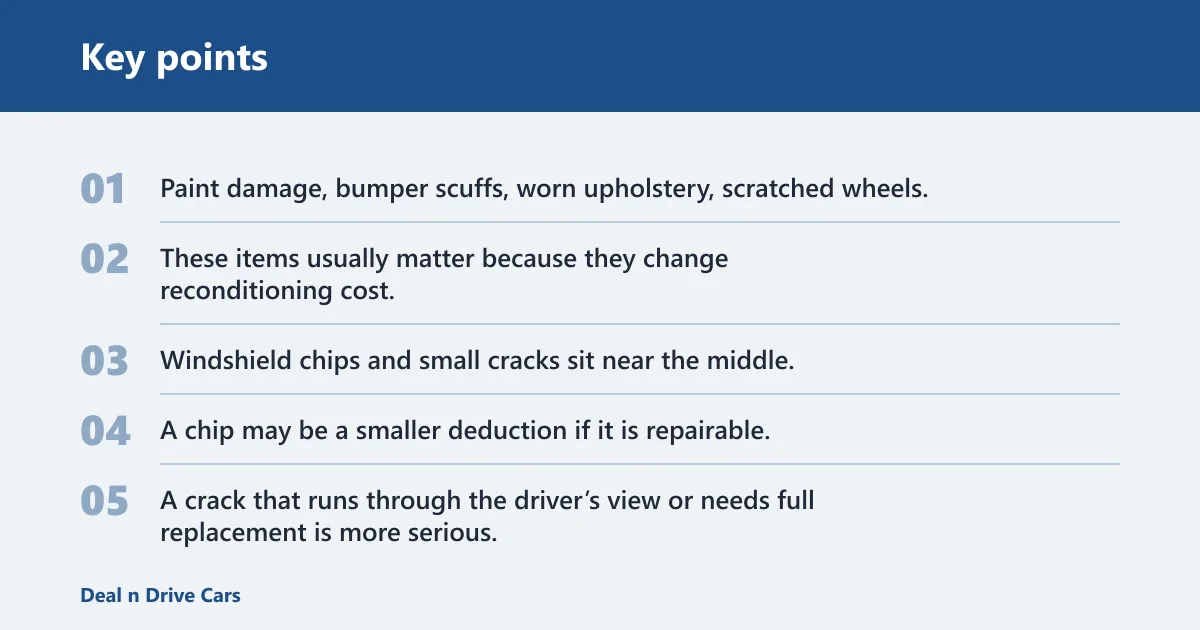
Paint damage, bumper scuffs, worn upholstery, scratched wheels, and minor hail marks often lead to modest revisions when they were not disclosed. These items usually matter because they change reconditioning cost, not because they make the car unsellable.
Windshield chips and small cracks sit near the middle. A chip may be a smaller deduction if it is repairable. A crack that runs through the driver’s view or needs full replacement is more serious.
Mechanical problems that usually matter more
Warning lights, a check-engine light, rough shifting, failed air conditioning, brake noise, weak battery, leaking fluids, and bald tires often carry a larger effect. They suggest the buyer may need diagnostic work or immediate repair before resale.
Aftermarket modifications can also lower an offer if they change reliability, compliance, or buyer demand. A lifted suspension, nonfactory exhaust, altered wiring, or engine tuning may be fine if disclosed and accepted, but hidden mods often trigger revision because the car is no longer the one that was priced.
Paperwork and identity mismatches that can cause the biggest changes
Title mismatch, odometer mismatch, salvage or rebuilt branding that was not disclosed, lien problems, or a VIN that does not match the paperwork can change the deal fast. These are not small cosmetic issues. They affect ownership, transfer, and legal saleability.
Missing keys can matter too. A modern key fob can be expensive to replace, and the buyer may deduct that cost if the listing said all keys were included.
Offer change risk matrix

Use this matrix to sort common inspection findings before you hand over the car. The “likely offer impact” column reflects how buyers usually treat the issue when it was not clearly disclosed. The seller action column shows what to bring or record so you can defend the quoted price or challenge a bad revision.
| Issue type | Likely offer impact | Seller action |
|---|---|---|
| Paint damage | Low | Photograph every panel in daylight, plus close-ups of chips, scratches, and prior repair edges. |
| Minor interior wear | Low | Take wide shots of seats, steering wheel, floor mats, and dashboard; note wear already disclosed. |
| Windshield chip | Low | Capture a close photo with a coin or finger for scale and note whether it was disclosed. |
| Bald tires | Medium | Photograph tread depth indicators and all four tires; bring service records if replacements were already discussed. |
| Warning lights | High | Photo the dash with ignition on and save any scan results, repair orders, or code printouts. |
| Check-engine light | High | Document the light, the condition under which it appears, and any prior estimate or diagnostic report. |
| Aftermarket mods | Medium | List every mod up front and photograph it; keep receipts for parts and install work if available. |
| Undisclosed accident damage | High | Bring repair invoices, body shop estimates, and before/after photos if damage was already repaired. |
| Missing keys | Medium | Count all keys and fobs before inspection and document what was promised in the listing or messages. |
| Smoke odor | High | Disclose it before inspection and photograph interior condition; keep any cleaning records if the odor was treated. |
| Title mismatch | High | Bring the exact title, registration, and ID; verify the name, VIN, and mileage before the appointment. |
| Excessive mileage | Medium | Enter the exact odometer reading and keep a time-stamped photo of the cluster before transfer. |
| Nonfunctional systems | High | Note broken power windows, infotainment failures, A/C problems, or seat faults before the buyer arrives. |
What documents to gather before inspection
Gather title, registration, ID, service records, payoff details if there is a loan, and any repair or diagnostic paperwork related to current issues. Add dated photos of the exterior, interior, odometer, dashboard lights, tires, and any damage you already disclosed.
The sourced policy also says the revised quote can include photos of the issues. That makes your own photo set important. If your records show the problem was disclosed in advance, a sudden price cut is easier to challenge.
How to protect the quoted price before inspection
The best defense is a clean paper trail. Take matching photos, disclose known defects, and bring every item that proves the car is the same one you described online. If the car is accurate, the offer is far more likely to hold.
Take photos that match the listing
- Photograph the car from all four corners in daylight.
- Capture each side, the roof, the hood, and the trunk.
- Take close-ups of scrapes, dents, cracked glass, worn tires, and torn trim.
- Photograph the dash with the ignition on so any warning lights are visible.
- Take a clear shot of the odometer and VIN plate.
- Save images with dates and keep them with your listing record.
Disclose damage, mods, and warning lights up front
Do not wait for the inspector to find obvious issues. Hidden damage, nonfunctional systems, modifications, and accident history are the exact items that most often trigger a revised cash offer. Up-front disclosure gives the buyer a chance to price the car correctly the first time.
A common first-timer mistake is to describe the car as “good condition” and leave out a lit check-engine light because the car still drives. That usually backfires. The buyer prices risk, not optimism.
Bring keys, title, service records, and payoff details
Bring every key and fob, the signed title, and any lien or payoff information the buyer needs. If the car has a loan, confirm the payoff process before the appointment so title release does not stall payment. If the car was repaired after an accident, bring the invoices so you can show what was fixed and when.
What happens if the revised offer is lower?
If the revised offer is lower, compare it against your disclosure record before you decide anything. Ask for the exact discrepancy, the photos of the issue, and the reason the buyer believes the car no longer matches the original description. Then decide whether to accept, ask for a recheck, or walk away if the return option exists.
How revised offers are communicated
In the sourced policy, if the item arrives not as described, the seller is notified by email. The revised quote may include photos of the issues. That matters because a vague price cut is harder to assess than a documented one.
Ask for a written breakdown. You want the specific item, the observed condition, and the amount tied to that finding. If the buyer cannot explain the change clearly, the revision deserves scrutiny.
Decision path after a lower quote
Start with three checks: what was disclosed, what was found, and whether the new deduction matches the finding. If the issue was already disclosed and documented, ask for a recheck. If the issue is real and the price gap is acceptable, you can accept the revised offer. If the terms allow a return, you can decline.
Picture a hatchback listed with one small scratch and no warning lights. At inspection, the buyer claims the car also has a roof leak and a dead backup camera. If your photos show the roof damage was already noted and the camera worked, that mismatch is worth challenging before you agree to a lower number.
Can you walk away after inspection?
Usually yes, but the return or cancellation terms depend on the buyer and the transaction setup. In the policy, the seller may accept the revision or have the item returned, and there is no obligation to sell after accepting the offer. Other buyers may handle cancellation, transport, and timing differently, so read the terms before you hand over the car.
Return terms, transport responsibility, and timing
Do not assume the return is free unless the buyer’s terms say so. Some providers cover return shipping or transport; others do not. The policy says return shipping is covered at no additional cost, and it appears to include shipping labels with tracking and delivery confirmation. That is a specific policy, not a universal rule.
The timing matters too. If you decline a revised offer, ask how long you have to respond, when the vehicle is returned, and whether the car comes back as-is. You do not want the car tied up for days while the buyer holds your original paperwork or keys.
How long the seller usually has to respond?
Response windows vary by buyer. Some allow a short review period, while others treat the decision as immediate. The important part is to know that the final step is not automatic; if the car does not match the description, you usually have an accept-or-decline choice, but the exact deadline is part of the buyer’s process.
When is payment issued after inspection?
Payment is usually issued only after the inspection, title checks, and approval are complete. In the sourced policy, payment is sent soon after inspection when the description is accurate, but the exact timing still depends on the payout method and any remaining verification steps. Do not assume the funds will appear before those checks finish.
Approval can depend on title and lien checks
If the title is not ready, the lien payoff is unclear, or the odometer and VIN do not match the paperwork, payment can be delayed. Those are not minor inconveniences; they are approval blockers. Clear paperwork is the fastest path to getting paid.
ACH, cashier’s check, and wire timing vary
Payout method affects timing. ACH can take longer than an immediate handoff, while cashier’s checks and wires may be handled under separate processing rules. If the buyer offers multiple methods, ask which one is approved for your deal and when each method is sent after inspection.
Do not hand over the car until you understand the payout step. A good offer means little if the release, approval, and transfer steps are unclear.
Frequently asked questions
Can an instant cash offer change after inspection?
Yes. If the car does not match the submitted description, the buyer may revise the offer after inspection. The biggest triggers are undisclosed damage, warning lights, title problems, missing equipment, or mileage and VIN mismatches. Cosmetic wear alone is a weaker reason for a major cut.
What makes an instant cash offer go down after inspection?
Common reasons include bald tires, check-engine lights, smoke odor, cracked glass, accident damage, missing keys, and nonfactory modifications that were not disclosed. Paperwork issues can cut the most because they affect transfer and resale. Ask for the exact discrepancy before accepting a lower number.
Is the online cash offer guaranteed if the car matches the description?
Usually yes, if the inspection confirms the same condition that was described. In the sourced policy, payment is guaranteed when the item is described accurately. The catch is that the description must be true, complete, and supported by the title, mileage, and vehicle condition at handoff.
What happens if the inspection finds damage that wasn’t disclosed?
The buyer may issue a revised quote, often with photos of the issue. If the damage changes repair cost or resale risk, the lower offer can be fair. If the damage was already documented in your photos or messages, ask for a recheck and point to that record.
Can I reject a revised offer after inspection?
Often yes. Many buyers let you accept the new number or walk away, but the exact return or cancellation option depends on the provider. In the sourced policy, the seller can accept the revision or have the item returned. Check who pays for transport before declining.
How long is an instant cash offer valid before inspection?
It varies by buyer, so read the terms before you schedule the handoff. In the sourced policy, the quote is valid for 30 days after receipt, and it can be locked in for 30 days after acceptance. That is a specific policy, not a universal market rule.
Will I still be paid if the car matches the online description?
Usually yes, after inspection and approval. The sourced policy says payment is sent soon after inspection when the description is accurate, and it also says payment is guaranteed if the item is described accurately. Title, lien, and payout-method checks can still affect timing.
Can I get my car back if I don’t accept the inspection offer?
Sometimes. The return option depends on the buyer and the transaction terms. In the sourced policy, the seller can have the item returned, and return shipping is covered at no additional cost with tracking and delivery confirmation. Other buyers may use different rules, so confirm them first.