Why Is My Trade-In Value So Low?
Your trade-in value is usually low because the dealer’s offer starts near wholesale auction value, then subtracts reconditioning, title, mileage, and market risk; if the gap is bigger than about $1,000 to $2,000, one of those three parts is doing the damage. Ignore that split, and you can lose money or choose the wrong selling channel. This guide shows how to identify whether the problem is market price, vehicle-specific deductions, or dealer margin.
Why trade-in offers feel low
Trade-in offers feel low because a dealer is buying at a number close to wholesale, while retail pricing has room for repairs, overhead, and profit. As of September 2025, average wholesale used car prices were $15,269 and average retail used car prices were $30,016, a retail-to-wholesale gap of roughly $14,747. In 2021, that gap was only about $9,000.
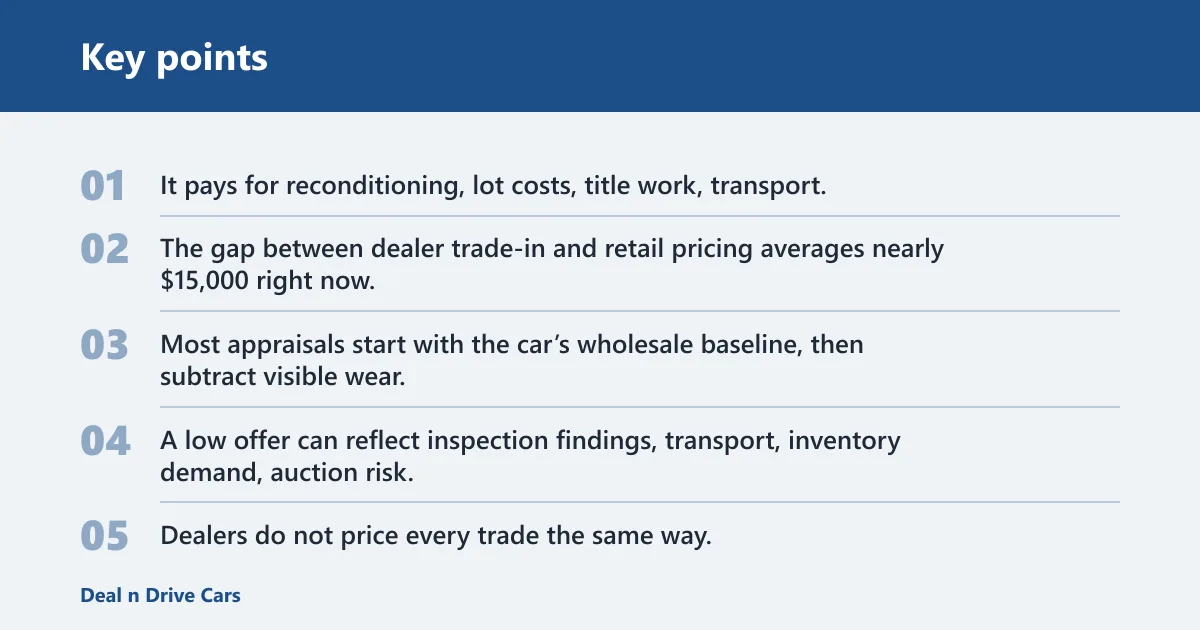
That spread is not a mystery markup. It pays for reconditioning, lot costs, title work, transport, and the chance that the car may need more money after inspection. The gap between dealer trade-in and retail pricing averages nearly $15,000 right now, so a quote that looks “low” may still fit wholesale economics.
How dealers build a trade number
Most appraisals start with the car’s wholesale baseline, then subtract visible wear, known mechanical needs, and a cushion for risk. A low offer can reflect inspection findings, transport, inventory demand, auction risk, local sales, and transaction costs. Dealers do not price every trade the same way, because a car that can be retailed easily is worth more than one that needs time or money before resale.
That is why two cars with the same sticker age can get very different bids. A clean, well-maintained model with service records can often stay close to the baseline. A high-mileage example with warning lights and missing keys can move down fast because the dealer may have to invest before resale or send it straight to auction.
Trade-in value deduction worksheet
Use this worksheet to separate the offer into three pieces: the market baseline, your car’s deductions, and the dealer’s risk margin. The goal is not to calculate a perfect number. It is to see which column is pulling hardest so you know what to question.
| Line item | Market baseline | Vehicle condition deductions | Dealer risk margin |
|---|---|---|---|
| Wholesale starting point | Use the car’s current wholesale class or auction lane value | None if the car is clean enough for retail | Built in to cover resale uncertainty |
| Mileage band | No change if mileage sits below a major threshold | Higher mileage can trigger sharper drops at 60,000 or 100,000 miles | Added cushion if the buyer pool shrinks |
| Tires and brakes | Normal wear assumed only if tread and pad life are acceptable | Subtract repair estimates for weak tires or worn brakes | Buffer if inspection may find more wear |
| Cosmetic damage | Baseline assumes normal use, not heavy wear | Subtract for scratches, dents, stains, pet hair, or smoke odor | Extra margin if the car may need reconditioning beyond the visible issues |
| Accident history | No deduction if history is clean | Reported accidents can reduce retailability, even after repairs | Margin rises if the car is harder to retail at full price |
| Warning lights | Assumes no active faults | Subtract diagnostic and repair estimates for check-engine lights or related faults | Dealer adds a buffer for surprises after inspection |
| Missing keys or records | Two keys and service history assumed | Subtract replacement key cost and any lost service value | More caution if paperwork is thin |
| Local demand | Higher for models that move quickly in your area | Lower if the segment is slow or crowded | Higher if the dealer expects longer floor time |
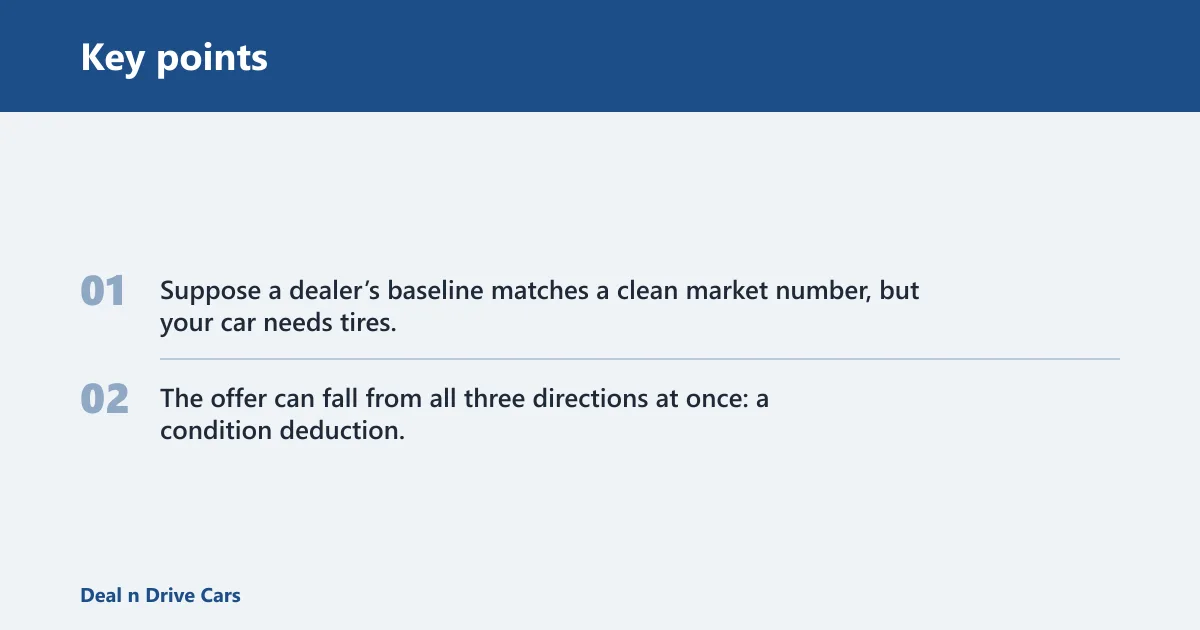
Suppose a dealer’s baseline matches a clean market number, but your car needs tires, has a recorded accident, and is missing one key. The offer can fall from all three directions at once: a condition deduction, a weaker retail story, and a risk margin for the next owner’s objections.
What lowers a car’s trade-in value the most?
Mileage, accident history, cosmetic wear, and mechanical problems usually do the most damage because they either reduce retail appeal or create a known cost. A single issue may be manageable. Several at once can push the car out of the retail lane and into a wholesale bid.
Mileage bands and threshold drops
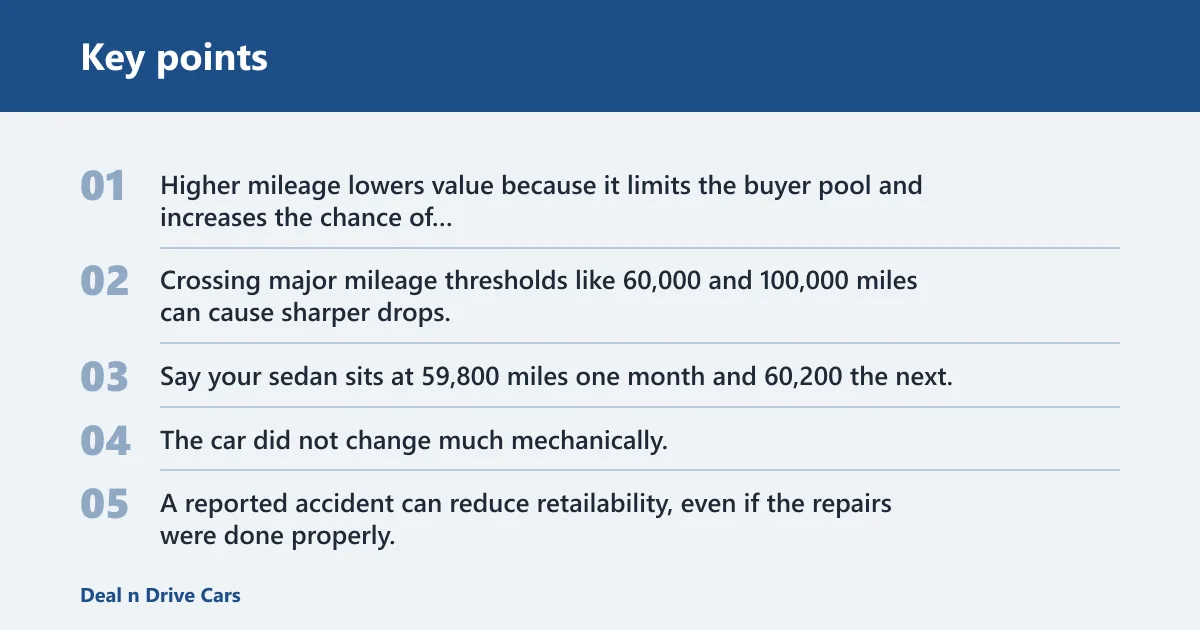
Higher mileage lowers value because it limits the buyer pool and increases the chance of wear. Crossing major mileage thresholds like 60,000 and 100,000 miles can cause sharper drops, not because a number is magical, but because buyers and dealers start expecting more repairs, shorter remaining life, and weaker resale flexibility.
Say your sedan sits at 59,800 miles one month and 60,200 the next. The car did not change much mechanically, but the number may matter because it moves the appraisal into a different mental bracket for the buyer and the dealer.
Accident history and report data
A reported accident can reduce retailability, even if the repairs were done properly. Carfax or AutoCheck history matters because many buyers filter on reported damage before they ever see the car. A repaired accident may still lower offers if the dealer expects slower sale speed or tougher objections.
Cosmetic wear that is costly to fix
Scratches, dents, stains, pet hair, smoke odor, and worn interior surfaces can lower the appraisal because appearance affects first impressions and reconditioning cost. Some cosmetic damage is expensive to make right, especially if it involves upholstery cleaning, trim parts, paintwork, or odor removal.
A common first-timer mistake is assuming “it runs fine” protects the value. A clean mechanical report helps, but a smoked-in cabin, torn seat bolster, and dented door panel can still pull the bid down hard because the dealer has to spend money before resale.
Mechanical issues and repair estimates
Check-engine lights, worn brakes, weak tires, and transmission issues often trigger repair-based deductions. Dealers usually subtract the repair estimate, then add a buffer for surprises. If a scan reveals more than one fault, or if the car needs deeper work after a lift inspection, the deduction can jump quickly.
How much do repairs affect trade-in value?
Repairs affect trade-in value by turning visible or hidden problems into a dollar subtraction. Dealers typically spend around $1,000 per vehicle on reconditioning, but cars with higher deferred maintenance can cost well above that to recondition. Repairs, detailing, tires, brakes, and oil changes can all reduce the offer.
When a repair becomes a deduction
If the dealer can see the issue and price it accurately, the deduction often tracks the repair estimate closely. If the issue is uncertain, the dealer may cut more than the visible repair cost because it may uncover related problems after inspection. Some dealerships use a rule of thumb tied to reconditioning costs exceeding the original estimate by about 20%.
Why surprise findings add margin
Unexpected repair findings raise the dealer’s risk because the first inspection may miss a worn control arm, leaking seal, or electrical fault. That uncertainty gets priced into the offer. The dealer is not paying only for the visible issue; it is also paying for the chance that the next inspection reveals a larger bill.
Why the market may be pulling your number down
Sometimes the car itself is not the main problem. Local demand, supply, and price band activity can drag the offer lower even when the vehicle is decent. Dealers in one region may bid more aggressively for a truck, hybrid, or commuter car than a similar dealer in another region because the local sales pattern is different.
Local demand by model and price band
Regional demand influences bids because dealers stock what they expect to sell quickly. Certain price bands may move differently too. In February 2026, dealers nationwide had about 2.13 million used vehicles on their lots, which equals 42 days’ supply. Cars priced below $15,000 at retail were especially scarce, with only 31 days’ supply.
That matters because a scarce, quick-moving segment can support a firmer bid, while a crowded segment can weaken it. A car that fits a thin supply pocket may hold value better than a similar car in an already full lane.
Why some cars wholesale faster than others
Dealers may wholesale risky units instead of retailing them when the resale path looks slow or uncertain. Inventory carrying costs and floor-plan interest matter, so a car that sits too long can cost money even before it sells. The dealer needs margin on both the trade and the car it eventually sells.
Can you negotiate a low offer?
Yes. You can negotiate a low offer by separating the trade from the replacement purchase, then challenging specific deductions with records, receipts, and photos. Compare multiple bids before accepting. If a dealer’s number is below the evidence, the weak point is often the deduction, not the whole appraisal.
- Ask for the trade value by itself, before any talk about the new car.
- Request the deduction breakdown in writing.
- Bring maintenance records, tire receipts, brake invoices, and both keys.
- Show dated photos if the car has fresh repairs or better condition than assumed.
- Get another appraisal from a different dealer or a buying service.
- Use the highest verified bid as your comparison point.
That approach matters because some deductions are avoidable and some are not. A dealer should be able to explain why the number is lower: mileage band, accident record, cosmetic repair cost, mechanical work, or lower local demand. If the explanation stays vague, ask for the specific line item.
Private sale vs trade-in
A private buyer may pay more than a dealer because that buyer is not building in reconditioning, inventory cost, or resale risk. But private sale is a separate decision from trade-in. You take on ads, showings, payment risk, title transfer, and more paperwork if you sell it yourself.
Trade-in often makes sense when convenience matters, the car has issues, or you want fewer steps. Private sale can work better when the car is clean, popular, and easy to explain. The higher number is only worth it if the extra work fits your timeline and comfort level.
What if you still owe money on your car?
If you still owe money on your car, the payoff is separate from trade value. A low offer can still be fair, but the loan balance may create negative equity that has to be handled in the deal structure. The trade number does not disappear just because the loan is higher than the appraised value.
Ask the dealer to show the trade value, the loan payoff, and the net equity position as separate lines. That keeps the discussion clear. A low trade offer and an upside-down loan are different problems, and they should not be mixed into one number.
How do I know if my trade-in offer is fair?
A fair trade offer usually fits the car’s wholesale position, the visible deductions, and the dealer’s resale risk. If the number is much lower than other bids, or much lower than what the condition supports, ask for a written breakdown. A clear appraisal should point to specific costs, not a vague shrug.
Check three things: comparable wholesale or trade guides, the car’s condition, and local demand for that segment. If the dealer’s deductions line up with real repair costs, the offer may be fair. If they do not, get another bid before deciding.
Frequently asked questions
Why is my trade-in value so low?
Your trade-in value is usually low because the dealer starts near wholesale value, then subtracts reconditioning, condition issues, and risk margin. If the gap feels larger than expected, look for the biggest driver: mileage bands, repair needs, accident history, or weak local demand. The answer is usually one of those, or a mix of them.
Does higher mileage lower trade-in value?
Yes. Higher mileage lowers trade-in value because it signals more wear and fewer remaining miles before major service. The drop can be sharper around mileage bands such as 60,000 and 100,000 miles, where buyers and dealers often expect more maintenance and less resale flexibility.
Should I sell privately instead of trading in?
A private sale can bring more money, but only if you are willing to handle listings, calls, showings, payment risk, and title paperwork. Trade-in is often faster and simpler. If the car is older, has issues, or you want less hassle, trade-in may still be the better fit.
Can I negotiate a trade-in offer?
Yes. You can negotiate by separating the trade from the new-car purchase, asking for the deduction breakdown, and bringing maintenance records, receipts, and photos. Get multiple appraisals before you accept. If another dealer values the car higher, use that as a factual comparison rather than a guess.