Why Do Vehicle History Reports Cost Money?
Vehicle history reports cost money because providers pay to collect, license, and refresh records from DMVs, insurers, auctions, repair networks, and salvage databases; basic checks can be free, but full reports often run about $25 to $50. Skipping the right report can leave you unaware of an accident, title, mileage, or theft issue that may become expensive later. This guide shows what you pay for and when a full report beats a basic check.
How scattered records are linked to a single vin
A paid vehicle history report is not a single database lookup. It is a VIN-based record assembled from many sources, then cleaned, matched, and updated over time. Providers pay for data access, system maintenance, customer support, and the work needed to turn scattered records into something a buyer can use.
The business cost behind a VIN report
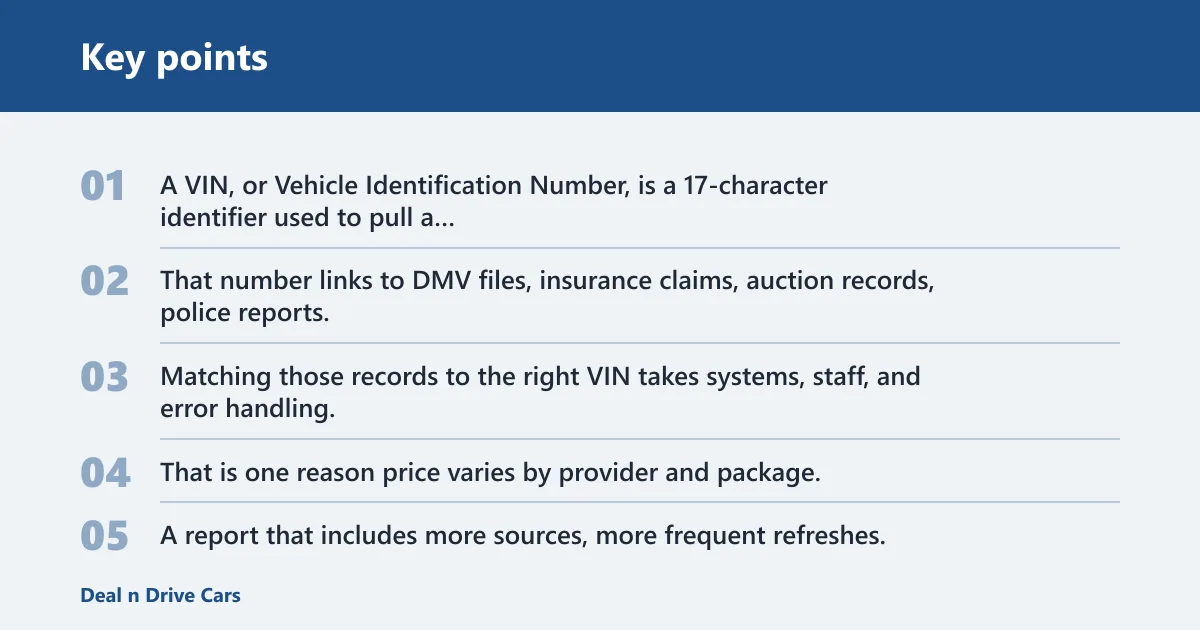
A VIN, or Vehicle Identification Number, is a 17-character identifier used to pull a vehicle record. That number links to DMV files, insurance claims, auction records, police reports, dealer activity, and sometimes repair-shop data. Matching those records to the right VIN takes systems, staff, and error handling.
That is one reason price varies by provider and package. A report that includes more sources, more frequent refreshes, or broader ownership and mileage coverage costs more to produce than a narrow title check.
Why multi-source data is not free
Providers do not own most of the underlying data. They license it. They also need to merge records that arrive in different formats, from different states, and on different timetables. A salvage record, an auction listing, and a mileage entry may all use the same VIN, but they do not arrive in the same structure or at the same speed.
That aggregation work is a real cost driver. A low-price product can be cheap because it uses fewer sources, not because the data problem is simple.
Why freshness changes the price
Freshness matters because some records lag. Accident and damage records may arrive after the sale date, and title updates can take time to move through the system. If a car was recently at auction, traded at a dealer, or repaired after a crash, a stale report can miss the newest change.
More frequent updating means more infrastructure and more data processing. That is part of why a newer or more complete report can cost more than a basic or older one.
Say your shortlist has a sedan that just came off a dealer trade and another that sat in an auction lane last week. A report pulled too early may still look clean even though the newest title event has not posted yet.
What a vehicle history report includes
A full vehicle history report can include accident history, title history, odometer or mileage records, ownership history, service or repair records, and recall data. The exact mix depends on the provider and package. Some brands also include theft or lien-related checks, while others focus more heavily on title and ownership events.
Title brands matter because they change the car’s risk and value. Salvage, rebuilt, flood, junk, and lemon law titles can affect insurability, resale, and safety. Ownership and mileage records also matter because they can reveal a broken ownership chain or possible odometer rollback fraud.
Why free VIN checks can miss problems
Free VIN checks are often useful, but they are not the same as a full multi-source report. Some free options only confirm basic title status or stolen-vehicle status. Others draw mainly from NMVTIS, the government title-information system, which is useful but limited compared with a full paid report.
Basic title checks versus full reports
A basic government title check can tell you whether the vehicle has a title problem or a reported brand in the title system. A full report goes further by combining title data with ownership history, mileage records, accident records, auction activity, and other source types.
That difference matters when you are trying to judge price, safety, and negotiation room. A title-only result can be clean while the car still has a hidden accident history or an awkward ownership trail.
Missing or delayed accident data
Accident and damage records are important, but they can lag. A crash may happen, the car may be sold, and the database entry may appear later. A report pulled the same day as the sale can miss that update.
That is why a “clean” result is not the same thing as a verified clean car. It means no matching record showed up yet, or no source reported a problem.
Why seller-provided reports can be outdated
Seller-provided reports can be outdated, altered, or fake. Even when the report is real, it may have been pulled before a recent accident, auction event, or title transfer. A current report in your own name is safer than trusting a PDF someone else sends.
A common first-time mistake is to accept a report from a private seller because the PDF looks official. If that car crossed an auction lane after the report date, the newest event may never appear on the copy you received.
Cost to coverage table
Use the price band to judge what kind of coverage you are getting, not just whether the number looks low. A cheaper report can be fine for a quick screen. A full report is better when the purchase is larger, riskier, or more time-sensitive.
| Report type | Typical price band | Source scope | Freshness risk | Best use case |
|---|---|---|---|---|
| Quick VIN check | $5 to about $10 | Title-and-stolen checks, often limited to one or two core databases | Lower source depth; may miss accidents, ownership changes, and mileage history | Fast screen before you spend more time on a car |
| Basic NMVTIS-based report | About $10 to $20 | Government title information and brand checks | Moderate; title data is useful, but other records may not be included | Checking title status on a budget, especially early in the search |
| Full multi-source report | About $25 to $50 | DMV, insurance, auction, police, dealer, repair, and other records depending on provider | Lower if recently refreshed, but some events still lag by days or weeks | Private-party sales, higher-risk cars, or final purchase decisions |
| Bundle purchase | Per-report cost often falls below single-report pricing | Same scope as the provider’s full report, with lower cost per VIN | Depends on how current each report is when pulled | Two-car shortlist or multiple searches over a short period |
When a basic check is enough
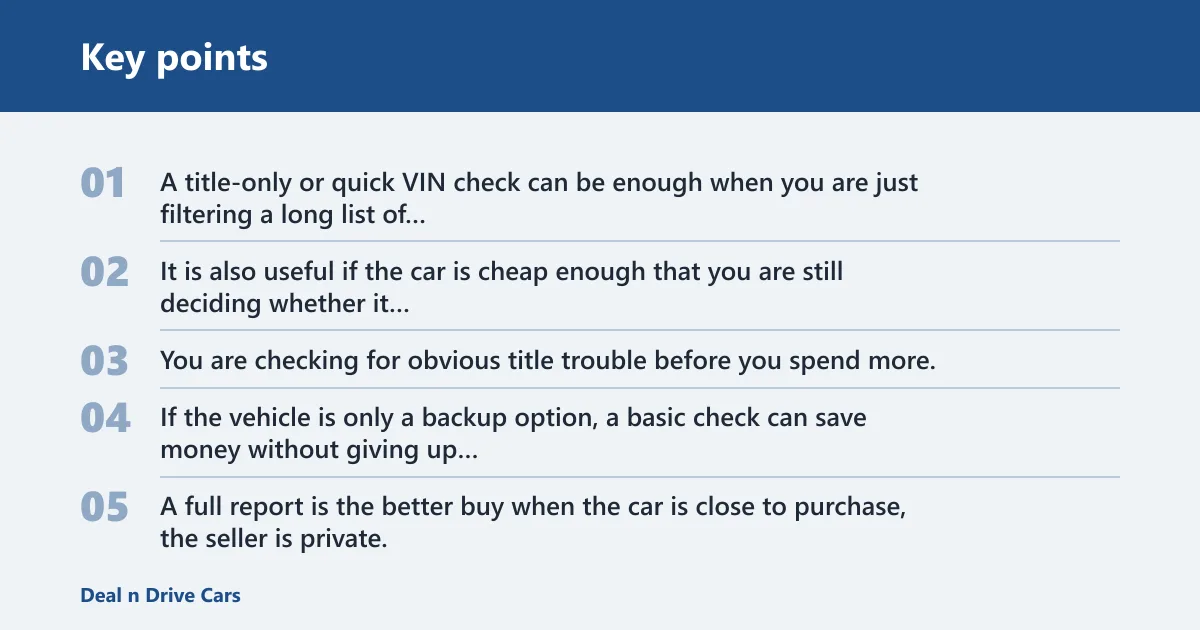
A title-only or quick VIN check can be enough when you are just filtering a long list of cars. It is also useful if the car is cheap enough that you are still deciding whether it deserves a deeper look. You are checking for obvious title trouble before you spend more.
If the vehicle is only a backup option, a basic check can save money without giving up the main title warning signs.
When a full report is the better buy
A full report is the better buy when the car is close to purchase, the seller is private, or the vehicle has a history that needs more than a title check. The extra source coverage can surface ownership gaps, mileage mismatches, auction activity, and accident records that a basic check may miss.
Why Carfax costs more than some rivals
Carfax is often priced above lower-cost competitors because it markets a broad, frequently updated report with heavy source coverage and brand recognition. Carfax pricing cited on comparison pages includes a single report at $39.99, while the pricing page also shows $49.99. Bundle pricing can lower the per-report cost.
Single-report pricing and bundles
CarBuyingTips cites one CARFAX report at $39.99, a 3-report bundle at $59.99, and a 6-report bundle at $99.99. That bundle structure lowers the per-report cost when you are shopping multiple cars or expect to run several VINs.
Instant Vehicle History also cites Carfax at $39.99 for a single report. The spread between cited prices and page pricing is a reminder to check the current offer before you buy.
How provider scope affects price
Carfax reports are commonly described as covering records from DMVs, auctions, manufacturers, dealers, police, and repair shops. That broad scope costs more to assemble and refresh than a narrow title-only product. Carfax is also often compared with AutoCheck, another common paid report brand used in ownership and title discussions.
AutoCheck may fit buyers who want a different package structure or a different mix of source emphasis. The right choice depends on which records matter most for the car you are considering.
How bundled report prices lower the cost per report
Bundles lower the cost per report because the provider spreads fixed account and access costs across several VIN checks. VinPassed is a clear example: a single report is $30, two reports are $50, three reports are $66, and five reports are $90. The per-report cost drops to $25, then $22, then $18.
VinPassed also sells a $5 Quick Check, described as a title and stolen check. That is a much narrower product than a full history report, so the lower price reflects the smaller scope.
When is a paid report worth it?
A paid report is worth it when the purchase risk is high enough that missing one event could cost more than the report itself. Private-party sales, recent auction activity, multiple owners, title-state changes, and lower-priced used cars all push you toward fuller coverage.
Pay for a full report when…
- the sale is private-party and there is no dealer paperwork to lean on;
- the car was recently listed at auction or may have crossed an auction lane;
- the vehicle shows multiple prior owners or an unclear ownership chain;
- the car changed states, which can delay or separate title records;
- the used car is under $10,000 and a surprise title or mileage issue would matter a lot to the budget.
When a cheap car still needs full coverage
A low price does not necessarily mean low risk. A sub-$10,000 car can still carry a salvage brand, flood history, or mileage inconsistency that changes the real cost of ownership. On a car this price, one bad record can wipe out the savings.
Suppose you are looking at a $7,800 compact sedan from a private seller. A $25 to $50 report can be a sensible cost if it helps you avoid a title brand or odometer issue that would be far more expensive to unwind later.
When inspection should come first
A mechanical inspection still matters. A history report can flag records, but it does not replace a lift inspection, a scan for leaks, or a check for worn brakes and tires. If the report is clean, the car still needs a physical look before money changes hands.
Can you trust a seller-provided report?
You can use a seller-provided report as a clue, but you should not rely on it alone. The timing may be off, the report may be incomplete, or the copy may not include the newest record. Run the VIN yourself before you buy.
Why timing matters after auctions or trade-ins
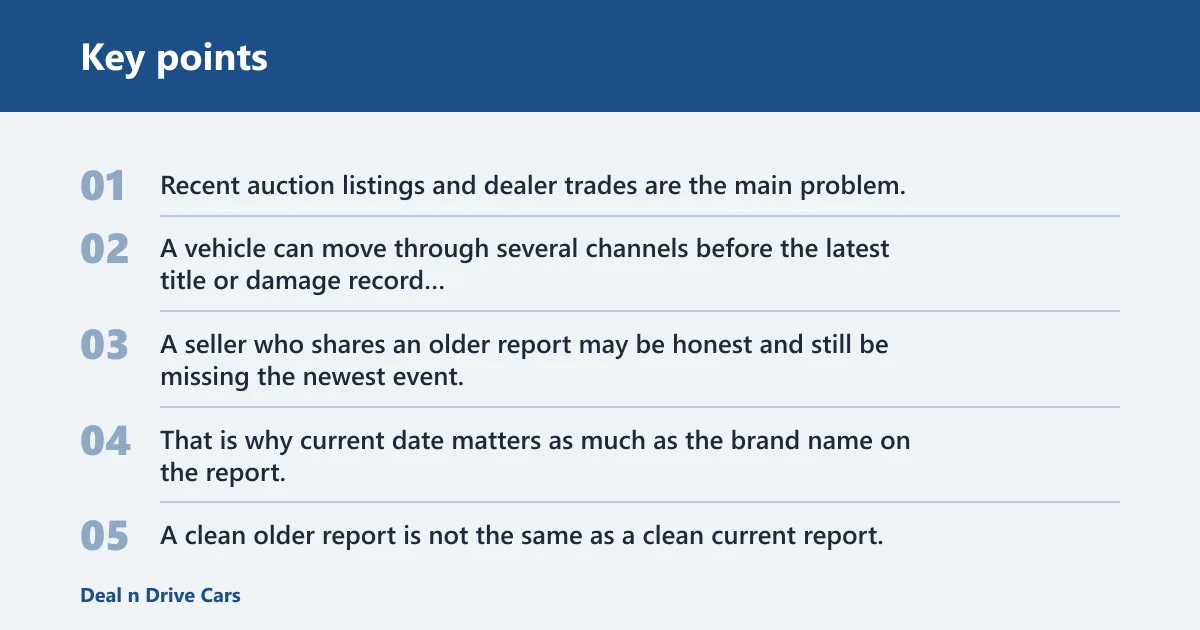
Recent auction listings and dealer trades are the main problem. A vehicle can move through several channels before the latest title or damage record posts. A seller who shares an older report may be honest and still be missing the newest event.
That is why current date matters as much as the brand name on the report. A clean older report is not the same as a clean current report.
Why you should run the VIN yourself
Running the VIN yourself gives you a current copy tied to your own purchase timing. It also lets you compare the seller’s document against the one you pulled. If the two do not match, you have a reason to ask better questions.
That matters most when ownership history, mileage records, and title brands are the deciding factors. Those are exactly the records that can reveal rollback fraud, title washing, or a hidden flood or salvage event.
What a clean report still may not reveal
A clean report does not guarantee a clean car. It means no reported problem showed up in the provider’s current source set. Hidden mechanical wear, frame damage that was never reported, or a fresh issue that has not entered the databases can still exist.
That is why the best buying rule is simple: use a full report for record risk, then inspect the car for condition risk.
Frequently asked questions
Why do vehicle history reports cost money?
They cost money because providers pay for data licenses, source integration, record matching, update systems, and customer support. A full report also needs ongoing refreshes so accident, title, mileage, and ownership records can be updated after they appear in outside systems.
What do you get that free vehicle history reports do not?
Free checks often cover only a small slice of the picture, such as title status or stolen status. A paid report is more likely to include accident history, title brands, ownership history, mileage records, and additional source coverage from auctions, insurers, dealers, and repair networks.
How much should a vehicle history report cost?
For a full multi-source report, a common buying range is about $25 to $50. Basic title checks can cost less, while some premium brands sit near the top of that range. Bundle pricing can lower the cost per report if you are checking more than one VIN.
Are cheap vehicle history reports reliable?
Cheap reports can be useful if you know their limits. A low-cost NMVTIS-based product or quick VIN check may catch title issues, but it may miss accidents, ownership changes, or mileage events. Reliability depends on source scope, update timing, and what the seller is trying to hide.
Why is Carfax more expensive than other report providers?
Carfax often costs more because it is built around broad source coverage and frequent updates, and that data is expensive to assemble. Cited pricing includes $39.99 for a single report, with bundles that lower the per-report cost. Some shoppers pay more for that wider scope.
What is the difference between a quick VIN check and a full report?
A quick VIN check is usually a limited title-and-stolen screen. A full report adds accident, title, ownership, mileage, service, and recall data from more sources. If you are only screening cars, quick may be enough; if you are ready to buy, full coverage is the safer choice.