What Makes a Used Car Price Too Good to Be True?
A used car priced about 15% to 20% below similar listings without a clear reason deserves extra caution, since that kind of discount can sometimes point to accident damage, title issues, overdue repairs, or financing tricks. Miss the warning sign and you can buy a car with expensive problems that wipe out the savings. This guide covers the most common reasons for a low price and the checks that show whether the deal is real.
Why a low price can be a warning sign
A low sticker price is a signal, not a verdict. The car may be priced under market value because it needs repairs, has a title problem, has been in a crash, or is being sold with fees and financing that change the real cost.
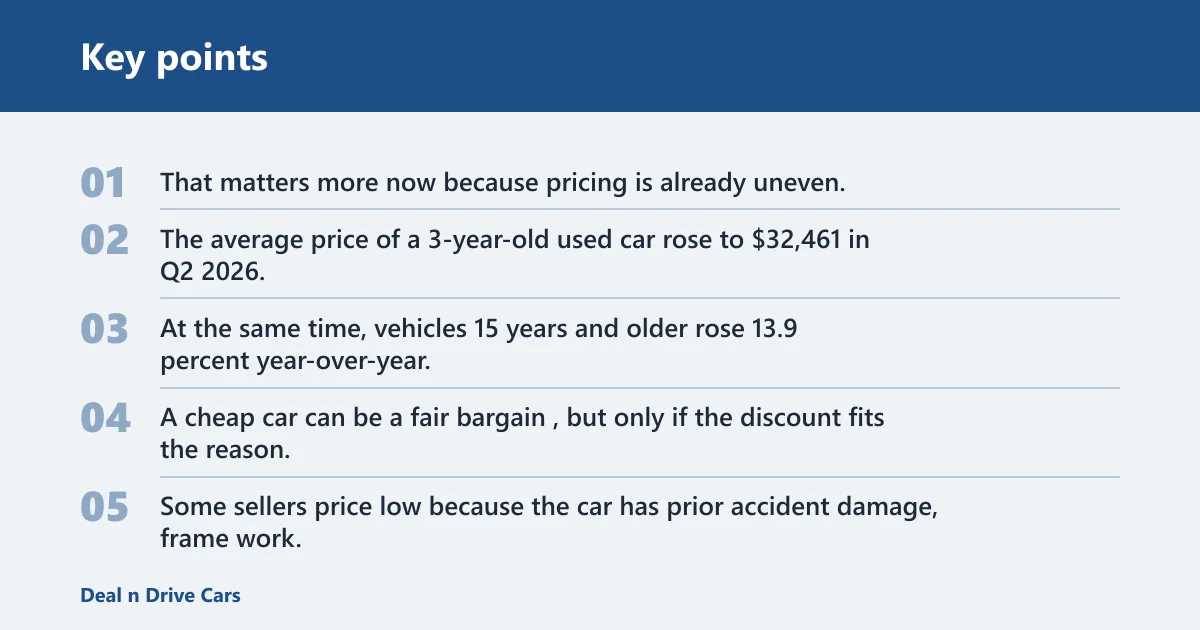
That matters more now because pricing is already uneven. The average price of a 3-year-old used car rose to $32,461 in Q2 2026, while the average used-car listing price was $27,028 in July 2026. At the same time, vehicles 15 years and older rose 13.9 percent year-over-year, while vehicles 5 years or newer saw only a 3 percent increase. A cheap car can be a fair bargain, but only if the discount fits the reason.
The discount may reflect hidden damage
Some sellers price low because the car has prior accident damage, frame work, flood exposure, hail dents, or a title that will be harder to insure or finance. Those issues can be expensive to fix or difficult to reverse. A clean exterior does not cancel the risk.
The car may need repairs you will pay
Many listings are cheap because the seller expects the next owner to handle brakes, tires, suspension parts, worn fluids, or electrical faults. The price can look attractive before you add reconditioning. A mechanical inspection matters before money changes hands.
A cheap sticker can hide a high total cost
The asking price is only one part of the deal. Dealer documentation charges, add-on products, taxes, insurance, and APR can turn a low listing into an expensive loan. The average used-car interest rates rose from just over 9 percent in 2019 to over 11 percent in Q1 2026, so financing can erase part of the discount fast. (Consumerreports)
📊 The average used-car listing price was $27,028 in July 2026. Source: Consumerreports.
How to compare the price to similar listings
Start with a market value benchmark built from similar year, mileage, trim, equipment, and local inventory. Do not use one listing as the benchmark. Compare the car against other cars in the same area, then judge the gap against current market conditions and the car’s condition.
Match year, mileage, trim, and equipment
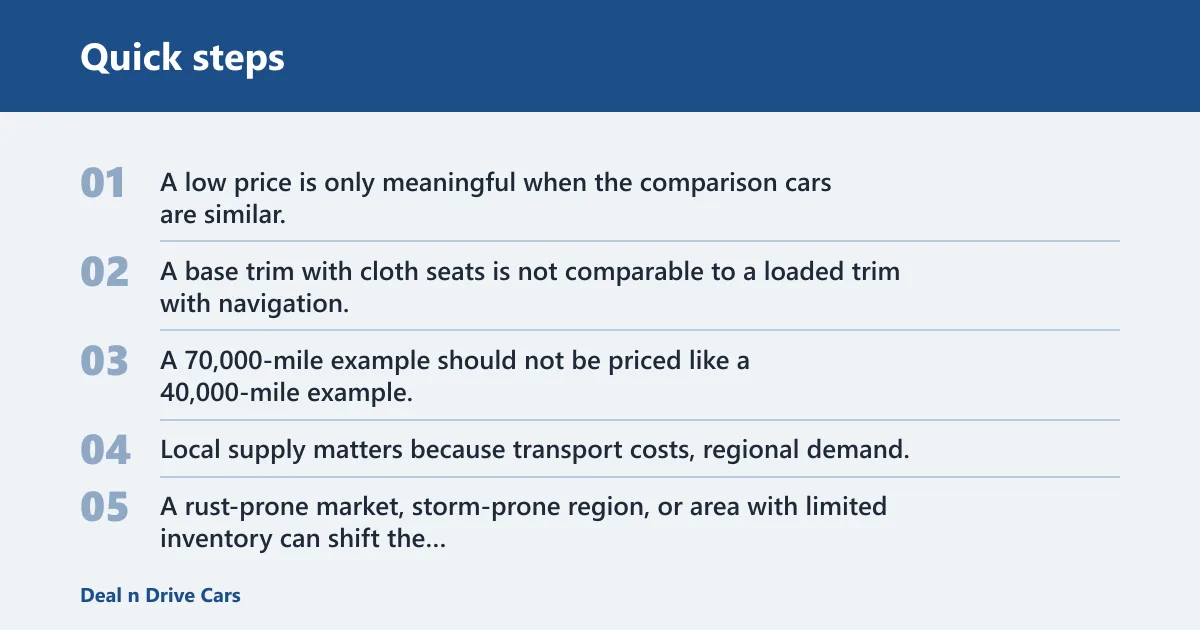
A low price is only meaningful when the comparison cars are similar. A base trim with cloth seats is not comparable to a loaded trim with navigation, driver-assist features, or a premium package. Mileage also changes the value. A 70,000-mile example should not be priced like a 40,000-mile example.
Use local inventory, not one national listing
Local supply matters because transport costs, regional demand, and weather patterns affect price. A rust-prone market, storm-prone region, or area with limited inventory can shift the going rate. Check several nearby listings of the same model before deciding a price is suspicious.
Judge the gap against current market conditions
Use the gap, not the sticker alone, to think about risk. A car priced 5% below nearby listings may simply be a decent deal. A car priced about 15% to 20% below similar local cars needs a clear explanation. Below that level, assume there is a reason until the paperwork and inspection prove otherwise.
Suppose a 4-year-old midsize sedan with 62,000 miles is priced $2,800 below similar local listings. If the seller can show a clean history report, regular service entries, and a recent inspection with no frame, flood, or electrical findings, the lower price may be real. If those records are missing, the discount becomes a warning sign.
Cheap car risk check

| Price gap vs similar listings | Likely reason for discount | What to verify | Walk-away threshold |
|---|---|---|---|
| 10% to 25% below market | Accident damage | Vehicle history report, paint-matching clues, panel gaps, pre-purchase inspection for frame and suspension damage | Walk if the seller cannot explain the repair with invoices or if frame work appears likely |
| 20% to 40% below market | Salvage title | Title status on the history report and the state title record | Walk unless you accept the resale and insurance limits and the price still makes sense after inspection |
| 15% to 35% below market | Rebuilt title | Rebuilt designation, repair receipts, and a thorough mechanical inspection | Walk if the repairs are undocumented or the inspection finds structural, electrical, or airbag issues |
| 10% to 30% below market | Flood damage | Musty odor, water line marks, corroded connectors, wet carpet underlay, history report, under-dash inspection | Walk if flood signs appear anywhere in the cabin, fuse box, or seat tracks |
| 5% to 20% below market | Hail damage | Roof, hood, and trunk panel inspection in direct light; paintless repair records | Walk if the dents are widespread and the seller cannot confirm quality repairs |
| 5% to 18% below market | High mileage | Odometer reading, service consistency, wear on pedals, steering wheel, seat bolsters | Walk if mileage is high and maintenance gaps suggest major wear items are due |
| 5% to 15% below market | Cosmetic wear | Scratches, curb rash, torn trim, faded headlights, worn tires, interior stains | Walk if cosmetic issues hint at poor care everywhere else |
| 8% to 20% below market | Overdue maintenance | Service records, oil change intervals, brake life, tire age, fluid condition | Walk if the catch-up work will erase the savings |
| 10% to 30% below market | Missing history | Service records, ownership records, title history, odometer consistency | Walk if the seller cannot document basic ownership or maintenance |
| Advertised price looks low, out-the-door price is not | Dealer add-ons disguised as a low price | Line-by-line out-the-door quote, documentation charge, add-on products, VIN etching, paint protection, nitrogen fill | Walk if add-ons turn the real price back to market or above |
| Pressure to act today with no paper trail | Urgent seller behavior | Title in hand, service records, inspection access, time to review the deal | Walk if the seller blocks inspection or rushes payment before verification |
What should you check before buying a cheap used car?
Check the vehicle history report, ask for service and ownership records, and arrange a mechanical inspection before you commit. Those three steps help you separate a discounted car from one hiding accident damage, title trouble, or deferred maintenance. Do not rely on the seller’s description alone.
Review the vehicle history report
The report should show accident history, title status, odometer anomalies, and service or ownership records. If the report is missing data, that absence matters. A clean report does not prove the car is sound, but a troubled report can explain why the price is low.
Request records for service and ownership
Ask for oil changes, brake work, tire replacement, timing belt or chain service if relevant, and ownership history. Consistent records matter because they show whether the car was cared for on schedule or left to run on borrowed time. Missing records are a discount reason, not a reassurance.
Arrange a mechanical inspection before you commit
A pre-purchase inspection by a mechanic can expose frame damage, flood signs, electrical problems, and repair costs that do not show up in photos. That inspection matters most for rebuilt title cars, cars with fresh paint, and cars that sit far below comparable listings.
Can a low used car price mean hidden damage or a bad title?
Yes. A low price can point to accident damage, salvage or rebuilt title status, flood damage, or odometer problems. The key is whether the seller can prove why the car is discounted and whether a mechanic can confirm the car is worth the risk.
Accident and frame damage clues
Look for uneven panel gaps, overspray, mismatched paint, bent hardware, airbag lights, and tires that wear unevenly. Frame damage can be expensive to repair and may still affect the car after cosmetic work is done. If the seller avoids a lift inspection, treat that as a red flag.
Salvage title and rebuilt title risks
A salvage title means the car was labeled a major prior damage indicator and was typically considered a total loss at some point. A rebuilt title means that salvage car was repaired for road use. Both bring a discount versus a clean title, but both can create insurance and financing friction, and rebuilt cars need a deeper inspection.
Say your compact SUV has a rebuilt title and a price that is 25% below similar clean-title listings. If the seller has repair invoices, a state inspection record, and a mechanic confirms the frame, airbags, and electronics are sound, the discount may be explainable. Without those papers, the price gap is probably there for a reason.
Flood and odometer red flags
Flood damage can hide in carpet padding, wiring, seat motors, and connectors. Odometer problems can hide in a report that does not match wear on the pedals, steering wheel, or driver’s seat. If the numbers and the wear do not agree, step back.
How fees and financing can erase the discount
A low list price is not the same as a low purchase cost. Dealer documentation charges, add-on products, taxes, and financing terms can turn a bargain into an average or expensive deal. You need the out-the-door price before you judge the offer.
Dealer documentation charges and add-on products
Ask for a full buyer’s order with every fee listed. Documentation charges, tire protection, paint protection, etching, nitrogen, and service contracts can stack up fast. A dealer can price a car low and recover the margin in the back end.
Out-the-door price versus listed price
The out-the-door total is what matters. If the listing is low but the paperwork adds thousands in fees, the deal may no longer be good. Compare the final figure to similar vehicles, not the headline price. That is the only clean comparison.
APR and loan term effects on total cost
Financing can change the deal more than the sticker does. With average used-car interest rates now over 11 percent in Q1 2026, a longer loan can make a modest discount disappear through interest. A lower monthly payment is not the same as a lower total cost.
For example, a car that seems $1,500 under market can become more expensive than a fair-priced rival if the loan carries a higher APR or a longer term. Run the math on the full payment schedule, not just the monthly number.
When a low price is worth a closer look
A lower price is worth pursuing when the seller can document the reason, the history report is clean or explainable, and the inspection supports the story. A genuinely discounted car often has clear cosmetic wear, higher mileage, or a recent repair that no longer affects safety or drivability.
Acceptable reasons for a lower price
Common fair reasons include higher mileage, older age, faded trim, worn tires, a less popular color, or a seller who wants a quick sale with full paperwork. Consumer Reports also notes that its marketplace listings include CR reliability and owner satisfaction ratings, which can help you compare cars with more context. Carwow says franchised dealers can be intimidating on price negotiation, but they may make it easier to include a warranty or service plan. Car supermarkets can offer a massive stock across many manufacturers, though they may have cars without a solid service history.
Signs the seller can document the discount
Good documentation includes title paperwork, service records, a clean history report, recent inspection results, and repair invoices that match the price cut. If the seller can show exactly why the car is cheaper, the deal may be fine. If the story changes, the price is probably a trap.
Walk-away thresholds when the gap is too large
Walk away when the price is far below similar local listings and the seller cannot prove why. A missing title trail, no inspection access, inconsistent odometer history, or major repair uncertainty should end the deal. The price gap should explain the risk, not hide it.
Frequently asked questions
What makes a used car price too good to be true?
A price is too good to be true when it sits far below similar local cars and there is no clean explanation. The usual causes are accident damage, title issues, hidden repair needs, or financing and fees that raise the true cost after the sale.
Why is one used car much cheaper than similar ones?
It may have higher mileage, more wear, a prior crash, a salvage or rebuilt title, flood exposure, or missing service records. It may also be priced low because the seller expects the buyer to pay for repairs soon after purchase.
How do I tell if a used car deal is actually fair?
Compare it with similar year, mileage, trim, equipment, and local inventory, then subtract the real cost of fees, taxes, and financing. If the car’s condition and paperwork support the discount, the deal may be fair. If not, the price is bait.
Should I walk away if a used car is below market value?
Not always. Walk away when the seller cannot document the lower price or when the inspection raises major concerns. If the discount matches the car’s age, mileage, cosmetic wear, or documented repairs, it may still be worth a closer look.