
How to Apply for Bad Credit Auto Loan Without Hurting Score
Apply for a bad credit auto loan by getting one or more soft-pull prequalifications first, then submit only one hard-pull application set within a 14-day shopping window after you compare terms. Bad timing or duplicate full applications can stack inquiries and make an already weak score look riskier. This guide shows the lowest-impact application order, from credit check to final loan form, with the mistakes that most often cost approvals.
Distinguishing Soft Pulls From Hard Inquiries for Car Loans

Yes, if you start with soft-pull prequalification and avoid repeated full applications. A soft pull generally does not affect your score, while a hard inquiry may appear on your credit file when a lender reviews you for final approval. Use soft pulls to compare offers, then save hard pulls for the last step.
What counts as a hard inquiry versus a soft pull
A soft pull is a limited credit review used for estimates, screening, or prequalification. A hard inquiry happens when you formally apply for credit and authorize a lender to review your full file. One hard inquiry is often manageable; several in a short period can make you look overextended.
For car buyers with weak credit, the damage often comes from applying too early, applying with multiple lenders on different days, or repeating the process after a dealer says “let’s try another bank.” That creates avoidable inquiry clutter.
Which steps are low-impact and which are not
Low-impact steps include checking your own credit, reviewing prequalification offers, and gathering documents before any lender submits a hard pull. Higher-impact steps include full loan applications and many dealer finance submissions if they are treated as separate credit requests.
Picture a buyer who submits three full applications over ten days because each lender asked for one more form. That pattern can create extra hard inquiries without improving approval odds. A cleaner sequence is better.
Check your credit reports before you apply
Start with your credit report, not the car lot. Get your free credit report from each bureau once per year through AnnualCreditReport.com. Credit Karma also says you can review Equifax and TransUnion reports for free on its platform.
Look for late payments, incorrect balances, accounts that are not yours, and duplicate inquiries. If something is wrong, dispute it before a lender pulls your file. A clean report can help approval odds and may keep you from paying a higher rate based on bad data.
📊 Subprime credit is defined as scores of 501 to 600. Source: Creditkarma.
What credit score counts as subprime for auto loans?
Experian defines subprime credit as scores of 501 to 600. Borrowers in that range often face higher auto loan APRs because lenders price in greater risk. Lower scores can still get approved, but the rate and total cost are usually less favorable than prime offers.
Why lower scores often lead to higher APRs
Lenders use your credit score to assess risk. A lower score can signal a greater chance of missed payments, so lenders often respond with a higher interest rate. In Q1 2026, the average new-vehicle APR for subprime borrowers was 13.44%, and the average used-vehicle APR for subprime borrowers was 19.42%.
For context, the average 60-month new-car loan rate was 7.53% in the same period. That gap shows why even a small improvement in terms matters when credit is weak.
Use prequalification to compare lenders first
Auto loan prequalification lets you estimate loan terms before you submit a full application. It is the safest way to compare lenders early because it should minimize hard inquiries where possible. You can compare estimated rates, payment ranges, loan amounts, and down payment needs before you commit.
How prequalification works
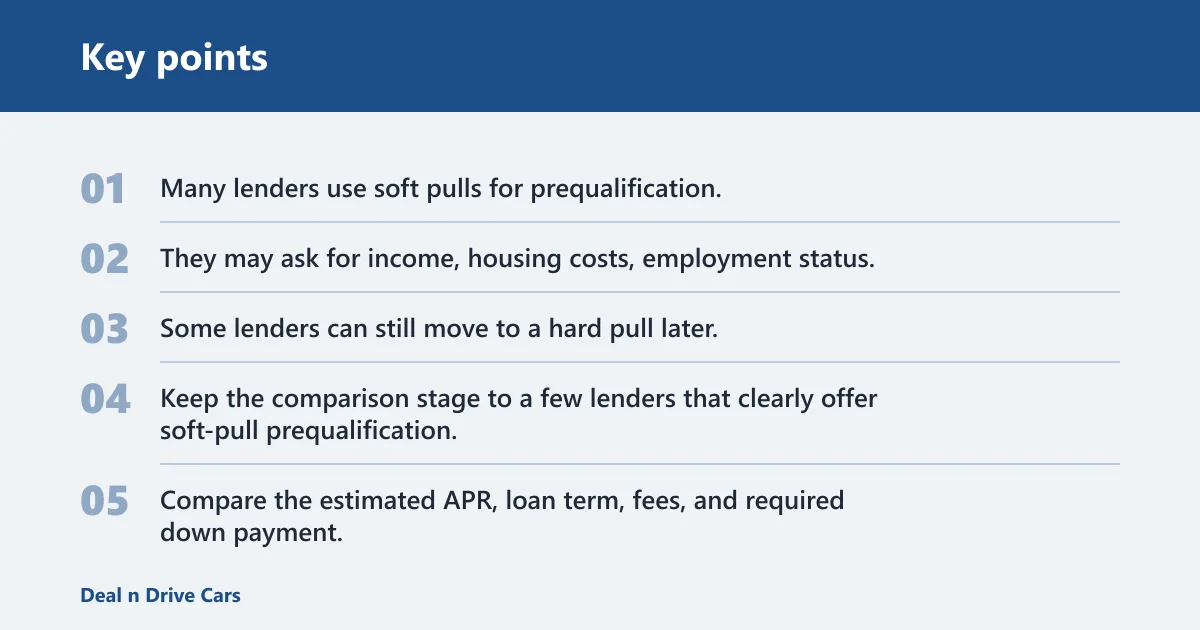
Many lenders use soft pulls for prequalification. They may ask for income, housing costs, employment status, and the vehicle price you are targeting. Some lenders can still move to a hard pull later, so read the prequalification language carefully before you proceed.
| Step | What happens | Credit impact |
|---|---|---|
| Soft-pull prequalification | Estimate rates and terms without a full application | Usually no score change |
| Full lender application | Formal request for credit approval | Hard inquiry may appear |
| Dealer finance submission | Dealer sends your file to one or more lenders | May create one or more hard inquiries depending on how it is processed |
How to compare offers without overapplying
Keep the comparison stage to a few lenders that clearly offer soft-pull prequalification. Compare the estimated APR, loan term, fees, and required down payment. If a lender will not give any estimate without a hard pull, save that lender for last.
When a lender may still run a hard pull
Some lenders use “prequalification” loosely. If the disclosure says the review may affect your credit or lead to a full application, treat it as a hard-pull event. Do not assume every rate check is harmless.
How many auto loan applications can you submit?
You should aim for one final hard-pull application set after you finish soft-pull comparison, not a stack of separate applications spread over several days. Credit models often treat multiple auto inquiries within a short shopping window more leniently than scattered applications, but you still want to keep the activity tight and purposeful.
Rate-shopping windows and inquiry timing
Submit your final applications inside one short window, ideally about 14 days, so the shopping activity is more likely to be treated as rate shopping rather than multiple separate credit decisions. That timing matters because spacing applications across a week or two can make the file look like repeated credit chasing.
A common first-timer mistake is prequalifying in one month, then returning later for a different lender, then adding a dealer application after the car is chosen. That breaks the sequence and can add unnecessary credit hits.
How to avoid stacking applications across several days
- Collect your report, pay stubs, residence history, and vehicle details first.
- Use soft-pull prequalification with a small group of lenders.
- Compare the offers on the same day if possible.
- Choose one lender path and keep the hard-pull stage inside one shopping window.
- Do not restart the process unless the first round is clearly unusable.
Build your application to improve approval odds
Prepare before you apply. Lenders want income, residence, and vehicle details they can verify quickly, and missing documents can force a second round of pulls or push you into a weaker deal. A down payment can reduce the amount financed and may improve approval odds. A co-signer can also help in the right situation.
Prepare income, residence, and vehicle documents
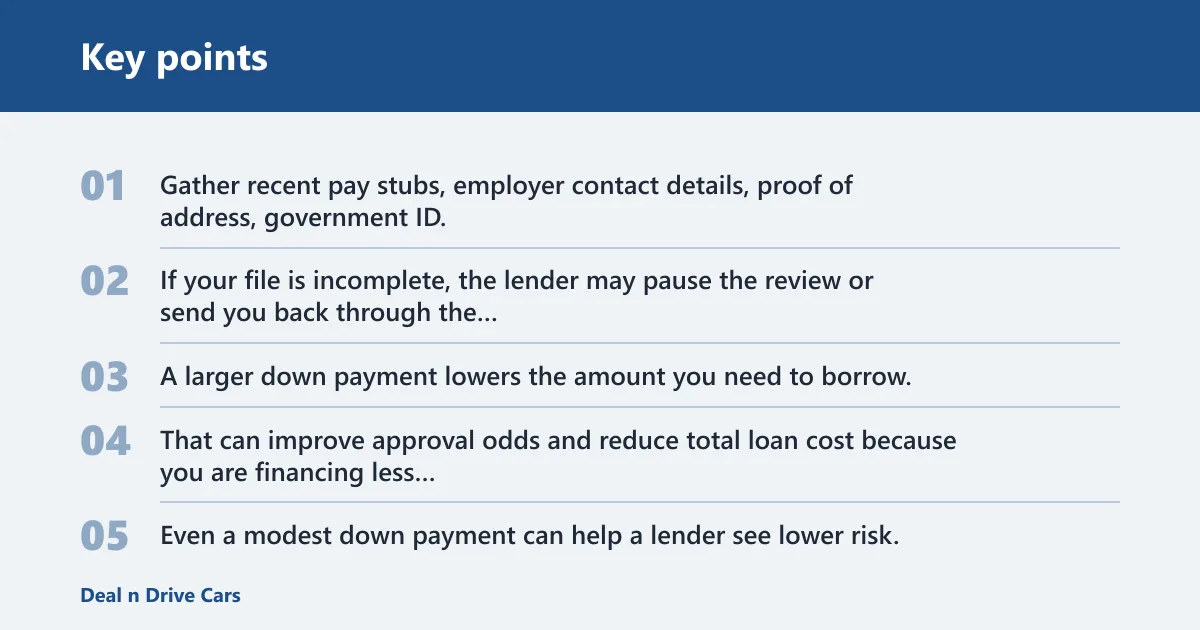
Gather recent pay stubs, employer contact details, proof of address, government ID, and any trade-in documents before the lender asks. If your file is incomplete, the lender may pause the review or send you back through the process, which can waste your shopping window.
Save a down payment to reduce the amount financed
A larger down payment lowers the amount you need to borrow. That can improve approval odds and reduce total loan cost because you are financing less principal. Even a modest down payment can help a lender see lower risk.
Say your target car costs around that amount and you can put some money down. The loan request becomes smaller, which may help the lender approve the file or offer a better structure than a zero-down deal.
Consider a co-signer only when the tradeoff makes sense
A co-signer with good credit may improve approval odds and may help you secure better loan rate and terms. The article recommends asking a family member or close friend if you cannot wait. The tradeoff is real: the co-signer becomes responsible if payments are missed.
Use a co-signer when the file is otherwise close to approval, not as a shortcut around a broken application. If the lender already sees missing income proof, unresolved report errors, or no down payment, a co-signer may not solve the core problem.
Apply without unnecessary score damage
Use this sequence to limit avoidable hard inquiries and approval mistakes. The order matters because each step either protects your score or risks a new pull. If a step is not ready, stop and wait rather than forcing a weak application.
- Pre-check with a soft pull. Review your own credit and get prequalification estimates before any full application.
- Fix report errors and gather documents. Dispute inaccuracies first, then assemble income, residence, and vehicle paperwork.
- Get prequalified with a few lenders. Use soft-pull offers to compare estimated APR, term, and payment.
- Keep all rate shopping inside one short window. Avoid spreading applications over many days or returning to restart the process later.
- Submit one final dealer or lender application. Choose the best offer and complete only the needed hard-pull step.
- Stop and wait if terms are too costly or files are not ready. Do not add more inquiries just to force a decision.
Should you apply now or wait and improve credit?
Apply now if you have reviewed your reports, resolved errors, gathered documents, and already have a realistic down payment or co-signer option. Wait if your reports contain mistakes, your income proof is incomplete, or the terms you are seeing seem higher than you can support.
Signs you can apply now
You are better positioned to apply now if your reports are clean, your score is stable, and your prequalifications show a payment you can handle. You should also apply now if the car is urgent and you have already narrowed the field to a short list of lenders with soft-pull prequalification.
Signs you should wait 30 to 90 days
Wait if you have unresolved errors, recent collections you can fix, no down payment, or no documents ready. Waiting can also help if your score is near the subprime edge and a small improvement could move you into a better rate band. A short pause is often cheaper than a rushed approval.
Suppose a buyer needs a used sedan next week but has a report error showing a late payment on an account that was closed on time. Applying immediately risks a decision based on bad data. Disputing first can be the smarter move even if it delays the purchase.
How do I apply for a bad credit auto loan without hurting my credit?
Start with soft-pull prequalification, not full applications. Check your credit reports, fix errors, prepare your documents, and keep any hard-pull applications inside one short shopping window. That sequence limits unnecessary score damage and helps you compare terms before you commit.
Does checking auto loan rates hurt my credit score?
Rate checks do not always hurt your score. Soft-pull prequalification is designed to estimate terms without a hard inquiry, while a formal loan application usually does affect your file. Read the lender’s disclosure carefully so you know which type of pull you are authorizing.
How many auto loan applications can I submit without damage?
There is no magic number that makes hard inquiries harmless. The safer approach is one short shopping window with a few related applications after soft-pull comparison. Spreading applications across several days or weeks can add unnecessary inquiry exposure and make the file look more risky.
Should I check my credit before applying for a car loan?
Yes. Checking your own credit helps you catch errors, estimate where you stand, and avoid surprise denials. Use your free annual reports from AnnualCreditReport.com, and review Equifax and TransUnion through Credit Karma if you want another free access route before you apply.
Can a co-signer help me get approved for a bad credit car loan?
Yes, a co-signer with good credit may improve approval odds and may help you get better loan rate and terms. That said, the co-signer takes on repayment responsibility too. Use this option only when the borrower and co-signer both understand the obligation and the risks.
How much down payment should I save for a bad credit auto loan?
Save as much as you reasonably can without draining your emergency cash. Even a modest down payment can reduce the amount financed and improve approval odds. The practical target is the amount that makes the monthly payment and loan size manageable, not just the minimum a dealer suggests.