How Much Income Do You Need for a Bad Credit Auto Loan?
A common target is to keep car payments at about 10% to 15% of monthly income, with total debt payments usually staying below about 10% to 15% of monthly income. If you miss that target, you can end up with a payment that strains your budget or gets denied after a hard credit check. This guide shows how lenders turn income into an affordable payment, then into a car price you can shop for.
How lenders judge your income
Lenders usually start with gross monthly income, meaning before-tax income. They compare that figure with your existing monthly debts and the proposed car payment to see whether the loan fits your budget. Stable, documentable income usually matters more than the paycheck amount alone.
Bad credit does not end the conversation. Lenders may still review income, payment history, and the size of the payment you request. Some lenders also accept fixed income, unemployment income, self-employed income, and temporary income, though they may weigh each one differently.
Gross monthly income vs. take-home pay
Gross monthly income is the number lenders usually use for screening. Take-home pay can be lower after taxes, insurance, and retirement deductions, so it can be safer for your own budget planning, but it is not always the number used in the approval review. If your gross pay looks high but your net pay is tight, the loan can still be too large.
Why stable income matters
Stability matters because lenders want a payment that is likely to continue. A steady job with consistent hours is easier to document than income that swings from month to month. That does not mean variable income is unusable. It means the lender may average it over time or ask for more proof.
How recurring debts affect the review
Recurring debts reduce room for a car payment. Those debts can include rent or mortgage, credit cards, student loans, child support, and other installment loans. A lender is checking whether your new payment still leaves enough room for living costs after those obligations are paid.
How income becomes a car payment

Lenders turn income into a car payment by looking at debt-to-income ratio, then testing whether the monthly payment fits what is left. A common affordability example uses the 28% income rule for housing and a total debt limit near about 40% to 45%. The exact limit changes by lender and credit profile.
That is why approval amount and affordable amount are not the same thing. A lender may approve a higher payment than you should accept. Your goal is the payment that fits your full budget, not the largest payment a system might allow.
Debt-to-income ratio in plain terms
Debt-to-income ratio compares monthly debt payments to gross monthly income. If you earn $4,000 gross per month and already pay $1,200 in recurring debts, that leaves less room for a car payment than it would for someone with $500 in debts. The ratio helps show whether the payment is realistic, not just whether it is technically available.
Why APR changes the payment you can afford
APR changes the cost of borrowing. A higher APR means more interest is built into the monthly payment, so the same car price can require a bigger income or a larger down payment. With bad credit, that difference matters quickly. A vehicle that looks affordable at one rate can become too expensive at another.
Say your gross monthly income is $3,500 and your current debts total $900. At a 12% target for car payment, that would suggest about $420 for the payment. If a higher APR pushes the payment up to $475 for the same vehicle, the car may no longer fit the budget even if the lender is willing to approve it.
Approval amount vs. affordable amount
The approval amount is the most a lender may be willing to finance. The affordable amount is the payment your budget can handle after rent, utilities, food, insurance, and your other debts. Those two numbers often differ. For bad credit shoppers, that gap is one of the biggest traps in car buying.
Income worksheet
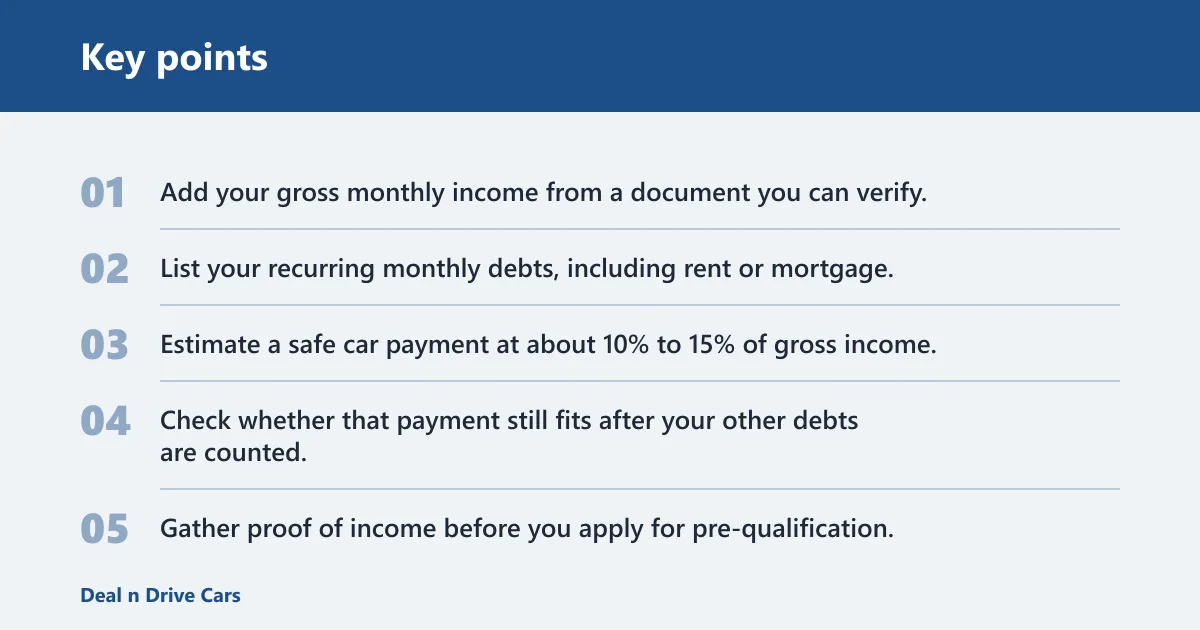
This worksheet translates income into a payment target before you apply. Use it to decide whether the loan size, not just the car, fits your monthly budget. The pass/fail checklist is for pre-qualification readiness, not final approval.
| Scenario | Gross monthly income | Recurring debts | Estimated maximum safe car payment | Documents to bring | Pre-qualification checklist |
|---|---|---|---|---|---|
| Fixed income | $2,400 | $700 | $240 to $300 | Award letter, recent bank statements, proof of deposits | Pass if income is documented, deposits are steady, and debts are current |
| Hourly income with overtime | $3,200 base; $3,800 with consistent overtime | $1,000 | $320 to $480, depending on how much overtime the lender counts | Recent pay stubs, year-to-date earnings, bank statements | Pass if overtime is regular enough to document for several months |
| Self-employed income | $4,500 average | $1,400 | $450 to $560 | Two years of tax returns, business bank statements, profit-and-loss records | Pass if income is consistent across tax returns and deposits |
- Add your gross monthly income from a document you can verify.
- List your recurring monthly debts, including rent or mortgage.
- Estimate a safe car payment at about 10% to 15% of gross income.
- Check whether that payment still fits after your other debts are counted.
- Gather proof of income before you apply for pre-qualification.
- Compare the payment, not just the car price, before you shop.
Fixed income example
Picture a buyer with $2,400 in monthly Social Security and pension income and $700 in monthly debts. A payment around $240 to $300 may be safer than a larger figure, because the rest of the budget still has to cover insurance, fuel, and repairs. The key question is whether the payment is steady and documented.
Hourly income with overtime example
Suppose a worker earns about $20 per hour for a base schedule and adds overtime that can lift monthly gross income to around $3,800 in some months. A lender may want several recent pay stubs and year-to-date totals to see whether the overtime is regular. If overtime spikes only once in a while, it may not support a larger payment.
Self-employed income example
A common first-timer mistake is counting business deposits as full income without backing them up. If gross deposits average $4,500 a month but business expenses are high, tax returns and bank statements may show a smaller qualifying figure. Lenders often look for a pattern they can document, not one strong month.
Can fixed income qualify?
Yes, fixed income can qualify if the lender can verify it and the payment fits the budget. Social Security, disability income, and pension income may be considered, but lender standards vary. Credit Acceptance says fixed income can be considered, and approved applicants can have no minimum credit score.
What lenders may ask
Be ready to show an award letter, bank statements showing regular deposits, and any other proof that the income is ongoing. If the income is tax-free or comes from multiple sources, the lender may still want a clean paper trail. The issue is not whether the money is “real”; it is whether the lender can document it and rely on it.
When a co-borrower may matter
A co-borrower can help if your fixed income is steady but not high enough for the payment you want. That second borrower may improve the approval picture by adding income and reducing the risk seen by the lender. It is still wise to keep the payment modest, because both borrowers are tied to the loan.
Does self-employed income count?
Yes, self-employed income can count, but lenders usually want more proof than they ask from a W-2 worker. The same source says self-employed income can be considered. The usual review focuses on tax returns, bank statements, and whether the income has stayed steady enough to support the payment.
Tax returns and bank statements
Tax returns help show net income after business deductions, while bank statements help show money moving through the account on a regular basis. A lender may use both to decide how much income is safe to count. If your business income swings seasonally, bring a longer record rather than a single month.
How lenders judge income stability
Stability means the lender can see a pattern. A two-year tax history with similar earnings usually helps more than a short burst of strong sales. Seasonal income can still count, but the review may be tighter if your busy months do most of the work for the year.
What proof of income should you bring?
Bring the documents that match your income type. Recent pay stubs are best for wage earners, bank statements help show cash flow, tax returns support self-employment, and award letters support fixed income. Good documentation can speed up pre-qualification and reduce back-and-forth later.
Recent pay stubs
Pay stubs usually show gross pay, year-to-date earnings, and deductions. Lenders use them to confirm that the paycheck is current and the job is active. Bring the most recent stubs you have, especially if your hours vary or you recently changed shifts.
Bank statements
Bank statements can help when deposits are irregular, when pay is not deposited through a standard employer system, or when you receive income from several sources. They also help confirm that the money keeps arriving. For bad credit shoppers, that kind of proof can matter as much as the credit score itself.
Tax returns
Tax returns are especially useful for self-employed income and other income that does not show up on a pay stub. They give the lender a fuller year-by-year view. If your business income dropped in one year, be ready to explain the reason with records, not guesses.
Award letters for fixed income
Award letters can verify Social Security, disability, pension, or similar income. They show the source, amount, and often the expected duration. That helps the lender decide whether the payment is likely to remain affordable.
What if your credit is bad or you had a repo?
Bad credit or a prior repossession can make approval harder, but they do not always end the search. The same source says bad credit or multiple repossession may still qualify, and approved applicants can have no minimum credit score. Income still matters because it helps lenders judge whether the next payment is more manageable than the last one.
Why income still matters
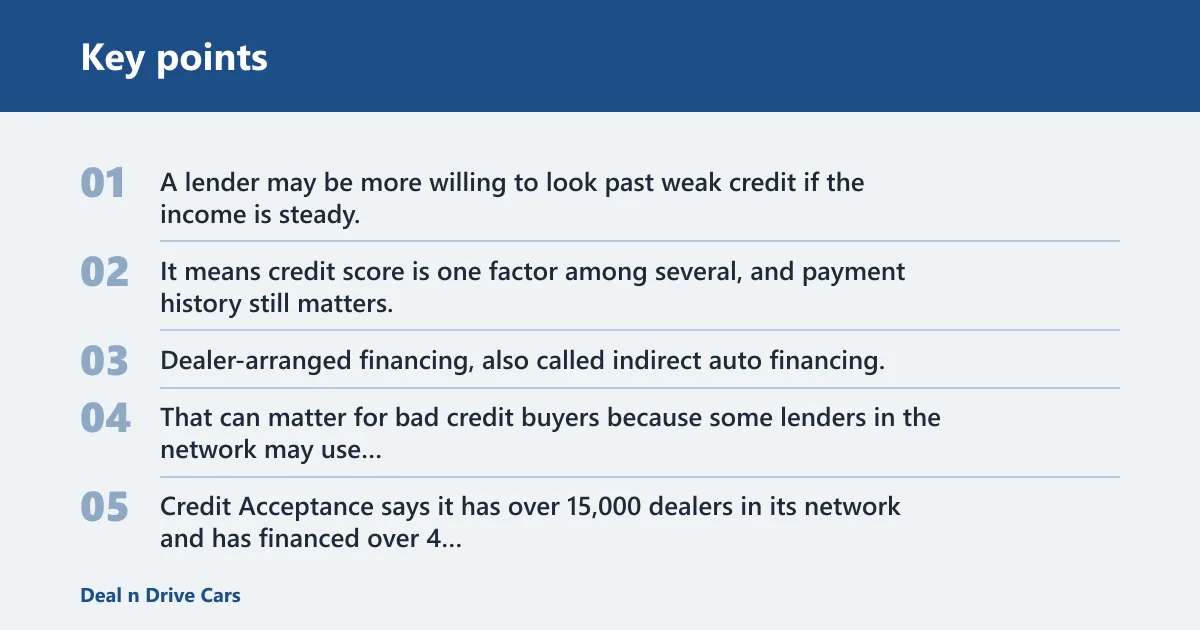
A lender may be more willing to look past weak credit if the income is steady, the debts are under control, and the requested payment is modest. That does not mean credit is irrelevant. It means credit score is one factor among several, and payment history still matters.
How dealer-arranged financing can help
Dealer-arranged financing, also called indirect auto financing, routes the loan through a dealer and a lender network. That can matter for bad credit buyers because some lenders in the network may use different approval standards. The same source says it has over 15,000 dealers in its network and has financed over 4 million customers.
Credit Acceptance also says its financing can help customers pre-qualify in minutes, and pre-qualification shows the maximum monthly payment you qualify for. That can help you set a price limit before you spend time on the lot. It is still only a starting point, not a final approval.
When a prior repossession can still be reviewed
A repo can be a setback, but some lenders still review the rest of the file. They may look for a new job, stronger income, a down payment, or better payment history since the repo. If the prior loss was recent, the payment you request matters even more.
How do you know what monthly payment you can afford on a bad credit auto loan?
Start with gross monthly income, subtract recurring debts, then keep the car payment low enough to leave room in the rest of the budget. A common guide is to aim for about 10% to 15% of gross income for the car payment itself. Then test the number against insurance, fuel, and maintenance before you apply.
Use pre-qualification before shopping
Auto loan pre-qualification can show an estimated maximum monthly payment without the same impact as a full application, when a lender offers it that way. That gives you a shopping ceiling before you pick a vehicle. It is useful because a payment you can pre-qualify for is still not the same as a payment you can truly carry.
Use the payment to set the car price
Once you know the payment target, work backward to the car price. A bigger down payment lowers the amount financed and can reduce the monthly payment. That matters more when credit is weak, because a down payment may also help offset a higher APR.
What if unemployment income is your only income?
Unemployment income can help in some cases, but it is usually less stable than wages or fixed benefits. The same source says unemployment income can be considered, yet lender rules vary, and some lenders may treat it as limited or temporary income rather than a base for long-term repayment. That means the payment request needs extra caution.
Frequently asked questions
How much income do you need for a bad credit auto loan?
There is no single minimum income for every lender. A common target is enough gross income to keep the car payment around 10% to 15% of monthly income, while total debt payments stay below about 40% to 45%. The real test is whether the payment fits after your recurring debts.
Can I get approved for a car loan if I’m on fixed income?
Yes, fixed income can qualify if it is steady, documentable, and enough to cover the payment. Lenders may ask for award letters, bank statements, and proof that the deposits are ongoing. A smaller down payment or lower-priced vehicle may improve the odds.
Does self-employed income count for a bad credit car loan?
Yes, self-employed income can count, but lenders usually want tax returns and bank statements to verify it. They may average income over time rather than rely on one strong month. If your earnings change with the season, be ready to show a longer record.
How much monthly income do lenders want for an auto loan?
Lenders do not use one universal number. They usually want enough gross monthly income to support the proposed payment after other debts are counted. A lender may approve a payment that is higher than the one you should choose, so pre-qualification is only a guide.
What if I have bad credit but a steady job?
A steady job can help a lot, because stable income can offset weak credit in the review. Lenders still look at debt load, payment size, and payment history. If the job is full-time and the pay is documented, you may have a stronger case than the score alone suggests.
Do bad credit auto lenders have a minimum income requirement?
Some lenders have internal minimums, but they are not the same from one lender to another. Others focus more on payment size, debt-to-income ratio, and proof that the income is stable. That is why pre-qualification and document prep matter before you shop.