How Many Days Should You Spend Shopping for a Used Car?
Spend 2 days if you already have financing and know your target, 1 week for most cash or dealer shoppers, and up to 2 weeks for private-party buys or first-time buyers. Waiting past that often costs you the best listing, pushes you toward higher-priced options, and leaves less time to verify the car properly. This guide shows the stop point, by buyer type, and what to verify before you make an offer.
How long should you spend shopping for a used car?
For most shoppers, a useful window is a few days to a couple of weeks, depending on how clear your budget is and how easy it is to replace the car if you pass on one. The shopping window covers comparing listings, contacting sellers, test driving, and judging value. It does not include loan funding, title transfer, or DMV wait time.
The short answer by buyer type
Cash buyers with a narrow target can often finish in a few days to about a week. Financed buyers usually need several days to about a week and a half because pre-approval and rate comparison happen before the deal is ready. Private-party buyers often need about a week or two because scheduling, inspection, and paperwork tend to move more slowly.
What shopping time is actually meant to cover
Use shopping time for the market search itself: comparing vehicles, reviewing history reports, arranging test drives, and deciding whether the car fits your budget and needs. Keep paperwork time separate. That includes loan finalization, title signing, emissions or safety steps where required, and transfer documents.
When a longer search starts to cost you the car
Used cars move fast. A clean one-owner car with the right trim and color can disappear in a day or two, especially in a tight local market. If you keep browsing after your target is already clear, you raise the chance of missing the right unit and then settling for a weaker one later.
What should happen before you start comparing cars?
Set your money limits first. Before you scan listings, decide your out-the-door ceiling, monthly payment target if you need financing, and repair reserve. If you need a loan, get pre-approval before you spend time on listings so you know your cap and avoid looking at cars that do not fit.
Set an out-the-door ceiling and monthly payment target
Your out-the-door limit should include price, tax, title, registration, and dealer fees. If you are financing, set a monthly payment target and a maximum loan amount before you shop. A deal that fits the sticker price but breaks the total budget is the wrong car.
Set a repair reserve before you visit listings
Keep a repair reserve separate from the purchase price. For an older used car, that reserve should be large enough to cover tires, battery, brakes, fluids, and one surprise repair without forcing an immediate second decision. If that reserve is too small, you will judge the wrong cars as “affordable.”
Get pre-approval first if you need a loan
Pre-approval usually takes from a few minutes online to a few business days, depending on the lender and the documents requested. Get it early, before serious shopping. Rate shopping should happen in a short window, because multiple auto-loan inquiries made close together are commonly treated as one credit event by scoring models.
How many days is enough for each buyer type?
Two days can be enough for a prepared cash buyer chasing a common model. One week is enough for many shoppers who need a bit of comparison and logistics time. Two weeks is the practical upper end for most people before decision fatigue starts to work against the search.
Cash buyer timeline
Cash buyers can move fastest because there is no loan approval step. If the local market has several similar cars, 2 to 5 days is often enough. If the car is uncommon, the color or trim is picky, or the seller is private party, plan closer to 1 to 2 weeks.
Financed buyer timeline
Financed buyers should allow 3 to 10 days, with the first day or two spent on pre-approval and rate comparison. After that, search and compare as normal. If your loan approval expires in 30 to 60 days, do not start too early or you may need to refresh it before closing.
Private-party buyer timeline
Private-party purchases often need the longest window because you may have to wait for an available appointment, arrange a pre-purchase inspection, and verify title details carefully. Seven to 14 days is a realistic planning window, and the upper end is common when the seller can only meet after work or on weekends.
Is one week enough to shop for a used car?
Yes, one week is enough for many used-car buyers if your budget is set, your financing is ready, and the local market has more than a handful of suitable cars. Seven days is often too short only when inventory is thin, the model is rare, or you need inspection scheduling and seller coordination.
When seven days is realistic
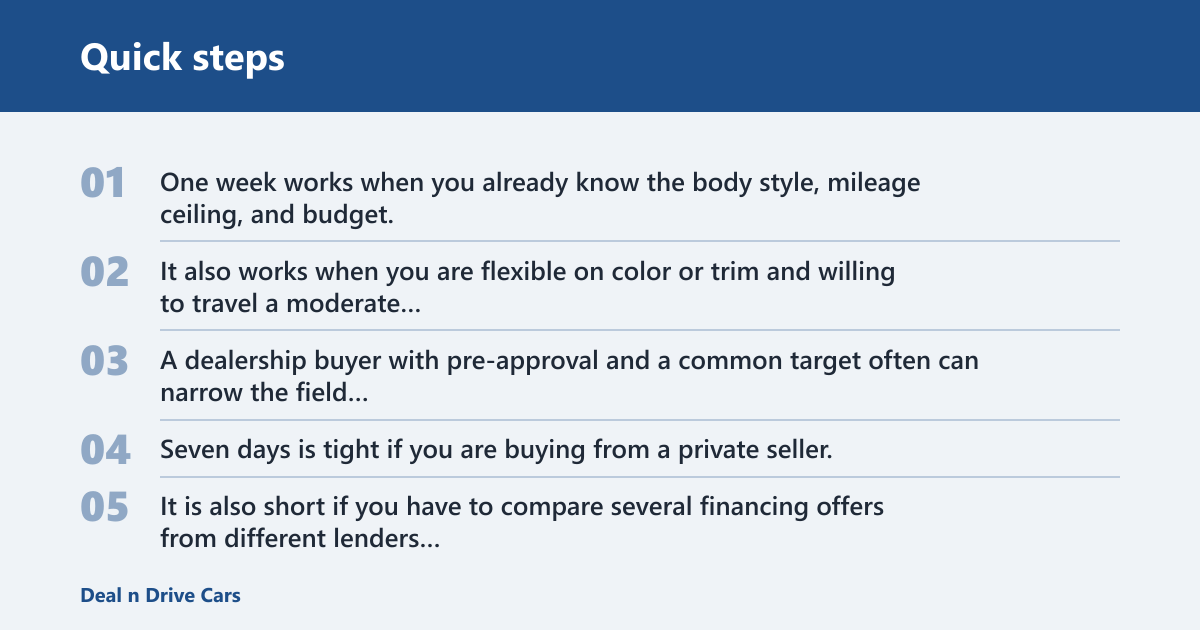
One week works when you already know the body style, mileage ceiling, and budget. It also works when you are flexible on color or trim and willing to travel a moderate distance. A dealership buyer with pre-approval and a common target often can narrow the field quickly.
When seven days is too short
Seven days is tight if you are buying from a private seller, want a specific trim and color, or need a mechanic to fit in a pre-purchase inspection. It is also short if you have to compare several financing offers from different lenders before locking in a rate.
How to split the week between searching, driving, and checking records
Use the first 2 days to filter listings and compare asking prices. Use the next 2 or 3 days to run history reports, call sellers, and inspect photos closely. Reserve the last 2 days for test drives, an inspection, and the final decision. Do not leave the record checks until the end.
Suppose you are comparing two compact SUVs with 48,000 and 52,000 miles. If both have clean titles and similar service records, the better timeline is not “keep looking.” It is a same-route test drive, a history report check, and then a decision before the cleaner example disappears.
What proof should you collect before you stop shopping?
Before you stop shopping, collect proof that the car fits your budget, passes the records check, and drives better than the alternatives you saw. The minimum set is a vehicle history report, a same-route test drive on more than one car, and, when practical, a pre-purchase inspection.
Vehicle history report checks
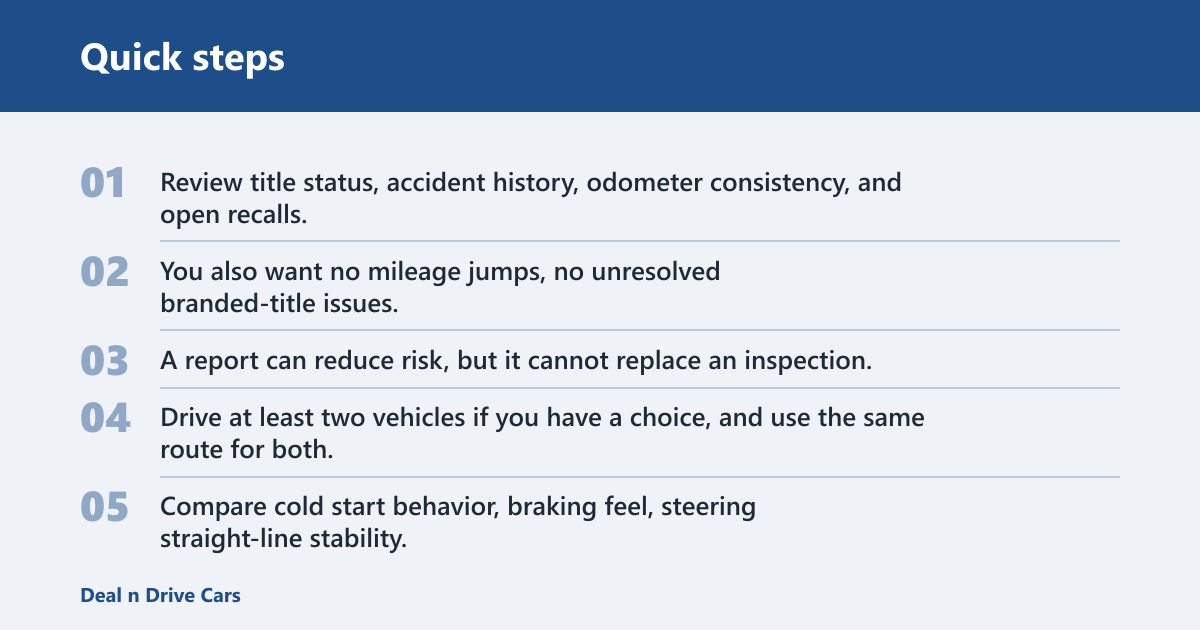
Review title status, accident history, odometer consistency, and open recalls. A clean title is not enough by itself. You also want no mileage jumps, no unresolved branded-title issues, and no recall that would change your willingness to buy. A report can reduce risk, but it cannot replace an inspection.
Test-drive comparison on the same route
Drive at least two vehicles if you have a choice, and use the same route for both. Compare cold start behavior, braking feel, steering straight-line stability, transmission shifts, cabin noise, and dashboard warning lights. If one car pulls under braking, shudders at highway speed, or triggers a warning light, that is a red flag.
Pre-purchase inspection timing and cost
A pre-purchase inspection usually fits after you have narrowed the field to one or two cars and before you make a final offer. Typical turnaround is same day or next day, depending on the shop. Cost often falls in the lower end of the typical range, though local pricing varies. If the mechanic finds frame damage, leaks, or major wear, the timeline should extend.
A common first-timer mistake is booking an inspection after mentally deciding on the car. That can force a rushed choice if the shop finds something major. Schedule the inspection while you still have one fallback car, not after you have already talked yourself into the first listing.
Should you wait a few days before buying online?
A short pause helps when the listing is new and you want time to verify photos, records, and payment terms. Waiting a few days is risky only if the car is priced well below similar listings, the market is tight, or the seller already has other interested buyers. Verify first, then decide fast.
When a short pause helps
A day or two of pause can be smart if you need to read the history report, confirm VIN details, and compare the car with nearby alternatives. It can also help if you are waiting on loan terms or inspection scheduling. Use the pause for facts, not indecision.
When waiting raises the chance of losing the car
If the vehicle is a common commuter car priced under similar local listings, one extra day may not matter. If it is a clean one-owner model with low miles and the right trim, waiting a few days can be enough for another buyer to make the offer. Good deals rarely wait politely.
Which details to verify during the pause
During the pause, confirm the VIN, title status, mileage, service history, recall status, tire condition, and whether the seller has the title in hand. For dealership listings, ask whether the out-the-door price already includes fees. For private-party listings, confirm who is named on the title and whether liens remain.
How do inventory and seller type change the timeline?
Inventory depth and seller type are major timing drivers. If your local market has only a few matching cars, expect a longer search. Dealerships usually move paperwork faster, while private-party deals often need more coordination, more verification, and more time before you can finish.
Local inventory depth and distance willing to travel
If you are willing to travel 50 to 100 miles, you may double or triple your options in some markets. If you will only buy within 10 miles, the search window should be longer because you are relying on a much smaller pool. Distance can shorten or stretch the timeline quickly.
Trim, color, and seasonality tradeoffs
Flexibility matters. A buyer who accepts several trims and colors can often stop shopping sooner than a buyer who wants one exact configuration. Seasonality also matters: trucks, SUVs, and convertibles do not always move at the same pace, and prices can tighten when demand rises for a given body style.
Dealership versus private party timing
Dealerships usually offer faster appointments, quicker paperwork, and more room to compare similar cars in one place. Private-party sales can bring better pricing, but they often require evening meetings, a title check, and more time for a mechanic appointment. That difference alone can add several days.
Buyer-type timeline table and stop-shopping checklist
The table below gives a practical day range by buyer type. Use it to decide whether 2 days, 1 week, or 2 weeks is enough, then stop shopping once the checklist conditions are met. If those conditions are not met, keep searching; if they are met, make the offer.
| Buyer type | Recommended day range | Minimum viable search time | Maximum practical search time | Main risk of shopping too long |
|---|---|---|---|---|
| Cash buyer | 2 to 7 days | 2 days | 10 to 14 days | Good listings sell first, then you settle for worse mileage or condition |
| Financed buyer | 3 to 10 days | 3 days | 14 days | Pre-approval expires or rates change while you browse |
| Private-party buyer | 7 to 14 days | 7 days | 14 days | Scheduling delays and competing buyers increase the chance of losing the car |
Stop-shopping checklist
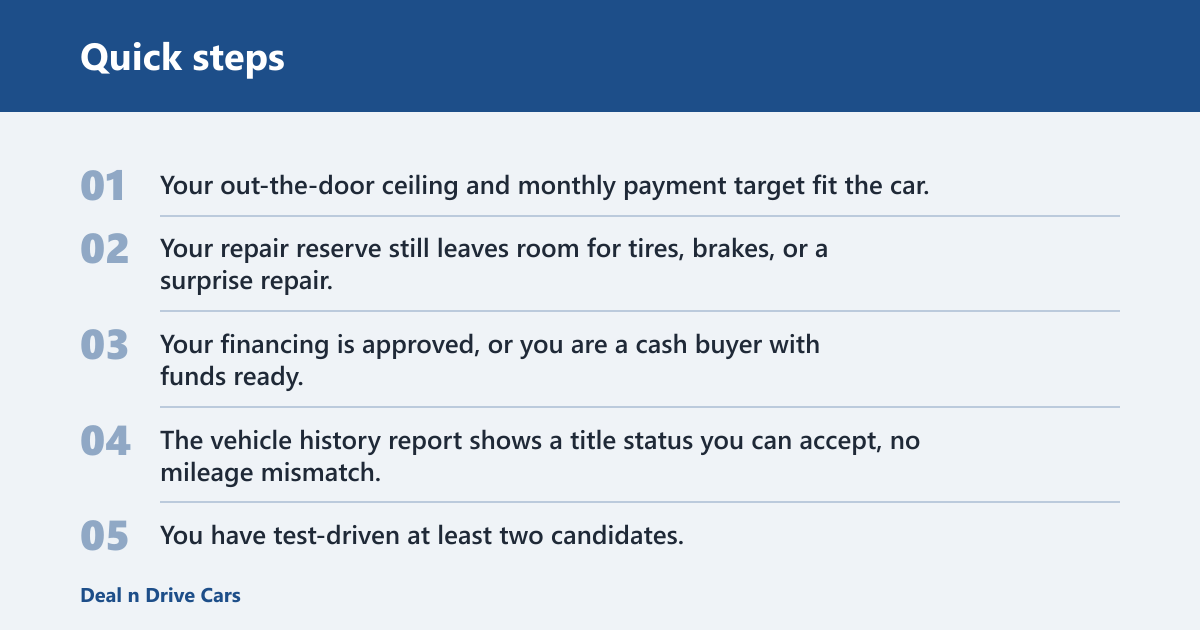
- Your out-the-door ceiling and monthly payment target fit the car.
- Your repair reserve still leaves room for tires, brakes, or a surprise repair.
- Your financing is approved, or you are a cash buyer with funds ready.
- The vehicle history report shows a title status you can accept, no mileage mismatch, and no unresolved recall that changes the decision.
- You have test-driven at least two candidates, or one clear winner with a direct comparison on the same route.
- A pre-purchase inspection is complete, or you have a clear reason it is not needed for this specific car.
- The seller can provide paperwork fast enough that the car will not slip away while you wait.
How do I avoid rushing when buying a used car?
Do the hard parts first: budget, financing, records, and inspection. Then set a deadline for your decision window so the search does not drift. Rushing usually happens when these steps are left until the last minute, not when the search itself is short.
Use a simple rule. If the car fits your budget, passes the history check, drives well on the same route, and clears inspection, stop shopping. If one of those items is missing, keep looking rather than guessing.
Frequently asked questions
How many days should I spend shopping for a used car?
Most buyers should plan on 2 to 14 days. Use 2 days if you already have financing and know exactly what you want. Use about 1 week for a typical cash or dealership purchase. Use up to 2 weeks for private-party deals or when inspection scheduling adds delay.
Is one week enough to shop for a used car?
Yes, one week is enough for many shoppers if the budget is set and the local market has decent inventory. It is less reliable if you need to compare loans, wait for a mechanic, or search for a specific trim and color. In those cases, give yourself more time.
How long should I compare used cars before buying?
Compare until you have enough data to judge price, condition, and drivability, then stop. For many shoppers, that means comparing 2 to 4 vehicles, or fewer if the market is thin. The goal is not to see everything; it is to see enough to make a grounded decision.
When does shopping too long start costing me the car?
Shopping too long starts costing you the car when the listing is already well priced, the vehicle is in high demand, or the seller has other interested buyers. If your checklist is complete, waiting for a “better” option can mean losing the right one and paying more later.
How can I tell if I’ve seen enough used cars to make a decision?
You have likely seen enough when one car clearly fits your budget, history, and driving preferences better than the others, and the reasons are factual, not vague. If every extra listing only adds minor differences in color or trim, you probably already have enough information to decide.
Should I wait a few days before buying a used car online?
A short wait is useful if you need to verify the VIN, history report, and seller details. A longer wait is risky if the vehicle is priced well and inventory is thin. A good rule is to use 24 to 72 hours for checks, then decide quickly if the car still fits.