Are Bad Credit Auto Loans with Guaranteed Approval Legit?
Usually not: a “guaranteed approval” bad-credit auto loan is often a marketing phrase rather than a legal promise, because lenders still commonly verify income, identity, residency, vehicle limits, and sometimes a down payment. Skipping those checks can cost you time, hard inquiries, higher APRs, or a denied contract at the dealership. This guide audits the claim, lists the conditions that still decide approval, and shows when a bad-credit auto loan is real, risky, or impossible.
Are bad credit auto loans with guaranteed approval legit?
Sometimes the offer is real, but the wording does more selling than legal work. A legitimate program may still approve shoppers with damaged credit, yet it usually depends on income, residence, identity, and lender rules. If the ad skips those details, treat it as conditional, not automatic.
What the claim usually means
In practice, “guaranteed approval” often means a dealer or lender has a program with looser credit-score limits and a broader review path. It does not mean every applicant gets funded. It usually means the company will look at more than score alone.
Why the wording matters
The phrase can hide two very different steps: a quick pre-screen and a final credit decision. Pre-screening may suggest an eligible payment range, but the lender can still reject the deal after verifying documents or the vehicle. That gap is where many shoppers get surprised.
Where the claim breaks down
The claim breaks down when the file fails basic underwriting. Low income, unstable housing, high existing debt, missing pay stubs, or an identity mismatch can stop approval even if the ad says “everyone approved.” The vehicle itself can also be a limit if it falls outside the program’s age, mileage, or price rules.
Guaranteed approval reality check
| Claim | What it usually means | What to verify | Red flag? |
|---|---|---|---|
| No minimum credit score | The program may accept very low or thin files, but score is only one factor. | Ask whether income, residence, and vehicle limits still apply. | Sometimes |
| Pre-qualification | Early screening that estimates fit before a full application. | Confirm it is not a final loan contract. | No |
| Fixed income | Retirement, disability, or similar income may be accepted by some programs. | Ask which proof documents count and whether the amount is enough. | No |
| Unemployment income | Some programs may count it for now, but timing and duration matter. | Check whether the lender treats it as temporary income only. | Sometimes |
| Chapter 7 | Some lenders may still review the file after discharge or during the case window. | Confirm current case status and required documents. | No |
| Chapter 13 | May be possible, but court or trustee approval can be part of the process. | Ask what approval is needed before submitting the deal. | Sometimes |
| Multiple repossessions | Some lenders still consider the file, though terms may tighten. | Ask how recent repos affect pricing, payment, and down payment. | No |
| Maximum monthly payment | A budget cap used in screening, not a promise of the best rate. | Check how the cap affects term length and vehicle price. | No |
What the table shows
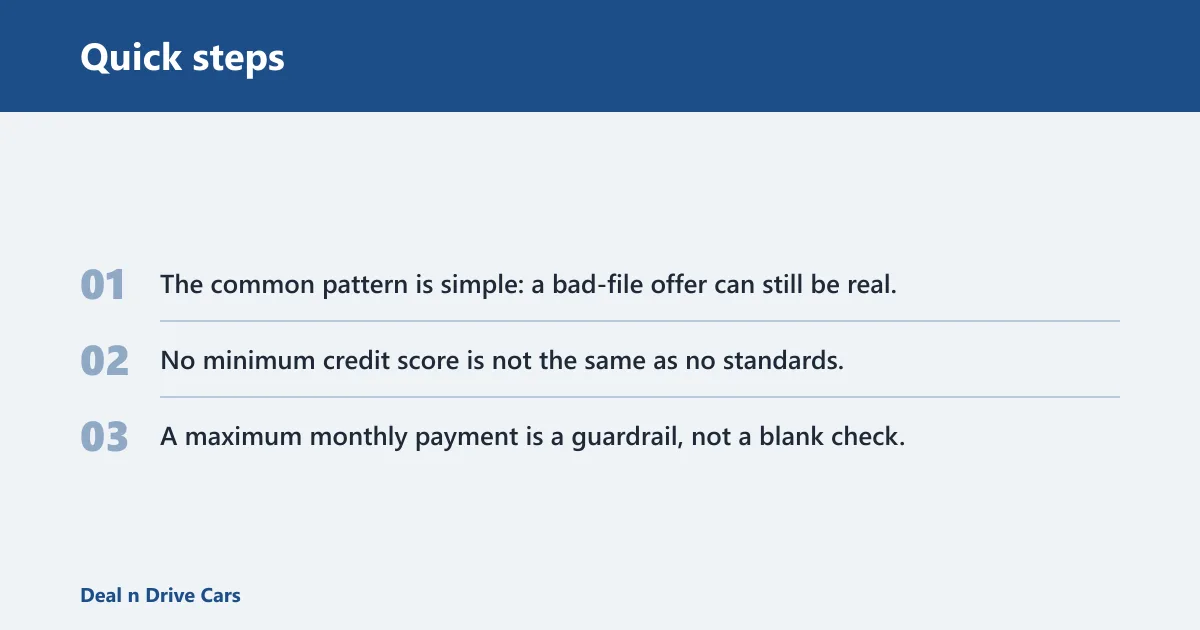
The common pattern is simple: a bad-file offer can still be real, but each “yes” comes with conditions. No minimum credit score is not the same as no standards. A maximum monthly payment is a guardrail, not a blank check.
What guaranteed approval actually means
“Guaranteed approval” is a marketing phrase, not a universal lending standard. In bad-credit auto finance, it usually points to a program with relaxed credit-score screening and a longer list of deal checks. Final approval can still change after the lender reviews income, identity, residence, and the vehicle.
Marketing claim versus underwriting
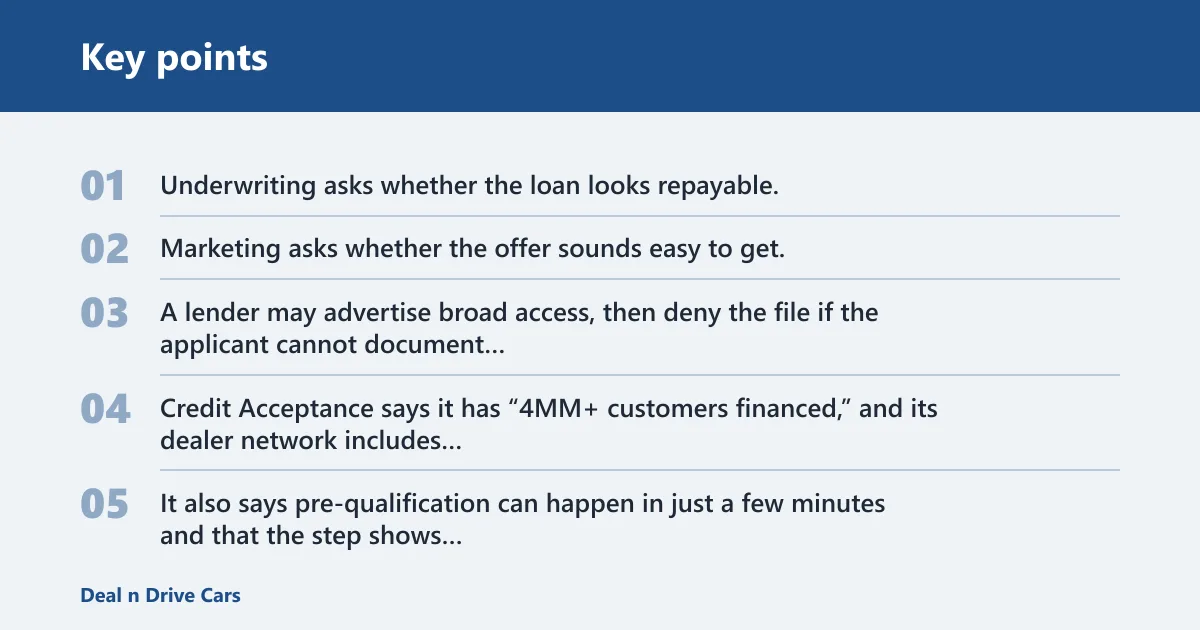
Underwriting asks whether the loan looks repayable. Marketing asks whether the offer sounds easy to get. Those are not the same question. A lender may advertise broad access, then deny the file if the applicant cannot document income or if the requested payment exceeds the program limit.
Common program conditions
Credit Acceptance says it has “4MM+ customers financed,” and its dealer network includes dealers in all 50 states. It also says pre-qualification can happen in just a few minutes and that the step shows the maximum monthly payment. Those details matter because they show screening first, then full review.
Why final approval can still change
Final approval can change if documents do not match the application, the vehicle is outside program rules, or the payment cap and term do not fit the shopper’s budget. Say your pre-qualification points to about a $425 monthly ceiling, but the only approved vehicle may need a 72-month term and still come out to about $510 per month. That deal fails the math.
Can you really get approved with bad or no credit?
Yes, some programs may approve bad credit or no credit, but neither condition guarantees funding. Lenders still review whether the borrower can repay and whether the file meets program limits. Credit score is part of the picture, not the whole picture.
No credit score offers
Some programs advertise no minimum credit score. That means thin or absent credit history does not automatically block the application. It does not mean the lender ignores income, identity, or the vehicle’s price and age.
Low score applicants
Shoppers with damaged credit may still get considered if the rest of the file is stable. That includes steady income, a reachable monthly payment, and enough documentation to verify the person and address. A very low score can still bring a higher APR or a shorter term.
Other factors lenders still review
Debt load matters. So does residence stability. Existing auto debt can matter too. If the application shows a recent move, missing bank records, or a large payment already tied to another loan, approval odds can fall even if the score itself is not the main issue.
How pre-qualification differs from final approval
Pre-qualification is an early screening step. Final approval is the lender’s binding decision after verification. The first can happen quickly; the second depends on documents, the vehicle, and the completed contract. Treat them as related steps, not the same outcome.
Soft screening versus full application
Pre-qualification often uses limited information to estimate fit. A full application asks for proof. If income, residence, or identity cannot be verified, the lender can deny the file even after a promising pre-qualification result.
What a monthly payment cap means
A maximum monthly payment tells you the ceiling the program may allow. It is a budget guardrail, not a promise of the best rate. That ceiling shapes the vehicle price, term length, down payment, and sometimes the amount of negative equity the lender will tolerate.
Why the final contract can differ
The contract can change if the car is priced too high, the term must be shortened, or a required add-on raises the payment. Compare the pre-qualification number with the final retail installment contract line by line. If the payment jumps without a clear reason, stop and ask why.
Indirect auto financing and dealer networks
Indirect auto financing means the dealer submits your application to a finance company instead of lending the money directly. That setup is common in bad-credit lending because it opens access to a broader dealer network. Approval depends on participating dealers and the lender’s own program rules.
How dealer-arranged lending works
You pick a vehicle, the dealer sends the application, and the finance company reviews the deal. If approved, the lender funds the purchase through the dealer. That can be faster than shopping lender by lender, but it also means the dealer controls much of the process.
Why participating dealers matter
If the lender only works through participating dealers, your options depend on who is in that network. A larger dealer network can widen choices and reduce wait time. A smaller network can limit inventory, financing speed, and how many vehicles fit the program.
How network size affects speed and options
The same source says its network includes dealers in all 50 states, which can improve access for shoppers who need a broader search area. That does not mean every dealer or every car qualifies. It means there may be more approved places to start.
What can still qualify you?
Several hard-credit situations can still fit some programs, but the rest of the file has to work. Income type, bankruptcy chapter, repo timing, and payment capacity all matter. The question is less “Is there a problem?” and more “Can the rest of the application support the loan?”
Income types some programs may accept
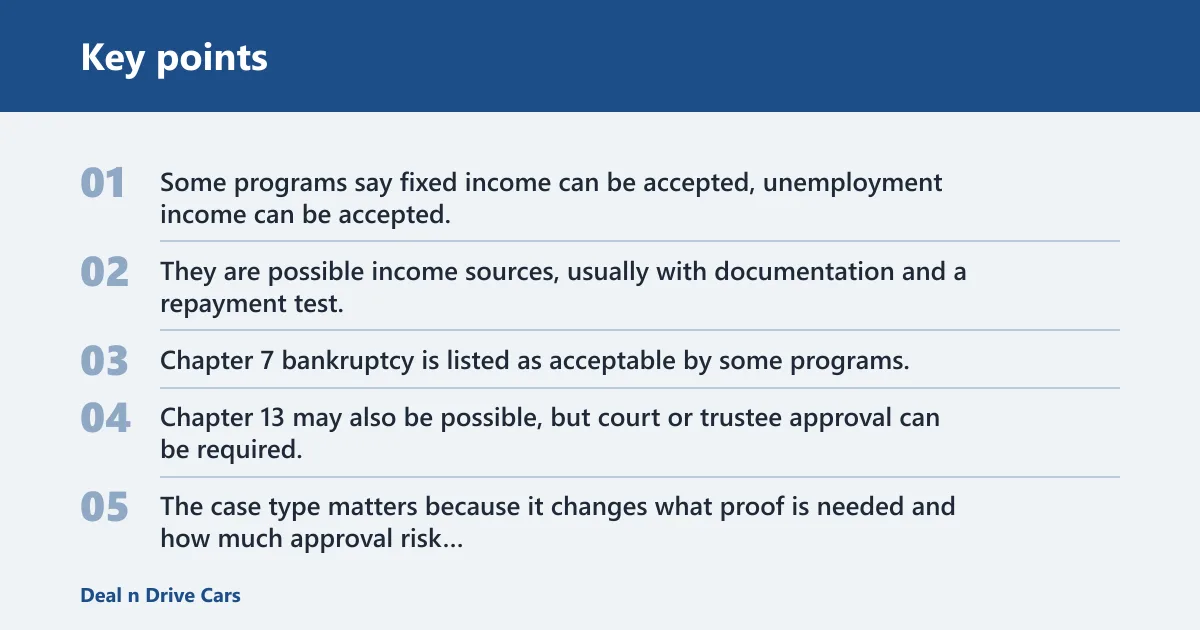
Some programs say fixed income can be accepted, unemployment income can be accepted, self-employed income can still qualify, and temporary income can be acceptable. Those are not automatic approvals. They are possible income sources, usually with documentation and a repayment test.
Bankruptcy cases that may still fit
Chapter 7 bankruptcy is listed as acceptable by some programs. Chapter 13 may also be possible, but court or trustee approval can be required. The case type matters because it changes what proof is needed and how much approval risk remains.
Repo history and timing
Multiple repossessions can still be considered, and multiple open auto loans can still be considered by some programs. A recent repo usually hurts more than an older one because it suggests a more current repayment problem. The repo does not always end the search, but it can tighten terms.
Suppose a shopper has one repo from about four years ago and stable W-2 income now. That file may be easier to place than a shopper with two repos in roughly the past 18 months and little or no current savings. The history is the same category, but the timing changes the risk.
When approval is still unlikely
Approval is still unlikely when the file has too little income, unstable housing, too much existing debt, or missing documents. Even a relaxed bad-credit program needs proof that the payment is realistic. If the file cannot support the loan on paper, the dealer cannot force the lender to accept it.
Ask direct questions before you submit anything. A real offer should survive basic scrutiny on payment, documentation, and terms. Vague ads, rushed signatures, and unexplained fees are warning signs, not conveniences.
- Ask whether the offer is pre-qualification or final approval.
- Ask which income types the program accepts.
- Ask what documents are required for identity, residence, and income.
- Ask whether bankruptcy, repo history, or open auto loans change the rate or term.
- Ask whether there is a maximum monthly payment and how it affects vehicle price.
- Review the full contract before you sign anything.
Red flags in the contract
Watch for add-on fees you did not ask for, payment packing, and pressure to sign fast. Payment packing means the monthly number is inflated by products or charges that are not clearly explained. If the dealer will not itemize the deal, walk away.
Why comparing offers still matters
Even in bad-credit lending, terms can vary a lot. One dealer may have a workable payment cap and another may not. Compare APR, term length, total of payments, and required down payment before you choose. A fast yes is not the same as a good deal.
Frequently asked questions
What does guaranteed approval actually mean on a car loan?
It usually means the program is willing to review files that many lenders reject. The ad may be built around softer credit screening, but final approval still depends on proof of repayment ability and the vehicle meeting program rules.
Is a no credit score auto loan the same as guaranteed approval?
No. No minimum credit score means score alone will not decide the file. Guaranteed approval, if used at all, is broader marketing language. A lender can still deny the application if income, residency, or paperwork do not fit.
What should I watch out for in a guaranteed approval car offer?
Watch for vague promises, add-on fees, payment packing, and pressure to sign quickly. Also check whether the quote is only a pre-qualification and whether the final payment cap is different. Ask for every term in writing before you agree.
Do guaranteed approval lenders check income, employment, or repossessions?
Yes, they often do. Some programs accept fixed income, unemployment income, self-employed income, or temporary income, but they still review whether the payment is affordable. Repo history can still be considered, and recent repos may raise the risk or cost.
Can bankruptcy or multiple repossessions still qualify you?
Sometimes. Chapter 7 may be acceptable in some programs, and Chapter 13 may be possible with court or trustee approval. Multiple repossessions can also be considered, but the file usually needs stronger income, cleaner documentation, and a realistic payment.
How is pre-qualification different from final approval?
Pre-qualification is an early screen that can happen in just a few minutes and may show a maximum monthly payment. Final approval comes after full verification and contract review. The numbers can change, and the lender can still say no.