How Do I Sell My Car Privately for Free?
Sell your car privately for free by getting it ready at no cost, pricing it well, and listing it on commonly used free channels like Facebook Marketplace and Craigslist. Skip paid extras and you avoid fees, stale ads, and rushed compromises that cut into your sale price. This guide shows the no-cost prep steps, free listing options, and the hidden costs to avoid later.
This guide is part of our How to sell a car privately series.
What you’ll need
- The vehicle title, or the steps to request a replacement title if it is lost
- A lien payoff letter from the lender if the car still has a loan (Caranddriver)
- Current odometer reading, photographed clearly
- Basic service and maintenance records
- Your phone camera
- Cleaning supplies for the interior and exterior
- A free account for at least one listing channel
- A quiet place to meet buyers and review documents
- Find the title before you list the car, and confirm the name matches the seller.
- Check whether a lien still exists, then request payoff documentation from the bank if needed.
- Gather maintenance and repair records that show the car was taken care of.
- Clean the car inside and out, remove personal items, and clear expired registration stickers from the photos.
- Photograph the exterior, interior, blemishes, rust, and the current odometer reading.
- Check free valuation sources, then compare similar local listings to set your asking price.
- Write a short honest ad, post it on free channels, and respond to buyers with clear meeting rules.
- When you get serious interest, prepare the title-transfer paperwork and payment steps before the test drive.
Car privately table
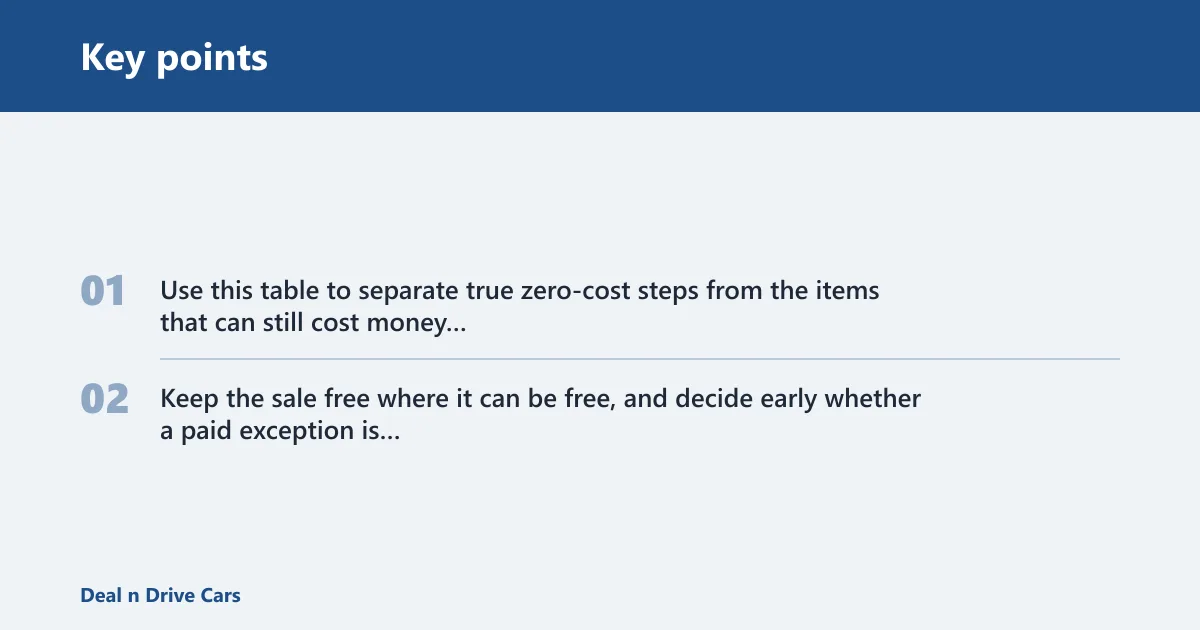
Use this table to separate true zero-cost steps from the items that can still cost money later. Keep the sale free where it can be free, and decide early whether a paid exception is worth it.
| Step | Typical cost | Likely paid exception | Skip or pay? |
|---|---|---|---|
| Check free valuation sources | $0 | Paid appraisal or paid pricing tool | Skip paid tools unless free checks disagree widely |
| Compare local listings | $0 | Sponsored listings or dealer valuation reports | Skip paid reports if nearby comps are easy to find |
| Find the title | $0 | Replacement title if the original is lost | Pay only if the title cannot be found |
| Request a lien payoff letter | $0 | Loan payoff amount, if money is still owed | Pay off the loan before private sale if required |
| Clean the car | $0 if self-cleaned | Professional detailing | Skip detailing unless odors or stains need outside help |
| Take photos | $0 | Paid photographer | Skip paid photography if your phone camera is clear |
| Run a vehicle-history report | Free or paid depending on source | Paid report from some providers | Pay if the free report is incomplete or unavailable |
| List the car | $0 on free channels | Boosted ads or paid marketplaces | Skip paid promotion unless free reach is weak |
| Transfer ownership | Varies by jurisdiction | Title replacement, transfer fee, or required inspection | Pay only what your local process requires |
How do you price your car for free?
Start with free valuation checks, then compare similar cars for sale near you and set an asking price above the least you will accept. Private sales can net greater financial gain than selling to a dealer, and dealer offers often undercut a car’s actual value by thousands of dollars.
Use free sources first
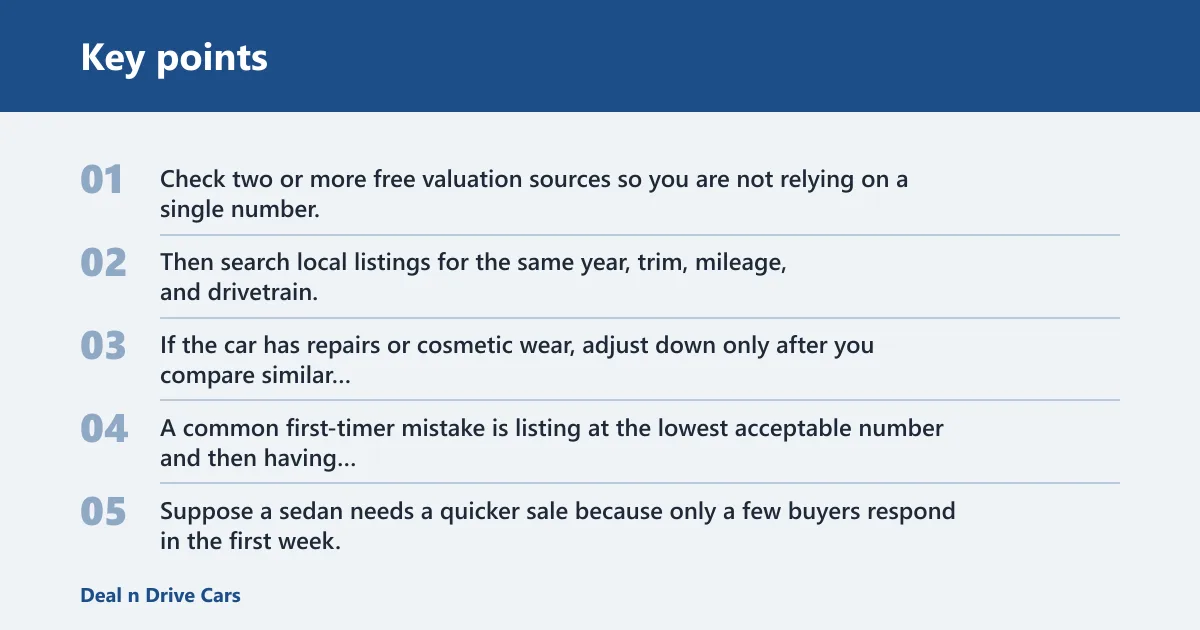
Check two or more free valuation sources so you are not relying on a single number. Then search local listings for the same year, trim, mileage, and drivetrain. If the car has repairs or cosmetic wear, adjust down only after you compare similar vehicles with the same issues.
Set the asking price with room to negotiate. A common first-timer mistake is listing at the lowest acceptable number and then having nowhere to move. Suppose a sedan needs a quicker sale because only a few buyers respond in the first week; a modest price drop is easier than relisting from scratch.
Adjust without restarting the sale
If interest is low after several days, reduce the asking price in a clear increment and recheck buyer response. A practical adjustment is about $100 per reduction for lower-priced cars, then about $200 or $250 for pricier vehicles, followed by another round of messages and views. Keep the ad honest so the next buyer does not waste time.
Where can I sell my car privately for free?
You can sell privately for free through free listing channels that match your buyer reach, such as Facebook Marketplace, Craigslist, and local community groups. The best choice is the one that brings real buyers without charging a posting fee or forcing you into paid promotion.
Choose channels by reach and cost
Use one or more services, but keep the first post simple. Facebook Marketplace can reach nearby buyers fast. Craigslist can work well for local searches. Community groups can help if the car is older, inexpensive, or likely to interest someone in your area.
Write an honest description with the year, make, model, trim, mileage, title status, known flaws, and whether the car has a lien history. Do not hide problems in vague language. Clear facts attract serious buyers and cut down on unsafe back-and-forth.
What do you need to sell privately?
You need the title, a way to prove lien status if one exists, the current odometer reading, and the paperwork your jurisdiction requires to transfer ownership. Maintenance records help, but they are not always mandatory. A vehicle-history report can help buyers, yet it may be free or paid depending on source.
Must-have documents
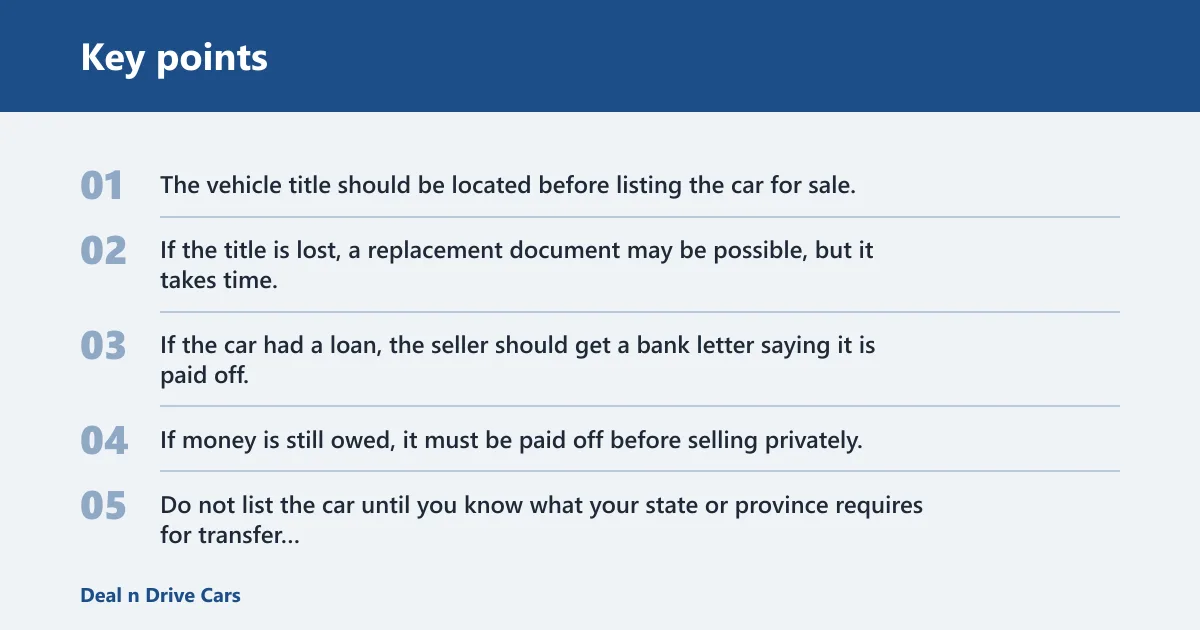
The vehicle title should be located before listing the car for sale. If the title is lost, a replacement document may be possible, but it takes time. If the car had a loan, the seller should get a bank letter saying it is paid off. If money is still owed, it must be paid off before selling privately.
Do not list the car until you know what your state or province requires for transfer timing and signatures. Some places may want a notarized title, some may want a bill of sale, and some may require odometer disclosure. Those steps are local, so check the transfer process before meeting a buyer.
Helpful extras
Maintenance and repair records help show the car was taken care of. A vehicle-history report can show how many owners the car has had and whether it has been in accidents or damage incidents. That report can be free or paid depending on the source, so treat it as useful, not mandatory in every sale.
Clean the car and take strong photos
Clean the car inside and out before listing it. Remove personal items, expired registrations, and anything that distracts from the sale. Clear photos reduce message clutter and make buyers more likely to ask informed questions instead of guessing about condition.
What photos should you include?
Take all angles of the exterior, enough of the interior to reveal condition, close-ups of blemishes or rust, and a clear photo of the current odometer reading. The odometer shot helps verify mileage and should be current. If the tires, windshield, or seats have visible wear, include those too.
Picture a hatchback parked in daylight with one rear-quarter panel showing a scratch. That is better than hiding the scratch, because the buyer will see it at the meetup anyway. Honest photos reduce wasted trips and protect your price by setting the right expectation.
If odors are strong or the upholstery needs deep treatment, professional detailing is optional and can cost money. Start with self-cleaning first. A vacuum, microfiber cloths, and basic soap are free or low-cost compared with a full detailing bill.
Handle lien payoff and transfer paperwork
If the car still has a loan, the lender usually supplies the payoff letter. That letter should show the loan is paid off or state the exact payoff amount and steps to clear the lien. A financed car cannot usually be sold privately cleanly until the lien is handled.
Transfer steps to prepare early
Before a buyer arrives, check what your title transfer process requires: title signatures, buyer and seller names, odometer disclosure, bill of sale, and any release form for the lien. Keep the paperwork together so the sale does not stall after the test drive.
A common first-timer mistake is assuming the lender will sort out everything after the sale. Do not count on that. Get the payoff letter first, then confirm whether the title can be signed over directly or whether the lender must release it before transfer.
Common mistakes
Most costly problems come from skipping paperwork, not from the ad itself. Listing before checking the title or lien status can create delays. Overpaying for repairs that will not change buyer interest can also burn cash. Unsafe meetups and payment mistakes can turn a private sale into a loss.
- Listing before you find the title: stop and sort the title first, or request a replacement title if needed.
- Ignoring a loan balance: get the payoff letter and clear the lien before transfer.
- Paying for cosmetic work that does not move price: fix only what affects safety, drivability, or buyer confidence.
- Using weak photos: include the odometer, full exterior, interior, and flaws.
- Meeting somewhere risky: choose daylight, a public place, and bring someone with you if possible.
- Accepting unsafe payment: confirm funds before handing over the title or keys.
Keep the car insured and the title paperwork ready until the transfer is complete. That lowers the chance of a last-minute delay if the buyer wants to finalize quickly.
Frequently asked questions
What paperwork do I need to sell my car to a private party?
Have the title ready first, then confirm whether your area requires a bill of sale, an odometer disclosure, or a notarized signature. If there was a loan, include the lender’s payoff or lien-release letter. Keep copies for your records before you hand over the car.
Can I sell my car privately?
Yes, if you can transfer the title properly and meet any lien or local paperwork requirements. Private sales usually pay more than dealer trade-ins, but only when the paperwork is clean and the buyer can verify condition. Do not advertise before you know the title status.
What if I still owe money on my car?
Get the lender’s payoff letter before listing, then pay off the loan or follow the lender’s release process. If money is still owed, it must be paid off before selling privately in the usual case. Once the lien is cleared, complete the title transfer only after funds are confirmed.