Dealer Test Drive vs Private Seller Test Drive Differences
Dealer test drives are often shorter, more controlled, and better documented, while private-seller drives may give you more freedom but also more risk; for both, bring a valid driver’s license, have proof of insurance ready, and allow about 20 minutes. Skip those checks and you can miss hidden faults, lose bargaining power, or put yourself at risk during the drive. This guide compares safety, logistics, documents, and bargaining power so you can adjust your approach to each seller type.
| Factor | Dealer test drive | private seller test drive | Winner |
|---|---|---|---|
| Safety | Usually at a staffed location with business-hours traffic, camera coverage, and set procedures. | Depends on the meeting place and how much verification the seller is willing to do. | Dealer test drive |
| Documents | The dealer often handles plate, insurance, and paperwork checks at the desk. | You may need to review the title, registration, insurance proof, and bill of sale terms yourself. | Dealer test drive |
| Who rides along | A salesperson often rides along, and solo drives may be limited or denied. | The seller may ride along, or you may get a solo drive if the seller is comfortable with it. | Tie |
| Route flexibility | Often limited to a short loop, with some dealers allowing an extended off-lot route after approval. | Usually more flexible if the seller agrees, including parking lots, city streets, and highway access. | private seller test drive |
| Insurance responsibility | May be covered by dealer plate or dealer insurance, but buyer insurance and permission still matter. | You more often need proof of your own coverage or clear permission from your insurer. | Dealer test drive |
| Negotiation leverage | Pressure can rise because add-ons, financing, and trade-in talk can start right after the drive. | Less formal pressure, but the seller can still use urgency or other buyers as bargaining power. | private seller test drive |
| Walk-away triggers | Refusal to explain route, documents, or warning lights; pushy add-on talk can also matter. | No title, no insurance proof, no clear permission, or resistance to inspection and route planning. | Tie |
Dealer vs private seller: the core trade-off
Dealerships usually control the process and paperwork. Private sellers usually shift more verification and safety work to you. That changes everything: where you meet, who rides along, what documents you can inspect, and how much freedom you get on the route.
Control and convenience at a dealership
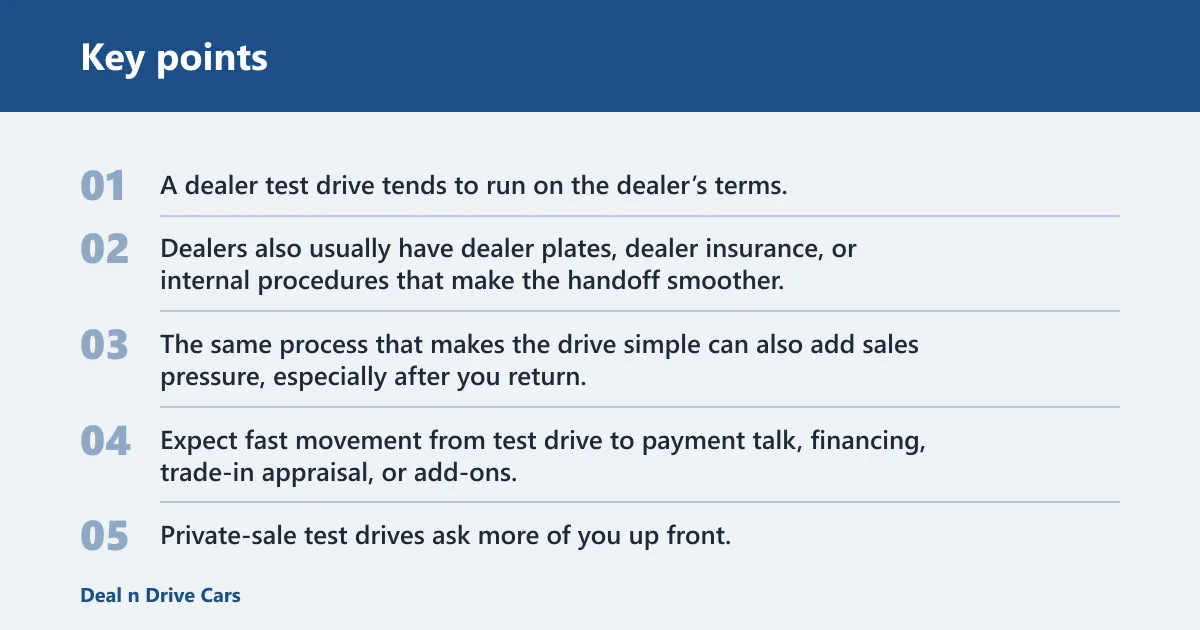
A dealer test drive tends to run on the dealer’s terms. Staff may ask for a valid, unexpired driver’s license, may check a second photo ID, and may keep the route short unless you ask for more time. Dealers also usually have dealer plates, dealer insurance, or internal procedures that make the handoff smoother.
That convenience cuts both ways. The same process that makes the drive simple can also add sales pressure, especially after you return. Expect fast movement from test drive to payment talk, financing, trade-in appraisal, or add-ons.
Buyer responsibility with a private seller
Private-sale test drives ask more of you up front. You should verify the seller’s identity, inspect the registration and title, and confirm that the car appears insured and legal to drive. Meet in a public place, in daylight, and choose a location that is easy to leave.
The upside is control. A private seller may let you pick the route, spend more time on parking and low-speed maneuvers, and compare the car without a sales desk waiting at the end.
Dealer vs private seller test drive: what changes?
The biggest change is not the car. It is the amount of control you have over the drive and the amount of verification you must do yourself. Dealers usually keep the process structured; private sellers usually make you prove the paperwork before you go anywhere.
Safety and meeting setup
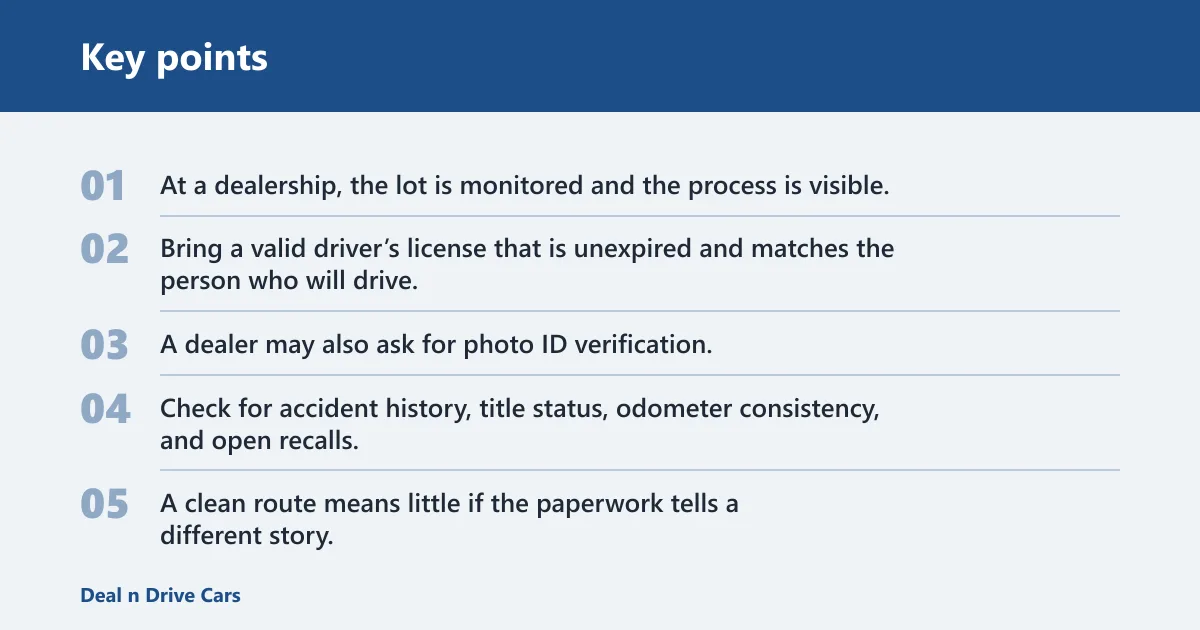
At a dealership, the lot is monitored and the process is visible. That lowers some physical risk, but it does not remove pressure or the chance of rushed decisions. At a private meeting, safety depends more on where you meet, whether someone else knows your plans, and whether the seller is willing to verify documents before the keys come out.
Documents and insurance
Bring a valid driver’s license that is unexpired and matches the person who will drive. A dealer may also ask for photo ID verification. For a private seller, ask about insurance proof before you turn the wheel, because some insurers require permission to drive another vehicle and some buyers rely on their own policy for temporary coverage.
Vehicle history still matters in both cases. Check for accident history, title status, odometer consistency, and open recalls. A clean route means little if the paperwork tells a different story.
Who rides along and route freedom
Dealer drives often include a salesperson in the passenger seat. Some dealers allow a solo drive, but many do not. Private sellers may ride along, but some will let you drive alone after they have seen your license and insurance proof.
Route freedom matters because the car can hide problems at different speeds. City traffic shows throttle response and brake feel. Highway merging shows acceleration and stability. Parking and tight turns expose steering effort, low-speed clunks, and camera or sensor behavior.
Bargaining power and walk-away triggers
Dealers often turn the return trip into a sales moment. That can help if the car is strong and you want competing offers, but it can also push you toward add-ons you did not ask for. Private sellers usually have less scripted pressure, yet price flexibility can still appear if you point to a real problem or a missing document.
Walk away if the seller will not show the title, will not allow a basic route, or will not answer direct questions about warning lights, recalls, or prior damage. If the process feels narrow or evasive, the car probably deserves the same treatment.
What should you bring before the drive?
You should bring your license, a second photo ID if requested, proof of insurance if you have it, and a short inspection list. For a private seller, payment basics matter too: enough cash to discuss a deposit if needed, but never hand over money just to “hold” a car without written terms.
-
Bring your license.
Carry a valid, unexpired driver’s license, and make sure the name and photo match the person who will actually drive. A dealer may scan or copy it, and a private seller may want to see it before handing over the keys.
-
Carry insurance proof.
Have your auto insurance card or policy details ready, and confirm that your coverage permits you to drive another vehicle if that applies. If you are unsure, call your insurer before the appointment, because some policies handle temporary use differently.
-
Pack a quick checklist.
Use notes for lights, tires, brakes, steering, warning lights, recalls, and title details. A phone charger helps if you need navigation or a video call to confirm paperwork. Keep payment basics separate from the test drive itself.
Is a dealer test drive safer than a private seller test drive?
Not automatically. A dealer test drive is usually more supervised and better documented, which can lower some risks. A private seller test drive can be safe too, but only if you control the meeting place, verify identity and paperwork, and refuse any drive that skips the basics.
Dealership policies, dealer plates, and accompaniment rules
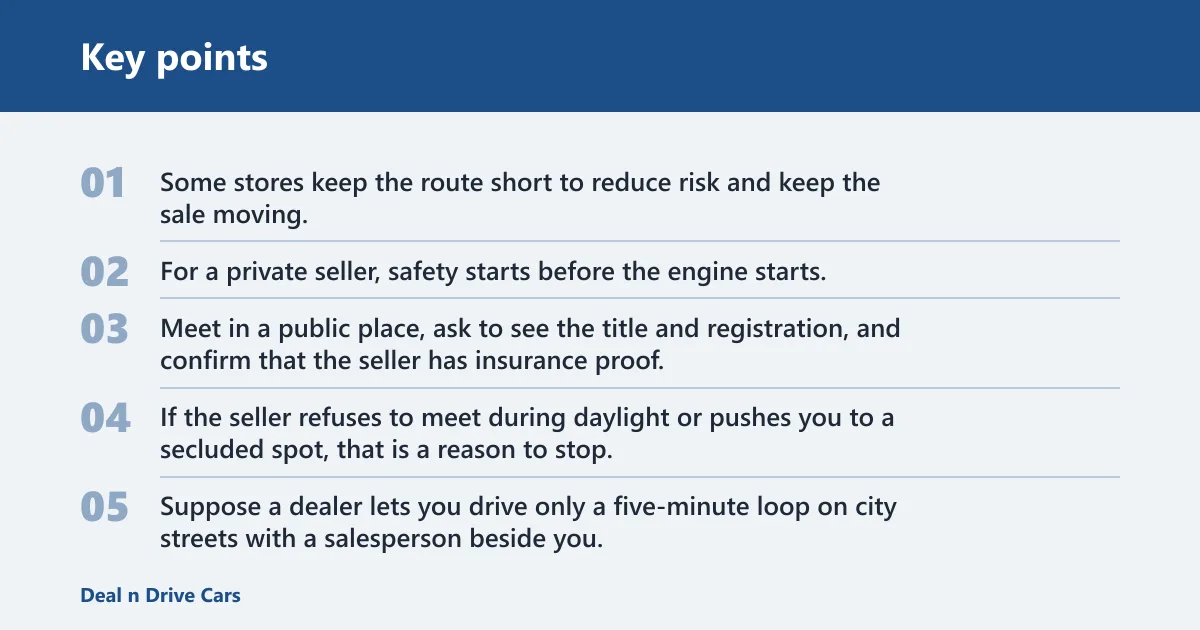
Dealers often use dealer plates or dealer insurance procedures, and they typically want to see your license before anyone moves the car. That structure helps, but it also means the dealer can limit distance, speed, or solo driving. Some stores keep the route short to reduce risk and keep the sale moving.
Private-party meeting safety and verification checks
For a private seller, safety starts before the engine starts. Meet in a public place, ask to see the title and registration, and confirm that the seller has insurance proof. If the seller refuses to meet during daylight or pushes you to a secluded spot, that is a reason to stop.
When “safer” depends on paperwork and visibility
Suppose a dealer lets you drive only a five-minute loop on city streets with a salesperson beside you. That may feel controlled, but it still hides highway behavior. Suppose a private seller agrees to a daylight meeting, shows the title, and lets you take a 20-minute route with a highway merge. That can be the better setup, even without a showroom.
How should the route differ?
Use the same car through different conditions, not the same route for every seller. City streets, stop-and-go traffic, highway merging, parking, and low-speed maneuvers reveal different faults. A short loop is useful only if it includes more than one speed range.
City streets, stop-and-go traffic, and parking
In slow traffic, listen for brake noise, vibration, clunks, and steering looseness. Try a few tight turns and one or two parking maneuvers. That is where worn suspension parts, rough low-speed transmission behavior, or bad sensors often show up first.
Highway merge, cruising, and passing behavior
If possible, include a highway on-ramp and a short cruise at steady speed. You want to see how the car pulls under load, whether the transmission hesitates, and whether the steering tracks straight. A car that feels fine in a lot can feel very different at 55 or 65 mph.
What to listen for at low speed
Low speed is where you catch brake squeal, a loose steering feel, delayed gear changes, and dashboard alerts that may flash only after the car has moved. Modern driver-assist warnings and digital dash messages matter here too. Do not ignore a lane-keeping or sensor warning just because the engine sounds normal.
What warning signs should end the drive?
Stop the drive if you hear brake grinding, feel vibration through the pedal, notice the car pulling to one side, or see overheating or warning lights that stay on. You should also walk away if the odometer, title, or recall information does not line up with the seller’s story.
Brake noise, vibration, or pulling
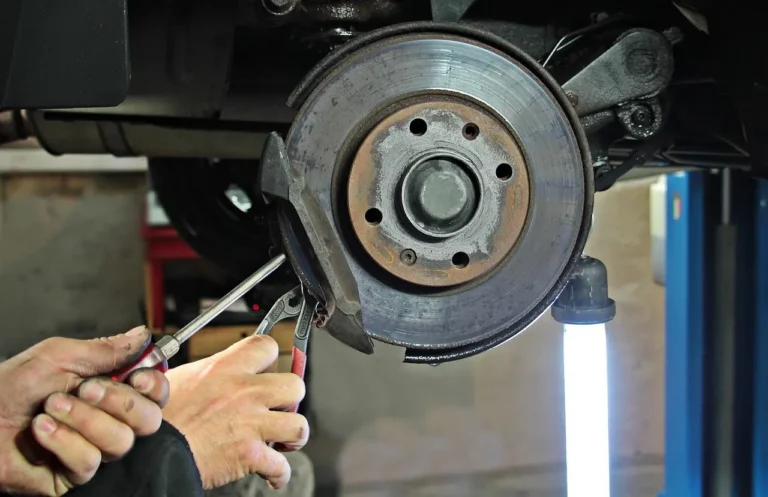
A sharp squeal can be less serious than grinding, but repeated noise still needs an explanation. Vibration under braking can point to warped rotors or other wear, and pulling can point to brake, tire, or suspension problems. If it is strong enough to distract from the drive, end it.
Steering looseness, transmission hesitation, or overheating
Loose steering or delayed shifting changes how the car behaves in traffic and on the highway. Overheating is a hard stop. A warning light that appears during the drive, even briefly, should be written down before the seller can dismiss it.
Picture a sedan that merges cleanly at 20 mph but hesitates twice when shifting from second to third at a steady 35 mph. That is useful information. It means the route exposed a fault that a parking-lot circle would have missed.
Warning lights, recall notices, or inconsistent odometer readings
Check the dashboard before and after the drive, and compare the mileage with the title and history report. Open recalls are not the same as immediate failure, but they matter because they affect what you are buying and what must be fixed later. If the numbers do not match, do not guess your way through the sale.
Choose Dealer test drive if… / Choose private seller test drive if…
Choose Dealer test drive if you want a controlled process, visible paperwork handling, and a route that starts and ends inside a staffed business. Choose private seller test drive if you want more route freedom, more room to negotiate on the spot, and you are ready to verify the title, insurance, and identity yourself.
- Choose Dealer test drive if… you want the seller to manage plate, paperwork, and most of the handoff.
- Choose Dealer test drive if… you expect a shorter route and can tolerate sales pressure after the drive.
- Choose private seller test drive if… you want a longer route with city, highway, and parking checks.
- Choose private seller test drive if… you are comfortable stopping the deal when the title, insurance, or permission story is weak.
Post-drive paperwork and negotiation
After the drive, the paperwork path changes as much as the route did. Dealers may move quickly into financing and add-ons. Private sellers usually focus on price, title transfer, bill of sale, and odometer disclosure, with less room for bundled extras and more room for direct negotiation.
Ask about as-is language before money changes hands. For a private sale, make sure the bill of sale and title transfer match the car, the mileage, and the agreed price. At a dealer, read the add-on menu as carefully as you read the car’s dash warnings.
-
Review the paperwork first.
Check the title, registration, odometer disclosure, and any as-is wording before discussing price. If the seller cannot explain the documents clearly, the deal is not ready.
-
Use drive findings.
Point to specific issues from the route, such as brake vibration, a transmission delay, or a warning light. Specifics carry more weight than a vague complaint, and they help you negotiate with facts.
-
Do not rush the close.
Dealer add-ons can raise the final number fast, and private sellers may push for a quick deposit. Take time to read the terms, then decide whether the car still fits the risk you found.
Frequently asked questions
What should I bring to a private seller test drive?
Bring a valid, unexpired driver’s license, proof of insurance if you have it, a second photo ID if the seller asks for one, and a short checklist for lights, tires, brakes, steering, and warning lights. For a private sale, also be ready to review the title and registration before driving.
Can I drive a car alone at a dealership?
Sometimes, but not always. Many dealers want a salesperson to ride along, and some only allow a solo drive after they verify your license and confirm their own route rules. Do not assume a solo drive is available until the staff says so clearly.
Should I inspect the car differently at a dealer vs private seller?
Yes. At a dealer, focus on whether the car’s condition matches the listing and whether any add-on pressure appears after the drive. At a private sale, put more weight on title, registration, insurance proof, and whether the seller is willing to answer direct questions before you move the car.
How long should a test drive be when buying used?
Plan at least 20 minutes if possible. That is long enough to cover stop-and-go traffic, a stretch of steady speed, a parking maneuver, and a few low-speed turns. Shorter drives can miss transmission hesitation, brake issues, and warning lights that only appear after the car warms up.
What documents or insurance do I need for a test drive?
Bring a valid driver’s license and proof of insurance, and confirm that your policy allows you to drive another vehicle if that matters. Dealers may also ask for photo ID. For private sellers, ask for title and registration review before driving, and do not skip that step.
What route should I use for a dealer test drive versus a private seller test drive?
Use the same test goals in both settings, but expect a dealer to limit the route more often. Include city streets, stop-and-go traffic, highway merging, steady cruising, parking, and low-speed maneuvers if the seller allows it. If the route is short, use every minute to cover more than one condition.
What red flags should I watch for during a private seller test drive?
Watch for refusal to show the title, no insurance proof, a request for cash before paperwork, a blocked route, or evasive answers about warning lights and recalls. Also treat brake noise, steering looseness, transmission hesitation, overheating, and mismatched odometer readings as reasons to stop the deal.