What Does No Title Mean When a Private Seller Lists a Car?
“No title” usually means the seller cannot show the current legal ownership document, so you should only proceed if they can get a DMV replacement or prove a lawful transfer path; otherwise, the car may be impossible to register in your name. Ignore that, and you can pay for a car you cannot title, insure, or legally drive. This guide explains the difference between a lost title, an untransferable title, and a deal you should walk away from.
What “no title” usually means
In a private sale, “no title” usually means one of three things: the title was lost, damaged, or stolen; a lender still has a lien on the car; or the seller never had a transferable ownership document in the first place. Those are different problems, and only one is usually fixable without major delay.
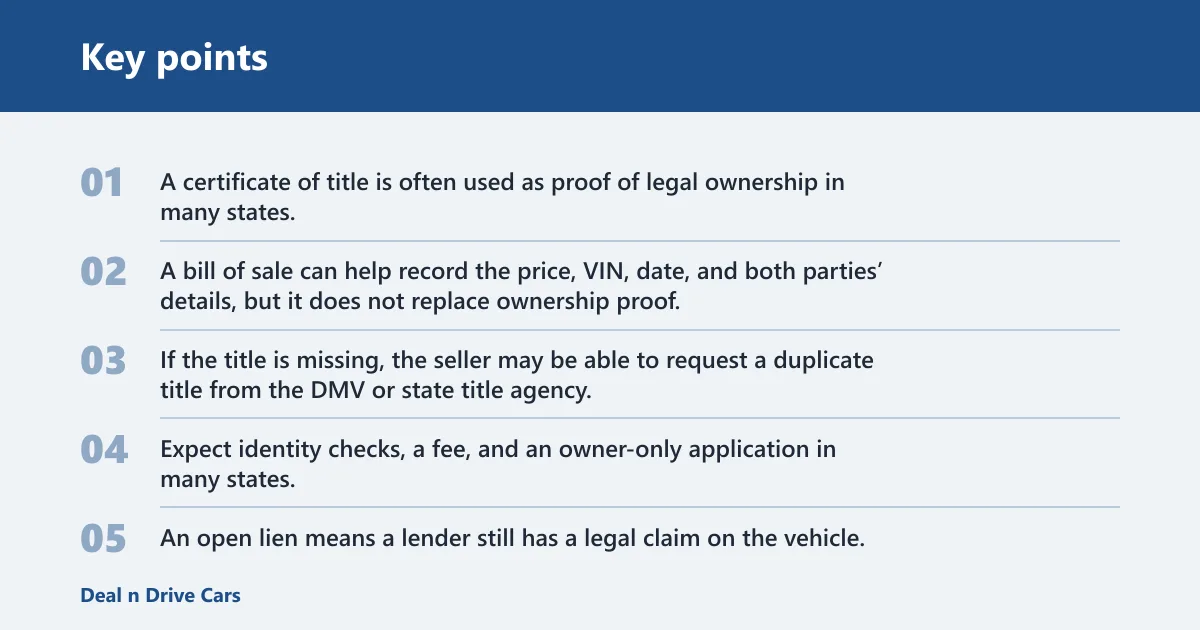
A certificate of title is often used as proof of legal ownership in many states. In a private sale, the seller name usually must match the title, or the seller must have a state-approved way to transfer it. A bill of sale can help record the price, VIN, date, and both parties’ details, but it does not replace ownership proof.
Lost, damaged, or stolen title
If the title is missing, the seller may be able to request a duplicate title from the DMV or state title agency. That is the standard fix when the original was lost, damaged, or stolen. Expect identity checks, a fee, and an owner-only application in many states.
Open lien or unpaid loan
An open lien means a lender still has a legal claim on the vehicle. An open lien usually needs to be released before transfer, since it can block title transfer until the lender signs off. If the seller says the title is “with the bank,” that is only workable if the lender can issue a release quickly.
Seller never had transferable ownership
Some sellers never received a title in their name, bought the car from a family member without completing the transfer, or are trying to sell a car that was abandoned, inherited, or otherwise tangled in ownership records. In those cases, the issue is not a missing paper. It is a missing legal path.
Can this no-title car be titled?

Yes, sometimes. The key question is whether the seller can still prove ownership or use a state-specific remedy to create a legal path to transfer. If the missing title is just lost, a duplicate title may solve it. If a lien is still open, the lender must usually release it first. If ownership is incomplete, a bonded title or estate paperwork may be required.
Lost title with no lien
This is the easiest version of the problem. The registered owner may be able to file for a duplicate title, then sign it over to you. You should not pay as if the deal is done until the DMV confirms the replacement process and the seller is the person allowed to request it.
Lien still open
An open lien is a major warning sign because the seller may not have the right to transfer the car yet. The lender usually needs to issue a lien release letter or send the title after the loan is paid off. If the seller cannot show how the lien will be cleared, the car may be unbuyable for you.
Inherited or estate vehicle
Inherited cars often need probate documents, a death certificate, a small-estate affidavit, or other estate records before the DMV will accept the transfer. The right path depends on state law and on whether the deceased owner’s name still appears in the records. If the seller cannot document authority to sell, stop there.
Salvage or rebuilt vehicle
A salvage title means the car was branded after major damage or an insurance total loss. That brand can affect insurability, resale, and the documents needed for registration. Some states also require inspection before a rebuilt title can be issued, and a seller’s verbal explanation is not enough.
Out-of-state title or seller-name mismatch
An out-of-state title problem can be fixable, but only if the paperwork chain is clean. If the seller’s name does not match the title, or the title is from another state and was never properly transferred, you may need a correction, reassignment, or DMV title search. If the names do not line up and the seller cannot explain why, walk away.
Can title records prove ownership?
Title records can help prove whether a transfer path exists, but they do not always prove that the seller has the right to sell right now. A DMV title search can confirm title status, show a lien in many cases, and tell you whether a duplicate title may be possible. It cannot fix missing signatures, incomplete estate authority, or a bad seller story.
VIN check and title search
Start with the VIN. It is a 17-character vehicle identifier that should match the car, the paperwork, and any plate or sticker location used by your state. Use that VIN to check title status and history, because a mismatch can mean clerical error, swapped paperwork, or a stolen-car problem.
Suppose the windshield VIN and the title both match, but the door-jamb sticker is missing and the seller says the car was “repaired a while back.” That is not enough by itself, but it does tell you to slow down and verify the records before money changes hands.
What a DMV record can and cannot confirm
A DMV record can often confirm who is listed as the legal owner, whether a lien is shown, and whether a duplicate title might be issued. It usually cannot prove the seller has physical possession of the car, whether a signature was forged, or whether a missing co-owner has legal objections. Treat it as a screening tool, not a final guarantee.
No-title car decision matrix
Use this table to triage the problem before you pay. The safest action depends on whether the missing title is a duplicate-title case, a lien issue, an estate issue, a salvage-brand issue, or a name mismatch. If the document path is not clear, the deal is not ready.
| Situation | Safest buyer action | Required document | Likely DMV path | Walk-away trigger |
|---|---|---|---|---|
| Lost title | Wait for the seller to obtain a duplicate title before paying in full | Duplicate title application and seller ID | Owner requests replacement title from DMV or state title agency | Seller refuses to apply or cannot prove identity |
| Lien still open | Only proceed if the lender can issue a release tied to the VIN | Lien release letter or lender payoff proof | DMV records lien release, then title can transfer | No release date, no lender contact, or payment demanded before release |
| Inherited car | Ask for estate authority before discussing sale terms | Probate papers, small-estate affidavit, or death certificate as required | DMV processes transfer through estate or successor paperwork | Seller cannot show authority to sell the deceased owner’s car |
| Salvage vehicle | Check branding and inspection rules before offering money | Salvage or rebuilt title and any required inspection report | State inspection and branded-title transfer or rebuilt-title process | Seller hides the brand or says “it’s just a clean title now” |
| Out-of-state title | Verify whether the title can be transferred in your state | Original out-of-state title and assignment sections | DMV title search and interstate transfer processing | Seller cannot explain a missing chain of ownership |
| Seller-name mismatch | Pause until the name mismatch is explained with records | Proof of legal name change or assignment documents | DMV review of correction, reassignment, or title history | Name on title, ID, and bill of sale do not line up |
What paperwork should you ask for?
Ask for every document that can show ownership, authority to sell, or a clear path to a replacement title. A bill of sale is useful, but it is not enough by itself. If the seller cannot produce the ownership paper or the DMV steps to get it, treat that as an unresolved legal problem.
-
Request the title status first. Ask whether the title is lost, tied to a lien, in probate, or already branded salvage. That answer determines whether the rest of the paperwork will help or just waste your time.
-
Ask for a duplicate title path. If the title is lost, request the completed duplicate title application or proof that the seller can file one. Many states require the registered owner to apply, and some require identity verification and a fee.
-
Collect lien release proof. If a lender still appears on the record, ask for a lien release letter or payoff documentation showing the lien will be cleared. Without that, the title may not transfer cleanly.
-
Keep the bill of sale. Make sure it includes the VIN, sale price, date, and both parties’ full names and addresses, as these details are commonly included. It records the transaction, but it does not replace a title or give you ownership on its own.
-
Ask for estate documents. If the car came from a deceased owner, get probate papers, a small-estate affidavit, or other documents your DMV accepts. If the seller cannot show legal authority, the sale is not ready.
A common first-timer mistake is accepting a handwritten promise that “the title will be mailed next week” without keeping the seller’s full name, phone number, VIN, and date in writing. If that promise later fails, those details are the evidence you need for a DMV follow-up or a dispute.
What should you do before paying?
Before paying, verify that the VIN on the car matches the paperwork, confirm that the seller can legally transfer title, and make sure the DMV path is realistic in your state. If the seller says the title will be mailed later, get written proof of exactly who will mail it, by when, and where it is coming from.
-
Match the VIN carefully. Compare the VIN on the dashboard, door-jamb sticker, and paperwork. A mismatch should stop the deal until the discrepancy is explained.
-
Check the seller’s ID. The name on the ID should line up with the title or the legal authority documents. If the names do not match, ask for the document that explains why.
-
Verify transfer eligibility. Ask the DMV or motor vehicle agency whether the seller can still obtain a duplicate title, clear a lien, or use a bonded-title route. Rules vary by state and county, so local confirmation matters.
-
Get written delivery terms. If the title will be mailed later, write down the exact date, the mailing address, and what happens if it never arrives. Keep copies of texts, emails, and the bill of sale together.
What happens if the title problem cannot be fixed?
If the ownership problem cannot be fixed through a duplicate title, lien release, estate document, or state title remedy, the safest answer is usually no. In some states, a bonded title may be possible when ownership evidence is incomplete, but it is not available everywhere and usually requires a surety bond and DMV review.
Bonded title path
A bonded title can create a path when the ownership record is incomplete but the car appears eligible for transfer. The bond protects against future ownership claims, and the DMV usually sets the bond amount and document requirements. If the state does not allow this route, the problem may have no practical fix.
State-specific DMV limits
Some states are strict about abandoned vehicles, salvage brands, and estate transfers. Others require an in-person inspection or a title search before any correction is accepted. If the DMV cannot tell you the exact path, that is a strong sign the seller should solve the problem first.
Walk-away triggers
Walk away if the seller will not provide ID, cannot explain the title gap, asks for payment before the lien is released, or has a name mismatch they cannot document. Also walk away if the VIN does not match, the car story changes, or the state refuses the only available transfer path. No title plus no legal fix means no safe deal.
Frequently asked questions
What does it mean when a private seller says they have no title?
It usually means the seller cannot show the current legal ownership document. That may be a lost title, an open lien, an inherited vehicle, or a transfer problem. The key is whether a DMV-approved path still exists, not whether the seller sounds convincing.
Can you buy a car without a title from a private seller?
Sometimes, but only if the seller can get a duplicate title, clear a lien, or complete another state-approved ownership path before you need to register the car. If there is no realistic fix, you may buy a vehicle you cannot title in your name.
Is it safe to buy a car with no title?
It is only as safe as the paperwork path behind it. A missing title can be a fixable clerical issue or a serious ownership problem. You should not pay until the VIN, seller identity, and DMV transfer route all line up.
Can a seller get a duplicate title before the sale?
Yes, in many states the registered owner can apply for a duplicate title if the original was lost, damaged, or stolen. The DMV may require identity verification and a fee. If the seller refuses to do that, the deal is not ready.
What paperwork do I need if a private seller has no title?
At minimum, ask for a bill of sale, seller ID, the VIN, and whatever document explains the missing title, such as a duplicate-title application, lien release, or estate paperwork. A bill of sale alone does not transfer ownership or fix the title gap.
Can I register a car if the seller has no title?
Usually not unless the DMV accepts a substitute path, such as a duplicate title, lien release, bonded title, or probate transfer. Registration depends on proving legal ownership, and that proof varies by state. If the ownership path is unclear, expect a registration problem.