What Used Car Sites Deliver Cars to Your Home?
Used-car sites that can deliver to your home include Carvana, CarMax, some CarGurus dealer listings, and many local dealer sites, but delivery depends on the specific seller and ZIP code. The strongest option shows a posted fee, a defined delivery radius, a written return window, and a clear handoff process. A weak policy can add surprise charges, long waits, or no easy way to unwind a bad purchase.
Home delivery at a glance
Home delivery is worth using when the seller shows the full policy before checkout. You want the delivery fee, service area, estimated arrival window, inspection steps, and return shipping responsibility in writing. If those details are missing, the buyer takes on avoidable risk.
Think in three buckets. Marketplace listings connect you to a dealer or private seller, so delivery terms vary by listing. Dealer websites may offer local delivery, trade-in pickup, and document signing at drop-off. Third-party shipping carriers are used when the car must move long distance, including out-of-state deals.
Buyer acceptance checklist: confirm the VIN, compare the odometer and listing photos, inspect for new damage in daylight, verify the title packet and temporary plates, read the return window and mileage cap, and keep every delivery note and signed page. If any item is missing, treat the delivery as incomplete until the seller fixes it in writing.
Red flags that should stop delivery acceptance: a VIN mismatch, missing title or payoff paperwork, warning lights that were not disclosed, fresh transport damage, a seller who refuses a written return policy, a fee that appears only at delivery, or a handoff that does not allow a walkaround before you sign.
Home delivery comparison table
| Site or seller type | Delivery fee | Delivery radius | Return window | Inspection at drop-off | Who pays return shipping | Financing availability | Vehicle history access |
|---|---|---|---|---|---|---|---|
| Carvana | Posted on the vehicle checkout page; fee can vary by vehicle and location, and some deliveries may be free or promotional depending on the listing (policy page, checked 2026-11-11) | ZIP-based service area; exact availability is shown during checkout by location (policy page, checked 2026-11-11) | 7-day return window with mileage limit per policy terms (policy page, checked 2026-11-11) | Yes, but the buyer should complete a curbside walkaround and VIN check before accepting release (policy page, checked 2026-11-11) | Typically covered by the seller within the return policy terms; confirm before purchase because conditions apply (policy page, checked 2026-11-11) | Yes, financing is offered through checkout for qualifying buyers (policy page, checked 2026-11-11) | Vehicle history report access is shown on the listing and checkout flow; use the report plus VIN verification (policy page, checked 2026-11-11) |
| CarMax | Delivery fee is dealer/store dependent and may vary by location; the site shows terms during the purchase flow (policy page, checked 2026-11-11) | Store and market dependent; delivery availability is shown by location and inventory (policy page, checked 2026-11-11) | 10-day money-back return policy is advertised by CarMax, subject to policy conditions (policy page, checked 2026-11-11) | Yes, buyers should inspect the car and paperwork at drop-off before final acceptance; confirm the store’s handoff steps (policy page, checked 2026-11-11) | Return transport terms are policy dependent; confirm whether pickup or shipment back is covered before signing (policy page, checked 2026-11-11) | Yes, financing is available through the purchase flow for qualified buyers (policy page, checked 2026-11-11) | Vehicle history information is available on listings through CarMax and should be reviewed before delivery (policy page, checked 2026-11-11) |
| CarGurus dealer listing | Varies by dealer; delivery fee may be shown in the listing or in dealer checkout, but often depends on the store (dealer-dependent, checked 2026-11-11) | Varies by dealer and inventory location; some dealers limit delivery to a local radius while others ship farther (dealer-dependent, checked 2026-11-11) | Varies by dealer policy; many listings do not include a standard return window unless the dealer posts one (dealer-dependent, checked 2026-11-11) | Dealer-dependent; ask for a written walkaround and condition-report process at handoff (dealer-dependent, checked 2026-11-11) | Varies by dealer return policy; if a return is allowed, the dealer may charge transport or restocking costs (dealer-dependent, checked 2026-11-11) | Varies by dealer; many dealers offer outside lender financing or in-house financing, but the listing should confirm the option (dealer-dependent, checked 2026-11-11) | Usually through the dealer’s listing tools or linked history report; verify the report source before purchase (dealer-dependent, checked 2026-11-11) |
| Local dealer website | Varies by store; some dealers advertise free local delivery while others charge a flat or distance-based fee (dealer-dependent, checked 2026-11-11) | Usually local or regional, but confirm by ZIP code and ask whether the route is within the dealer’s free-delivery zone (dealer-dependent, checked 2026-11-11) | Varies by store and contract; many local dealers sell “as is” unless they publish a return policy (dealer-dependent, checked 2026-11-11) | Dealer-dependent; the buyer should request a pre-signing walkaround and document review at the drop-off address (dealer-dependent, checked 2026-11-11) | Varies by dealer policy and return reason; the buyer often pays if the return is buyer’s remorse rather than a seller error (dealer-dependent, checked 2026-11-11) | Varies by dealer; financing may be arranged through the dealer, a partner lender, or an outside lender (dealer-dependent, checked 2026-11-11) | Varies by dealer; many stores provide a CARFAX or AutoCheck summary, but the buyer should confirm the report source (dealer-dependent, checked 2026-11-11) |
| Third-party shipping carrier setup | Quoted separately by carrier; transport is usually billed by distance, vehicle type, and service level (quote required, checked 2026-11-11) | National or cross-state, depending on the lane; delivery area is set by the carrier route, not the listing (quote required, checked 2026-11-11) | Set by the seller, not the carrier; carrier shipping does not create a buyer return right by itself (seller policy, checked 2026-11-11) | Yes, but the buyer should complete a condition report and photos at handoff before signing the bill of lading (carrier process, checked 2026-11-11) | Depends on seller policy and who booked transport; if damage is noted, the carrier claim process may decide responsibility (seller/carrier dependent, checked 2026-11-11) | Depends on the seller and lender; shipping carriers do not provide vehicle financing (seller-dependent, checked 2026-11-11) | Depends on the seller listing; the carrier does not provide a vehicle history report, so the buyer must request one from the seller or listing |
Which used car sites deliver to your home?
Used-car sites that deliver to your home fall into three groups: online marketplaces, dealer websites, and shipping setups arranged by the seller. Carvana and CarMax are common direct-to-home examples, while CarGurus listings and dealer sites often depend on the individual seller’s posted policy. Check the exact vehicle page before you pay.
Online marketplaces
Online marketplaces list inventory from dealers or other sellers, then route you to the seller’s policy. Vehicle history reports are commonly available through the listing, but delivery terms can differ from one vehicle to another. Some listings include financing integration and return terms; others do not. When choosing between a marketplace delivery and a private sale, the marketplace is usually the safer fit if the listing shows a written return policy, a posted fee, and a clear inspection step.
Dealer websites
Dealer websites are the best fit when you want local inventory, trade-in handling, and the chance to sign paperwork at delivery. They may also offer a test-drive policy at home or at the store. The downside is inconsistency: one dealer may deliver across town, while another limits delivery to a narrow radius. Dealer delivery is best when the store confirms the fee, route limit, and handoff process before you reserve the car.
Third-party shipping carrier setups
Third-party shipping is the right tool for distance, not convenience. Open transport is the common lower-cost option; enclosed transport is used for added protection. The carrier should provide insured shipment, pickup coordination, and an ETA window, while the seller should provide the condition report and title paperwork. If you are buying from a private seller, shipping is often the cleanest way to manage a long-distance handoff without relying on the seller’s personal schedule.
Picture a buyer in Ohio purchasing a used SUV from a dealer in another state. The listing may look simple, but the real questions are delivery timing, temporary plates, tax handling, and who fixes damage if the truck arrives with a scraped bumper.
How to judge a delivery policy
The strongest delivery policy is the one you can read before you commit. Start with the fee, then check the radius, timing window, inspection at drop-off, and who handles return transport. If the seller will not put those details in writing, the policy is not strong enough.
Fee and radius limits
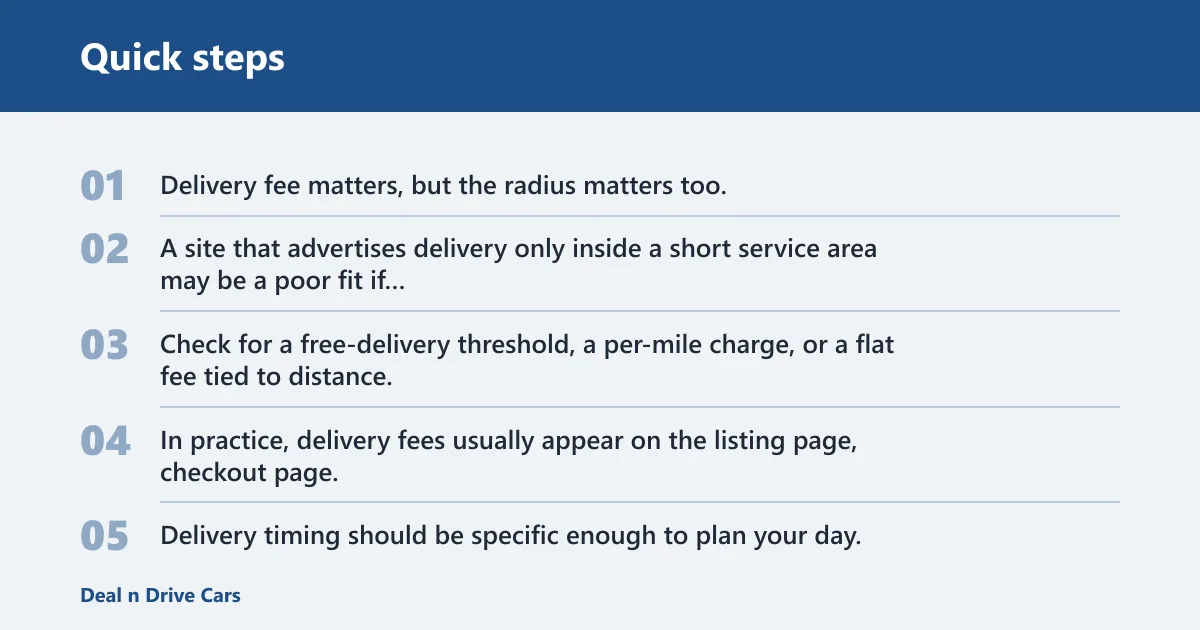
Delivery fee matters, but the radius matters too. A site that advertises delivery only inside a short service area may be a poor fit if you live outside the zone. Check for a free-delivery threshold, a per-mile charge, or a flat fee tied to distance. In practice, delivery fees usually appear on the listing page, checkout page, or dealer finance worksheet, and they can become nonrefundable once the seller schedules transport or dispatches the vehicle.
Timing and ETA window
Delivery timing should be specific enough to plan your day. Look for a date range or ETA window, not an open-ended promise. If the vehicle comes by carrier, ask how pickup coordination works and what happens if weather, traffic, or paperwork pushes the arrival back. The likely scenario is that a quoted window stays flexible until the vehicle is assigned to a truck; after dispatch, the seller may treat transport as a committed expense even if the buyer later changes their mind.
Handover inspection process
The handoff should include a walkaround, VIN check, and a chance to inspect the car before you sign final release documents. Ask whether the driver waits while you compare the vehicle against listing photos and the condition report. If the seller expects instant acceptance, that is a warning sign. If damage is noted at handoff, write it on the delivery paperwork, take photos, and ask whether the seller will repair it, open a carrier claim, or pause the sale until the issue is resolved.
Document signing before release
Document signing can happen at the curb, in the driveway, or electronically before delivery. Do not sign away your rights before you have checked the VIN plate, title paperwork, and odometer reading. If the seller wants full payment released before inspection, ask how disputes are handled. The practical question is whether signing final acceptance ends your ability to reject the car for visible damage or missing paperwork.
Suppose a dealer delivers a 2021 sedan with 38,000 miles. The car looks clean at first glance, but the buyer should still compare the VIN on the dash, the windshield tag, and the paperwork before signing. One mismatch can stop the sale before it becomes a title problem.
Can you return a delivered used car?
Yes, but only if the seller’s policy allows it and you meet every condition. Return terms can commonly include a set number of days, a mileage cap, restocking fees, and condition rules. The biggest cost swing is return transport: some sellers cover it, while others bill the buyer. For policy-sensitive buyers, the most important question is whether the return clock starts at delivery, at signing, or at the moment the seller marks the car as accepted.
Days and mile limits
A return window is only useful if you can keep the car within its mileage cap. Read both numbers together. A short window with a low cap can be enough for a home inspection and a brief test route, but not for a full week of driving. If the seller uses a 24-hour, 72-hour, or 7-day clock, confirm whether weekends and holidays count toward the deadline.
Restocking and transport fees
Restocking fees and return transport charges can erase the value of home delivery. Ask whether the seller charges a flat fee, deducts transport from your refund, or requires you to arrange shipping back at your own cost. The return policy should spell out who pays if the seller’s description was wrong. In many deals, the buyer pays return shipping when the return is elective, but the seller or carrier may absorb the cost if the car arrives damaged or materially different from the listing.
Condition rules for returns
Return eligibility usually depends on the car coming back in near-delivery condition. That means no fresh damage, no missing keys or documents, and no unexplained warning lights caused after acceptance. If the seller requires original accessories, make sure they are in the car before you sign. A typical return dispute starts when the buyer adds miles, removes items from the trunk, or discovers a new defect after the return window closes.
What should you check at delivery?
Check the car as if you were buying it from scratch. Match the VIN, title paperwork, and odometer to the listing. Then review the vehicle history report, look for body damage, and confirm that open recalls or title issues are disclosed before you accept the keys.
VIN and paperwork
Start with the VIN on the dashboard, door jamb, and title packet. The numbers must match. Review the bill of sale, title status, temporary registration if provided, and any lender paperwork before the driver leaves. If any document is missing, stop and ask for it in writing. For state registration and title transfer rules, check your DMV or state motor vehicle agency guidance before you accept an out-of-state car.
Vehicle history report details
A vehicle history report should answer the basics: accident history, title status, odometer checks, open recalls, and ownership records. If the report shows a branded title, inconsistent mileage, or unresolved recall data, you need a direct explanation from the seller before you sign. Vehicle history providers explain the report differently, but the buyer should treat the report as a screening tool, not a guarantee. For recall checks, use the NHTSA recall lookup guidance to verify whether the VIN has open recalls.
Damage photos and odometer
Take curbside photos from all four corners, plus close-ups of wheels, glass, paint, and trim. Compare them with the listing photos. Check the odometer reading against the ad and paperwork. If you see a fresh scratch or a warning light, note it before release. If the seller or carrier asks you to note damage on a bill of lading, write the defect clearly and keep a copy before the truck departs.
Open recalls and title status
Open recalls are not a cosmetic issue. They matter because they can affect safety and future service. Title status matters because a delayed or unclear title can block registration. If the seller cannot explain either item clearly, do not accept the car yet. Before delivery, confirm the VIN on the NHTSA recall lookup and match the title status against your state registration rules so you know whether the car can be legally driven after handoff.
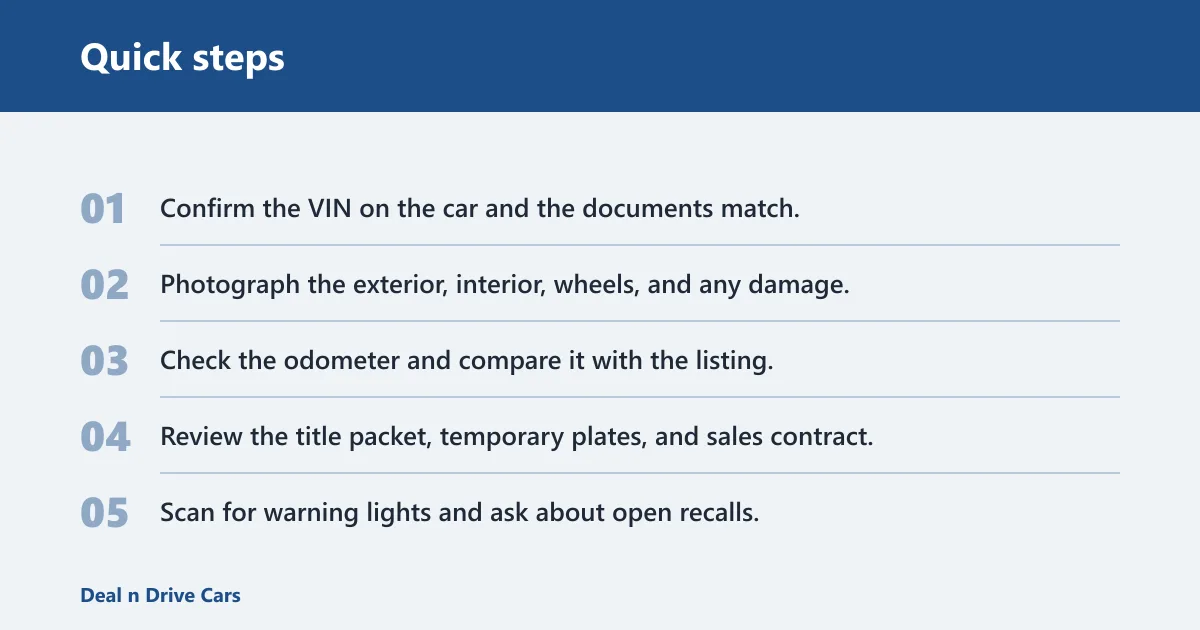
- Confirm the VIN on the car and the documents match.
- Photograph the exterior, interior, wheels, and any damage.
- Check the odometer and compare it with the listing.
- Review the title packet, temporary plates, and sales contract.
- Scan for warning lights and ask about open recalls.
- Keep copies of every signed page and delivery note.
Out-of-state delivery questions
Out-of-state purchases add tax, registration transfer, and timing questions that local buys do not have. You also need to know whether temporary plates are provided, whether the car meets your state’s emissions rules, and who coordinates delivery with the title transfer. The buyer should confirm the local DMV steps before the vehicle ships so the car does not arrive before the paperwork is ready.
Taxes and registration transfer
Buying across state lines can create tax and registration questions. The buyer should confirm where taxes are paid, how the dealer or marketplace handles registration transfer, and whether the title paperwork will arrive in time for local registration. State DMV and revenue agencies typically explain whether the buyer pays sales tax in the purchase state, the home state, or both with a credit for taxes already paid.
Temporary plates and emissions compliance
Temporary plates are a bridge, not a solution. They buy time while title and registration are processed. Before you accept an out-of-state delivery, confirm that the vehicle meets your local emissions rules and that the temporary tags are valid for your route home and your registration timeline. If your state requires a smog or emissions inspection, ask whether the vehicle can be registered before that inspection is completed.
Cross-border delivery limits
For a US-leaning buyer, the main issue is interstate compliance, not international travel. Cross-border delivery adds customs and tax questions that sit outside the normal used-car checkout flow, so the practical advice is to stay focused on state registration, title transfer, and recall verification before accepting delivery. If the seller says the car is “ready to ship,” ask what paperwork is included and which agency will process the title after arrival.
Frequently asked questions
What used car sites deliver cars to your home?
Carvana and CarMax are the clearest direct-to-home examples, while CarGurus listings and local dealer sites depend on the individual seller’s policy. Delivery is not a site-wide promise on every listing. Check the vehicle page for the fee, service area, timing, and return terms before you pay.
Which used car websites offer home delivery?
Used-car websites that can offer home delivery include direct sellers, marketplace listings with dealer delivery, and local dealer sites. The important detail is not the brand name alone. It is whether the specific vehicle page states the delivery zone, handoff process, and return policy in writing.
Can I buy a used car online and have it delivered?
Yes. Many buyers complete the search, financing, paperwork, and delivery online. The safer path is to confirm vehicle history, inspect the listing photos, and read the delivery terms before payment. If the seller cannot explain the inspection and return process, do not treat the transaction as finished.
Do used car sites charge for home delivery?
Some do, some do not, and some charge based on distance or ZIP code. The key is the full cost, not the headline promise. Check whether the fee is flat, tied to mileage, bundled into the price, or added later as a transport charge.
How do I know if a delivered used car is legit?
Match the VIN, title paperwork, and odometer to the listing and vehicle history report. Confirm accident history, title status, open recalls, and ownership records. If any document is missing or inconsistent, stop before signing. A legitimate delivery should survive a careful curbside check.
What should I check before accepting a car delivered to my house?
Check the VIN, odometer, exterior condition, warning lights, title packet, temporary plates, and any accessory items promised in the listing. Take photos before you sign anything. If the car arrives with new damage or missing documents, note it immediately and contact the seller before release.
Can I return a used car if home delivery goes wrong?
Sometimes, yes. The return window, mileage cap, restocking fee, and condition rules control that answer. Also check who pays return transport. If the seller’s policy is unclear, assume you may have to cover the cost until you see the written terms.
Which used car sites deliver across state lines or internationally?
Out-of-state delivery is more common than international delivery, but both require extra paperwork. Check tax handling, registration transfer, temporary plates, emissions compliance, and who coordinates shipping. For domestic delivery, the buyer should rely on the seller’s written policy and the state DMV rules rather than vague assurances.