Why Is My Instant Cash Offer for My Car So Low?
An instant cash offer is often lower than a private-party estimate because the buyer builds in wholesale pricing, reconditioning, fees, and inspection risk. If the gap is 10% to 20%, that can be normal. This guide explains the biggest discount drivers, how financed cars change the math, and when a quote is likely to shift after inspection.
How instant cash offers account for wholesale margins
The first number is usually a preliminary price, not a final sale price. It is based on the VIN, mileage, and condition you entered, then adjusted for the buyer’s costs and risk. Many instant cash offers stay valid for up to 7 days and remain subject to inspection.
Market value versus private sale value
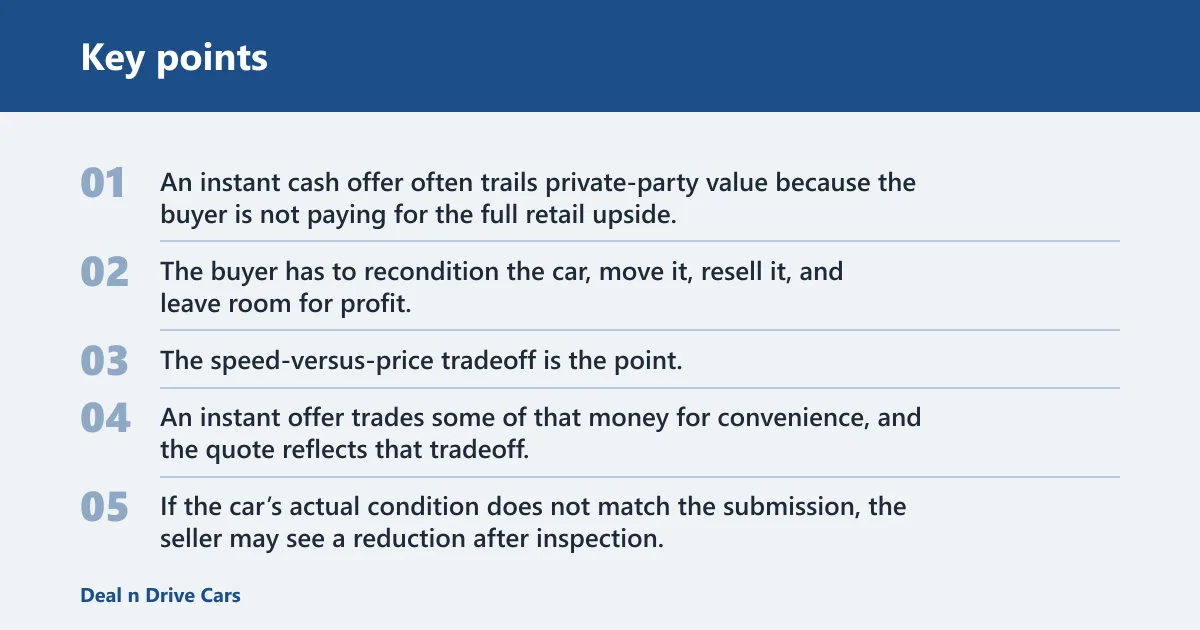
An instant cash offer often trails private-party value because the buyer is not paying for the full retail upside. The buyer has to recondition the car, move it, resell it, and leave room for profit. That usually puts the quote closer to wholesale than to retail.
The speed-versus-price tradeoff is the point. A private sale can bring more money, but it also asks you to screen buyers, answer messages, meet in person, and wait for payment. An instant offer trades some of that money for convenience, and the quote reflects that tradeoff.
Risk pricing built into the quote
The buyer also prices in uncertainty. If the car’s actual condition does not match the submission, the seller may see a reduction after inspection. That is why the quote is preliminary and why the final payout can move after the vehicle is checked in person.
Some deductions are normal. Others are avoidable. That difference matters, because a quote that is low for market reasons is not the same as a quote that is low because the car was misdescribed.
What drives the discount?
Start with the basics: VIN, mileage, and condition. The VIN identifies trim, options, and history. Mileage is a core valuation input, and higher mileage can reduce the offer when it is high for the car’s age. Vehicle condition then shapes the rest: wear and tear, accident history, major repairs, and mechanical issues can all trim the number further.
A common first-timer mistake is to blame the whole gap on mileage when the real hit comes from several smaller items. Missing keys, warning lights, rough body panels, or a repair record that does not match the online description can each pull the figure down.
What makes an instant cash offer lower than private sale value?

An instant cash offer is lower than private sale value because the buyer must absorb reconditioning, transport, resale risk, and margin before the car reaches the next owner. The private-sale path can capture more of the vehicle’s retail value, but it shifts the work and risk to you.
That gap is not automatically a bad sign. It becomes a problem only when the offer is far below a realistic market range or when the seller finds a fixable data issue, such as an incorrect trim, an omitted option, or a mileage entry that is off.
How do mileage and vehicle age affect the offer?
Mileage matters because it feeds the valuation model alongside the VIN and condition data. A high-mileage vehicle can still sell well, but the quote will usually reflect more wear, more near-term maintenance, and a shorter resale window.
If the odometer reading is accurate and the car is simply older, that is a normal discount source. If the entered mileage is wrong by a large amount, that is a fixable error and worth correcting before you accept.
How do cosmetic wear and missing equipment affect the offer?
Scrapes, dents, curb rash, cracked trim, and torn upholstery usually affect value because they point to immediate reconditioning costs. Missing equipment can do the same. A missing second key, for example, is not cosmetic, but it still costs the buyer to replace.
Say your sedan has 92,000 miles, a scuffed rear bumper, and only one key fob. The mileage may explain part of the gap, but the bumper repair and replacement key explain why the quote lands below a cleaner example with the same trim.
How do accident history and prior repairs affect the offer?
Accident history can lower the offer even when the car looks fine. Prior repairs matter too, especially when they involve structural work, airbag deployment, or paintwork that changes how the car is valued in resale. If the history report and your submission do not match, expect a recheck.
That does not mean every repaired car is rejected. It does mean the buyer will likely price in resale caution, which is normal when the next buyer may ask for the same history details.
How do mechanical issues and warning lights affect the offer?
Mechanical issues are among the clearest reasons an instant offer falls. Warning lights, rough shifting, overheating, brake noise, fluid leaks, and engine misfires all suggest near-term cost. The buyer may discount the quote or reappraise it after inspection if those issues show up.
Do not ignore small dashboard alerts. A tire-pressure light can be simple, but a check-engine light, transmission fault, or ABS warning often changes the number more than a cosmetic flaw does.
Does inspection change the offer?
Yes. Inspection can change the final price because the quote is based on the details entered online, and the car is often checked after that quote is issued. If the vehicle does not match the submitted condition, has undisclosed damage, or needs repairs, the final number can drop.
What gets checked after the quote?
Inspection usually confirms the car’s VIN, mileage, condition, keys, tires, warning lights, body panels, glass, and major functions. It can also reveal title or finance issues that were not clear during the online request. In many cases, the inspection happens after the online quote and before payout.
That order matters. The online number is only as good as the data behind it.
Why can an instant cash offer change after inspection?
Undisclosed accident damage is a major trigger. So are warning lights, frame or suspension issues, missing keys, nonworking electronics, tire wear beyond what was entered, and repairs that were not mentioned during the quote request. If the vehicle’s condition differs from the submission, the buyer can revise the price.
Some changes are small. Others are not. A damaged windshield or a dead A/C system can create a much larger reduction than a few scratches because the buyer has to pay for repair before resale.
When can the final price drop?
The final price can drop any time the inspection proves the car is not what the buyer priced. That includes mismatched mileage, undeclared body damage, a missing title item, or a mechanical problem that was not visible in the online request. The quote is preliminary precisely because these checks happen later.
-
Verify the submission.
Match the VIN, mileage, trim, keys, and condition photos to the online form before you hand the car over. A clean recheck now can prevent a last-minute reduction later.
-
Fix obvious issues first.
Replace a dead key battery, clear simple warning lights only if the repair is real, and document any recent work with receipts. Do not paper over a mechanical issue, because inspection can expose it.
-
Ask what changes price.
Before inspection, ask which items would trigger a reappraisal and which ones are already baked into the quote. That separates normal wear from avoidable deductions.
Offer gap diagnostic table
This table helps you sort the most common discount reasons into three buckets: normal, avoidable, or likely to change after inspection. Use it to decide whether to accept the number, fix a data error, or wait for a fresh quote.
| Discount reason | Likely impact band | Likely post-inspection adjustment? | Likely negotiable? | What to do before re-quoting |
|---|---|---|---|---|
| Mileage | Small to moderate when the reading is high for age | Low unless the mileage entry is wrong | Usually no, unless the mileage entry is wrong | Confirm the odometer reading and make sure the VIN-linked history is correct |
| Cosmetic wear | Small to moderate for scratches, dents, scuffs, torn trim | Low to moderate if the damage was understated | Sometimes, if the damage was overstated or already repaired | Document the actual condition with clear photos and list recent repairs |
| Accident history | Moderate to large, depending on severity and repair type | Moderate to high if the history report reveals more than entered | Usually limited | Gather repair receipts, confirm what was repaired, and verify the history report |
| Mechanical issues | Moderate to large when warning lights or drivability issues exist | High if the issue is visible at inspection | Rarely, unless the issue was fixed before inspection | Repair the fault and keep the invoice, or expect the buyer to reprice it |
| Title or finance status | Large if payoff details are missing or the title is not ready | High until the paperwork is corrected | Yes, only after the paperwork is corrected | Obtain the title status, lien details, or settlement figure before re-quoting |
| Missing service records | Small to moderate, often tied to buyer confidence | Low | Sometimes | Collect oil-change records, major repair receipts, and any dealer maintenance printouts |
| Market softness | Moderate, and often outside the seller’s control | Low | No | Compare a few offers on the same day and use the best net amount |
Low instant cash offer checklist
- Confirm the VIN, mileage, trim, and title status are entered correctly.
- Replace missing or weak keys and document any working spare.
- Repair actual warning lights or drivability issues before requesting a new number.
- Gather receipts for maintenance, major repairs, and accident-related work.
- Take clear photos that match the vehicle’s current condition.
What should you check before you accept a cash offer for your car?
Check the VIN, trim, mileage, title status, keys, service records, and warning lights before you accept. Then compare the offer against your own estimate of net proceeds after any fees, transport costs, or payoff obligations. That is the only way to know whether the number is truly weak or just normal.
VIN, trim, and options
Make sure the quote matches the exact VIN and trim. Options such as premium audio, navigation, wheel packages, and driver-assist equipment can change value, but only if they were entered correctly. A wrong trim can pull the quote down for no good reason.
Service records and repair receipts
Service records help prove that maintenance and repairs were handled on time. Keep receipts for major work, especially brakes, tires, suspension, transmission service, and any accident-related repair. If the buyer has to guess, the offer is more likely to stay conservative.
Title status, keys, and warning lights
Check whether the title is clean, whether any lien remains, and whether all keys are present. Then inspect the dashboard for warning lights. These are not small details; they affect the buyer’s cost and can change the number after inspection.
-
Review the quote line by line.
Compare the offer against the VIN, mileage, trim, and condition you submitted. If any field is wrong, correct it before you decide anything.
-
Price the net outcome.
Subtract any fees, transport, or payoff amount from the offer so you can compare net proceeds, not just the headline number. This is where a quote that looks high can end up paying less.
-
Decide whether the gap is normal.
If the difference is tied to market softness or ordinary wear, accepting may be reasonable. If it is tied to bad data, ask for a correction or walk away and re-quote.
Are financed cars offered less?
Financed cars are not automatically worth less, but the payoff math can make the seller’s net proceeds look smaller. You need the settlement letter, which states the exact amount required to clear what you owe, so you can compare the payoff with the offer and see whether you have positive equity or negative equity.
Settlement letter and payoff amount
The settlement letter tells you the exact amount required to clear the loan. That number may be lower or higher than your current balance, depending on interest and timing. Compare it with the offer before you agree to sell.
Negative equity and shortfall math
Negative equity means you owe more than the car is currently worth. In that case, the shortfall has to be covered somehow. If the offer does not cover the payoff, you either bring cash to closing or the deal cannot fully settle.
Positive equity is the easier case. If the car is worth more than the payoff, the dealer clears finance directly and sends any surplus to the seller. That surplus is your actual net proceeds, not the headline offer.
Suppose the offer is $12,000 and the settlement figure is $13,400. The shortfall is about $1,400, which means the sale may not wipe out the loan by itself. If the buyer will not adjust the deal, you must cover that gap or keep the car.
How do payoff figures affect your net?
The payoff figure can change the result even when the offer itself looks fair. A seller with positive equity may receive a check after the lien is cleared. A seller with negative equity may owe money at closing, which makes the sale less attractive unless the quote is strong enough to absorb the shortfall.
Can multiple quotes raise your result?
Yes, getting 2–3 instant quotes can improve your result, but only if you submit the same facts to each buyer. Use the same VIN, mileage, title status, accident history, and condition details so you compare real differences, not mismatched inputs. Then compare net proceeds, not just headline price.
Some buyers price transport, fees, or verification risk differently. That is why one quote can look higher while paying less after deductions. The best offer is the one with the highest net amount and the fewest surprise changes after inspection.
How do you compare offers fairly?
-
Use the same vehicle facts.
Enter one VIN, one mileage reading, and one condition description across every request. If one form says “good” and another says “excellent,” the comparison is not clean.
-
Compare net proceeds.
Subtract payoff, transport, or fees where they apply. A higher headline price can still leave you with less money after those items are deducted.
-
Watch for inspection changes.
Ask whether the quote is subject to inspection and what would trigger a reprice. That keeps you from choosing a number that looks best only on paper.
Choose based on the final number, the payment process, and the certainty of the transaction. ACH payouts commonly arrive in 1–3 business days after handoff, so the fastest offer is not always the best one if its net is weak or its inspection terms are stricter.
Frequently asked questions
Why is my instant cash offer for my car so low?
It is usually low because the buyer is pricing wholesale value, reconditioning, fees, and verification risk into the offer. That does not automatically mean the quote is wrong. It may simply reflect the speed and convenience of the sale, plus the buyer’s resale costs.
Does an instant cash offer change after inspection?
Yes. The online quote is preliminary, and inspection can change it if the car does not match the submission. Undisclosed damage, warning lights, missing keys, or mechanical issues are common reasons for a reduction before payout.
Is a low online offer because of mileage or condition?
It can be either, or both. Mileage is a core valuation input, and condition covers accidents, wear and tear, repairs, and mechanical issues. If the number seems unusually weak, check whether the mileage was entered correctly and whether any damage was omitted.
Can I get a better instant cash offer by getting more quotes?
Often, yes. The guide recommends collecting 2–3 instant quotes so you can compare the same vehicle facts across buyers. Just compare net proceeds after fees or transport, because a higher headline price is not always the better deal.
Are instant cash offers lower on financed cars?
Not because the car is financed, but because the payoff math changes your net outcome. A settlement letter shows the exact amount needed to clear what you owe. If there is negative equity, you may have to cover the shortfall before the sale can fully close.