What Causes a Used Car to Depreciate Faster?
Used cars may depreciate faster when they start with a high sticker price, have weaker reliability records, get poor fuel economy, draw limited buyer demand, or have accident or flood history; mileage, condition, and trim can also speed up the drop. Miss those factors and you can overpay, then lose hundreds or thousands more at resale or trade-in. This guide ranks the causes, shows what you can verify before buying, and points out which ones you can negotiate.
Built-in and avoidable value loss
The main value loss comes from four things: age, mileage, market demand, and history. After that, the details matter more than many shoppers expect. A clean title, strong service records, and a desirable trim can hold value better than a similar car with the same odometer reading but weaker demand.
The biggest value-loss drivers, in order
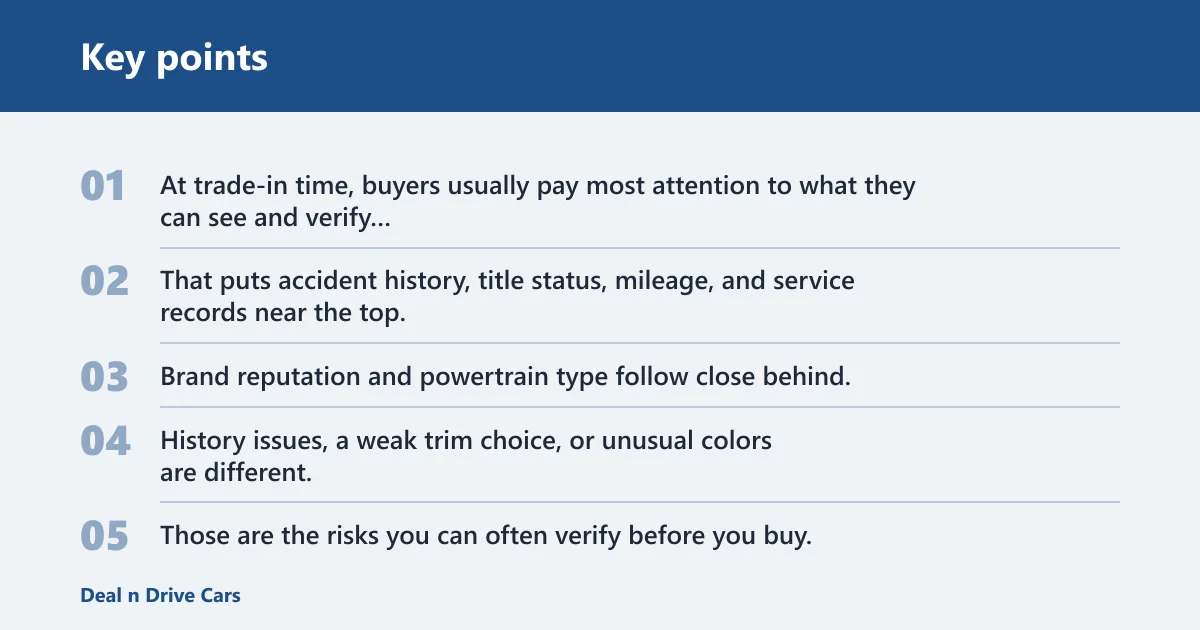
At trade-in time, buyers usually pay most attention to what they can see and verify quickly. That puts accident history, title status, mileage, and service records near the top. Brand reputation and powertrain type follow close behind, because they shape demand across a whole segment, not just one car.
Age and mileage are unavoidable to a point. History issues, a weak trim choice, or unusual colors are different. Those are the risks you can often verify before you buy, and some of them can be negotiated into a lower price.
Built-in depreciation versus avoidable depreciation
Some loss is built in. A newer model year becomes an older model year the moment it leaves the lot, and the market prices that in. The other kind comes from negative signals: accident records, missing maintenance, poor condition, or a powertrain that buyers distrust.
A sedan with 90,000 miles and full service records may hold value better than a lower-mileage example with a salvage title. The market does not reward mileage alone. It rewards confidence, and confidence depends on the full package.
What matters most at trade-in time
Dealers and private buyers both start with the same questions: Has it been wrecked? How many miles? Any title problem? Is the maintenance record complete? If the answer is uncertain, the offer usually drops fast because the next buyer will ask the same questions.
That is why two similar cars can differ by thousands of dollars. The one with clean records and normal wear has fewer unknowns, so it is easier to price and easier to resell.
How does mileage affect a used car’s depreciation?
Mileage affects depreciation because it signals wear, remaining life, and future repair risk. Buyers notice odometer readings quickly, and the market tends to penalize cars that sit well above the expected range for their age. A clean, high-mileage car can still be a better buy than a lower-mileage one with poor history, but the odometer still matters.
Annual mileage thresholds buyers notice
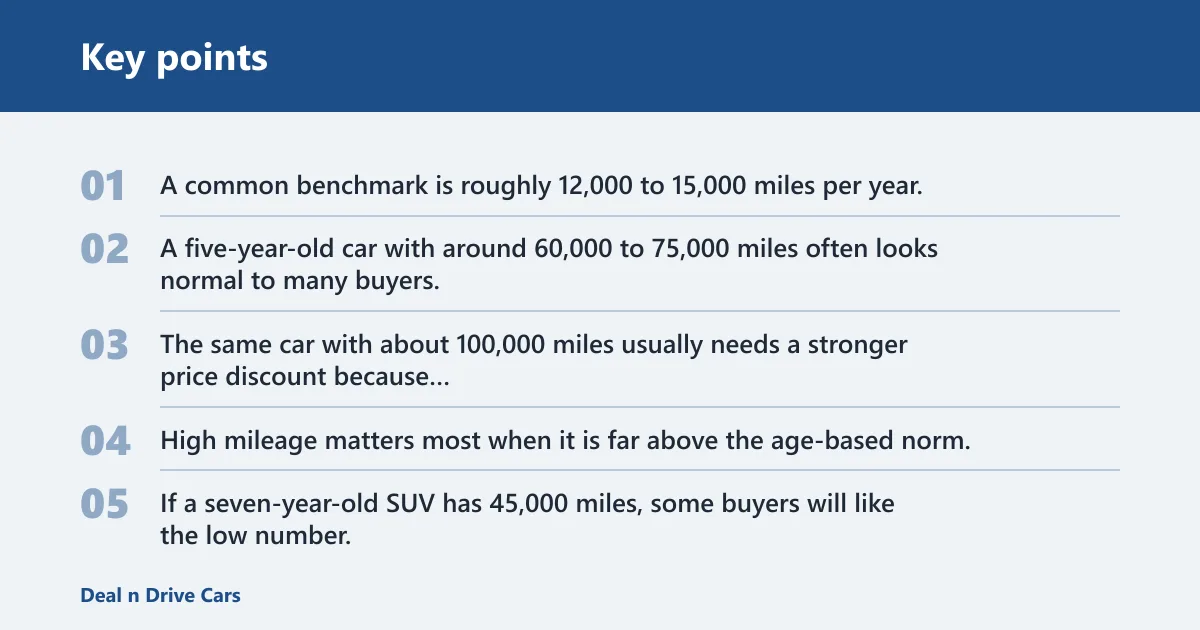
A common benchmark is roughly 12,000 to 15,000 miles per year. A five-year-old car with around 60,000 to 75,000 miles often looks normal to many buyers. The same car with about 100,000 miles usually needs a stronger price discount because the remaining life on wear items may look shorter.
High mileage matters most when it is far above the age-based norm. If a seven-year-old SUV has 45,000 miles, some buyers will like the low number. If it has 140,000 miles, they will expect a lower price and more repair risk.
First-year drop versus later-year decline
New cars often lose the most value early, sometimes in the first year, because they move from “new” to “used” right away and the market tends to price in that change. Later years usually bring a steadier decline, shaped more by mileage, condition, and the next model year’s features than by the initial sticker shock.
That pattern matters when comparing used cars. A three-year-old vehicle with modest miles may have already absorbed the sharpest part of the early drop, while a seven-year-old one may lose value more slowly but face more wear-related price pressure.
How odometer readings shape resale value
Odometer readings influence resale because they imply usage, not just distance. Highway miles are usually easier on a vehicle than stop-and-go city use, but buyers rarely get a clean split in the listing price. They mostly see the number and adjust from there.
Picture a compact SUV with 58,000 miles and complete records. Compare that with the same model at 104,000 miles, with no maintenance proof. The second car may need a larger discount even if it looks tidy, because the buyer must price in hidden wear.
Do accidents and service history matter?
Yes. Collision records, structural damage, and weak maintenance records can pull value down faster than mileage alone. A repaired crash can still leave diminished value if the damage was serious, if the repairs were uneven, or if the title has been branded. Service history can soften that hit, but it does not erase it.
Collision records and structural damage
A minor bumper repair is not the same as frame or structural damage. Buyers discount heavily when the report shows airbags, frame work, flood damage, or a salvage title because those issues raise safety and long-term reliability concerns. Structural damage is often one of the fastest ways to cut resale value.
Even when the car drives straight, a structural hit can keep market value below similar clean-title vehicles. The repair may look fine on a walkaround and still price badly at resale.
Why repairs do not erase diminished value
Repairs fix the visible damage, not the market memory. A car with a collision record often sells for less because future buyers know the incident happened and may worry about hidden problems, uneven paint, alignment issues, or repeated claims.
That is why repair quality matters. Good documentation can reduce suspicion, but it usually does not return the car to the same value as a clean-history example.
Maintenance records, timing service, and buyer trust
Regular maintenance records help because they show the car was cared for on schedule. Oil changes, brake work, fluid service, and tire rotations do not guarantee perfection, but they make the condition easier to trust. A complete file also helps buyers judge whether neglect caused any wear.
Timing belt or timing chain service can matter a great deal on the right engine. If the manufacturer calls for a timing belt at a specific interval and there is no proof it was done, the buyer may price in a major future expense. Documented ownership care often narrows that discount.
Do brand, model, and powertrain matter?
Yes. Reliability reputation, segment demand, and powertrain type all influence how quickly a used car loses value. Some brands hold value because buyers trust them and parts are easy to find. Others fall faster because repair costs, fuel use, or ownership risk are harder to ignore.
Reliability reputation and resale demand
Brands with a strong reliability image often depreciate more slowly because more buyers want them at every age. That demand supports resale values. Brands with a mixed record, high repair bills, or weak long-term confidence tend to need a lower asking price to move.
Model reputation matters too. A dependable midsize sedan can hold value differently from a luxury sedan with similar mileage because the buyer pool is broader for the mainstream car.
Gasoline, hybrid, and EV depreciation patterns
Gasoline cars usually depreciate on the familiar path of age, miles, and condition. Hybrids can hold value well when fuel economy matters and battery risk looks manageable. EVs can depreciate faster in some markets because buyers watch battery health, charging speed, range, and the pace of new technology.
That does not mean every EV drops quickly. It means the value can depend more on local charging access, range expectations, and incentives than on the usual age-and-mileage story alone.
Why EVs can lose value faster in some markets
Battery degradation is part of the concern, even when the pack is still healthy enough for normal use. Buyers also compare range, warranty coverage, and charging speed against newer models. If a newer EV offers much more range for a similar price, older models can soften faster.
Fuel savings help some hybrids and EVs hold demand, but that advantage can shrink if electricity rates rise, public charging is limited, or the local market has a large supply of similar cars.
How do age and condition change depreciation on a used car?
Age and condition work together. A car gets older every year, but condition tells buyers how that age has been treated. First-year depreciation is usually steepest on new cars, while later-year decline depends more on wear, appearance, and whether the model-year refresh makes the older version less appealing.
Model-year aging and demand
Model-year aging matters because shoppers compare the current model year with the prior one. If the newer version adds safety tech, better fuel economy, or a refreshed cabin, the older model may lose value faster even if it has low mileage. The age gap alone can change demand.
That effect is stronger in fast-moving segments like EVs and compact SUVs, where buyers watch feature changes closely.
Interior wear, paint color, and cosmetic condition
Cosmetic wear matters, but usually less than mechanical risk unless it is severe. Worn seats, stained carpets, cracked trim, heavy curb rash, and dull paint make a car harder to sell, especially if the asking price is near cleaner examples. Neutral colors such as black, white, gray, and silver usually appeal to more buyers than unusual shades.
Suppose two similar compact SUVs have the same mileage and service records, but one has a fleet-rental history and the other was privately owned. One has a clean beige interior and no scratches. The other has stained seats, peeling clear coat, and a strong odor. The second car will usually need a bigger discount because buyers can see the cost of fixing it.
How fast does a used car depreciate each year?
There is no single yearly number that fits every car. Depreciation is usually fastest early, then it slows, then it varies with mileage, condition, and market demand. A newer used car may lose value faster in a strong model year than an older one with the same mileage if demand changes sharply.
How to think about yearly value loss
A practical way to think about it is this: the newer the car, the more sensitive its value is to age and model-year changes. The older the car, the more sensitive it becomes to mileage, repairs, and cosmetic condition. Once a car reaches high mileage, the annual drop can be less about age and more about looming maintenance.
What market conditions change value?
Market conditions can move used-car prices even when the car itself has not changed. Supply levels, interest rates, seasonality, and regional demand all affect what buyers pay. A clean car can still lose value faster in a weak market, while a scarce segment can hold up better than expected.
Supply levels and used-car pricing
When more similar vehicles are for sale, prices tend to soften. When inventory is tight, sellers have more room. That is why depreciation can look different from one month to the next even for the same model and trim. Supply shifts are one reason used-car values do not fall in a straight line.
Interest rates, seasonality, and regional demand
Higher interest rates can reduce what buyers can afford, which can pressure prices lower. Season matters too. Convertibles may move better in spring and early summer, while four-wheel-drive trucks and SUVs can draw more interest before winter in snowy regions. Regional demand can be a real price advantage.
How segment shortages can slow depreciation
Some segments hold up better because demand is durable and supply is limited. Trucks, some hybrid SUVs, and certain reliable sedans can depreciate more slowly when buyers keep chasing them. A car in a short-supply segment may still age, but the market gives it more support than a model with heavy inventory.
What causes used car checklist
Use this checklist before you buy. Score each factor from 1 to 5, where 1 means low risk and 5 means high risk. The higher the total, the more value-loss risk you should expect and the stronger your negotiating position may be.
| Factor | Severity 1-5 | Buyer-visible warning signs | Negotiation implication |
|---|---|---|---|
| Mileage above age norm | 4 | Far over 12,000-15,000 miles per year | Ask for a lower price if the odometer is high for the model year |
| Vehicle age | 3 | Older model-year, outdated features, heavier wear | Use age to compare against newer listings with similar equipment |
| Collision history | 5 | Accident report, panel mismatch, paint differences | Require a meaningful discount, especially on structural repairs |
| Frame or structural damage | 5 | Airbag deployment, frame repair, salvage or rebuilt title | Price in diminished value and higher future resale risk |
| Maintenance gaps | 4 | Missing oil changes, no service file, overdue fluids | Discount for catch-up maintenance and unknown wear |
| Timing belt or chain uncertainty | 4 | No proof of scheduled service on an interference engine | Subtract the likely service cost before making an offer |
| Weak brand or model reputation | 4 | Lower demand, known repair costs, slow resale category | Offer less than a stronger-reputation rival in the same class |
| Unwanted trim or options | 3 | Base trim, missing safety tech, unpopular package mix | Do not pay premium-trim money for a plain build |
| Powertrain risk | 4 | Battery concerns, poor fuel economy, expensive repairs | Use operating cost and resale demand in your price target |
| Color and cosmetic wear | 2 | Unusual paint, worn seats, scratches, faded trim | Ask for a smaller but real discount if appearance hurts demand |
A scratched bumper and a salvage title do not belong in the same price bucket. Cosmetic issues may be easy to fix, while structural damage, title branding, and missing records usually cut deeper into resale value.
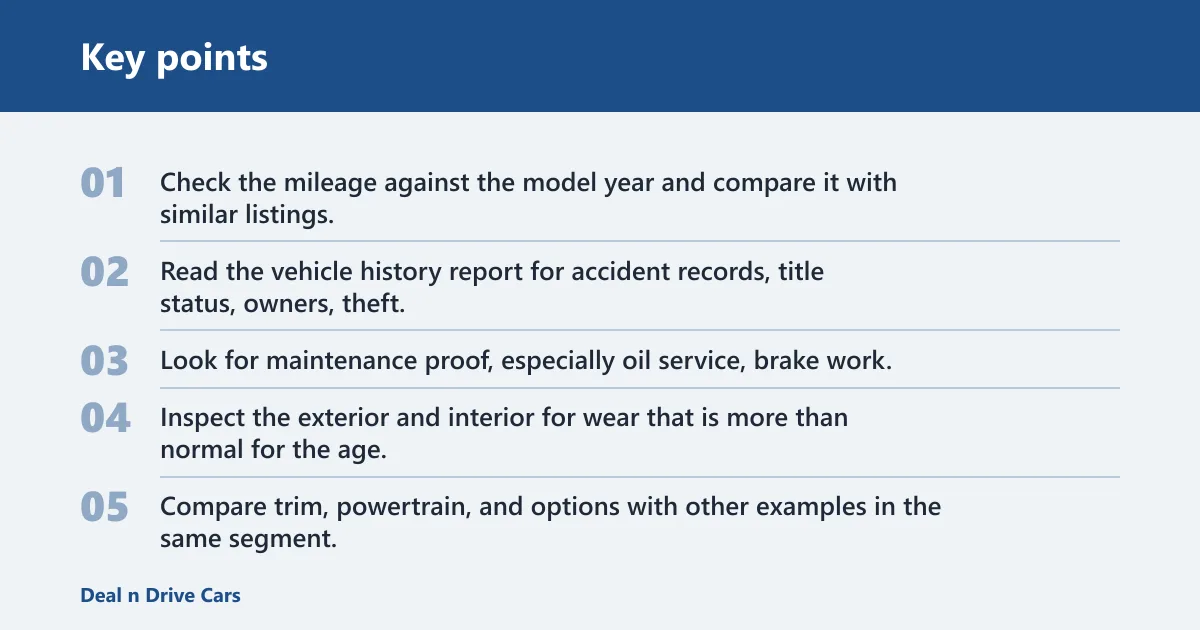
- Check the mileage against the model year and compare it with similar listings.
- Read the vehicle history report for accident records, title status, owners, theft, and flood flags.
- Look for maintenance proof, especially oil service, brake work, and timing belt or chain records.
- Inspect the exterior and interior for wear that is more than normal for the age.
- Compare trim, powertrain, and options with other examples in the same segment.
- Adjust your offer for market conditions, including supply, rates, season, and local demand.
Frequently asked questions
Why do used cars depreciate faster than others?
Used cars depreciate faster when several value signals move in the wrong direction at once: high mileage, weak brand demand, accident history, poor fuel economy, and low-grade condition. The fastest losers usually combine a high starting price with limited buyer appeal and expensive future ownership.
Do accidents make a used car depreciate faster?
Yes. Collision records reduce buyer confidence, and frame or structural damage can cut value much more than a minor cosmetic repair. Even well-done repairs often leave diminished value because the market still prices in the history, the risk of hidden damage, and the possibility of future resale trouble.
Why do some brands depreciate faster than others?
Brands depreciate at different speeds because buyers trust some names more than others. Reliability perception, repair cost, fuel economy, and parts availability all matter. If a brand has weaker resale reputation in a segment, it usually needs a lower price to attract the same buyer.
Does trim level affect how quickly a used car loses value?
Yes. Trim level affects who wants the car and how much they are willing to pay. Popular options, desirable safety features, and better equipment can help a higher trim hold value, while a base trim with few extras may depreciate faster if buyers prefer a better-equipped version.
Why do electric cars depreciate so quickly?
Some EVs depreciate quickly because buyers focus on battery health, range, charging speed, and fast-changing technology. Local charging access and incentives also affect demand. In markets with strong used-EV supply or weak charging access, prices can soften faster than for similar gasoline or hybrid models.
How can I tell if a used car will hold its value?
Start with the history report, then compare mileage, service records, trim, powertrain, and local demand. Clean titles, regular maintenance, desirable options, and a strong reputation in the segment are the best signs. If several of those are missing, expect faster depreciation after purchase.