Carfax vs AutoCheck: Which Is Better?
Carfax is usually better for shoppers who want service records and consumer-facing detail; AutoCheck is better for quick score-based screening and usually costs less, and you should compare both when a car is expensive, rebuilt, or sourced from an auction. Miss the wrong report and you can pay too much for accident history, title issues, or gaps in maintenance records. This guide compares coverage, price, score use, and the best times to run one report or both.
| Decision factor | Carfax | AutoCheck | Winner |
|---|---|---|---|
| Service-history detail | Often shows maintenance visits, plus safety or emission inspection history | Can show service-related data, but it is not as known for service detail | Carfax |
| Score-based comparison | No comparable score system is the main draw | Uses a numerical score to compare cars with similar vehicles of the same age and mileage | AutoCheck |
| Price for one report | $39.99 | $24.99 | AutoCheck |
| Brand recognition for buyers | Stronger consumer recognition and more familiar to many retail shoppers | Less familiar outside dealer and auction settings | Carfax |
| Best fit for auction screening | Useful, but not built around a score comparison | Often better for peer comparison on inventory lots and auction candidates | AutoCheck |
Carfax vs AutoCheck by buyer scenario
| Buyer scenario | Private-party buy | Dealer purchase | Auction candidate | Same-car conflict between reports | Low-budget screening |
|---|---|---|---|---|---|
| Data strength | Carfax is stronger when you want service entries, ownership history, and a consumer-friendly readout | Carfax is stronger for retail confidence; AutoCheck can still help if the dealer shares both reports | AutoCheck is stronger for score comparison across similar units; Carfax adds service detail when available | Both can reveal different accident, title, or mileage clues that deserve paper verification | AutoCheck gives more screening value per dollar if you need a first pass |
| Likely blind spots | Recent crashes, unreported repairs, or independent-shop service may be missing | Dealer-provided copies can still omit recent updates or source gaps | Recent auction moves, fresh title events, or body repairs may lag in either report | Source timing and reporting gaps are often the reason for the mismatch | A cheap report can still miss a bad title or a recent claim |
| Whether to buy one or both | Start with Carfax; buy AutoCheck too if the car is high value or the history looks thin | Use the free dealer copy first; buy the second report only if the first raises questions | Buy both if the bid is high enough that a missed title brand or mileage issue matters | Buy both, then verify the title, odometer, and repair paperwork before you offer more | Buy AutoCheck first; add Carfax only if the car survives the first screen |
| What to verify next in title or inspection paperwork | VIN, title brand, mileage, repair invoices, and recall status | VIN, title brand, mileage trail, and any late-arriving damage or auction notes | Bid sheet, title copy, salvage or rebuilt notation, and an independent inspection | Look for the exact VIN, dates, mileage, and branded-title language | Confirm the VIN, title status, and open recalls before you spend more |
What a vehicle history report is and why it matters
A vehicle history report is tied to the car’s VIN, the vehicle identifier used to pull records from different databases. It can help you spot reported accidents, title brands, odometer problems, ownership changes, recalls, and some service entries before you buy. It cannot prove the car is problem-free.
The value is practical: one report can show a salvage or rebuilt title, a mileage jump, or a rental-fleet past that changes the asking price. The same report can also miss damage that was never claimed, never titled, or never entered into a source database.
Carfax overview and data coverage
Carfax is the most tenured vehicle history report, dating to 1986. It says it pulls data from over 100,000 sources and has over 17 billion records. For many retail shoppers, that brand familiarity matters because the output is easier to read and often includes service history.
Carfax can show reported accidents, service records, safety or emission inspection history, ownership history, and open recalls. It may also include a buyback guarantee if a DMV issue was missed. Single-report pricing is listed at $39.99.
What Carfax shows that matters most
Carfax is strongest when you want service history and a consumer-facing summary of the car’s past. That can include dealership maintenance visits and inspection entries that help you judge whether the car was serviced on schedule or just moved from one lot to another.
Say your search turns up a 2019 sedan with a clean-looking exterior and one reported front-end accident on Carfax. The report may also list oil changes and state inspection entries, which tells you the damage is not the only thing to review; you still need the repair invoice and the title paperwork.
AutoCheck overview and score system
AutoCheck is owned by Experian. It uses a numerical score to compare cars with similar vehicles of the same age and mileage, which can be helpful when scanning auction inventory or comparing similar trims on a dealer lot. Single-report pricing is listed at $24.99.
AutoCheck can show title data, accident data, ownership changes, and odometer issues. It also offers buyback protection. The score is the selling point: it gives you a fast comparison point, not a full repair diary.
What AutoCheck shows that matters most
AutoCheck is often the better first screen when you are sorting through many listings or need a lower-cost look before spending more. The score can point out a car that looks normal on the surface but compares poorly with similar cars on age and mileage.
Suppose two 2021 crossovers have the same mileage and trim. If one AutoCheck report scores much worse, that does not prove the lower-scoring car is bad, but it is a strong reason to inspect the title chain, check for prior damage, and compare auction or dealer paperwork line by line.
Why do the reports differ?
Carfax and AutoCheck can differ because they do not receive identical data at the same time, and they may not format the same sources the same way. One report may show a service entry or claim that the other has not yet picked up. Another may show a title event first because the state database updated sooner.
Different data sources and timing
Both reports are tied to the VIN, but the path from event to database is uneven. An insurance claim, a DMV title update, or a dealership service record can arrive late, or not at all, depending on who reported it and how quickly the record moved.
That timing gap matters most after a recent collision, a fresh salvage or rebuilt event, or a recent odometer correction. A clean result on one report today does not mean the other report, or the title file, will look the same tomorrow.
Reported claims versus unreported damage
Accident history usually means reported insurance claims, not every dent or repair. If the driver paid out of pocket, repaired the car at a small shop, or never filed a claim, the event may not appear in either report. Damage indicators can still show up later in auction records, body-shop notes, or title branding.
That is why a clean report is only a starting point. A car can have no accidents listed and still have frame work, hail repair, flood damage, or a mileage mismatch that was never entered into a searchable source.
Dealer, insurer, and DMV reporting gaps
Dealer service data is often more complete than independent-shop data, while some independent repairs never enter a national database. The same problem affects title brands. Salvage, rebuilt, flood, lemon, and clean title status can move at different speeds from state to state.
That is also why two reports on the same VIN can disagree on a detail that matters to you. The disagreement does not automatically mean one report is wrong; it often means one source has not updated yet.
How to read the comparison
The right report depends on how much you need to know before you make an offer. Carfax fits shoppers who want service detail and a familiar retail readout. AutoCheck fits buyers who want lower-cost screening and a score that compares a car with similar vehicles.
When Carfax fits the buyer
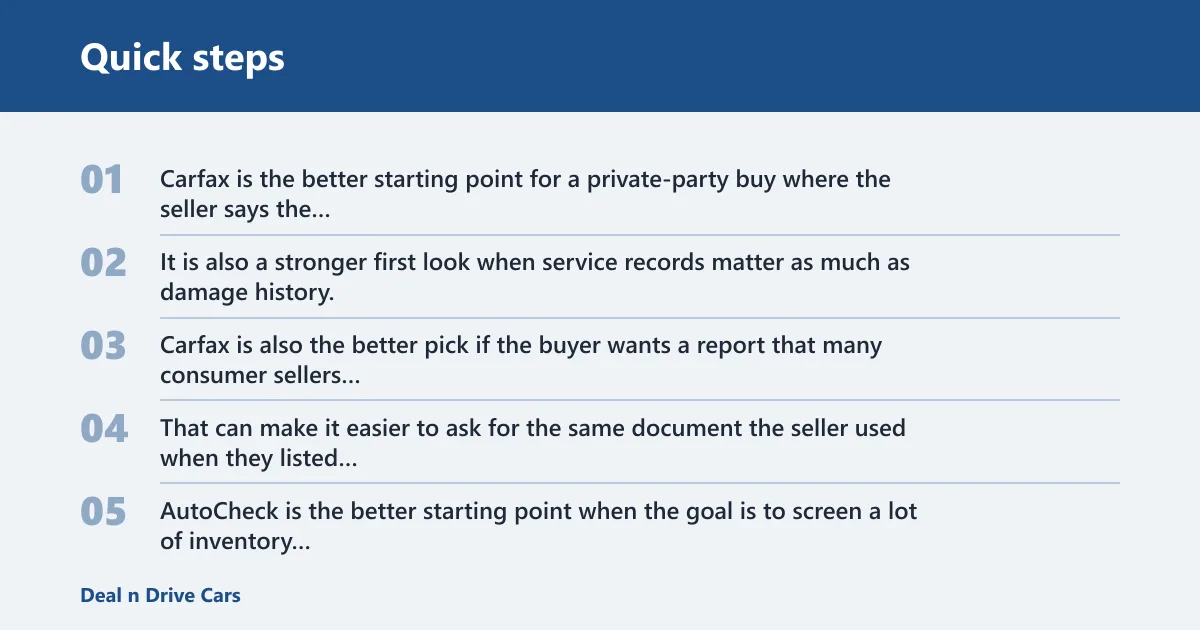
Carfax is the better starting point for a private-party buy where the seller says the car has been maintained and you want proof beyond a handshake. It is also a stronger first look when service records matter as much as damage history, such as on a high-mileage daily driver.
Carfax is also the better pick if the buyer wants a report that many consumer sellers already recognize. That can make it easier to ask for the same document the seller used when they listed the car.
When AutoCheck fits the buyer
AutoCheck is the better starting point when the goal is to screen a lot of inventory without paying premium pricing for every VIN. The score helps compare a car against similar vehicles of the same age and mileage, which is useful on dealer lots and at auction.
It also makes sense when the first question is, “Is this car worth a deeper look?” rather than, “Can I see every service visit?” That is a real difference in buying context.
When neither report is enough
Neither report is enough when the title copy, odometer readings, or inspection results look odd. A clean report can still miss a recent collision, a late title update, or an unreported repair. In that case, stop treating the report as the deciding factor.
Use the VIN on the paperwork, compare the mileage to the title and auction sheet, and ask for invoices or a state title record. If the seller will not provide those, the report has already done its job by warning you.
Choose Carfax if… / Choose AutoCheck if…
Choose Carfax if you want service-history detail, a familiar consumer-facing format, and a report that is easier to discuss with a retail seller. Choose AutoCheck if you want a lower-cost screen, a score for comparing similar cars, or a first pass on auction and dealer inventory. Buy both when the same VIN has conflicting mileage, accident, or title signals.
- Choose Carfax if the car is a private-party sale and service records matter.
- Choose Carfax if the listing claims regular maintenance and you want support for that claim.
- Choose AutoCheck if you are screening auction candidates or dealer stock in bulk.
- Choose AutoCheck if the budget is tight and you need the lower-cost first pass.
- Buy both if the car is expensive, rebuilt, flood-affected, or the reports disagree.
How to use both reports without wasting money
A practical rule is simple: buy the cheaper screening report first when the car is ordinary and the price is modest, then add the second report only if the first one flags a title brand, mileage jump, or accident. If the car is high value, auction-sourced, or recently repaired, buy both up front.
- Check the VIN on the car, title, and listing for an exact match.
- Run the report that best fits the buying context.
- Look for accidents, title brands, ownership count, odometer changes, and service entries.
- Compare the findings with the title copy, repair invoices, and inspection notes.
- If the reports conflict, pause and verify the state title record before you offer more.
What the reports can miss
Recent collisions, fresh title updates, and newly entered service records can lag behind the actual event. That lag is one reason a report can look cleaner than the paperwork or the bodywork on the car itself. Open recalls are different: they can be checked for free through NHTSA, so you do not need to pay a report just to see them.
Odometer history can also be incomplete. A rollback may be obvious if the mileage drops between records, but a gap in reporting can hide the problem until you compare the title, the inspection sticker, and the service invoices.
What to verify next in title and inspection paperwork
Start with the title brand. Salvage, rebuilt, flood, lemon, and clean title status should match what the report says, and the exact VIN should appear on every page. Then compare the odometer reading on the title or auction sheet with the dash reading and any service records.
Next, ask for repair invoices, inspection sheets, and recall completion proof. A clean report plus messy paperwork is a warning, not a bargain.
Frequently asked questions
Is Carfax better than AutoCheck for a used car?
Carfax is usually better if you want service records, a familiar retail format, and more consumer-facing detail. AutoCheck is better when you want a lower-cost screen and a score for comparing similar vehicles. For expensive, rebuilt, or auction-sourced cars, the safest move is to use both.
What does Carfax show that AutoCheck does not?
Carfax is better known for service history and safety or emission inspection history, which many shoppers want before buying. It also has strong consumer recognition and may include a buyback guarantee if a DMV issue was missed. That does not mean AutoCheck lacks title data, only that Carfax is more service-focused.
What does AutoCheck show that Carfax does not?
AutoCheck’s score is the main difference. It compares a car with similar vehicles of the same age and mileage, which helps you screen auction candidates or dealer inventory fast. That comparison tool is useful when you need a yes-or-no sorting method before paying for deeper review.
Which vehicle history report is more accurate?
Neither report is automatically more accurate in every case. Accuracy depends on source quality, reporting speed, and whether the event was ever entered into a database. A report can be perfectly honest and still miss a crash, a repair, or a title update that was never reported.
Should I pay for both Carfax and AutoCheck?
Pay for both when the car is high value, has a rebuilt or branded-title risk, or shows a conflict between mileage, accident, or ownership entries. If the car is ordinary and the budget is tight, start with the report that fits the buying context, then buy the second one only if the first raises questions.
Does a clean Carfax or AutoCheck mean the car is problem-free?
No. A clean report only means no problems were reported in the sources that fed the database. It does not rule out unreported damage, late title changes, missed service entries, or mechanical wear. That is why you still need an inspection and the title paperwork before you buy.