Used Car Down Payment: How Much Should You Put Down?
For a used car, put down enough to keep the loan under about 80% of the car’s price; that is often 10% to 20%, but on a cheap car a smaller fixed amount can be safer if you need repair cash. Too little down can leave you upside down and short on funds when the first repair bill hits. This guide breaks down the smallest safe down payment by used-car price band and how to keep money aside for repairs.
What is a used car down payment?
Components of your down payment
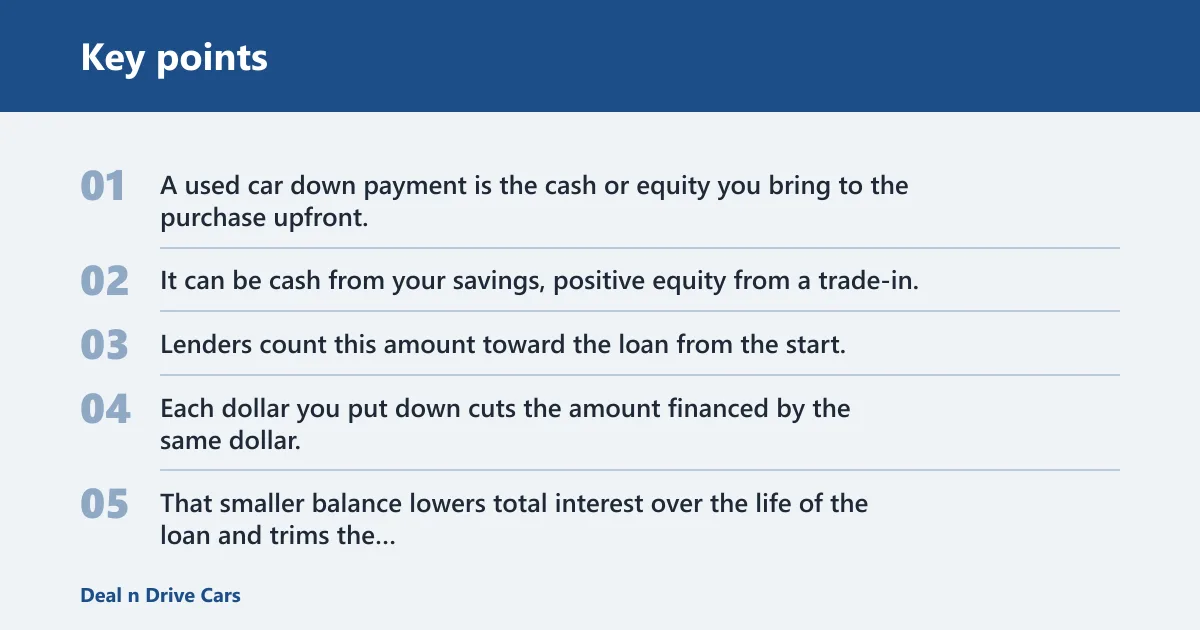
A used car down payment is the cash or equity you bring to the purchase upfront. It can be cash from your savings, positive equity from a trade-in, or a combination of both. Lenders count this amount toward the loan from the start, which lowers what you need to finance.
How it changes the loan
Each dollar you put down cuts the amount financed by the same dollar. That smaller balance lowers total interest over the life of the loan and trims the monthly payment. The link is direct: more money down means less money borrowed.
Used car versus new car benchmarks
A common starting point is 20% down on a new car and 10% on a used one. New vehicles lose value quickly, about 20% in the first year, so lenders and buyers often keep loan-to-value ratios lower to avoid immediate negative equity. Used cars have already taken that first hit, which changes the math slightly.
How much should you put down on a used car?
The smart down payment depends on your repair fund, not just a percentage rule. Start with the typical 10% benchmark, then adjust based on how much cash you need to keep for taxes, fees, and immediate repairs. A larger down payment protects your wallet, but only if you preserve enough emergency savings afterward.
What the 10% benchmark means at real price points
For a used car, around 10% is often used as a starting benchmark. On a $12,000 used car, 10% down is about $1,200. On a $30,000 used car, 10% down is about $3,000. The percentage stays the same, but the dollar amount grows with the purchase price. Buyers on tighter budgets sometimes focus on the fixed number rather than the rate.
Why the smart number depends on your repair fund
Used cars frequently need unscheduled maintenance soon after purchase. If putting down 10% would leave your checking account empty, a smaller down payment paired with a healthy cash reserve is the safer choice. The right number depends on savings, credit, and cash you can afford to part with
When a smaller or larger down payment makes sense
A smaller down payment works best when the car is inexpensive and predictable in its repair needs. A larger down payment makes sense when you expect higher maintenance costs, plan to keep the car long-term, or want to keep monthly obligations lower. Always weigh the down payment size against the emergency fund you will still have left.
Down payment decision table
The table below shows estimated down payments and cash-reserve floors across common used-car price points. The recommended reserve assumes basic fees and potential immediate repairs. Each row compares three down-payment levels side by side.
Methodology: Down payments are calculated as the stated percentage of the used-car price. Amounts financed equal the car price minus the down payment. Recommended cash reserves reflect typical sales-tax and registration costs (estimated at 6–10% blended by state) plus a minimum repair buffer of $1,000, per CFPB guidance on used-car buying costs. Reserve floors: $8,000 cars → $1,500; $12,000 cars → $2,000; $20,000 cars → $2,500; $30,000 cars → $3,000; $40,000 cars → $3,500.
| Used-car price | Down payment % | Estimated down payment | Estimated amount financed | Recommended cash reserve for repairs & fees |
|---|---|---|---|---|
| $8,000 | 5% | $400 | $7,600 | $1,500 |
| $8,000 | 10% | $800 | $7,200 | $1,500 |
| $8,000 | 15% | $1,200 | $6,800 | $1,500 |
| $12,000 | 5% | $600 | $11,400 | $2,000 |
| $12,000 | 10% | $1,200 | $10,800 | $2,000 |
| $12,000 | 15% | $1,800 | $10,200 | $2,000 |
| $20,000 | 5% | $1,000 | $19,000 | $2,500 |
| $20,000 | 10% | $2,000 | $18,000 | $2,500 |
| $20,000 | 15% | $3,000 | $17,000 | $2,500 |
| $30,000 | 5% | $1,500 | $28,500 | $3,000 |
| $30,000 | 10% | $3,000 | $27,000 | $3,000 |
| $30,000 | 15% | $4,500 | $25,500 | $3,000 |
| $40,000 | 5% | $2,000 | $38,000 | $3,500 |
| $40,000 | 10% | $4,000 | $36,000 | $3,500 |
| $40,000 | 15% | $6,000 | $34,000 | $3,500 |
How to read the table
Each price band shows how much you would pay upfront and what loan balance remains. The recommended cash reserve gives you room for sales tax, registration, and unexpected repairs without tapping the loan for those costs. A $2,000 reserve on a $12,000 car might cover a timing belt replacement and tire rotation. On a $30,000 car, $3,000 set aside can buffer major service intervals while keeping the monthly payment manageable.
Worked examples by price band
Below are concrete calculations for each price band at 5%, 10%, and 15% down. All examples use a 72-month term, 7.5% APR (the average used-car auto loan APR for a borrower with good credit per 2026 rates), and state-blended taxes and fees of 8% of the purchase price added to the amount financed when below 20% down, reflecting typical dealer and state surcharges.
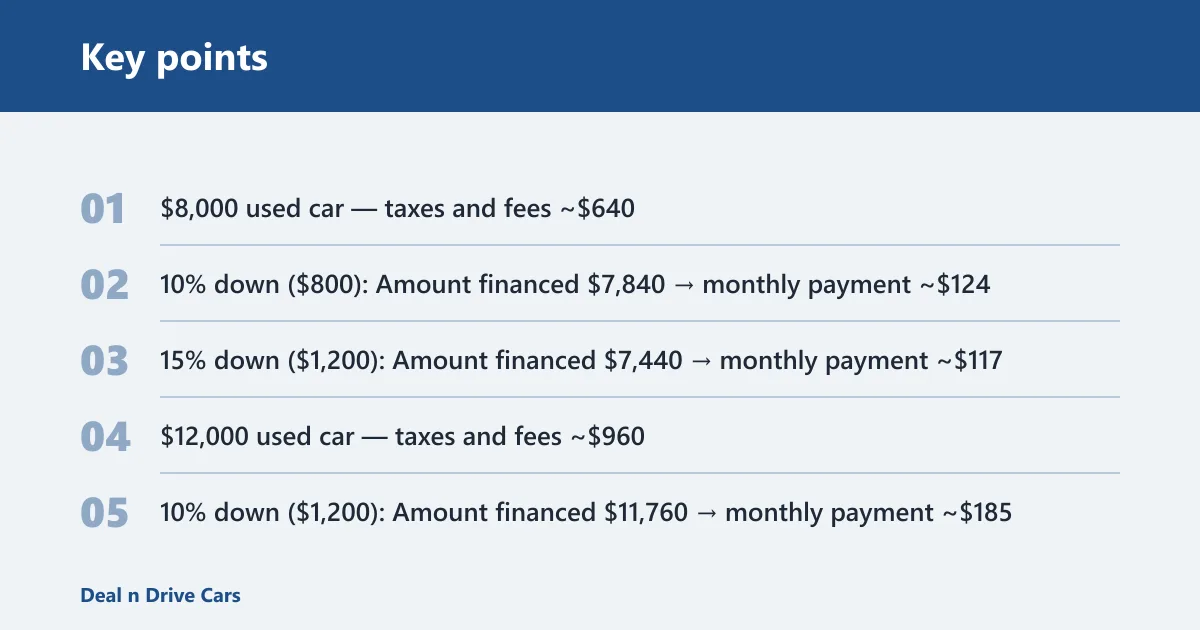
- $8,000 used car — taxes and fees ~$640
- 5% down ($400): Amount financed $8,240 → monthly payment ~$130
- 10% down ($800): Amount financed $7,840 → monthly payment ~$124
- 15% down ($1,200): Amount financed $7,440 → monthly payment ~$117
- $12,000 used car — taxes and fees ~$960
- 5% down ($600): Amount financed $12,360 → monthly payment ~$195
- 10% down ($1,200): Amount financed $11,760 → monthly payment ~$185
- 15% down ($1,800): Amount financed $11,160 → monthly payment ~$176
- $20,000 used car — taxes and fees ~$1,600
- 5% down ($1,000): Amount financed $20,600 → monthly payment ~$325
- 10% down ($2,000): Amount financed $19,600 → monthly payment ~$309
- 15% down ($3,000): Amount financed $18,600 → monthly payment ~$294
- $30,000 used car — taxes and fees ~$2,400
- 5% down ($1,500): Amount financed $30,900 → monthly payment ~$487
- 10% down ($3,000): Amount financed $29,400 → monthly payment ~$464
- 15% down ($4,500): Amount financed $27,900 → monthly payment ~$440
- $40,000 used car — taxes and fees ~$3,200
- 5% down ($2,000): Amount financed $41,200 → monthly payment ~$650
- 10% down ($4,000): Amount financed $39,200 → monthly payment ~$619
- 15% down ($6,000): Amount financed $37,200 → monthly payment ~$587
How do trade-ins and negative equity change your down payment?
Trade-in value and existing loan balances directly alter the cash you bring to the deal. Positive equity from a trade-in can count toward your down payment, while negative equity reduces the amount available. Understanding how these pieces interact helps you calculate the true upfront cost.
Using positive trade-in equity toward the down payment
If your current car is worth more than you owe, that difference is positive equity. You can apply it as a credit toward the new purchase. Suppose your trade-in is valued at $8,000 and you owe $5,000 on the loan. The $3,000 equity can serve as part or all of your down payment, reducing the cash you need to bring from savings.
When negative equity reduces usable down payment
Negative equity occurs when you owe more than the car is worth. That shortfall often rolls into the new loan, effectively increasing the amount financed. If you owe $10,000 on a car worth $8,000, the $2,000 difference may be added to the new loan balance. This increases monthly payments and total interest, even if you make a down payment with other funds.
How trade-in payoff affects total cash needed
The dealer will pay off your existing loan directly from the trade-in proceeds. Any remaining equity or deficiency is factored into the new purchase contract. Always request a detailed payoff statement before shopping. Knowing the exact amount your current lender requires prevents surprises at signing and tells you how much usable equity you actually have.
How do lenders decide your down payment?
Lenders use down payment size as a primary risk indicator. The loan-to-value ratio, or LTV, measures the loan balance against the car’s actual value. Lower LTV percentages generally signal lower risk to lenders and can affect both approval and pricing.
Loan-to-value ratio and lender risk
Many lenders prefer an LTV below about 80% for used cars. A 10% down payment results in an 90% LTV, which many lenders accept, especially if credit scores are strong. A 20% down payment brings LTV to 80%, often qualifying for better rates. Some subprime lenders may accept higher LTVs but charge higher interest rates to compensate. Lower LTV ratios generally correspond to better auto loan APRs, especially for borrowers in the prime credit tier.
Minimum down payment requirements
Experian says aim for at least 10% down on a used car. Equifax says used cars usually require down payments closer to 10%. These guidelines are common lender expectations, not absolute minimums. Some specialty programs or credit unions may approve loans with less, particularly for borrowers with excellent credit or strong employment history.
How LTV thresholds affect approval and pricing
Lenders set internal LTV cutoffs that determine loan eligibility. Falling below those thresholds often leads to better APRs and more favorable terms. A borrower with good credit might secure a 6.5% rate at 85% LTV but receive only a 9.0% rate at 95% LTV. The down payment size can be the deciding factor between standard and subprime pricing.
Does a bigger down payment lower your monthly car payment?
Yes, a larger down payment directly reduces the monthly payment. The effect scales with loan term and interest rate. Using a car payment calculator to model different down-payment amounts reveals exactly how much each dollar saved translates to monthly relief.
How amount financed drives monthly cost
Monthly payments are calculated based on the loan amount, interest rate, and repayment term. Each dollar you add to the down payment removes that dollar from the principal. For example, reducing the loan by $1,000 on a five-year loan at 7% APR typically lowers the monthly payment by roughly $15 to $18. NerdWallet estimates 10% down on a $25,000 used car is $2,500, and every $1,000 down reduces monthly payment by $15 to $18.
Interaction between down payment, APR, and loan term
Loan term amplifies the impact of down payment changes. A $2,000 down payment on a 72-month loan yields a larger monthly reduction than the same down payment on a 36-month loan, because the principal is spread over more payments. Higher APRs also increase the total interest burden, making a larger upfront payment even more valuable over time.
Using scenario testing to compare payment options
Run multiple calculations before committing. Compare payments at 5%, 10%, and 15% down using the same APR and term. Notice how small increases in down payment produce disproportionate benefits in shorter terms. A common first-timer mistake is assuming linear savings; the actual dollar savings can vary significantly depending on rate and length.
Can a bigger down payment lower your used car interest rate?
A larger down payment often improves loan pricing by lowering the lender’s risk exposure. However, credit profile and market conditions remain primary rate drivers. The down payment size alone rarely determines the final APR, but it can move you into a better tier within your range.
How lower LTV can improve loan pricing
Lenders reward lower loan-to-value ratios with better interest rates. Moving from 90% LTV to 80% LTV may drop the APR by several percentage points. This improvement reduces total interest paid over the loan life and can save hundreds or thousands of dollars. The exact savings depend on the original rate tier and lender policies.
When down payment size matters less for rate
If your credit score already qualifies you for the best available rates, increasing the down payment may not change the APR. Similarly, during periods of high demand or tight lending standards, rate differences between LTV tiers can shrink. Always confirm with the lender whether additional equity will affect pricing before adjusting your plan.
Why credit profile still drives final rate
Your credit score, debt-to-income ratio, and employment history carry more weight than down payment size alone. A borrower with excellent credit and a 5% down payment may receive a better rate than a borrower with fair credit and 20% down. Lenders evaluate overall risk holistically. The down payment is one piece of the approval puzzle, not the entire picture.
Should you drain savings to reach a down payment target?
No. Preserving an emergency fund matters more than hitting a specific down-payment percentage. Used cars bring unpredictable repair costs that can quickly overwhelm a depleted savings account. A balanced approach keeps you protected while still reducing loan size.
Used-car repair risk and emergency reserves
Immediate post-purchase repairs are common. Brakes, tires, batteries, and suspension components often need attention within the first few months. Setting aside $1,500 to $3,500 specifically for these costs ensures you are not forced into high-interest credit cards or additional loans when issues arise.
Balancing down payment size against cash buffer
Calculate your total available cash, then subtract the recommended reserve for repairs and fees. The remainder is the maximum you can safely apply as a down payment. If that amount falls below 10%, accept it. A smaller down payment with a solid safety net is financially healthier than an aggressive down payment that leaves you vulnerable. An emergency fund of three to six months’ expenses is the foundation recommended by the CFPB before taking on new installment debt.
When preserving savings outweighs a larger down payment
If your savings cover fewer than three months of essential expenses, prioritize building that foundation before committing most of it to a vehicle. Financial stability reduces the need for emergency borrowing later. The monthly payment increase from a smaller down payment is usually far less stressful than facing a major repair with no cash on hand.
Can you buy a used car with no down payment?
Yes, some lenders offer zero-down programs, but they come with stricter qualification requirements and higher costs. These options are available mainly to borrowers with excellent credit or special employer partnerships. They also increase the risk of negative equity from the start.
Programs and eligibility
Credit unions, some dealerships, and specialized lenders occasionally advertise no-money-down deals. Eligibility typically requires a credit score above 700, stable income, and low existing debt. Approval is not guaranteed, and the available vehicle inventory may be limited to newer, higher-priced models.
Risks of zero-down financing
Without an upfront payment, the loan balance equals the full purchase price plus taxes and fees. The car depreciates immediately, so you start underwater unless the vehicle holds value exceptionally well. Negative equity grows faster with zero down, making it harder to sell or trade later without bringing additional cash.
Alternatives to traditional down payment
If cash is tight, consider negotiating a lower purchase price instead of a larger down payment. A reduced price shrinks the loan amount naturally, achieving similar monthly relief without depleting savings. Also explore whether your employer has a preferred lender with flexible down-payment requirements. Understanding your trade-in value upfront can also reduce the amount you need to finance.
Frequently asked questions
How much of a down payment should you put down on a used car?
Aim for at least 10% of the purchase price, but adjust based on your repair fund. The exact amount should leave enough cash aside for taxes, fees, and unexpected maintenance. A smaller fixed sum on a cheap car can be safer than a larger percentage that empties your savings.
Is it better to put down a large down payment on a car?
A larger down payment lowers monthly costs and total interest, but only if you preserve emergency savings. Draining your account to reach a high percentage increases financial vulnerability. Balance the down payment size against the cash buffer you need for post-purchase repairs.
Should you put down a large down payment on a car?
Only after accounting for all associated costs and maintaining a healthy reserve. A large down payment reduces loan risk and may improve your interest rate, but it should not compromise your ability to handle unexpected expenses. Calculate your safe down-payment limit before committing funds.
Is it better to put a down payment on a car in cash?
Paying in cash avoids creating debt entirely, eliminating interest charges and monthly obligations. However, using most of your savings for a single purchase can leave you exposed to financial shocks. If paying cash, ensure you still have enough emergency funds to cover living expenses and car repairs.
What is a good down payment percentage for a used car?
Ten percent is the common benchmark for used vehicles. It keeps loan-to-value ratios manageable and aligns with most lender guidelines. Some buyers opt for 15% or 20% to further reduce monthly payments and interest costs, provided they retain adequate cash reserves afterward.
Is $500 enough for a used car down payment?
It can be enough on a low-priced car if it leaves sufficient room for fees and repairs. On an $8,000 vehicle, $500 represents about 6%, which is acceptable if you have a separate emergency fund. For higher-priced cars, $500 may be too small to meaningfully lower the loan balance or improve terms.