Why Is My Car Registration Renewal So Expensive?
Your car registration renewal is usually expensive because one or more line items changed: a value-based charge, a local fee, an inspection or emissions charge, or a late penalty. Ignore the breakdown, and you can overpay or miss an error that costs you more than the renewal itself. This guide shows how to read each line on the notice, spot the fee that jumped, and verify the total before you pay.
This guide is part of our Registration fees for a car: what you’ll pay and why series.
Why your renewal total jumped
A high renewal bill usually comes from a fee change, not one mystery price. Split the total into the base registration fee and every add-on on the renewal notice. Then compare this year’s notice with the last one and ask one question: which line changed first?
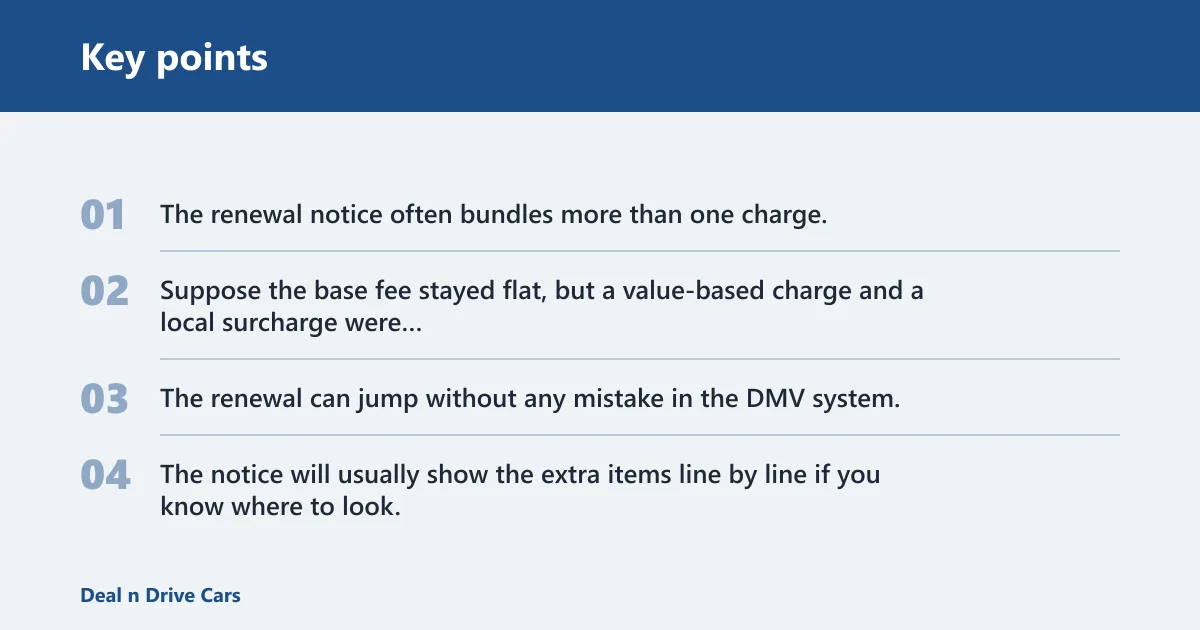
The renewal notice often bundles more than one charge, so the total can rise even when the base fee stayed the same.
Renewal bill diagnostic table
| Fee line item | Why it appears | Common states or scenarios | Red flags | What document to check next |
|---|---|---|---|---|
| Base registration fee | Core DMV charge for keeping the vehicle registered | Every state, though the formula varies | Total is high even though no add-ons are listed | State DMV fee chart and the renewal notice subtotal |
| Value-based fee | Charge tied to market value, model year, or assessed value | States that price registration by vehicle value | Newer or pricier vehicle gets a much higher bill | State DMV formula, vehicle record, or valuation schedule |
| Electric vehicle surcharge | Extra road-use fee or EV-specific registration fee | Some states, especially for battery-electric or plug-in vehicles | EV bill is far above a similar gas car | EV fee section on the renewal notice and state DMV rule |
| Inspection or emissions charge | Separate cost for safety or emissions compliance | States that require testing before renewal | Fee appears even though the base registration looks ordinary | Inspection receipt, emissions test record, or renewal instructions |
| County or city surcharge | Local add-on collected with state renewal | Counties or cities that impose extra registration charges | Notice lists a local authority or jurisdictional add-on | Local DMV or county fee schedule on the renewal notice |
| Late renewal fee | Penalty for missing the deadline | States that charge extra after expiration | Total jumps after the due date even though other lines stayed the same | Expiration date on the notice and the late-fee rule from the state DMV |
Suppose the base fee stayed flat, but a value-based charge and a local surcharge were added this year. The renewal can jump without any mistake in the DMV system. The notice will usually show the extra items line by line if you know where to look.
What the base registration fee covers
The base registration fee is the core DMV charge, and it is often only part of the total. It covers the right to keep the vehicle registered for the renewal period, but it does not always include testing, local add-ons, or penalties. That is why the base number on the notice can look small while the final bill feels large.
Why the base fee can look low
Some renewal notices list the base fee first and put other charges below it. That layout can make the core charge seem like the full price, even though the final total includes several separate items. If the notice has a subtotal and a total, use both.
The state DMV sets the formula, so two states can charge very different base amounts for the same type of vehicle. The key point is simple: check whether the notice separates the base fee from every add-on.
Why vehicle value can raise the bill
In some states, registration cost depends partly on vehicle market value. Higher-value cars can pay more because the DMV formula uses price, assessed value, or a value bracket. That means a newer or pricier vehicle can carry a larger renewal bill even if nothing else changed.
How to verify a value-based charge
Check whether the renewal notice lists an assessed value, market value, or a vehicle value factor. If the bill changed right after a purchase or title transfer, the first-year amount may not match the later renewal.
A common first-timer mistake is assuming the first renewal should match the dealer paperwork. It often does not. First-year charges and later renewal charges can follow different formulas, so compare the notice against the state DMV’s current fee schedule, not the window sticker or the purchase contract.
Could EV, inspection, or local fees be the reason?
Yes. Electric vehicle registration fees, inspection charges, and local surcharges can stack on top of the base fee and push the total much higher. These are state-specific add-ons, so the right question is not whether they exist somewhere, but whether they appear on your notice and in your DMV rule set.
Electric vehicle registration fees
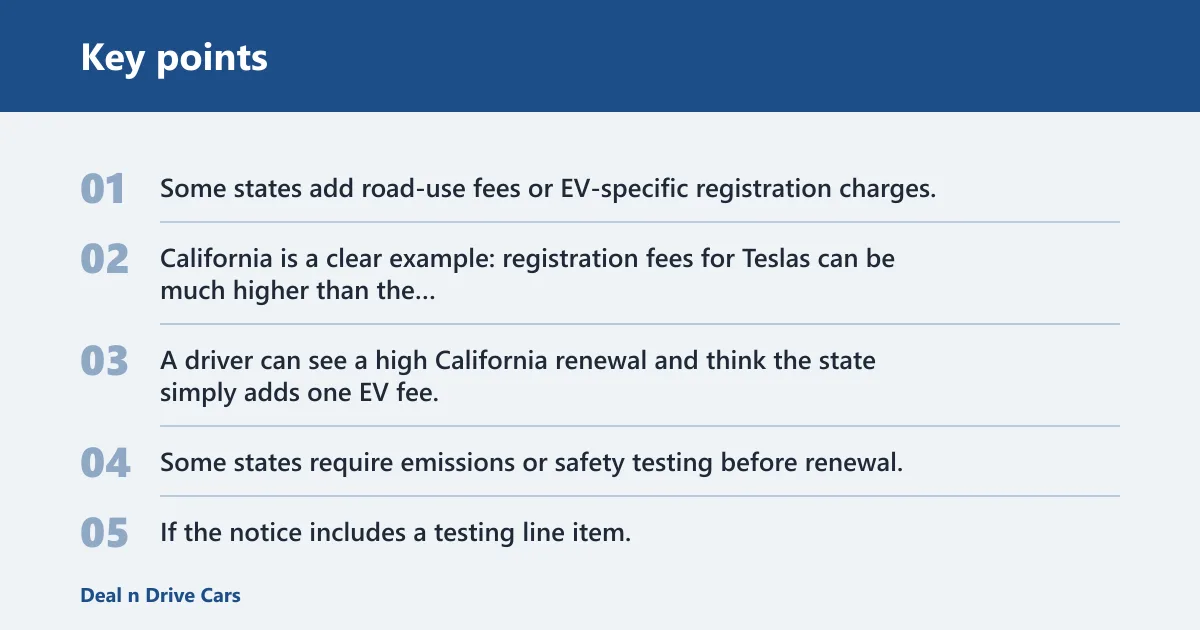
Some states add road-use fees or EV-specific registration charges. California is a clear example: registration fees for Teslas can be much higher than the base charge, and California fees can combine several separate items for plug-in vehicles.
That mix matters. A driver can see a high California renewal and think the state simply adds one EV fee, when the total may actually combine several separate charges.
Inspection or emissions fees
Some states require emissions or safety testing before renewal, and those fees can appear on top of the base charge. If the notice includes a testing line item, compare it with your inspection receipt and the state’s renewal rules.
County and city surcharges
Local governments can add their own registration charges. If the notice names a county, city, or local district, that is a strong clue the higher bill is not a DMV error.
Picture a driver who moves from one county to another and then gets a renewal notice with a new local surcharge. The bill can change without any change in the vehicle itself. The location tied to the registration can matter as much as the car.
Why late renewal makes the total higher
Missing the deadline can add a penalty on top of every other charge. Late renewal fees vary by state, and they are often listed as a separate line on the notice. If the bill jumped after the expiration date passed, the late fee may be the main reason.
What date to compare against
Use the expiration date on the renewal notice, not the date the notice arrived. Then compare that date with the date you are trying to renew. If the state treats the renewal as late, the penalty can be added automatically, and some states also apply extra administrative charges when a registration is overdue.
If the vehicle was already expired, do not assume the base fee changed. Check whether the new total is simply the normal renewal plus the overdue penalty. That distinction matters because one item is a routine charge and the other is avoidable.
How to verify each charge on your renewal notice
The fastest way to judge a high bill is to trace each line on the renewal notice back to the state DMV rule that created it. That means matching the line item name, the fee amount, and the reason it appears. If the notice does not explain a charge, look for the same wording in the DMV fee schedule or renewal instructions.
Use this order
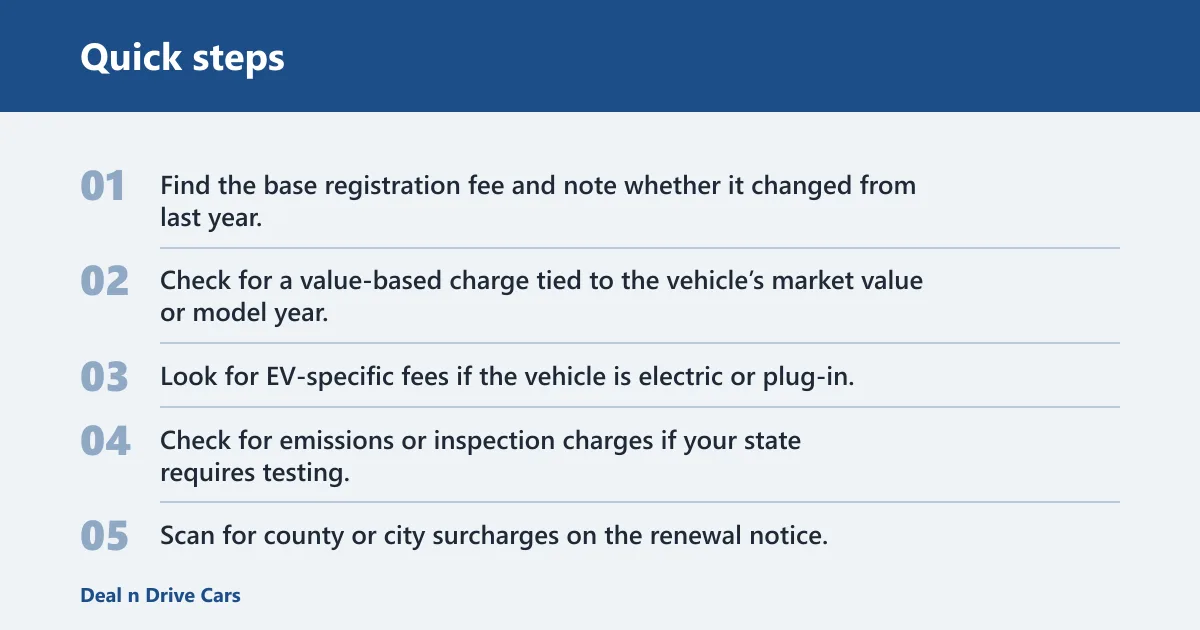
- Find the base registration fee and note whether it changed from last year.
- Check for a value-based charge tied to the vehicle’s market value or model year.
- Look for EV-specific fees if the vehicle is electric or plug-in.
- Check for emissions or inspection charges if your state requires testing.
- Scan for county or city surcharges on the renewal notice.
- Compare the expiration date with the renewal date to see whether a late penalty applies.
- Match every amount to the state DMV fee schedule before you pay.
What to check next if the total still looks wrong
Look for exemptions, credits, or a fee that should not apply to your vehicle class. Used-car buyers should also verify the registration details on the notice. If a line item does not appear on the state fee chart or renewal instructions, ask the DMV to explain that specific charge before paying.
Frequently asked questions
Why is my car registration renewal so expensive?
Your renewal is usually expensive because more than one fee is included in the total. The base registration fee may be only part of the bill, with value-based charges, inspection costs, local surcharges, or a late penalty added on top. The renewal notice should show which line item pushed the amount up.
Why is my car registration renewal so expensive in California?
California can be expensive because the renewal may include several separate charges. Check which of those items appears on your notice.
Why is my car tag renewal so expensive?
“Tag renewal” usually refers to the same registration renewal bill. The price can feel high when the notice includes more than the base fee, such as a local surcharge, inspection charge, EV fee, or late penalty. Read the line items, not the total alone.
Why do registration fees change by state?
State DMV rules generally set the formula, and each state can price registration differently. Some charge a flat amount, while others add value-based fees, local surcharges, or vehicle-type charges. That is why two similar cars can have very different renewals depending on where they are registered.
What fees are included in registration renewal?
The renewal can include the base registration fee, a value-based fee, an EV surcharge, an inspection or emissions charge, a county or city surcharge, and may also include a late fee if the deadline has passed. Your renewal notice should list each charge separately or show enough detail to match it to the DMV rule.
What makes registration more expensive for electric cars or luxury cars?
Electric cars can face state-specific EV surcharges or road-use fees, while luxury or high-value cars can trigger value-based charges. In both cases, the vehicle’s price or type changes the formula. That is why the same renewal category can cost much more for one car than for another.