Is 10% Enough Down on a Used Car?
Yes, 10% down is usually enough on a used car if it keeps your loan below the car’s value and leaves cash for fees and repairs. Put too little down, and you can go underwater fast, while paying more interest across the loan. This guide shows when 10% works, when it does not, and how to judge cash versus trade-in equity.
This guide is part of our Used car down payment: how much should you put down? series.
What 10% down means
Down payment means the cash you put in upfront, or the positive equity from a trade-in that you apply at signing. It cuts the amount financed, which lowers the monthly payment and the interest cost over the loan term. For used cars, about 10% is a common planning benchmark, not a lender rule.
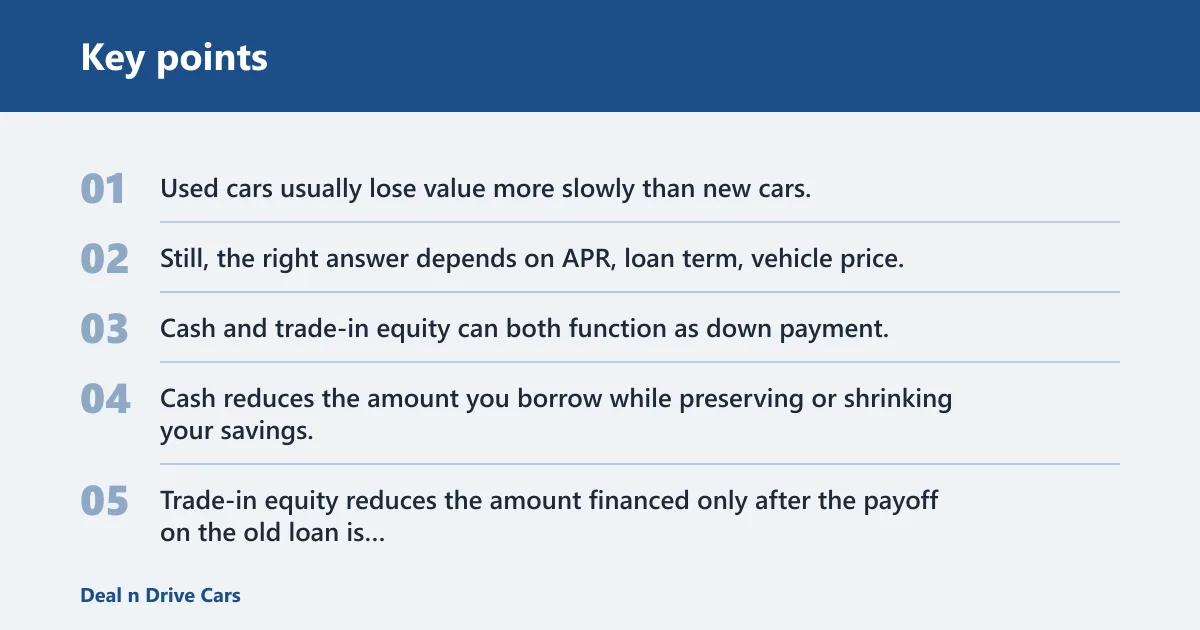
Used cars usually lose value more slowly than new cars, so the 10% benchmark can be enough more often than it would be on a brand-new vehicle. Still, the right answer depends on APR, loan term, vehicle price, and how much cash you need to keep after closing.
Cash versus trade-in equity
Cash and trade-in equity can both function as down payment, but they do not affect your budget the same way. Cash reduces the amount you borrow while preserving or shrinking your savings. Trade-in equity reduces the amount financed only after the payoff on the old loan is settled.
If your trade-in has negative equity, that shortfall increases the new loan balance instead of helping it. Positive equity can help you reach a stronger loan-to-value ratio without bringing as much cash to the table.
How it changes the amount financed
A larger down payment lowers the loan amount, which lowers the loan-to-value ratio. Lenders care about that ratio because it shows how much of the car’s value they are financing. A lower ratio usually means less lender risk and less chance that you owe more than the car is worth early in the loan.
HonestCredit says a stronger down payment may reduce the amount financed, and it warns not to drain cash reserves just to reach the target. That is the right trade-off to keep in mind.
Why it is a planning benchmark, not a lender rule
The same source says 20% and 10% are planning rules, not universal requirements. The common rule of thumb is 20% for new cars and 10% for used cars, but neither number guarantees approval or safety. A lender can approve less, while a safer budget may still call for more.
Down payment decision table
| buyer situation | 10% down outcome | better move |
|---|---|---|
| Low APR or 0% APR, short term, strong credit | 10% often keeps the loan manageable because the rate is already working in your favor | Use 10% if the payment fits and you still keep cash for repairs and registration |
| High APR, 72-month or 84-month term | 10% may still leave you underwater for a long stretch because interest and depreciation stack up | Put more down, shorten the term, or choose a cheaper car |
| Strong credit, 48-month or 60-month term | 10% can be enough if the monthly payment stays within budget | Keep 10% if the loan stays below the car’s value and cash remains untouched |
| Weak credit, high APR, 60-month or longer term | 10% may not protect you from a large payment or negative equity | Increase the down payment or reduce the price and term |
| Positive trade-in equity | 10% may be easier to hit because the trade-in can count toward it | Use the equity, but verify the payoff amount first |
| Negative trade-in equity | The rolled-over balance can erase part of the 10% and push the loan higher | Pay the negative equity separately if possible, or lower the car price |
| Emergency-fund-safe after closing | 10% is more defensible because you still have money for insurance, maintenance, and income shocks | Keep the 10% and preserve your cash buffer |
| Emergency-fund-draining to reach 10% | 10% becomes the wrong target if it empties your reserve | Put less down and keep liquid cash for the next repair or bill |
Is 10% enough on a used car?

Ten percent is usually enough on a used car when the loan stays below the car’s value, the term is reasonable, and you still have cash after closing. It is not enough when the payment strains your budget, the rate is high, or the loan term is so long that you stay underwater for years.
When 10% is usually enough
Ten percent tends to work best on a used car with a roughly 36-, 48-, or 60-month term. A shorter term reduces the time you spend exposed to depreciation, and a lower APR makes the loan less expensive to carry.
A 0% down loan on a $35,000 car shows a $693 monthly payment. A 10% down loan on that same $35,000 car shows a $624 monthly payment. A 20% down loan on that same $35,000 car shows a $554 monthly payment. The larger the down payment, the more the payment falls.
When 10% is not enough
Ten percent is weak if you pair it with an 84-month loan, high APR, or a car that is already close to the top of your budget. Long terms slow principal paydown, so the balance can stay above the car’s value for a long time. That is the classic negative-equity trap.
Picture a buyer who puts 10% down on an older SUV, then stretches the loan to 84 months to force the payment lower. The payment may look manageable at signing, but depreciation can outpace the loan balance for much longer than expected.
What to do if you are close but not there
If you are short of 10%, the best move is usually to reduce the purchase price, shorten the term, or increase the down payment with trade-in equity. Do not raid your emergency fund just to hit a percentage. A safer loan with cash left over is better than a slightly better loan that leaves you exposed.
Why a bigger down payment matters
A bigger down payment lowers the amount financed, which lowers the monthly payment and the total interest you pay. It also lowers the loan-to-value ratio, which makes the loan less likely to start underwater. That matters most when APR is high or the vehicle is older and depreciating faster than the balance falls.
Lower monthly payment
Every extra dollar upfront is one less dollar borrowed. On a fixed-rate auto loan, that usually means a smaller monthly bill. The difference matters more when the loan term is short, because each principal reduction has a larger effect on the payment.
Lower total interest
Because interest is charged on the amount financed, a larger down payment cuts the interest base from day one. The savings become more meaningful at higher APRs. At low or 0% APR, the interest benefit is smaller, so the cash decision shifts more toward liquidity.
Lower loan-to-value ratio
Loan-to-value ratio measures how much you borrow against what the car is worth. A larger down payment lowers that ratio and reduces the chance that you owe more than the car can sell for. That matters if you need to sell early or if the car is totaled.
Less negative equity risk
Negative equity means the loan balance exceeds the vehicle value. Low down payments raise that risk, and long loan terms make it worse because the balance falls slowly while the car loses value. A 72-month or 84-month loan needs more caution than a 36-month or 48-month loan.
When a smaller down payment can work
A smaller down payment can work when the APR is low, the term is short, and your savings are strong enough to absorb a repair, deductible, or short income gap. It can also work on a lower-priced used car where the loan balance is already modest.
Low APR or 0% APR offers
Low APR changes the math because less interest means the loan is less expensive to carry. In that case, the value of extra down payment shifts away from interest savings and toward cash preservation. If the rate is unusually low, keeping more cash may be the better move.
Short loan terms
Thirty-six and 48-month terms reduce the time spent exposed to depreciation. That can make 10% down more workable because the balance falls faster. Sixty months is still common, but 72 and 84 months increase underwater risk and demand more caution.
Strong cash reserves
If a larger down payment would leave you with too little cash for repairs, insurance deductibles, or a gap in income, it can backfire. HonestCredit specifically warns not to drain cash reserves just to reach the target. A healthy emergency fund is part of the deal.
Low-priced vehicles
On a cheaper used car, 10% may be a relatively small dollar amount, yet still enough to make the loan manageable. That is why some shoppers can buy safely with less than a textbook target, while others cannot. Vehicle price matters as much as the percentage.
Can a trade-in count toward your down payment?
Yes. Positive trade-in equity can count toward your down payment, and it is often the easiest way to reach a stronger upfront position. Negative equity works the opposite way, because the payoff shortfall gets added to the new deal and can erase part of your down payment.
Positive trade-in equity
If your trade-in is worth more than the payoff, the difference is equity you can use at closing. That equity lowers the amount financed the same way cash does, as long as the dealership applies it correctly to the new contract. Check the payoff amount before you assume the full trade value helps you.
Negative equity rolled into the new loan
If you owe more on the old car than it is worth, the unpaid amount can roll into the new loan. That makes the new balance higher than the sticker math suggests. A 10% down payment can disappear fast if the old payoff is upside down too.
How to check the payoff amount
- Get the exact payoff quote from your current lender.
- Compare that number with the trade-in offer, not the guess in your head.
- Subtract payoff from trade value to find positive or negative equity.
- Use only the positive amount as down payment credit.
- If there is negative equity, decide whether to pay it separately.
How much down on a used car do you need?
There is no single number that fits every used-car purchase. A common starting point is $1,000, but 10% is the better planning benchmark for many buyers. The right amount depends on price, APR, term length, and how much cash you need to keep after signing.
$1,000 down as a starting point
Is 1000 down on a car enough? Sometimes, but not always. On a low-priced used car, $1,000 may be a solid start. On a more expensive car, it can leave you with a high loan-to-value ratio and more underwater risk, especially if the term is long.
Wealthvieu lists used-car minimum down payment at 5-10%. On a $30,000 car, Wealthvieu shows $3,000 at 10% down and $6,000 at 20% down. That makes the scale of the decision clear: a fixed $1,000 does not mean the same thing across different cars.
10% by vehicle price
For a used car, 10% is often the cleaner target because it scales with the purchase price. On a $20,000 car, that would be about $2,000. On a $30,000 car, that is $3,000. On a $40,000 car, that would be about $4,000. The higher the price, the more important the percentage becomes.
How term length changes the target
Longer terms raise underwater risk, so they usually call for a stronger down payment. A 60-month loan may be manageable with 10% down, while a 72-month or 84-month loan can justify more cash upfront. The longer the loan, the slower your equity builds.
What happens if you put too little down?
Too little down can leave you with a monthly payment that squeezes your budget and a loan balance that stays above the car’s value. That makes it harder to sell, trade, or recover if the car is totaled. The risk is highest when APR is high and the term is long.
Payment strain
If the payment is too high, the loan can become a budget problem before it becomes a car problem. That is especially true when insurance, fuel, and maintenance are already taking a share of your income. A lower payment from a larger down payment can create breathing room.
Higher chance of being underwater
Negative equity is more likely with low down payments and long loan terms because the balance falls slowly while the car loses value. If you need to sell early, roll the loan into another car, or replace it after a loss, being underwater can be expensive.
More risk if the car is totaled or sold early
If the car is totaled, insurance may pay only the vehicle’s current value, not what you still owe. If you are underwater, you may still have a gap to cover. A larger down payment lowers that gap, but only if it does not empty your emergency fund.
Frequently asked questions
What percent down for a used car is recommended?
Ten percent is the common planning benchmark for used cars, and HonestCredit says 20% new and 10% used are rules of thumb, not universal requirements. If the APR is high or the term is long, a higher down payment can be safer. If cash is tight, keep your emergency fund intact.
Can I buy a used car with no down payment?
Yes, some lenders will finance a used car with no down payment, but approval is not the same as safety. A 0% down deal raises the loan-to-value ratio and can increase underwater risk. If you go that route, a shorter term and a strong cash buffer matter even more.
Does a bigger down payment lower my monthly car payment?
Yes. A bigger down payment lowers the amount financed, so the monthly payment usually falls. The $35,000 example shows that 0% down leads to a $693 monthly payment, 10% down leads to $624, and 20% down leads to $554. The payment drops as upfront cash rises.
Does a down payment lower my used car interest rate?
Not automatically. A larger down payment can improve the loan-to-value ratio and may help the deal look safer to a lender, but it does not guarantee a lower APR. A low or 0% APR offer changes the trade-off because interest savings from extra down payment are smaller.
Should I use my emergency fund for a car down payment?
No, not if it drains your reserve. A bigger down payment is not worth losing the cash you need for repairs, insurance, or an income shock. HonestCredit warns against draining reserves just to hit the target. Keep enough liquid cash to handle a real surprise.