How to Sell a Car Privately
To sell a car privately, set an asking price based on the market, gather title and payoff details before listing, screen buyers by phone, accept only verified funds, and file the release-of-liability form the same day the car leaves. Get the order or paperwork wrong, and you can lose thousands to underpricing, payment fraud, title delays, or tickets and crashes tied to your old registration. This guide lays out the exact sale sequence, paperwork, pricing method, safe meetup steps, and handoff checklist.
What you’ll need
- Car title in the seller’s name, or replacement-title application details if the original is missing
- Current registration
- Lender payoff statement and lien-release process details if the car is financed
- Current odometer reading
- Bill of sale form for your state, province, or country
- Release of liability form or the local DMV equivalent
- Driver license or ID for seller identity matching
- Vehicle history report dated before listing
- Service records, inspection receipts, and maintenance history
- Valuation tool results and local comparable listings
- Photo checklist: front, rear, both sides, wheels, interior, odometer, VIN plate, cargo area, defects
- Public meetup location and planned test-drive route
- Buyer-screening script for phone calls or messages
- Bank branch plan for verified cashier’s check or wire transfer receipt
Car privately table
| Step | Owner action | Document needed | Risk if skipped | Completion time estimate |
|---|---|---|---|---|
| 1 | Choose private sale or trade-in after checking title, loan, timing, and risk tolerance | Title status, payoff statement, valuation notes | You list a car that cannot transfer cleanly or is not worth the hassle | 30-45 minutes |
| 2 | Confirm the title is present, accurate, and ready for transfer | Physical title or replacement-title application | Sale stalls at handoff because ownership cannot legally transfer | 15-60 minutes |
| 3 | Get lender payoff details and lien-release timing if financed | Payoff letter, lender contact, account details | Buyer walks when the lien release is unclear or too slow | 20-40 minutes |
| 4 | Pull a current vehicle history report and gather service records | History report, receipts, maintenance log | Late surprises on accidents, title brands, or lien history kill trust | 30-60 minutes |
| 5 | Record the current odometer reading and prep the bill of sale | Odometer reading, bill of sale form | Transfer paperwork is incomplete, especially for 2011 or newer cars | 15-20 minutes |
| 6 | Price the car from valuation tools and local comps, then set a walk-away number | Valuation results, comparable listings | You underprice early or accept a weak offer under pressure | 45-90 minutes |
| 7 | Wash it, clear out personal items, photograph every required angle and flaw, then write a listing with VIN, mileage, title status, service history, and known defects | Photo list, VIN, condition notes | Low-quality leads, repeated basic questions, weaker offers | 2-4 hours |
| 8 | Screen inquiries before sharing meetup details | Phone script, meeting rules | Code scams, fake deposits, no-shows, or risky meetups | 5-15 minutes per lead |
| 9 | Run a controlled viewing and test drive | Buyer license check, route plan | Vehicle theft, uninsured driving, or pressure to release keys | 30-60 minutes |
| 10 | Verify payment before signing over the car | Bank confirmation, receipt, ID match | Reversible or fake payment after you already gave up the vehicle | 30 minutes to 1 business day |
| 11 | Sign title, complete bill of sale, and finish odometer disclosure | Title, bill of sale, any state forms | Buyer cannot register the car, or seller remains exposed | 15-30 minutes |
| 12 | File release of liability and complete post-sale DMV steps | Release form, plate rules, sale date | Tickets, tolls, crashes, or tax notices stay attached to you | 10-30 minutes |
| Failure point | What stops the sale | What to do first | Do not proceed until |
|---|---|---|---|
| Missing title | You cannot properly transfer ownership | Apply for a replacement title and confirm name accuracy | The replacement title or approved duplicate is in hand |
| Unsafe test drive | You lose control of the car, route, or driver identity | Verify license, choose public meetup, keep keys until seated together | The driver is verified and the route is agreed |
| Payment before transfer | Funds look sent but are not actually settled or verified | Meet at the buyer’s bank or confirm wire receipt with your bank | Your bank confirms funds and transfer paperwork is ready |
How do you decide whether to sell privately?
A private sale makes sense when your title is ready, any loan payoff is manageable, the car presents honestly, and you can spend time screening buyers and controlling the handoff. Trade-in is often the better call when timing is tight, title problems exist, or lender payoff friction could scare off buyers.
Check the upside against the friction
Carwow says private selling can earn you more money, and it also says private sale gives you more control over price and process. That upside disappears fast if the car needs costly repairs, you cannot produce a title, or you need it gone this week.
Start with three numbers:
- Pull a private-sale range from a valuation tool, then note the mileage, trim, condition, and ZIP or region assumptions behind that figure.
- Get a dealer trade-in or instant-buy quote.
- Subtract expected prep costs, payoff fees, and likely negotiation room.
If the adjusted gap still pays for your time, keep going. If it does not, trading in may be the cleaner choice.
Screen for deal-breakers before you list
- Compare your ID name to the title name.
- Check whether a lienholder is still listed.
- Confirm whether local emissions or inspection paperwork affects transfer.
The title must be signed over to transfer ownership. If the title is missing, replace it before sale. A bill of sale can support the transaction, but it does not replace a required title transfer.
Set your minimum net and your timeline
Pick a lowest acceptable number before the first buyer calls. Then set a timeline for prep, listing, in-person meetings, payment clearing, and post-sale filing.
Suppose your payoff is due in five days and the lender needs extra time to issue a lien release. That alone can push you toward a dealer or a bank-branch closing instead of an open-ended private listing.
Sell privately or trade in: the decision framework
Your final choice depends on whether the private-sale premium justifies the administrative burden. The supporting article details a specific break-even test: only sell privately if your net gain exceeds the combined cost of time, advertising fees, and repair liabilities. It outlines the exact paperwork, safety protocols, and tax implications that often surprise sellers during a private transaction.
Use this comparison to determine if a dealer’s quick cash offer is worth the savings on your hours and risk. The guide provides a side-by-side worksheet to calculate your true net proceeds from both paths, ensuring you avoid common mistakes like missed tax credits or title errors. Find the full breakdown of these financial and logistical factors in the private vs trade comparison guide.
How do you get the car and paperwork ready?
Get the transfer documents right before you spend time on photos or ad copy. Most failed private sales trace back to title problems, unresolved liens, missing odometer disclosure, or a thin maintenance record, not to a carpet that needed one more pass with a vacuum.
Confirm title status and the lien-release path
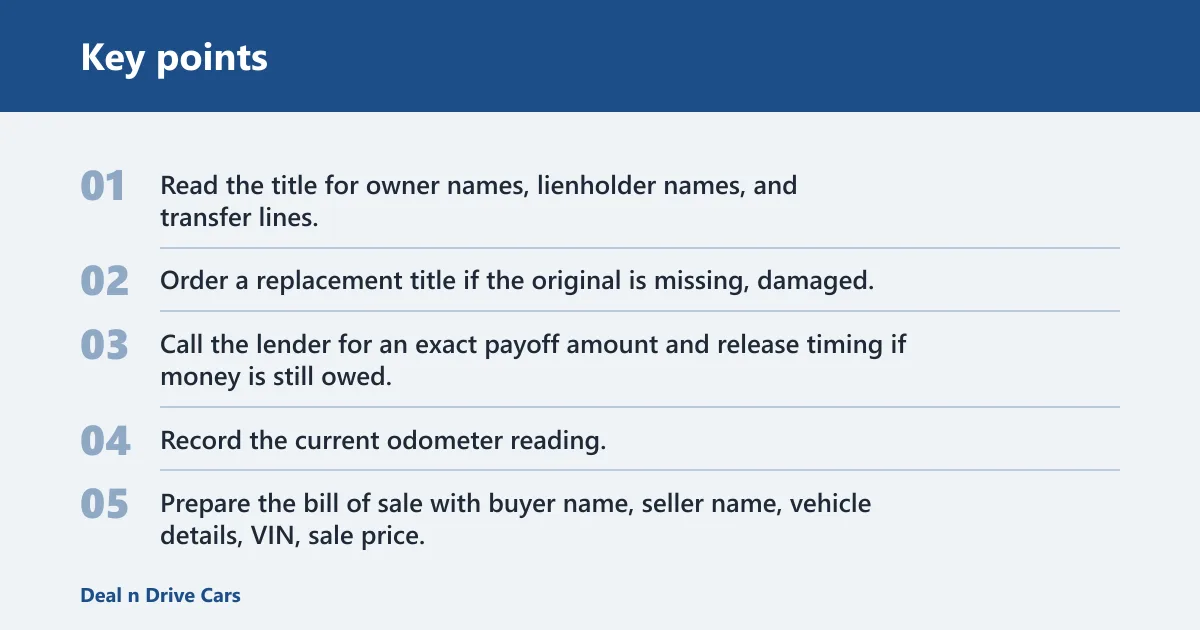
- Read the title for owner names, lienholder names, and transfer lines.
- Order a replacement title if the original is missing, damaged, or signed in the wrong place.
- Call the lender for an exact payoff amount and release timing if money is still owed.
If more than one owner is listed, confirm whether both signatures are required. If the seller ID name does not match the title, stop and fix that first through the local DMV or equivalent office.
Gather the full sale packet
- Record the current odometer reading.
- Prepare the bill of sale with buyer name, seller name, vehicle details, VIN, sale price, date, odometer reading, signatures, and any required local language.
- Set aside the release of liability form for same-day filing after handoff.
Odometer disclosure matters during transfer, and it is especially important for 2011 or newer cars, where federal odometer rules commonly apply. Keep the reading consistent across the title, bill of sale, and any state transfer forms.
Decide what to fix and what to disclose
Auto Express recommends a thorough clean before selling. Do that, but spend money only where it changes buyer confidence or legal exposure.
- Fix before listing: safety faults, active warning lights tied to drivability, tire issues that make a test drive questionable, broken lights, failed inspections that block transfer.
- Usually worth doing: detail cleaning, replacing cheap trim pieces, removing odors, basic paint touch-ups if the cost is low.
- Often poor return: large cosmetic jobs, major mechanical work you will not recoup, accessories the market does not pay extra for.
- Better disclosed than repaired: old dents, minor scratches, upcoming maintenance, known non-safety faults with receipts or estimates.
Service records, oil-change receipts, repair invoices, and inspection reports raise buyer confidence because they back up your condition claims with dates and parts replaced.
How do you price the car for a private sale?
Price from evidence, not hope. Use a valuation tool as the starting point, compare it with local listings for similar year, trim, mileage, and title status, then build in a clear negotiation buffer and a firm walk-away number before the ad goes live.
Build a pricing range
- Pull at least one valuation-tool estimate for private sale.
- Compare against local listings with similar mileage, trim, condition, and title history.
- Remove obvious outliers that have been sitting unsold or are missing key details.
Use local comparables that match your actual car, not the highest asking price online. A branded title, old accident history, worn tires, or overdue major service can erase much of the private-sale premium.
Make condition adjustments and set a walk-away number
Use a simple framework:
- Start with the realistic middle of your comparable range.
- Subtract for defects buyers will spot fast: cracked glass, tire wear, warning lights, paint mismatch, missing keys.
- Add for unusually complete records, fresh inspection, or rare options buyers actually search for.
Then set two numbers:
- Asking price: your target plus negotiation room.
- Walk-away price: the lowest net amount you will accept after payoff and sale costs.
A practical top-up method helps. If your first week brings strong interest but every buyer stops at the same lower number, adjust by $250 per change, then check response after the next few serious inquiries. That keeps price moves controlled instead of emotional.
How do you list the car and screen buyers safely?
A strong private-sale listing answers the buyer’s first risk questions before they ask: title status, accident history, maintenance proof, known defects, and who is actually selling the car. Safe screening then filters out code scams, fake deposits, shipping stories, and buyers who push to leave the platform too early.
Write a listing that removes doubt
- List the exact year, make, model, trim, VIN, mileage, and title status.
- Disclose known defects and recent work in plain language.
- State how payment and test drives will be handled.
The same source says good photos and key information matter in the listing. Include front, rear, both sides, wheels, seats, dash, odometer, cargo area, VIN plate, and every visible defect that a buyer would notice on arrival.
A vehicle history report supports transparency before listing. It can surface accidents, title brands, and lien issues early, while you still control the explanation, instead of later when a buyer thinks you hid something.
Use a screening checklist before any meetup
- Move from messages to a short phone call before sharing your exact location.
- Ask whether the buyer has funds ready and whether a trade, shipper, or third party is involved.
- Refuse code-verification requests sent to your phone or email.
- High-risk message: “I’ll send a deposit now, my mover will collect it.”
- High-risk message: “Please text me the code I sent to prove you’re real.”
- High-risk message: “My cousin will pick it up, I’ll overpay for transport.”
- High-risk behavior: pressure to move off-platform immediately, urgency without questions about the car, refusal to speak by phone.
Carwow warns the process puts you at risk of being scammed. The useful response is not broad suspicion. It is a hard stop on any buyer who avoids identity, avoids voice contact, or wants money or codes exchanged before a real viewing.
Say your listing is for a midsize sedan with 92,000 miles, and the first message offers full price if you remove the ad now. If that buyer will not take a phone call and wants a code sent back, end the conversation there.
How to write a listing that earns replies
A strong private-sale listing should make it easy for buyers to decide quickly: say what the car is, its condition, mileage, service history, price, and any flaws up front. The supporting guide on private car sale listing breaks down how to build a title, write a clear description, choose useful photos, and include the details buyers care about most.
That matters because vague ads create extra messages, low offers, and wasted time. A specific listing filters out unserious buyers, improves trust, and helps the right people contact you first—so you spend less time explaining basics and more time arranging viewings with genuine interest.
How do you handle viewings, test drives, and negotiation?
Run viewings like controlled appointments, not casual meetups. Verify the driver’s license, meet in a public place, keep possession of keys and documents until you choose to move forward, and negotiate from your evidence-backed price range instead of reacting to pressure on the spot.
Control the meetup and test-drive route
- Meet in a public location with cameras or at a bank branch parking area.
- Verify the buyer’s driver license before the engine starts.
- Set a short route with city streets and one higher-speed section if legal and safe.
Do not hand over the title, a signed bill of sale, or a full set of keys just to “look things over.” Keep one key in your possession. If local norms or insurance terms are unclear, call your insurer before the appointment and confirm how permissive use is treated.
Negotiate from evidence and pause when terms change
- Keep price separate from taxes, registration, shipping, or buyer fees.
- Use comparable listings, service records, and disclosed defects to justify your number.
- Pause the deal if the buyer changes payment method or adds new conditions.
A common first-timer mistake is agreeing on price at the curb, then accepting a different payment plan once the buyer says a cashier’s check will arrive tomorrow. Once terms move, the whole deal needs to reset.
How do you get paid and transfer ownership correctly?
The safest closing is the one with verified funds first and signed transfer documents second, all in one controlled session. Do not hand over the car, keys, title, or signed forms until payment is confirmed and you are ready to complete the title, odometer, and liability paperwork in order.
Choose a payment method you can actually verify
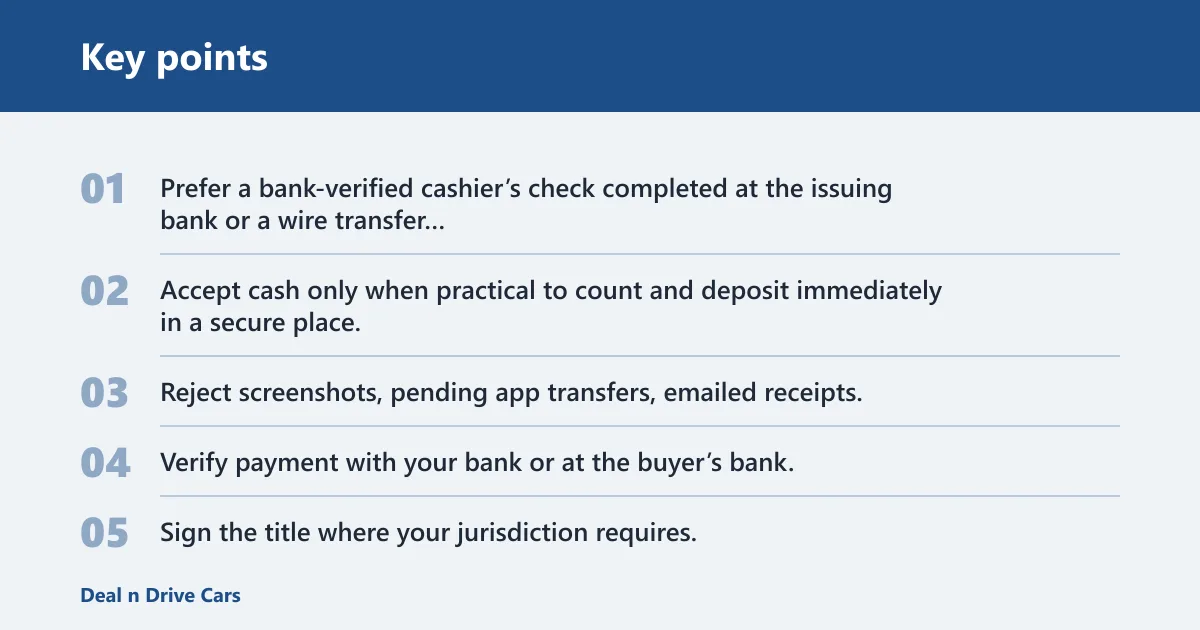
- Prefer a bank-verified cashier’s check completed at the issuing bank or a wire transfer confirmed by your bank.
- Accept cash only when practical to count and deposit immediately in a secure place.
- Reject screenshots, pending app transfers, emailed receipts, and “funds on hold” messages as proof.
A cashier’s check is safer when the bank confirms it on the spot and you watch it issued. A wire transfer is safer when your bank confirms the money has arrived and is available. Digital payment apps may look instant but can involve reversals, holds, or account limits.
Follow the handoff order exactly
- Verify payment with your bank or at the buyer’s bank.
- Sign the title where your jurisdiction requires.
- Complete the bill of sale and odometer disclosure.
- Remove plates if local rules require it.
- Hand over keys, manuals, and records.
- File the release of liability the same day.
The release of liability protects you from post-sale tickets, tolls, crashes, and registration exposure. File it after the sale as soon as the car leaves your control, and keep confirmation that it was submitted.
Account for jurisdiction differences before closing
Workflow changes by place, so confirm the exact forms and deadlines locally.
- California: sellers commonly deal with title transfer lines, odometer disclosure, smog-related considerations in many situations, and a release-of-liability filing shortly after sale.
- Texas: title assignment, buyer and seller signatures, and a seller-side vehicle transfer notice are common checkpoints to verify before handoff.
- Ontario: sellers commonly need the ownership permit, a bill of sale, and province-specific transfer paperwork; confirm package requirements before listing.
- UK: private sellers typically work through DVLA change-of-keeper steps, the V5C process, and separate proof-of-sale records; confirm how plates and tax status are handled before release.
These are workflow differences, not full legal guides. Check the current DMV, provincial, or DVLA process before you take a deposit or promise same-day transfer.
If that did not work
If your sale cannot close because the title is missing, the lien release is delayed, or the bank cannot verify funds that day, do not improvise. Reschedule the closing at the lender or bank, or switch to a buyer who can complete the transaction on your required timeline. Delay is cheaper than a bad transfer.
Common mistakes
Listing before title and lien issues are cleared
This creates the worst kind of momentum: buyer interest you cannot convert. Clear the replacement-title path, exact payoff, and lien release sequence before the ad goes live.
Letting an unverified buyer test drive the car
No license check, no route, and no public location is too much risk for a private meetup. Keep control of keys, meet publicly, and stay with the car.
Accepting payment that is not fully verified
Pending transfers and emailed confirmations are not the same as bank-verified funds. If the money is not confirmed, the sale is not closed.
Missing the post-sale notice that ends your liability
The transfer is not finished when the buyer drives away. File the release of liability or local equivalent the same day, save proof, and follow local plate rules.
Prevention
Build one folder before you list: title, registration, payoff details, odometer reading, bill of sale form, release form, service records, history report, and your pricing notes. Most private-sale mistakes start when those items come together too late.
Frequently asked questions
How do I sell my car privately and safely?
Start by confirming title status and any lender payoff, then price the car from a valuation tool and local comps. Screen buyers by phone, meet in public, verify the driver’s license before any test drive, accept only bank-verified funds, and file the release of liability the same day.
What paperwork do I need when I sell my car privately?
You usually need the car title, current registration, odometer reading, bill of sale, payoff details if financed, and a release of liability or local transfer notice. The bill of sale should include buyer, seller, VIN, vehicle details, price, date, odometer reading, and signatures.
How long does it take to sell a car privately?
Preparation can take a few hours to a few days, depending on title and lien status. Listing live time varies by price and market. Payment can clear the same day at a bank, but missing-title replacements or lien releases can stretch the process well beyond your planned handoff date.
Should I fix the car before listing it privately?
Fix safety issues, transfer blockers, and defects that make buyers doubt the car immediately. Skip expensive repairs with weak return unless they solve a major drivability or inspection problem. For cosmetic wear or upcoming maintenance, disclosure with receipts often works better than overspending before sale.
What is the safest way to get paid in a private car sale?
The safest method is a cashier’s check issued and verified at the buyer’s bank, or a wire transfer your bank confirms as received and available before you sign anything over. Cash can work for smaller amounts if you count and deposit it immediately at the bank.
How do the process differences work in California, Texas, Ontario, and the UK?
The core sequence stays the same, but local paperwork changes the workflow. California and Texas commonly add seller-side DMV notices, Ontario has province-specific transfer documents, and the UK uses DVLA keeper-change steps. Confirm current local forms before listing so your closing day matches the actual transfer process.