
How to Find a Fair Price for a Used Car Near You
Start with a national retail value, then adjust by about 5% to 10% for local market conditions, mileage, condition, and accident history, and add only legitimate fees to estimate a fair out-the-door price. Skip that math and you can overpay by thousands or miss a solid car because the sticker looks high before taxes and fees. This article shows how to compare local comps, spot fee padding, and make title-risk deductions before you buy.
This guide is part of our Fair price for a used car: how to know it series.
What counts as a fair price?
A fair price is a benchmark, not a final offer. It usually sits inside a local range built from guide values, exact-match nearby listings, and the car’s real condition, then converted to out-the-door cost with taxes and fees added. Fair market value only tells you where to start.
Use the benchmark, not the finish line
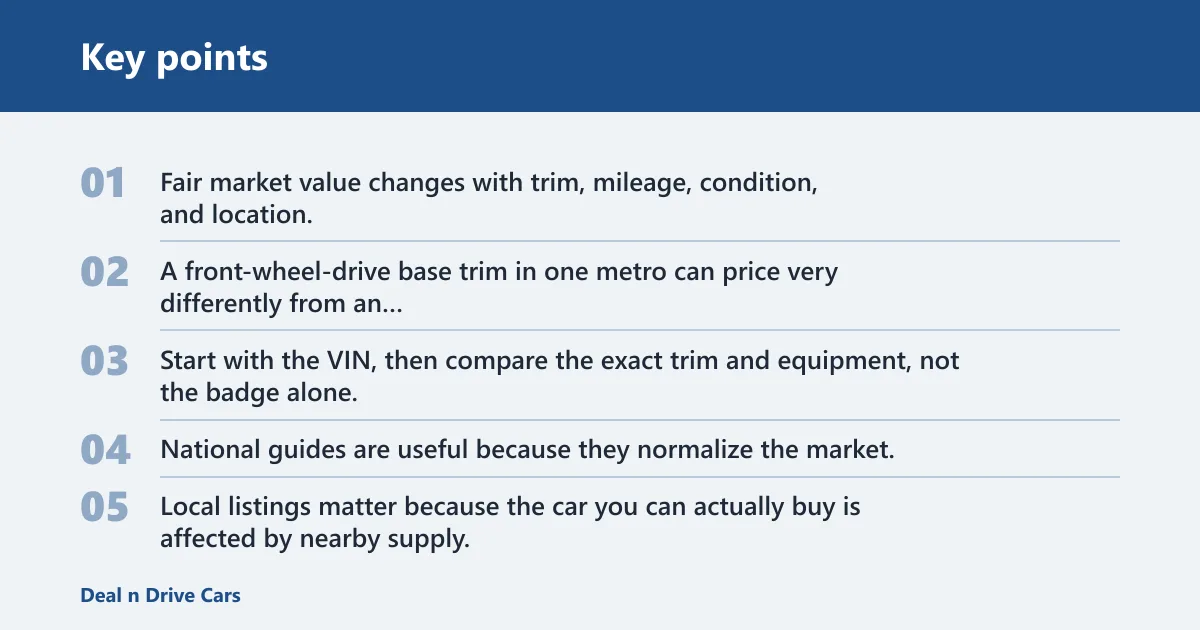
Fair market value changes with trim, mileage, condition, and location. A front-wheel-drive base trim in one metro can price very differently from an all-wheel-drive version with the same engine and year. Start with the VIN, then compare the exact trim and equipment, not the badge alone.
Why local listings matter
National guides are useful because they normalize the market. Local listings matter because the car you can actually buy is affected by nearby supply, seasonal demand, and dealer strategy. A compact SUV in a snowy market may hold value better than the same vehicle in a warm metro with more inventory.
When a price looks high, low, or about right
High prices usually show up when a listing sits above comparable local ads after you adjust for mileage, condition, and fees. Very low prices deserve a close check for title issues, accident history, or add-ons that do not appear in the ad. About right means the asking price is close to nearby comps and the out-the-door total still fits the local range.
Which pricing tools should you use?
Use Kelley Blue Book and Edmunds as starting points, then cross-check with Carfax or AutoCheck history data and local marketplaces. No single tool gives the whole answer. The best estimate comes from triangulating a guide value, nearby asking prices, and the car’s actual history and equipment.
Combine guide values with market data
Kelley Blue Book and Edmunds help set a baseline because they account for model-year data, trim, mileage, and region. Carfax and AutoCheck help flag history concerns that can lower value. Local marketplaces show what sellers are asking right now in your area.
Use ZIP code and market inputs
ZIP-code or metro-specific settings matter because prices can shift across city borders. Always enter the same region you plan to buy in. A car priced fairly in one market can be expensive in the next one over if local supply is tighter.
Ask for the number that matters
Do not stop at the advertised price. Ask for the out-the-door figure, then compare that total with guide-based estimates and nearby comps. That is the number you will actually pay.
How do you match the right car?

Match the exact year, make, model, trim, drivetrain, and VIN-decoded options before comparing prices. Two cars that look similar on a listing page can differ in value by thousands because of equipment, drivetrain, or package content. Asking price and sold price are also different numbers.
Use the VIN to confirm trim and options
The VIN helps decode the exact variant, factory packages, and sometimes equipment that is easy to miss in a listing. That matters when one version has leather, a larger infotainment screen, or advanced safety features and the other does not. Compare like with like.
Match drivetrain and mileage band
All-wheel drive, rear-wheel drive, and front-wheel drive can carry different values depending on model and market. Mileage should be compared in a band, not as a single number. A 72,000-mile car is not directly comparable to a 108,000-mile car, even if everything else looks close.
Asking price versus sold price
Asking price is what the seller wants. Sold price is what a buyer actually paid. When possible, use sold-price data from marketplaces or pricing tools that estimate transaction values, because listed prices often leave room for negotiation or hide fee structure.
Suppose two 2021 midsize SUVs have the same engine and trim, but one has 44,000 miles and the other has 82,000 miles. Even before condition adjustments, the lower-mileage vehicle should usually command more. If the higher-mileage unit is priced the same, it is not an equal comparison.
How do mileage and condition change price?
Mileage usually lowers price, but the size of the drop depends on age, use type, and maintenance. Condition also moves the number fast. Mechanical health, cosmetic wear, tires, brakes, interior quality, service records, and inspection findings all feed into the fair range.
Mileage is not a standalone discount
Higher mileage often lowers value because more parts have been used. But a well-maintained highway car can age differently from a short-trip city car with the same odometer reading. That is why mileage should be paired with records and inspection results.
Grade the condition honestly
Many buyers use clean, good, fair, and poor as a rough scale. Clean usually means no major wear and no urgent repairs. Good can include normal use. Fair often means visible wear or small deferred items. Poor usually signals immediate money needed for safety or reliability.
Check the parts that change cost fast
Worn tires, thin brake pads, a dirty service history, damaged upholstery, or unresolved warning lights all justify a lower price. Service records matter because they show whether routine maintenance was done on time. Inspection findings matter because they reveal issues a seller may not volunteer.
A common first-timer mistake is treating shiny paint as good condition. A car with fresh detailing can still need tires, pads, and a cooling-system repair. Those costs belong in the price math.
How do history and title affect value?
Accident history matters most when the damage was structural, involved the frame, or deployed airbags. Cosmetic repairs are different from collision repair that reaches the body structure. Title status matters even more, because salvage, rebuilt, flood, or lemon branding can cut value sharply and limit financing and resale.
Separate cosmetic repairs from structural risk
A painted bumper or a repaired door panel does not carry the same risk as frame damage or airbag deployment. Structural damage can affect alignment, safety systems, and long-term value. That is why the discount for serious collision history should be much larger than the discount for minor cosmetic work.
Watch title branding closely
Clean, salvage, rebuilt, flood, and lemon-branded titles are not close substitutes. A branded title can change how lenders value the car and how easily you can sell it later. Always verify the title status before treating a low price as a bargain.
When a lower price still is not a good deal
A low asking price may still be poor value if the title is branded, the airbag system was deployed, the car has flood evidence, or repair records are missing. The discount must be large enough to cover the risk, the financing limits, and the lower resale value. If not, pass.
What fees change the out-the-door price?
Dealer fees, taxes, registration, and title costs turn a listing into the real total. Dealer ads may leave out doc fees, advertising fees, prep fees, and add-ons. The out-the-door price is the best number for comparing offers because it captures what you actually pay.
Know the common fee buckets
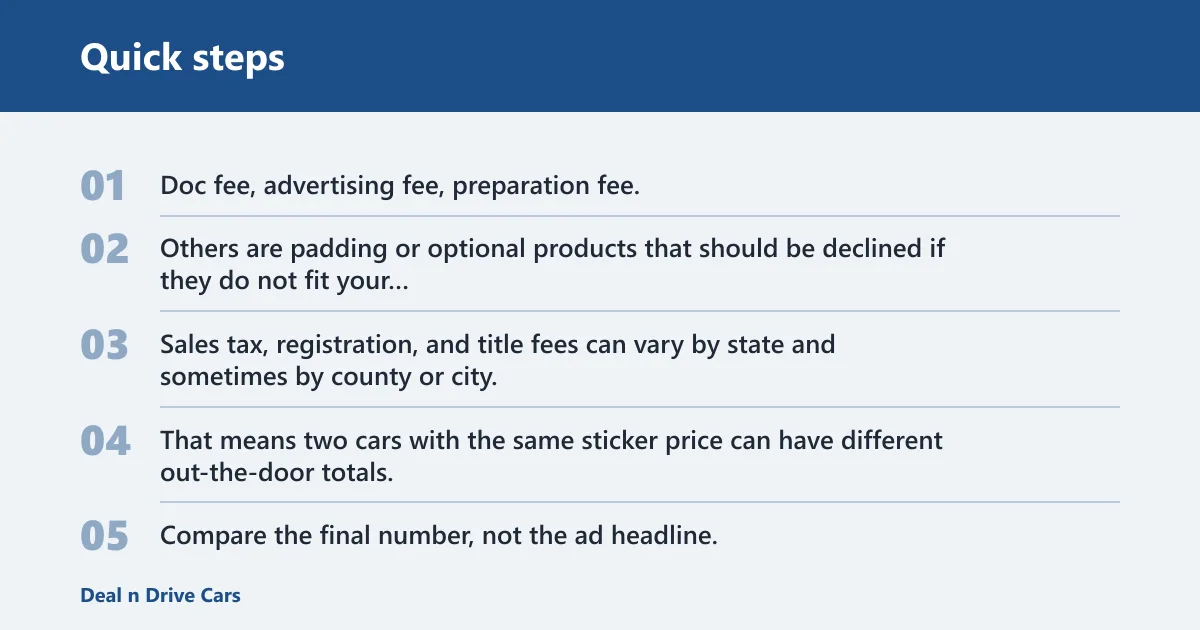
Doc fee, advertising fee, preparation fee, and dealer-installed add-ons are often separate from the advertised price. Some fees are legitimate and state-allowed. Others are padding or optional products that should be declined if they do not fit your budget.
Taxes and registration belong in the comparison
Sales tax, registration, and title fees can vary by state and sometimes by county or city. That means two cars with the same sticker price can have different out-the-door totals. Compare the final number, not the ad headline.
Certified pre-owned usually costs more
Certified pre-owned cars usually carry a premium because they have passed a manufacturer-backed or dealer-backed inspection and often include added warranty coverage. The premium can be worth it if the inspection is real, the reconditioning is documented, and the warranty would otherwise cost more than the difference.
| Line item | Example amount | Decision |
|---|---|---|
| Starting guide value | $24,000 | Yes |
| Local comp median | $24,800 | Yes |
| Mileage adjustment | -$600 | Yes |
| Condition adjustment | -$800 | Yes |
| Title and history discount | -$1,500 | Yes |
| Dealer fee estimate | +$699 | Yes |
| Tax and registration estimate | +$1,900 | Yes |
| Final fair-buy range | $23,600 to $25,200 out the door | Buy if the total lands inside range |
Fair-price worksheet
Use this worksheet to turn one listing into a fair out-the-door range. Start with a guide value, compare exact local comps, then add or subtract for mileage, condition, title risk, and fees. The final number should tell you yes or no.
- Record the exact year, make, model, trim, drivetrain, and VIN-decoded options.
- Set the starting guide value from Kelley Blue Book or Edmunds.
- Find at least three local comparable listings in your city or nearby metro.
- Use the median of those comps, not the highest listing.
- Adjust for mileage using the same mileage band.
- Adjust for condition based on mechanical, cosmetic, tire, brake, and interior state.
- Subtract for accident history if repairs were more than cosmetic, and apply a larger discount for structural or title-branded risk.
- Add dealer fees, taxes, registration, and title costs to get the out-the-door number.
- Compare the total to your fair-buy range and decide yes or no.
Frequently asked questions
How do I find a fair price for a used car near me?
Start with a national guide value, then compare exact-match local listings in your city or nearby metro. Match year, make, model, trim, drivetrain, and mileage band. After that, adjust for condition, title history, and all dealer fees to get an out-the-door range.
What counts as a fair price for a used car?
A fair price is one that fits the local market after accounting for mileage, condition, options, history, and fees. It should line up with guide values and nearby comps, and the final out-the-door total should stay within your planned budget without hidden add-ons.
How much should I pay over fair market value for a used car?
If the car has the right trim, strong records, and no major history issues, paying a small premium can be reasonable in a tight market. But the premium should be explained by mileage, condition, CPO coverage, or local supply, not by vague dealership markup.
Are dealer fees included in a fair used car price?
Not always. Many ads list only the vehicle price, then add doc fees, advertising fees, prep fees, and extras later. A fair comparison uses the out-the-door total, since that includes taxes, registration, title charges, and any non-optional dealer fees.
Does accident history change the fair price of a used car?
Yes. Minor cosmetic repairs usually affect value less than structural damage, frame issues, airbag deployment, or flood-related repairs. A clean-history car and a repaired car should not be priced the same unless the discount reflects the real risk and reduced resale value.
Is a certified pre-owned car worth paying more for?
It can be, if the inspection is real, reconditioning is documented, and the warranty coverage is worth more than the premium. CPO is not automatically a better deal, but it can reduce repair risk and add value when the comparable non-CPO car is close in price.