How to Budget for Maintenance Costs as a Gig Driver
Set aside about 8 to 12 cents per mile for maintenance if you drive rideshare or delivery full time, then add a repair buffer for older or high-mileage cars. Miss that target, and one brake job, tire set, or suspension repair can wipe out a week of earnings. This guide shows how to budget from earnings per mile and build in downtime risk.
Why app driving needs a per-mile budget
App driving turns maintenance into a mileage problem, not a calendar problem. More miles break down oil faster, shorten tire life, raise brake wear, and increase the odds that the car sits idle instead of earning.
How rideshare and delivery miles change wear
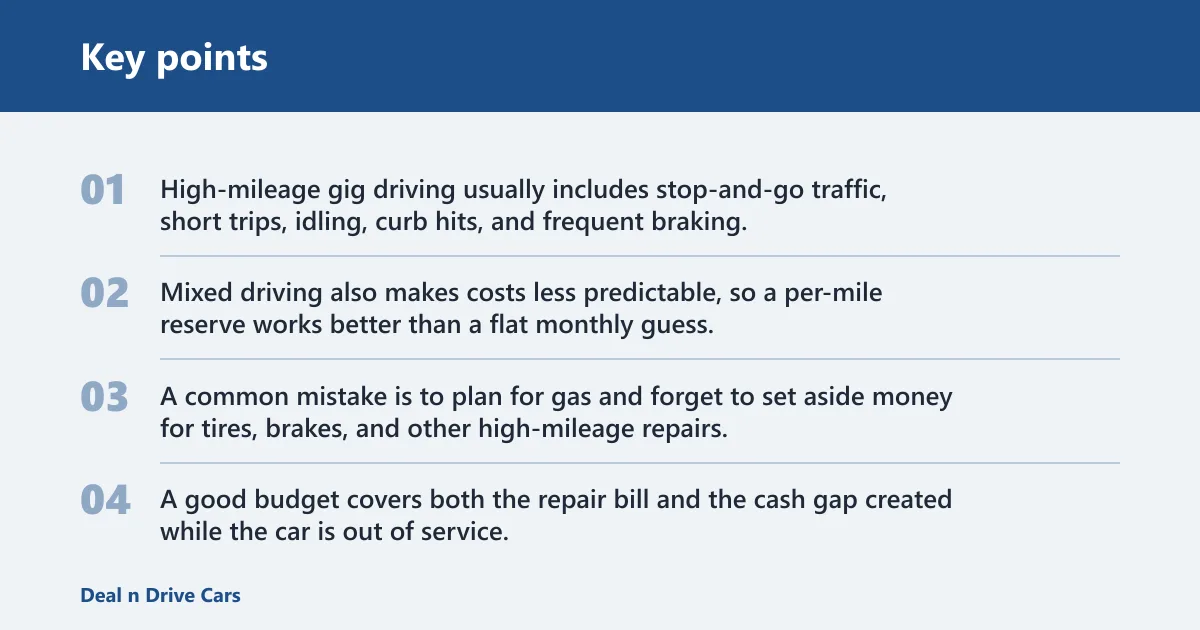
High-mileage gig driving usually includes stop-and-go traffic, short trips, idling, curb hits, and frequent braking. That combination wears tires, pads, rotors, suspension parts, and fluids faster than steady highway use. Mixed driving also makes costs less predictable, so a per-mile reserve works better than a flat monthly guess.
A common mistake is to plan for gas and forget to set aside money for tires, brakes, and other high-mileage repairs. A sedan running 2,000 app miles a month may need routine service on a schedule that feels normal on paper, then need tires or brakes earlier than expected because the miles are urban and the stops are constant.
Why downtime matters as much as repair cost
The repair invoice is only part of the hit. If a car is in the shop for two days, the real cost also includes lost trips, missed surge periods, and the gap between earnings and fixed expenses. A good budget covers both the repair bill and the cash gap created while the car is out of service.
Set your monthly maintenance reserve
Build the reserve from weekly miles, then split it into routine maintenance, wear items, and emergency repair money. A simple working range is 8 to 12 cents per mile for active full-time app driving, with older or rougher-use cars leaning toward the top of that range.
Convert weekly miles into a monthly number
Use this formula: weekly app miles × 4.33 × maintenance cents per mile = monthly reserve. The 4.33 factor converts an average week into an average month. If you drive 600 miles a week and budget 10 cents per mile, the reserve is about $260 a month.
Split the reserve into separate buckets
Do not keep one lump sum with no labels. Put money into distinct buckets for oil changes, tires, brakes, fluids, suspension, and an emergency repair fund. That separation matters because routine service arrives on schedule, while wear items and failures hit at different times.
-
Log your weekly miles. Write down app miles every week from the odometer or trip meter. Keep the log separate from tax records so you can use the same mileage history for both budgeting and deduction tracking without mixing the purposes.
-
Choose your per-mile rate. Use 8 to 12 cents per mile for full-time driving. Start near 8 cents for a newer vehicle with mostly highway miles, and move closer to 12 cents if you drive a higher-mileage car in dense city traffic.
-
Convert miles to dollars. Multiply weekly miles by 4.33, then by your rate. A driver logging 450 miles a week at 10 cents per mile sets aside about $195 a month for maintenance and repairs.
-
Divide the reserve. Put a set amount toward routine service, another toward wear items, and the rest into emergency repair money. This keeps a tire set or brake job from emptying the same account you use for a surprise alternator or cooling issue.
Maintenance budget worksheet
Use this worksheet to turn weekly miles into a monthly reserve. The values are planning numbers, not exact prices. They work best when you update them after each service visit and adjust for vehicle age, city driving, and how many app miles you actually put on the car.
| Budget line | Planning amount | How to set it |
|---|---|---|
| Oil changes | 1 change every 5,000 to 7,500 miles; synthetic oil often costs $50 to $120 before labor | Set aside weekly miles divided by the interval, then multiply by your shop price |
| Tires | Replacement around 40,000 to 60,000 miles; rotation every 5,000 to 7,500 miles | Reserve a small amount per mile for tread wear and periodic alignment checks |
| Brakes | Inspect every 10,000 to 15,000 miles in stop-and-go use | Save more if the car spends most of its time braking in traffic |
| Fluids | Check at each oil change; transmission fluid service often lands around 30,000 to 60,000 miles depending on the vehicle | Budget a small monthly amount for coolant, transmission fluid, and washer fluid top-offs |
| Suspension | Budget for shocks or struts once symptoms appear or mileage climbs | Use a separate reserve because potholes and curb strikes can lead to a larger bill |
| Emergency repair buffer | At least $500 to $1,000, more for older cars or deductibles | Keep this money untouched unless the car stops earning or needs immediate repair |
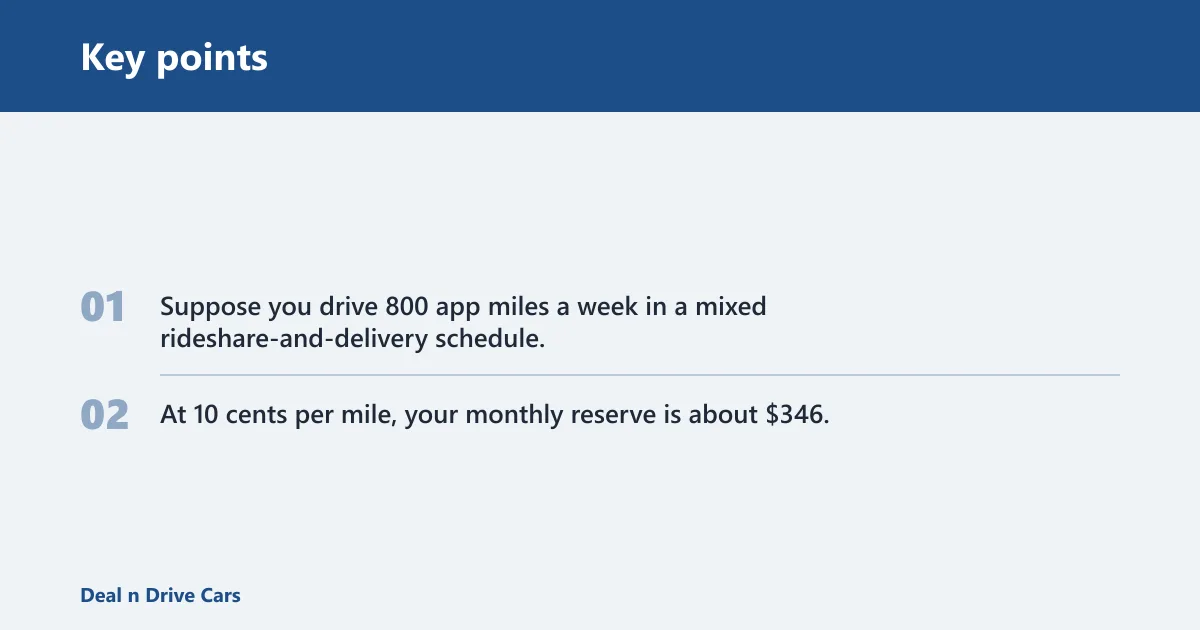
Suppose you drive 800 app miles a week in a mixed rideshare-and-delivery schedule. At 10 cents per mile, your monthly reserve is about $346. If you split that into $70 for oil and filters, $80 for tires and alignment, $60 for brakes and fluids, $40 for suspension, and $96 for emergency repairs, the budget matches both routine service and surprise costs.
What should you budget for routine upkeep?
Routine upkeep usually takes the first slice of the reserve. Oil changes, filters, tires, brakes, and basic fluid checks come up predictably, but city mileage can pull those intervals forward. Plan around your miles, not the odometer sticker on the windshield from years ago.
Oil changes and filters
Many drivers using synthetic oil should plan oil changes every 5,000 to 7,500 miles, especially with frequent app use. Synthetic oil often costs more than conventional oil, but the longer interval and better heat tolerance make it the more practical choice for heavy stop-and-go driving. Replace the engine air filter and cabin air filter about every 15,000 to 30,000 miles, sooner if the car runs dusty routes or heavy urban traffic.
Tires and alignments
Tires often wear out between 40,000 and 60,000 miles, but aggressive city driving can shorten that. Rotate tires every 5,000 to 7,500 miles, and check alignment if the steering wheel drifts, the car pulls to one side, or the inner edges wear faster than the rest. Potholes and curb strikes can cut tread life faster than highway miles alone.
Brakes and fluids
Brake pads and rotors wear faster when the car stops every few blocks. In dense traffic, inspect them every 10,000 to 15,000 miles or sooner if you hear squealing, feel vibration, or notice a longer stopping distance. Check coolant, transmission fluid, and washer fluid at each oil change. Coolant and transmission service should follow the owner’s manual, while washer fluid needs a top-off whenever visibility suffers.
How do you budget for bigger wear items?
Bigger wear items need their own reserve because they do not behave like routine service. Shock absorbers, struts, battery failures, belts, and age-related electrical repairs often arrive with little warning and can take the car off the road quickly.
Shock absorbers and suspension
Potholes, speed bumps taken too fast, and curb strikes can damage shocks, struts, bushings, and alignment settings. Watch for bouncing after bumps, uneven tire wear, nose dive during braking, clunks over rough pavement, or a car that sits lower on one corner. Budget separately for suspension because the repair can be large enough to derail a routine maintenance fund.
Battery, belts, and other age-related repairs
Heat, short trips, and frequent starts can shorten battery life. Belts, hoses, and mounts also age with time, not just mileage. For an older car, a wider repair buffer makes more sense than a bare minimum savings target, because one battery, serpentine belt, or cooling repair can arrive before the next planned service interval.
Picture a delivery driver with 170,000 miles on a compact sedan and a rough commute through broken pavement. If the steering starts wandering and one tire wears on the inside edge, the likely next steps are alignment inspection, tire replacement, and maybe a suspension repair. A reserve built only for oil changes will not cover that chain of costs.
How should you handle uneven gig income?

Irregular income needs a fallback rule, not a vague promise to save more later. Move money into the maintenance fund on good weeks, then use a smaller automatic amount on slow weeks so the reserve keeps growing even when app earnings dip.
Fixed transfer plan for good weeks
Set a standing transfer based on your average weekly miles, not your best week. If your budget calls for $220 a month, divide that into weekly transfers and move the money right after the apps deposit earnings. Automating the transfer reduces the chance that fuel, food, or slow payouts eat the maintenance money first.
Fallback rule for slow-income weeks
If a week comes in light, transfer a minimum amount anyway. A useful fallback is about 25 to 50 percent of the normal weekly maintenance transfer, with the rest filled in during the next stronger week. That keeps the fund moving without forcing you to choose between rent, fuel, and maintenance.
-
Set a floor amount. Decide on the smallest transfer that still feels safe, such as $15 or $25. Keep that amount available for weak weeks so the maintenance fund never goes to zero.
-
Raise the transfer on busy weeks. When earnings run above average, move the extra amount into the reserve the same day you get paid. That helps catch up after a slow stretch and lowers the chance of missing a tire or brake bill later.
-
Protect the repair buffer. Do not spend the emergency reserve on routine service. If the car needs a normal oil change, pay from the routine bucket first so the repair buffer stays available for the bill that can stop you from earning.
Frequently asked questions
How much should I budget for car maintenance if I drive for Uber or Lyft?
A practical starting point is 8 to 12 cents per mile for full-time rideshare driving. Newer cars with mostly highway miles can sit near the low end, while older cars or heavy city use need more. Add a separate emergency buffer for repairs that can take the car out of service.
What maintenance costs should delivery drivers expect each month?
Delivery drivers should expect oil changes, tires, brakes, fluids, and occasional suspension work to show up faster than on low-mileage personal cars. A monthly reserve based on miles driven works better than a fixed guess because one month of heavy delivery routes can wear the car more than two light months.
How do I set aside money for tires, brakes, oil changes, and repairs?
Split the reserve into separate buckets. Put routine oil and filter service in one bucket, tires and alignments in another, brakes and fluids in a third, and emergency repairs in a fourth. That way, a brake job or tire replacement does not empty the money meant for a future breakdown.
What is the best monthly maintenance budget for a high-mileage car?
For a high-mileage car, a higher per-mile reserve is safer than a single monthly target. Many drivers should plan above the 8-cent floor and closer to 12 cents per mile, plus a larger repair cushion if the car is past 100,000 miles or already needs frequent work.
How do I budget when my income changes week to week?
Base the budget on miles, then use a fallback transfer for slow weeks. Move the full planned amount on strong weeks and at least a small minimum on weak weeks. That keeps the reserve growing without forcing you to cover a repair from next week’s rent or fuel money.
How much emergency repair money should I keep for app driving?
Keep at least $500 to $1,000 in emergency repair money, and lean higher for older cars or vehicles with more than 100,000 miles. If your deductible is part of the risk, include that amount in the buffer so one covered claim does not leave you short on cash while the car is in the shop.
Does driving for Uber or DoorDash wear out a car faster?
Yes. App driving usually adds miles, stop-and-go traffic, idling, and more braking, which speeds up wear on oil, tires, brakes, suspension, and fluids. The effect is strongest in city driving and mixed delivery routes, where short trips and frequent stops shorten service intervals compared with steady highway use.