Can You Buy a Used Car with No Down Payment?
Yes, some lenders will finance a used car with no down payment, but approval usually comes down to your credit file, income, vehicle age, loan term, and whether the loan stays at or below the car’s value. Without a cushion, you can start upside down and owe more than the car is worth after fees, taxes, and fast depreciation. This guide explains when zero-down financing is possible, what lenders check, and the tradeoffs to watch before you sign.
What lenders require for zero-down approval
Yes, sometimes. A zero-down used-car loan means you pay no cash upfront toward the vehicle price, and in some cases the lender finances up to 100% of the car’s cost. That does not always cover every signing cost, and approval still depends on credit, income, and the car itself.
What zero-down financing usually means
In practice, “no down payment” can mean 0% upfront financing on the car price, not necessarily 0% upfront cash for the entire deal. A lender may approve the vehicle amount but still require taxes, registration, document fees, or add-ons at signing. That difference matters.
Why approval and out-the-door cost are different
Approval is about whether the lender will fund the loan. Out-the-door cost is the full amount due to drive away, including the sale price plus tax, title, registration, and dealer fees. A loan can be approved at the vehicle-price level and still leave you short on cash at signing.
What lenders check before saying yes
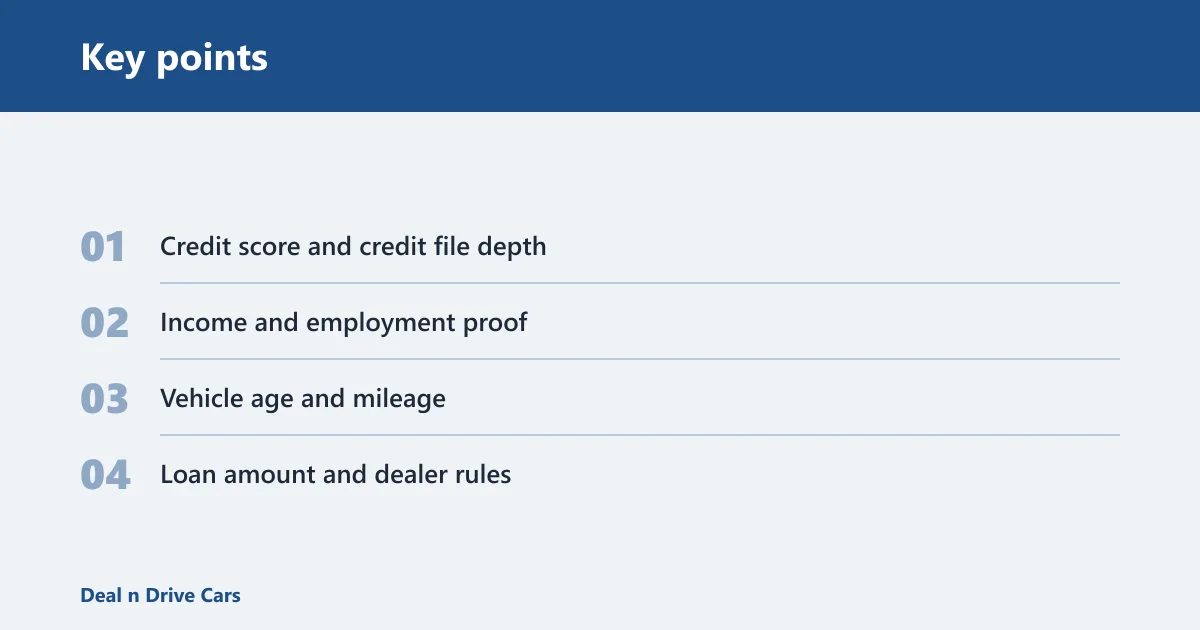
Lenders look beyond credit score. They also check income stability, employment proof, debt load, vehicle age, mileage, loan amount, and whether the dealer or lender program allows the deal. Some programs also set a minimum loan amount. CIBC, for example, says its minimum loan amount is $7,500.
- Credit score and credit file depth: stronger files usually face fewer cash requirements.
- Income and employment proof: steady pay and a manageable debt load can help approval.
- Vehicle age and mileage: some programs cap age at 10 years and may exclude higher-mileage cars.
- Loan amount and dealer rules: the lender may require a minimum balance or a participating dealer.
Dealer, bank, credit union, and captive rules
Where you borrow changes the answer. A dealer-arranged loan may be easier to structure on the spot, but the lender still sets the real terms. Banks and credit unions can be stricter about income, age limits, and loan size. Captive and CPO offers can be better on rate, but only on qualifying brands and vehicles.
CIBC says its car loan offers the possibility of no down payment for new or used vehicles, and that it can finance up to 100% of a new or used vehicle’s cost. It also says the vehicle can be up to 10 years old and the used-vehicle term can go up to 96 months.
Zero-down qualification table
This table gives a quick read on who is most likely to qualify, where the deal may fall apart, and when a small cash contribution is still common.
| Buyer profile | Credit tier | Income stability | Vehicle age/mileage | Lender type | Likely down payment required | Main approval risk | Likely answer |
|---|---|---|---|---|---|---|---|
| Good credit buyer | Good | Steady W-2 or documented self-employment | 5 to 8 years old; moderate mileage | Bank, credit union, or captive | 0% to small amount | Fees not fully covered; LTV may be too high | Yes |
| Thin file buyer | Limited history | Stable, but short work history | 6 to 10 years old | Dealer-arranged lender | Small cash ask is common | Not enough credit depth or prior auto history | Likely |
| Bad credit buyer | Poor | May be uneven or hard to document | Older, lower-priced unit | Special finance lender | Often around 10% or more | Payment shock and higher default risk | No or likely not |
| Newcomer buyer | Thin or no U.S. history | New job, visa, or new-to-country income trail | Late-model used car | Bank, credit union, or newcomer program | Often some cash or a co-borrower | Identity, income, and credit-history gaps | Likely |
| Low-income buyer | Any tier | Income may be tight against debt | Any qualifying used car | Any lender that will stretch ratios | Often some cash to lower payment | Debt-to-income and payment affordability | No or likely |
| Positive equity trade-in buyer | Good to fair | Documented and stable | Qualified vehicle under program limits | Dealer, bank, or captive | 0% cash possible if equity covers gap | Trade value must hold after payoff | Yes |
How much cash may still be due at signing
Even with zero down on the car price, you may still need cash for taxes, registration, doc fees, or dealer add-ons. Some lenders fund only the vehicle amount, not the full out-the-door total. That is why “no money down” and “nothing due today” are not the same thing.
Taxes, registration, and doc fees
These costs are common at signing and can be meaningful. If a lender finances 100% of the vehicle price but not the extras, you must cover the rest with cash or a separate structure. That can turn an otherwise approved deal into a cash shortfall.
Optional products and dealer add-ons
Service contracts, gap coverage, wheel protection, and similar products can raise the due-at-signing amount if they are not included in the loan. If the payment already stretches your budget, adding products can push the deal past what you can comfortably carry.
Suppose you find a used car priced at $18,000 and the lender approves the full price, but not the taxes and fees. If the out-the-door total rises by $1,400, you still need that cash at signing even though the car itself is financed. That is where the deal can stall.
Can you get a used car with bad credit and no down payment?
Sometimes, but the odds are weaker. Bad-credit auto financing often asks for a larger down payment, and some lenders want around 10% down or more to offset the risk. If the lender is not comfortable with the credit file, zero down may move from “possible” to “unlikely.”
Why bad credit often means a higher cash ask
When credit is weak, the lender worries about repayment risk and negative equity. A down payment lowers the amount financed and the loan-to-value ratio, which can make the loan easier to approve. Auto Credit Express says a standard down payment can vary between 0% and 20%, and that around 20% is typically recommended as an initial down payment.
How a trade-in or co-borrower can change the result
A trade-in with positive equity can act like a down payment and reduce the financed amount without new cash. A stronger co-borrower can also help in some cases, though the lender still reviews the vehicle, the income, and the total loan size. Neither fix overrides a weak car choice.
How zero down changes payment and risk
Zero down raises the amount borrowed, which can raise the monthly payment and the total interest cost. It also raises loan-to-value ratio, or LTV, because the loan covers more of the car’s value. Higher LTV means more negative equity risk if the car loses value faster than you pay it down.
Loan-to-value ratio and negative equity
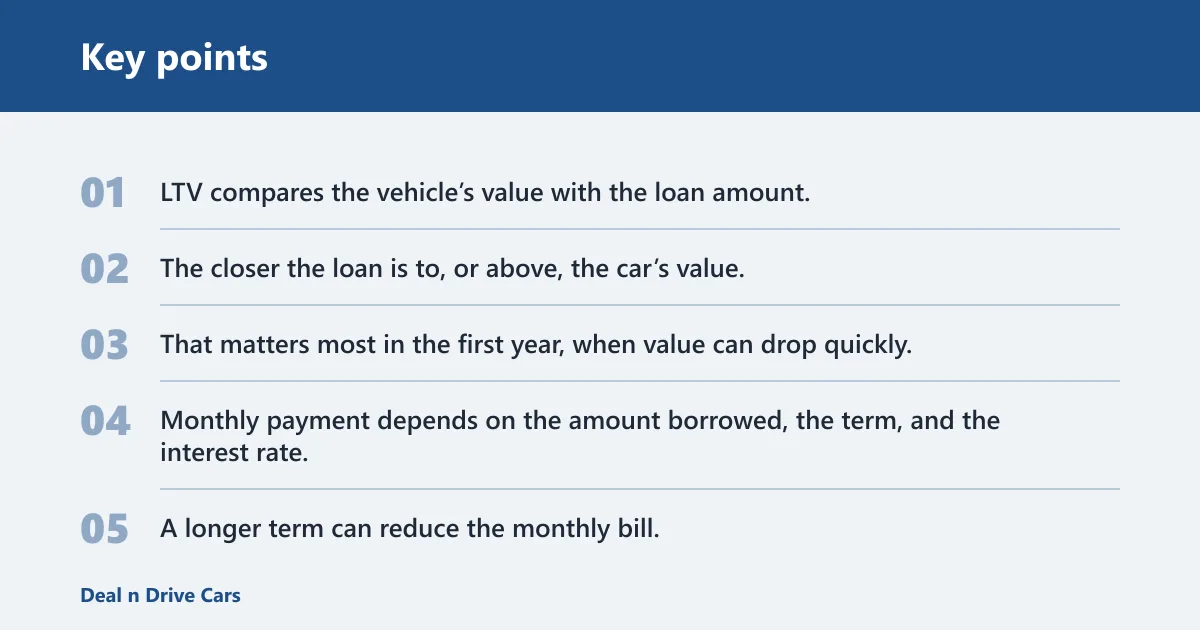
LTV compares the vehicle’s value with the loan amount. The closer the loan is to, or above, the car’s value, the more likely you are to owe more than the car is worth after depreciation. That matters most in the first year, when value can drop quickly.
Why term length and interest rate matter
Monthly payment depends on the amount borrowed, the term, and the interest rate. A longer term can reduce the monthly bill, but it often leaves you in negative equity for longer. A lower interest rate reduces total interest paid and can come from stronger credit or a better dealer program.
The same source says the average used-car down payment was $3,993, its network average down payment is traditionally around 13%, and bad-credit buyers may be required to put down around 10%. Those figures show why zero-down deals are the exception rather than the norm.
When a smaller down payment makes more sense
Start with the cash question, not the monthly payment. If a small down payment keeps your emergency fund intact and still leaves the payment comfortable, that can be smarter than draining your savings to force a zero-down deal. A common first-timer mistake is choosing the highest approved amount instead of the safest one.
Picture a buyer approved for a 72-month loan with no money down on a $16,500 used sedan. The monthly payment may look manageable, but a longer term plus zero down can keep the loan underwater for a long stretch if the car’s value falls faster than the balance.
Can you qualify for zero-down used-car financing?
Maybe, but the answer changes fast by credit tier, car age, lender type, and whether you need help with fees. Good-credit buyers and positive-equity trade-in buyers have the best odds. Thin-file, newcomer, low-income, and bad-credit buyers usually face more conditions or a larger cash ask.
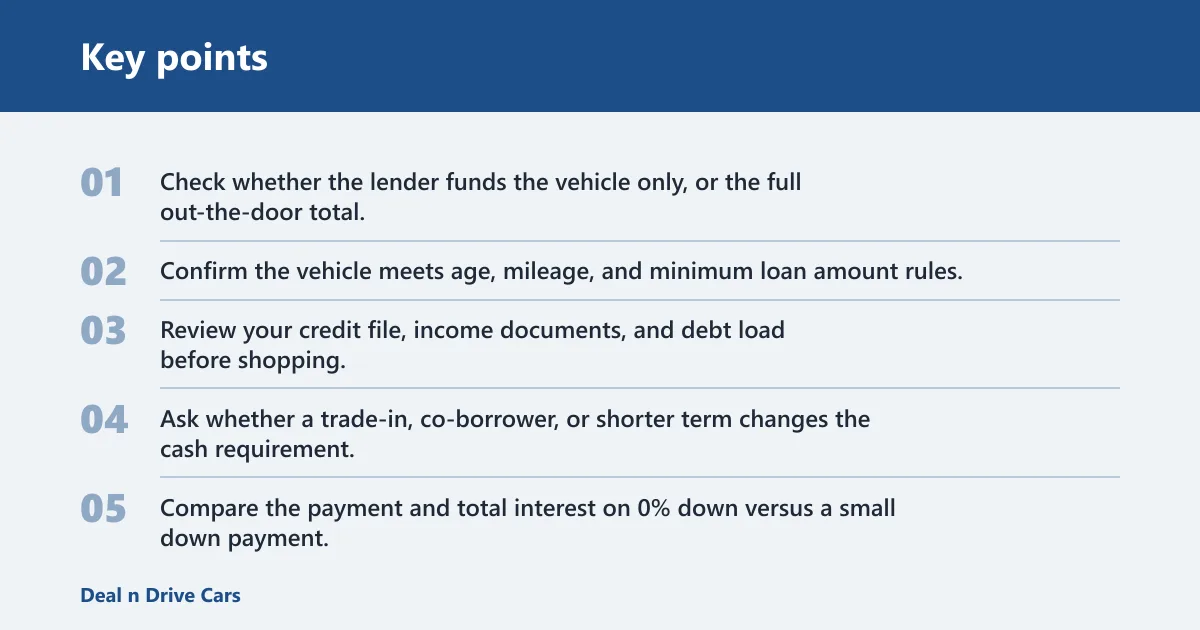
- Check whether the lender funds the vehicle only, or the full out-the-door total.
- Confirm the vehicle meets age, mileage, and minimum loan amount rules.
- Review your credit file, income documents, and debt load before shopping.
- Ask whether a trade-in, co-borrower, or shorter term changes the cash requirement.
- Compare the payment and total interest on 0% down versus a small down payment.
Used-car loan lender requirements usually include a credit score check, income or employment proof, vehicle age limits, and dealer participation. Some programs allow vehicles up to 10 years old; others are stricter. That is why the same buyer can get one approval and one rejection from different lenders.
Quick approval risk notes
Good credit can support a zero-down approval, but fees may still be due. Thin files often need stronger documentation. Bad credit usually brings a higher cash requirement, not a lower one. Newcomers and low-income buyers may need a co-borrower, a lower-priced car, or a trade-in with equity.
Certified pre-owned financing can help some shoppers. U.S. News says some CPO financing rates range from 1.99% to around 6%, and some offers extend to 7% or higher. It also says CPO vehicles are generally less than five or six years old and often have fewer than 60,000 to 80,000 miles. Availability depends on the brand and dealer program.
Frequently asked questions
Can you buy a used car with no down payment?
Yes, sometimes. The lender may finance the full vehicle price, but approval still depends on credit, income, vehicle age, mileage, and lender rules. You may also need cash for taxes and fees even when the car itself is financed at 0% down.
Can I get a used car loan with no down payment?
Yes, if the lender allows it and your file fits the program. Strong credit and stable income improve the odds. Thin credit, older cars, and higher-risk profiles usually make a zero-down approval harder, and some lenders will ask for money upfront anyway.
Can I buy a used car without a down payment?
Yes, but only if the lender accepts the structure and the dealer can build the deal within program limits. The main issue is not just approval; it is whether the out-the-door total, including fees and taxes, can be covered without extra cash.
Can you finance a used car with no down payment?
Yes. A no down payment auto loan means 0% upfront financing, and the loan amount may equal the full vehicle price. The catch is that many lenders still use LTV, income, credit, and vehicle rules to decide whether the deal is acceptable.
How to buy a used car with no down payment
Start by choosing a car that fits lender age and mileage limits, then compare bank, credit union, dealer, and captive offers. Bring proof of income, know your credit, and ask early whether taxes and fees are included. If not, plan for cash at signing.
Can you buy a used car with no money down?
Yes, and that phrase usually means no cash paid toward the car price at signing. It does not always mean every signing cost is financed. Always separate the vehicle amount from taxes, registration, doc fees, and optional products before you agree.