How to Sell a Car Privately Without Getting Scammed
Sell privately by meeting at a bank, verifying cleared payment in person, and handing over the title and keys only after the money is confirmed. Rush the deal, and you can lose the car, the payment, or both. This guide covers scam red flags, safe verification steps, and the exact order for car, title, and money transfer.
Why private sales attract scams
Private sales can bring more money than a dealer offer, and that price gap draws fake buyers, fake payments, and title tricks. A dealer offer still matters as a fallback number, because it gives you a quick exit if the private-party price does not justify the work.
Why the private-party price matters
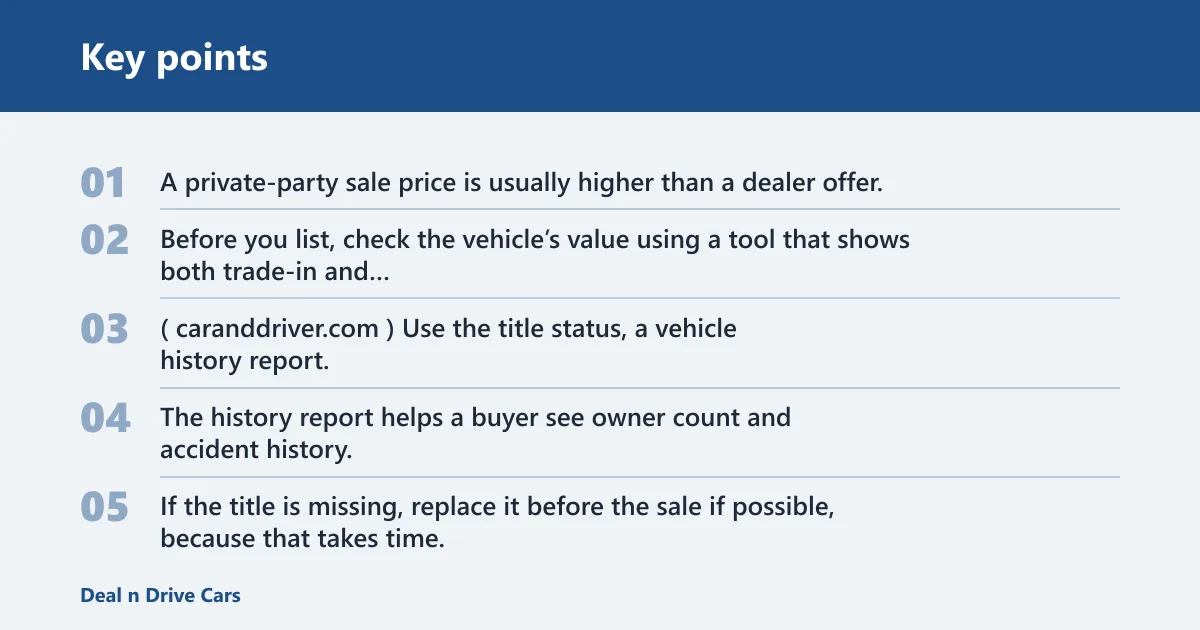
A private-party sale price is usually higher than a dealer offer, but it depends on condition and mileage, and it should leave room for negotiation. Before you list, check the vehicle’s value using a tool that shows both trade-in and private-party values; Car and Driver says its tool uses Black Book data and aggregated transaction prices. That gives you a tighter asking-price range. (Caranddriver)
Use the title status, a vehicle history report, and maintenance and repair records before the first listing goes live. The history report helps a buyer see owner count and accident history. Service records help prove care and upkeep. If the title is missing, replace it before the sale if possible, because that takes time.
Common fraud patterns sellers run
The most common traps are fake cashier’s checks, overpayment scams, VIN cloning, identity fraud, and buyers who try to rush the handoff before payment clears. A fake check can look official. An overpayment scam often includes a request to send back the “extra” amount. VIN cloning can make a buyer seem real while hiding a stolen or rebuilt vehicle identity.
Picture a buyer who offers to pay by cashier’s check, then asks you to release the car “as soon as the bank confirms it.” That is not enough protection. Verifying the issuing bank is not the same as having fully collected funds, so the safer move is to complete the exchange at the issuing bank or wait until funds are fully collected.
A common first-timer mistake is accepting a payment app transfer because the screen says “pending” or “completed.” Digital payments can be reversed, disputed, or delayed, so you need cleared funds, not a screenshot.
Where the risk usually enters the deal
Scams usually start before the meeting. The first message, the payment method, the meeting place, and the test drive are the main pressure points. If a buyer pushes one of those steps out of order, stop the process.
Car privately table
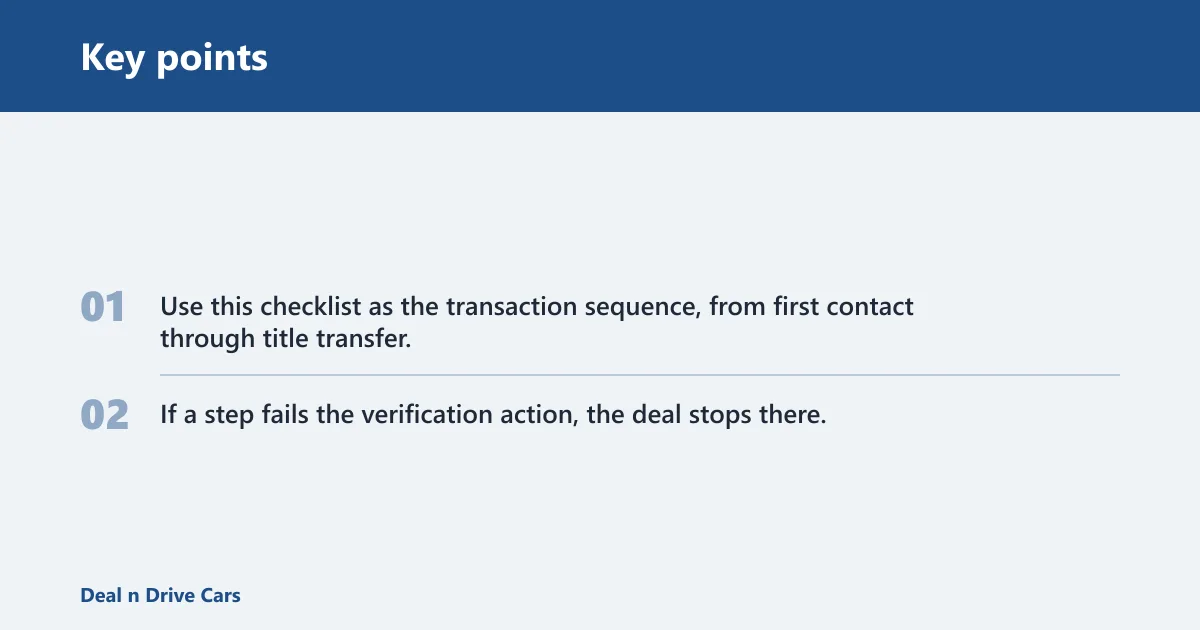
Use this checklist as the transaction sequence, from first contact through title transfer. If a step fails the verification action, the deal stops there.
| Step | Scam risk | Verification action | Stop/go decision |
|---|---|---|---|
| First message | Generic outreach, rushed offer, odd wording, refusal to answer direct questions | Ask for full name, phone number, and the reason they want the car | Go only if the buyer answers directly and stays consistent |
| Pre-meeting screening | Identity fraud, fake location claims, out-of-area pressure | Confirm the name matches the message history and the meeting plan | Stop if the story changes or the identity cannot be checked |
| Meeting place | Robbery risk, fake cash swap, unsafe exchange point | Choose a bank branch or a similar public place near the lender | Go only if the location reduces fraud risk |
| Test drive | Take-the-car scam, license swap, insurance lie | Before the test drive, the seller should check the buyer’s ID, proof of insurance, and proof of registration before the keys leave their hand. | Stop if documents do not match or the buyer resists inspection |
| Offer acceptance | Overpayment, bait-and-switch, sudden demand to wire money back | Use one agreed price and one agreed payment path | Stop if the buyer changes the payment terms |
| Payment check | Fake cashier’s check, reversed transfer, counterfeit cash | Verify cleared funds at the bank or wait for full collection | Go only after funds are fully available |
| Title transfer | Title hijack, incomplete signing, missing notarization or odometer disclosure | Confirm state title rules, complete required signatures, and finish any notarization | Stop if the title work is incomplete |
| Handoff | Buyer leaves with car before payment finalizes | Hand over title and keys only after cleared money is confirmed | Go only after the money is final |
| Post-sale notice | Traffic tickets, tolls, or liability after sale | File the state release-of-liability or sold notice promptly | Go immediately after the sale closes |
What should you prepare before listing?
Before listing, gather the title, payoff information if there is a loan, the vehicle history report, service records, and a price range. That lowers buyer suspicion and helps you answer questions without delay. Locate the title before listing. If the title is lost, replacement may be possible, but it takes time.
Title, lien, and payoff status
The vehicle title controls transfer of ownership. If the car is financed, the lender may hold the title until the loan is paid. In that case, get a lien payoff letter from the bank or lender before you talk price, because you need the payoff amount and the lender’s process.
Car and Driver says a loan must be paid off before selling privately, but that does not mean you must pay it off before meeting buyers. Many deals close with the buyer’s funds and the lender’s payoff handled at the same time, subject to the lender’s process.
Vehicle history report and service records
A vehicle history report shows owner count and accident history, which helps a buyer trust the listing. Maintenance and repair records show the car was taken care of. If you have receipts for brakes, fluids, tires, or timing work, include them in the package you show buyers.
Price, photos, and listing details
Price the car so you have room to negotiate, but do not pad it so far above market that you invite scam messages. Good photos should include blemishes, rust, and the odometer reading. A dirty car is less attractive to buyers, so clean it first. Then photograph it honestly. That reduces suspicion later.
How do you filter buyers before meeting?
Filter buyers by the questions they answer, the speed of their replies, and whether they try to move the deal off the page and into a risky payment path. Real buyers can usually explain their interest, ask about condition, and accept a public meeting place without drama.
Red-flag message patterns
Watch for vague greetings, rushed offers, requests to hold the car with no deposit, and messages that skip basic details. Be wary of buyers who claim they cannot talk by phone, will only text, or need someone else to arrange payment. Those patterns often show identity fraud or a setup for a payment trick.
Red-flag language to watch for includes: “I’ll send extra and you can refund the difference,” “My shipper will handle everything,” and “I need the car today, no questions.” Any message that creates urgency is a reason to slow down.
Questions that separate real buyers from scams
Ask what they plan to use the car for, how they want to inspect it, and how they plan to pay. Ask whether they can meet at a bank branch. Ask whether they need financing. A real buyer will usually answer directly. A scammer often dodges specifics.
Suppose a buyer says they are out of state and wants to send a driver for pickup after a wire transfer. That can be legitimate, but it increases risk. You should verify cleared funds, confirm the buyer’s identity, and keep the handoff at a bank if possible.
When to ignore a request and move
Ignore any request that asks you to move the car before payment clears, accept a payment method you cannot verify, or accept a third-party pickup plan without proof. If the buyer resists basic checks, move on. A safer buyer is worth waiting for.
How do you stay safe during the meet-up and test drive?
Meet in a public place, preferably a bank branch or a location near the lender if payoff work is part of the sale. Before the test drive, check the buyer’s ID, insurance, and registration expectations, then control the route and the keys. That keeps the car from disappearing and keeps the process orderly.
Best meeting places
A bank branch is one of the safest places to close because it helps with payment verification and can simplify a lien payoff. A police station lot or another busy public place can also work. Avoid isolated lots, late-night meetups, and homes where you are alone with the buyer.
ID, insurance, and registration checks
Before the test drive, ask to see a driver’s license and proof of insurance. A buyer may also reasonably need to inspect proof of registration and insurance before driving, especially if your state or insurer requires it. Do not hand over the keys until you are satisfied the documents are real and match the person standing there.
Test-drive rules that reduce risk
Ride along if possible, set the route, keep the drive short, and avoid handing over spare keys or documents. If the buyer wants to drive alone, think carefully. That is where “take-the-car” scams happen. Keep your phone with you, and end the drive if the buyer deviates from the route or refuses to return promptly.
How should you handle payment without getting tricked?
Accept only payment methods you can verify as fully collected. Cash can work if counted carefully at the bank. Cashier’s checks need more caution than many sellers expect. Wire transfers and other digital methods can carry timing and reversal issues. The rule is simple: no car, no title, no keys until the funds are final.
Cash, cashier’s check, wire, and digital payment risks
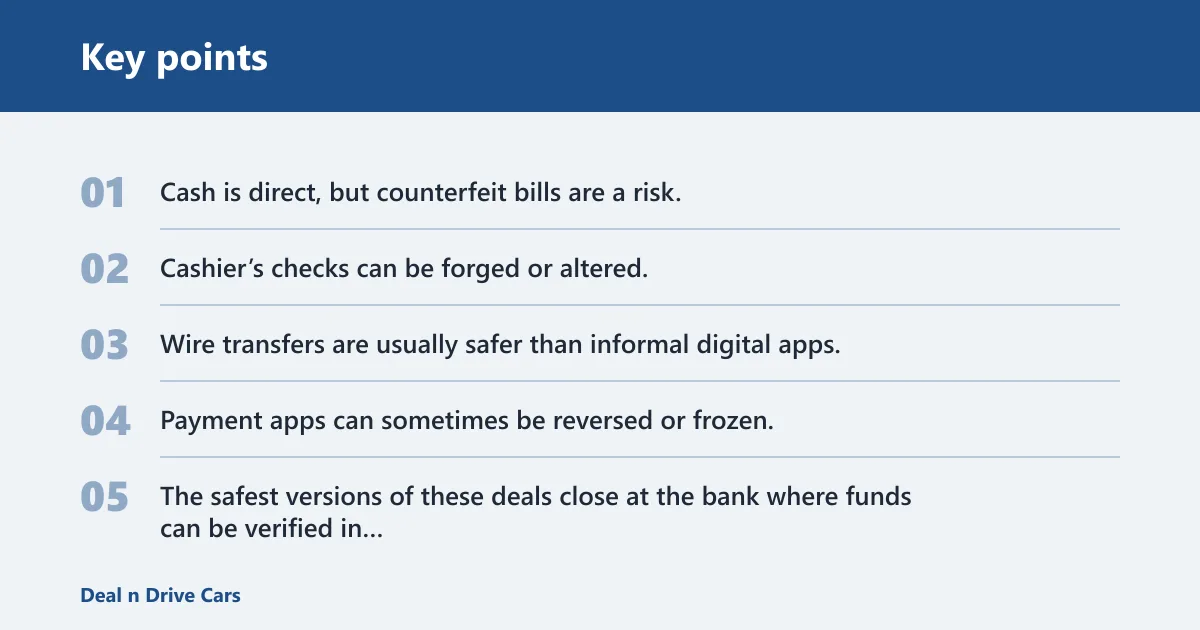
Cash is direct, but counterfeit bills are a risk. Cashier’s checks can be forged or altered, so a quick phone call alone may not be enough to confirm them. Wire transfers are usually safer than informal digital apps, but you still need to confirm that funds are fully received and available. Payment apps can sometimes be reversed or frozen.
The safest versions of these deals close at the bank where funds can be verified in person. If a buyer insists on speed, that is often a warning sign rather than a convenience.
How to verify cleared funds
Cleared funds generally mean the money has been fully collected and is available for withdrawal or transfer, rather than still pending. For a cashier’s check, the safest path is to complete the transaction at the issuing bank or wait until funds are fully collected. A bank employee can help confirm the available funds in a way that a text screenshot cannot.
When escrow helps and when it slows the deal
Escrow can help when both sides need protection. Car and Driver says escrow can be used when both sides need protection, and escrow involves a third party that holds funds. Jalopnik notes escrow services often charge a fee. That fee can be worth it for a complicated deal, but it may also cause buyer hesitation or add friction.
Use escrow only if the service is legitimate, the terms are clear, and you understand when the car will release and when the money becomes final. If the escrow setup adds confusion, delays, or odd instructions, walk away.
What if the car has a loan or the buyer needs financing?
If the car has a loan, you can still sell it privately, but the lender has to be part of the closing. The payoff letter shows the loan balance due, and the lender may require a specific payoff process. Buyer financing can also delay title release, so the bank branch is often the safest place to close.
How lien payoff works at closing
Many lenders require the loan to be paid in full before they release the title. The same source notes that different lenders handle payoff transactions differently, which means you need the lender’s instructions in advance. Some lenders want branch involvement. Others want a mailed payoff or an electronic process. Confirm the exact steps before meeting the buyer.
How buyer financing affects timing
If the buyer is financing the purchase, the buyer’s lender may need time to review documents, issue funds, and coordinate title handling. That can delay release of the title. Build that delay into the plan instead of promising an immediate handoff you cannot deliver.
Why the lender or bank branch may be the safest place to close
A bank branch can handle payoff, fund verification, and title transfer in one place. It reduces the chance of a fake payment, helps with a lien release, and keeps the exchange in a controlled setting. If the transaction is complex, that setting is often worth the extra time.
When do you hand over the title, keys, and plates?
Hand over the title, keys, and any removable items only after the money is fully verified and the paperwork is complete. State title rules vary, so confirm notarization, odometer disclosure thresholds, and plate transfer rules before the meeting. File the state release-of-liability or sold notice promptly after the sale.
Exact handoff order
- Verify the buyer’s identity and payment method.
- Confirm cleared funds at the bank or wait for full collection.
- Complete the title assignment and any required odometer disclosure.
- Finish notarization if your state requires it.
- Hand over the title and keys.
- Remove plates if your state requires the seller to keep them.
- Submit the sold notice or release-of-liability filing right away.
State title and odometer rules to confirm
Do not assume every state handles this the same way. Some states require notarized signatures. Others require specific odometer disclosure treatment based on vehicle age or title status. Plate rules also vary. Confirm the exact local requirements before the deal so you do not lose control of the transfer.
Release-of-liability or sold-notice timing
Do this immediately after the sale closes. That step protects you if the buyer gets tickets, tolls, or parking problems after pickup. It is one of the most important post-sale anti-scam protections, and it should not wait.
Frequently asked questions
What should I check before meeting a private buyer?
Check the buyer’s name, phone number, and reason for buying. Confirm the meeting place, the payment method, and whether they want a test drive. Bring the title, registration, and insurance proof if needed for inspection. If the buyer will not answer basic questions, do not meet.
How do I handle a buyer who wants to pay with a loan or financing?
Ask which lender is involved and how they will fund the purchase. If your car has a loan, get the payoff letter and follow the lender’s payoff process. Expect timing delays. The safest close is usually at a bank branch where title release and payment can be handled together.
What paperwork do I need so a buyer can’t scam me?
Have the title, payoff letter if there is a lien, vehicle history report, maintenance records, and any state-required disclosure forms ready. Keep the transaction order clear: money first, then title and keys, then sold-notice filing. Confirm whether your state needs notarization or odometer disclosure.
Should I use escrow to sell my car privately?
Escrow can help when both sides need protection, especially for remote or complicated deals. It adds a fee, and some buyers hesitate because of the extra step. Use it only if the escrow service is legitimate, the release terms are clear, and you still verify identity and funds carefully.