How Fast Do You Get Paid After a Car Cash Offer?
Most sellers are paid the same day or within about 1 to 3 business days after accepting a car cash offer, though timing may depend on when the vehicle, title, and ID are processed. Delays can leave you without the car and without funds if payoff, lien release, or bank cutoff times slow the transfer. This guide breaks down payout timing by payment method and seller situation so you know when money reaches your hand or bank account.
What happens after you accept the offer?
Acceptance usually starts a short sequence: the buyer confirms the vehicle details, schedules pickup or drop-off, checks the title and ID, then releases payment. The offer itself is often only a preliminary price based on VIN, mileage, and condition, and it may stay valid for up to 7 days.
That matters because the quote is not always the final payout. Car Battery Expert says many offers are subject to inspection, which means the price can change if the vehicle does not match the listing or photos. Pickup may be same day or next day, and free towing can remove transport delays.
Offer acceptance versus final payout
Acceptance means you agree to the quoted terms. Final payout happens after the buyer finishes the steps required by that payment method, and those steps can include inspection, title verification, or a bank transfer window. A same-day pickup does not always mean same-day money in your account.
Pickup, drop-off, and inspection in the timeline
Pickup or drop-off is often arranged right after acceptance. Some buyers can remove the vehicle the same day, while others schedule the next day. Inspection may happen before payment, and if the vehicle does not match the submitted details, the buyer may revise the offer before releasing funds.
When the clock starts for payment
The clock usually starts when the buyer has the vehicle, the required paperwork, and enough confirmation to close the file. For some sellers that means payment on pickup. For others it means the money moves after title verification or after the bank clears an ACH or cheque.
How paid table
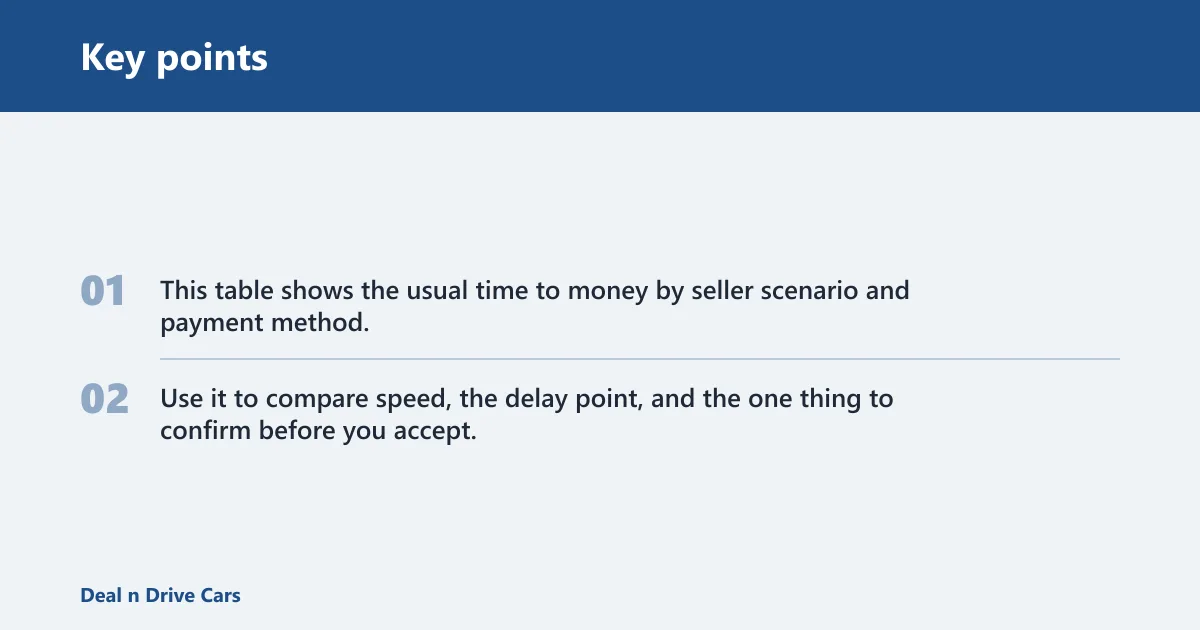
This table shows the usual time to money by seller scenario and payment method. Use it to compare speed, the delay point, and the one thing to confirm before you accept.
| Seller scenario | Cash | Check | ACH | Certified cheque or e-transfer |
|---|---|---|---|---|
| Drivable car | Same day, often on pickup; delay trigger: pickup window and paperwork; confirm: whether cash is handed over when the tow or driver arrives. | Same day to 1 business day; delay trigger: check handoff or local processing; confirm: whether the check is ready at pickup or mailed after inspection. | 1 to 3 business days; delay trigger: bank posting time; confirm: when the ACH is initiated and whether the cutoff time was met. | Same day to 24 hours; delay trigger: verification or transfer release; confirm: whether the payment is sent on pickup or after title review. |
| Non-running or junk car | Immediate on pickup is common; delay trigger: tow coordination; confirm: that free towing is included and cash is paid when the vehicle is loaded. | Same day to 1 business day; delay trigger: pickup timing; confirm: whether the check is issued at removal or after yard intake. | 1 to 3 business days; delay trigger: bank processing after handoff; confirm: whether the seller must wait for the electronic transfer after towing. | Same day to 24 hours; delay trigger: transfer release or walkthrough; confirm: that the junk or salvage buyer will use the promised method on pickup. |
| Financed car | Usually after title verification and lien payoff; delay trigger: lender payoff and release; confirm: how negative equity will be handled before the cash is handed over. | After lien payoff, often 1 to 3 business days; delay trigger: title clearance; confirm: whether the check is held until the lender confirms the payoff amount. | 1 to 3 business days, sometimes longer if the lien must clear; delay trigger: payoff release; confirm: when the ACH starts and who receives the lender payoff first. | Same day to 3 business days; delay trigger: lien and title verification; confirm: whether the transfer waits for the bank to release the title or payoff letter. |
| Post-inspection adjustment | Same day only if the adjusted offer is accepted; delay trigger: re-approval after inspection; confirm: that the final price cannot drop without your sign-off. | Same day to 1 business day after inspection; delay trigger: revised paperwork; confirm: whether the check amount changes after the vehicle is inspected. | 1 to 3 business days after final approval; delay trigger: updated payout amount; confirm: when the new ACH amount will be sent. | Same day to 24 hours if the final figure is settled; delay trigger: inspection discrepancy; confirm: that the e-transfer or certified cheque reflects the final offer. |
How fast does each payment method clear?
Payment method is the biggest reason two sellers can accept the same quote and still get paid at different times. Cash can be immediate, but ACH usually takes longer. Check and certified cheque sit in the middle, while instant e-transfer is often the quickest electronic option if the buyer supports it.
Cash on pickup
Cash is the fastest option when the buyer actually pays on pickup. Jrop says it can pay you “in 24 Hours” after pickup, and other sellers describe payment happening “the moment we pick up your car.” That usually means the money is exchanged when the driver takes the vehicle.
Check and certified cheque timing
A standard check may be handed over at pickup or after final review, but clearing time depends on your bank. A certified cheque is often more predictable than a personal check because the funds are already verified by the issuing bank. Kamo Cars says payment can be by “certified cheque or instant e-transfer.”
ACH timing
ACH is usually the slowest common method. The same source says instant online buyers usually pay within “1–3 business days” after handoff, and it also says sales can complete in “24–72 hours.” That is typical for bank transfer timing, not for cash in hand at the curb.
Instant e-transfer timing
Instant e-transfer can be very fast when the buyer uses it at pickup and your bank accepts it without delay. It is still worth asking whether the transfer is sent before the truck leaves, because some buyers wait until title checks finish. The same source says payment can be by “instant e-transfer.”
What slows the payout down?
Most delays come from paperwork, inspection, or title issues rather than the quote itself. The fastest buyers still need to confirm the vehicle identity, match the VIN, and check whether a lender has a claim on the title. If any of those steps are incomplete, payment can wait.
Title verification and lien payoff checks
If the car is financed, the buyer may need to verify the title before releasing full payment. That can take longer when a lender must confirm the payoff amount or issue a release. Until that happens, the seller may see only a partial payout or no payout at all.
Suppose you accept a quote for a sedan with an outstanding loan balance. The buyer may send the lender the payoff amount first, then release the seller’s share after the title clears. That is why “same day” may describe pickup, while the money reaches you later.
Inspection delays and offer changes
Inspection can happen before payout and may change the final offer. The same source says many offers are subject to inspection, and that is where missed details matter: damaged panels, missing keys, warning lights, or a car that does not run can all change the final number. If the revised offer is lower, payment pauses until you accept it.
A common first-timer mistake is assuming the online quote is locked the moment it is accepted. If the listing said the car started and the inspector finds a dead battery and a failed transmission, the buyer may adjust the price before sending funds.
Missing documents or missed pickup windows
Even a fast buyer can stall if the title, ID, or appointment details are not ready. Missed pickup windows can push payment to the next business day. If the seller cannot hand over the needed paperwork, the buyer may reschedule rather than pay early.
Do you get paid on pickup?

Sometimes, yes. That is common with junk or salvage buyers, cash offers for non-runners, and deals where the buyer is ready to pay at the handoff. It is not automatic for every car, and it is less likely when the title needs extra verification or when the payout method is an ACH transfer.
When same-day payment is realistic
Same-day payment is most realistic when the car is clear of liens, the seller has the title and ID ready, and the buyer uses cash, instant e-transfer, or a certified cheque at pickup. Original Cash For Cars says the vehicle is removed the same day, and that sellers are paid on the spot.
Do junk car buyers pay cash on pickup? Often, yes, especially when the car is non-running or damaged and the buyer controls the tow. CashForCarsAndRVs says they pay you “immediately in cash,” and it also says cash can be received “within 24 hours.”
When pickup happens first and payment follows
Pickup can happen before payment when the buyer wants to verify the title, process a lien payoff, or complete an inspection first. That is common with financed vehicles and with offers that are not yet final. In those cases, the tow truck may leave before the bank transfer posts.
What to confirm before the tow truck arrives
- Confirm the payment method and whether it is sent at pickup or after review.
- Confirm whether the offer can change after inspection.
- Confirm who handles the lien payoff if the car still has a loan.
- Confirm whether towing is free and whether pickup is same day or next day.
- Confirm the documents needed: title, ID, and any lender payoff details.
What if the car still has a loan?
If the car is financed, the payout usually takes longer because the lender has to be paid and the title may need to be released. The buyer may send money to the lender first, then send any remaining balance to you. That can move the seller’s funds from same day to 1 to 3 business days or more.
Lien payoff and release timing
The key delay is title verification. Until the lender confirms the payoff amount and releases its claim, the buyer may not send your share. If the payoff amount is higher than the offer, you may need to cover the shortfall before the sale closes.
How the buyer handles negative equity
Negative equity means you owe more than the car is worth. In that case, the buyer usually subtracts the payoff amount from the offer, and the remaining balance may be zero or negative. If the difference is negative, you may need to bring money to closing or cancel the deal.
When funds reach you after payoff
When the lender is involved, funds often reach you only after the payoff clears and the buyer has proof the title can be released. That is why financed car sales can feel fast at first, then slow down near the end. The delay is usually paperwork, not the quote itself.
How to get the fastest payout
The quickest path is the one that matches your car type and your payment needs. If speed matters more than method, choose a buyer that can pay on pickup, bring the paperwork, and spell out how inspection affects the final number. That cuts out the usual hold points.
Choose the right payment method
If you need money right away, cash or instant e-transfer is usually faster than ACH. If you want a bank-verified paper trail, certified cheque may fit better, but it can still require a pickup appointment and title checks. Ask which step actually triggers release of funds.
Prepare title and ID before pickup
Have the title, registration if needed, and government ID ready before the truck arrives. If the car is financed, have the lender payoff information ready as well. Missing one document can turn a same-day deal into a next-business-day payout.
Confirm inspection terms before you accept
Ask whether the offer is subject to inspection, what findings can change the price, and who approves the final number. The same source says instant cash offers are typically valid up to “7 days,” and Kamo Cars says the offer is good for “7-days.” That window helps, but it does not replace final verification.
What should you expect between accepting the offer and getting paid?
You should expect a short chain of checks, not an automatic payout. Most deals move from acceptance to pickup, then to inspection or title verification, then to payment. If the buyer uses cash or instant e-transfer and the paperwork is clean, the money may arrive on pickup. If not, expect 1 to 3 business days.
How long does it usually take from quote to payout?
For many sellers, the full path from quote to payout falls inside 24 to 72 hours, especially when pickup is fast and the vehicle clears inspection. The same source says instant online buyers can complete sales in “24–72 hours,” which is a practical range for straightforward deals. Financed cars and post-inspection adjustments can take longer.
Frequently asked questions
How fast do you get paid after accepting a car cash offer?
Most sellers get paid the same day or within 1 to 3 business days, depending on the payment method and whether the title clears without a lien problem. Cash can be immediate, while ACH usually takes longer. If inspection or paperwork is pending, payment may wait until that step finishes.
Do you get paid the same day or after the car is picked up?
Sometimes both happen on the same day, but they are not the same thing. Same-day pickup means the car is collected that day. Same-day payment means the money is released that day. Some buyers pay on pickup, while others pay after inspection, title review, or bank processing.
How long does an ACH payment take after selling a car?
ACH usually takes 1 to 3 business days after handoff, and it can stretch longer if the transfer is started late in the day or if title verification is still open. It is a slower option than cash or instant e-transfer, but it can be a good fit if you want a bank transfer instead of paper payment.
What is the fastest way to get paid for a car online?
The fastest path is a buyer that pays cash or instant e-transfer at pickup, with the title and ID ready and no lien to clear. Junk or salvage buyers are often quickest for non-runners and damaged cars because they can collect the vehicle and pay on the spot.
Can the payout be delayed if the car is inspected?
Yes. Inspection can slow the payout if the buyer needs to confirm the VIN, check the condition, or revise the offer after seeing the car in person. Many instant offers are subject to inspection, so a final payout may wait until the adjusted price is accepted and the paperwork is updated.
What happens if the buyer pays by certified cheque or bank transfer?
Certified cheque usually means the funds are verified, but you may still wait until pickup, title review, or local banking hours line up. Bank transfer, including ACH, can take 1 to 3 business days. Ask whether the payment is released before the truck leaves or after the buyer confirms the paperwork.