What APR Should You Expect on a Bad Credit Auto Loan?
Expect roughly 9% to 18% APR for strong subprime, 18% to 27% for deep subprime, and even more if the lender prices in a tiny down payment or long term. A bad offer can add thousands in interest and trap you in negative equity. This guide breaks down APR by score tier, then shows how down payment, term, and add-ons change the total cost.
This guide is part of our Bad credit auto loans: how to get approved and pay less series.
What counts as bad credit?
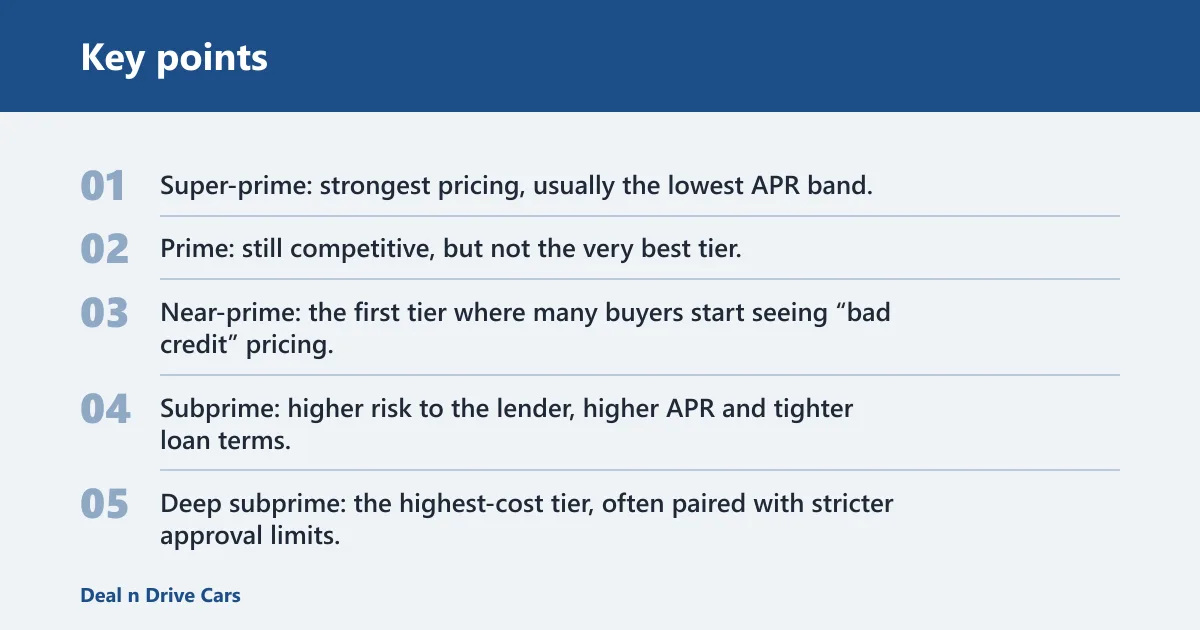
In auto lending, bad credit usually means FICO 660 and below. Lenders commonly sort applicants into five tiers: super-prime, prime, near-prime, subprime, and deep subprime. Near-prime is generally grouped around FICO 601–660, subprime around FICO 501–600, and deep subprime at FICO 500 or below.
Lenders may use FICO or VantageScore, and some also layer in income, vehicle age, and payment history. A 600 score is usually the border between subprime and near-prime. A 660 score often marks the edge between near-prime and prime pricing. A 500 score is where the cost jump gets steep.
How to read the tiers
- Super-prime: strongest pricing, usually the lowest APR band.
- Prime: still competitive, but not the very best tier.
- Near-prime: the first tier where many buyers start seeing “bad credit” pricing.
- Subprime: higher risk to the lender, higher APR and tighter loan terms.
- Deep subprime: the highest-cost tier, often paired with stricter approval limits.
That tiering matters more than the label on the credit score alone. Two buyers with the same score can still get different offers if one has a 20% down payment and stable income while the other is asking for zero down on an older used car.
Bad credit APR benchmark table
For a used-car shopper with bad credit, the cleanest way to judge an offer is to compare it with a fixed loan example. The table below uses an $18,000 loan over 60 months, which matches a common used-car example structure, and shows how the payment moves as the APR rises.
| Credit tier | Typical score band | Expected APR range, used car | Estimated monthly payment on $18,000/60 months | Total interest | Interest vs. near-prime benchmark |
|---|---|---|---|---|---|
| Prime | 661 and above | 7%–10% | $356–$382 | $3,372–$4,926 | $0–$0 |
| Near-prime | 601–660 | 13.93%–14.03% | $418–$419 | $7,084–$7,148 | Benchmark |
| Subprime | 501–600 | 19.10%–19.42% | $466–$469 | $9,920–$10,148 | About $2,800–$3,000 more |
| Deep subprime | 500 or below | 21.62%–21.77% | $490–$492 | $11,430–$11,472 | About $4,300 more |
The used-car APR figures above line up with market references that place near-prime around 13.93% to 14.03%, subprime around 19.10% to 19.42%, and deep subprime around 21.62% to 21.77%. That gap is large enough to change both the monthly payment and the total cost of the car.
Picture two buyers financing the same $18,000 used car for 60 months. One gets near-prime pricing around 14%, and the other lands in subprime around 19.4%. The second buyer pays roughly $50 more each month and several thousand dollars more in interest over the life of the loan.
Why bad credit loans cost more
Higher APR reflects higher lender risk, but the rate is also doing more work than people expect. A lender is pricing for missed payments, fast depreciation, and the chance the car will be worth less than the loan balance if the buyer falls behind.
That is why loan-to-value limits matter. Subprime lenders often cap LTV more tightly, which means the loan amount may have to stay closer to the car’s actual value. If you are already upside down on a trade-in, approval can get harder because the new loan starts with too much debt for the car’s worth.
What can push the rate higher?
- Thin credit files with little installment history.
- Prior repossession or collections tied to vehicle debt.
- Short job history or unstable income.
- Zero down payment on a higher-mileage used car.
- Longer terms that keep the lender exposed for more months.
A common first-timer mistake is thinking the score tells the whole story. A 610 score with 15% down and steady pay can price better than a 640 score with zero down, a prior repo, and a short work history.
How much down payment changes the offer?
A 10% to 20% down payment is a common target for damaged-credit borrowers because it lowers the amount borrowed and improves approval odds. It also cuts loan-to-value, which matters when the lender is deciding whether the car covers the risk. Less balance means less chance of ending up upside down.
Zero-down deals are the risky end of the market. They can still exist, but the lender has to cover more exposure, so the APR is often higher and the approval standard is tighter. If the car is worth $18,000 and you finance all of it, there is no cushion for tax, fees, or fast depreciation.
Down payment effect on cost
- More cash down lowers the financed amount.
- Lower LTV can improve approval odds.
- It can reduce the monthly payment and the chance of negative equity.
- It may also help offset a short job history or a thin file.
Suppose a buyer puts 20% down on an $18,000 car. The loan amount drops by $3,600 before taxes and fees. That smaller balance can make a borderline approval more workable, and it lowers the dollar damage if the vehicle depreciates faster than the loan pays down.
What lenders look at besides credit?
Lenders want proof that the payment fits your budget. Expect to provide pay stubs, year-to-date earnings, and enough employment history to show the income is stable. Self-employed buyers usually need tax returns, bank statements, or other documents that verify cash flow.
Debt-to-income also matters. If existing obligations already take a large share of your monthly income, the lender may shrink the loan amount, demand a bigger down payment, or move you into a higher-priced tier. A thin file with no installment history can also make the offer more expensive.
Common documents lenders ask
- Recent pay stubs.
- Year-to-date earnings on those stubs.
- Proof of stable employment history.
- Tax returns for self-employed buyers.
- Bank statements or other income records when needed.
Dealers and lenders use this paperwork to judge whether the loan is likely to perform. That means a buyer with a lower score can still get approved if the income story is clean and the loan amount is kept in line with the vehicle value.
Why loan term changes the real cost
A 60-month term is a useful baseline because it keeps the payment and interest in view at the same time. Stretching the term to 72 or 84 months can lower the monthly payment, but the loan stays outstanding longer and total interest rises. For subprime buyers, the longer term can also keep the loan upside down for more months.
Long terms can make a deal look easier on day one. They also increase the chance that a borrower pays for a car that is aging faster than the balance falls. That matters most on used cars, where depreciation and repair risk are already working against the borrower.
Refinance seasoning window
Refinancing is usually not immediate. Many lenders want a seasoning period and a record of on-time payments first. A practical rule of thumb is about 6 to 12 months of steady payments, along with enough score improvement to qualify for a better tier. Near-prime refi APR is shown at 9.5%–12.5%, subprime at 13.5%–17.5%, and deep subprime at 17%–22%.
If the original loan is extremely expensive, refinancing sooner can still help, but only if the lender allows it and the vehicle has not lost too much value. The goal is to replace a high-rate loan with one that trims both the rate and the total interest left on the balance.
What apr expect table
This table turns the rate tiers into a simple buying decision. It uses the same $18,000 used-car loan over 60 months so you can compare monthly payment, total interest, and the cost of waiting for a better tier.
| Tier | APR benchmark | Estimated payment | Total interest | Difference vs. near-prime benchmark |
|---|---|---|---|---|
| Prime | 7%–10% | $356–$382 | $3,372–$4,926 | Saves about $2,200–$3,800 |
| Near-prime | 13.93%–14.03% | $418–$419 | $7,084–$7,148 | Benchmark |
| Subprime | 19.10%–19.42% | $466–$469 | $9,920–$10,148 | Costs about $2,800–$3,000 more |
| Deep subprime | 21.62%–21.77% | $490–$492 | $11,430–$11,472 | Costs about $4,300 more |
The jump from prime to subprime is the one most shoppers feel. On this example loan, the payment rises by about $50 each month and the interest bill grows by roughly $3,000. Waiting for a score bump, a larger down payment, or a stronger job record can change the tier enough to matter.
Credit unions can be cheaper than dealer-arranged financing for some borrowers, especially if the credit file is damaged but not broken. Online marketplaces and specialty subprime lenders can widen the menu of offers, while dealer financing can be faster but often carries the widest spread in pricing. Shopping more than one channel is the only way to know whether the offer is fair.
Frequently asked questions
What APR should I expect with bad credit on a car loan?
Expect roughly 9% to 18% APR if your credit is in the stronger subprime range, and 18% to 27% if you are in deep subprime. The exact rate depends on score band, vehicle age, down payment, term, and lender type. Used cars usually price higher than new cars.
What is the average APR for a subprime auto loan?
For used cars, the cited subprime range is about 19.10% to 19.42%, with deep subprime even higher. New-car offers can be lower, but the spread remains wide. If a lender quotes far above those levels, check whether fees, term length, or add-ons are inflating the cost.
How much higher is APR for a bad credit auto loan?
Compared with prime pricing, bad-credit pricing can be several points higher and sometimes much more. On an $18,000 used-car loan over 60 months, moving from near-prime to subprime can raise the payment by about $50 a month and add around $2,800 to $3,000 in interest.
What credit score counts as bad credit for an auto loan?
Bad credit usually means FICO 660 and below. Some lenders may also use VantageScore, so the underwriting picture can change even when the headline score looks similar.
Can I get a car loan with a 500 credit score?
Yes, but pricing will usually land in deep subprime and the lender may tighten the loan amount, ask for more down, or limit the vehicle choice. A 500 score is not an automatic denial. It is a sign that the offer may need a bigger down payment and a shorter loan term.
How does a down payment affect bad credit auto loan APR?
A larger down payment does not guarantee a lower APR, but it often improves approval odds and can help the lender price the loan more favorably. Ten percent to 20% down is a common target because it lowers loan-to-value and reduces the chance of being upside down early in the loan.
How long should I wait before refinancing a high-rate auto loan?
Start looking after 6 to 12 months of on-time payments, once the lender’s seasoning rules are met and your score has improved enough to qualify for a better tier. Near-prime refi pricing can run 9.5%–12.5%, while subprime and deep subprime refi pricing is higher. Refinancing too early often means no real gain.
Are credit unions cheaper than online lenders for bad credit car loans?
Sometimes, yes. Credit unions can be more forgiving on rate and fees if your credit is damaged but your income is stable. Online marketplaces may show more offers quickly, and specialty subprime lenders can approve tougher files. The cheapest offer is the one you compare, not the one you accept first.
What fees or add-ons can make a bad credit auto loan more expensive?
Credit insurance, GAP insurance, extended warranties, and dealer-added products all raise the real cost of the loan. They can also increase the financed balance, which pushes the payment higher and may extend the time you spend upside down. Read the contract line by line before signing.