How to Pay a Private Seller for a Car Safely
Pay a private car seller by cashier’s check or wire only after the title, the seller’s ID, and the payoff amount are verified; cash is generally used only for lower-risk deals, often under about $1,000. A bad handoff can leave you with no car, no money, or a title you cannot use. This guide gives you a payment decision tree by deal size and risk, plus the exact handoff steps that reduce fraud and title problems.
This guide is part of our Private seller cars: how to buy safely and save series.
Private-car payment decision table
| Price band | Safest payment method | Where to meet | What to verify first | Top failure mode |
|---|---|---|---|---|
| $1,000–$5,000 | Counted cash | Inside the seller’s bank branch during business hours | Seller ID, VIN on the car and title, signed title, bill of sale | Counterfeit bills or a seller who leaves before paperwork is complete |
| $5,000–$10,000 | Cashier’s check made out to the seller by full legal name | Bank branch lobby during business hours | Title status, seller ID, VIN match, cashier’s check verification at the issuing bank | Fake or altered cashier’s check if it is not independently verified |
| $10,000+ | Bank-verified funds or escrow | Bank branch lobby or a licensed escrow process for long-distance deals | Title status, lien payoff amount, seller ID, VIN, all transfer documents | Funds move before lien payoff, title transfer, or release of liability is complete |
What is the safest way to pay a private seller for a car?
The safest method depends on the deal size and the title status. Cash can work for smaller purchases when you meet inside a bank branch and count the bills there; cashier’s checks are the better default above about $5,000, but only after the issuing bank confirms them; escrow fits long-distance purchases.
Cash versus cashier’s check
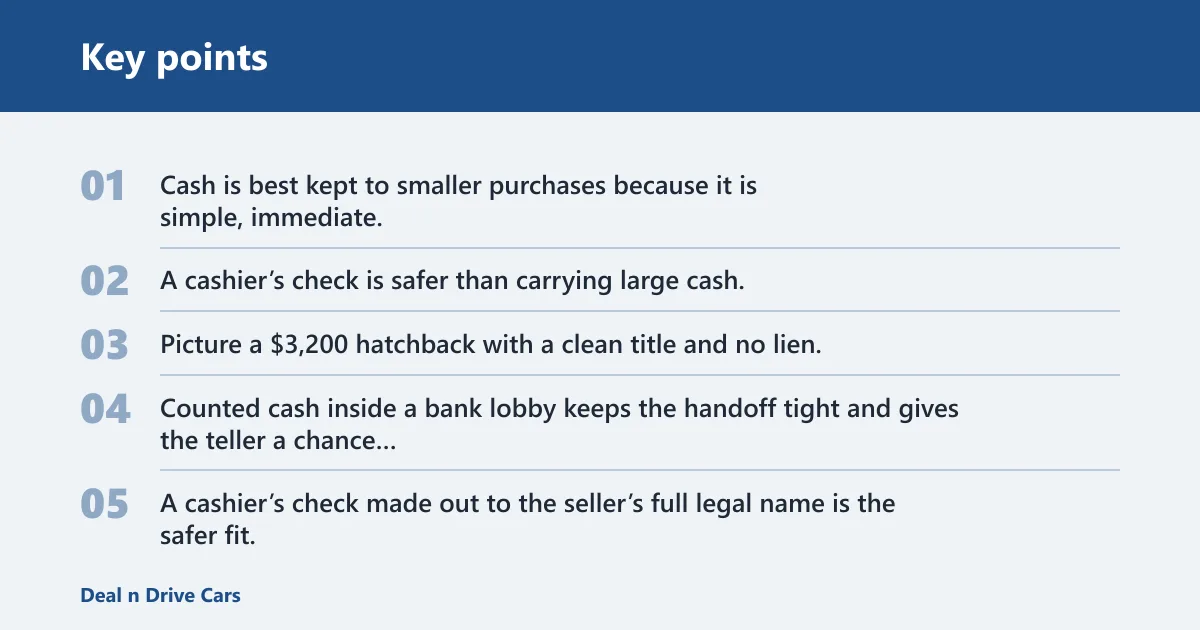
Cash is best kept to smaller purchases because it is simple, immediate, and easier to count in a bank lobby. A cashier’s check is safer than carrying large cash, but it is still vulnerable to forgery if nobody verifies it with the issuing bank before funds change hands.
Picture a $3,200 hatchback with a clean title and no lien. Counted cash inside a bank lobby keeps the handoff tight and gives the teller a chance to watch the exchange. Now picture an $8,500 sedan. A cashier’s check made out to the seller’s full legal name is the safer fit.
When escrow makes sense
Escrow makes sense for long-distance purchases, especially when the car and the buyer are in different states. The service should be licensed in the buyer’s state, and one cited guide puts the fee around 1%. That cost is easier to justify when the deal is large or the title transfer needs extra control.
Why payment apps fall short
Venmo, PayPal, Zelle, and Cash App are poor fits for most car purchases. They may have limits, fees, or transfer risk, and a seller can receive the money before the title problem is resolved. PrivateAuto says verified funds are checked before the parties ever meet, which is the direction to prefer, but common payment apps do not give that same protection by default.
Where should you meet the seller?
Meet inside the seller’s bank branch during business hours. That location is preferred because it has cameras, a teller can verify funds, and the title, bill of sale, and odometer disclosure statement can all be signed while both parties are present. The meeting place matters as much as the payment method.
What to do if the seller refuses the bank
If the seller will not meet at a bank, treat that as a risk signal, not a minor inconvenience. A driveway, parking lot, or roadside handoff removes teller help, weakens your ability to verify funds, and makes it easier for either side to back out after the other side has already acted.
Say your seller wants “just a quick meet” in a grocery-store lot for a roughly $9,400 SUV. That setup gives room for a fake cashier’s check, a swapped vehicle, or a last-minute refusal to sign the title. The safer answer is simple: no bank, no payment.
Why a driveway handoff adds risk
A driveway handoff hides too many points of failure. You lose the bank’s camera coverage, the teller’s help with verification, and the controlled sequence that keeps the title and funds moving together. That is how people end up with either a paid vehicle and no title, or a title and no final payment.
How do you verify the car and title first?
Verify the car before any money moves. Match the VIN on the dashboard to the VIN on the title, check that the seller’s name matches the title and ID, and look for lien notes, salvage branding, or a missing title. If any of those items fail, stop until the issue is resolved.
Match the VIN on the car and title
The VIN is the core anti-fraud identifier. It must match the dashboard tag and the title exactly. Use it to check the vehicle history report and recall status, then compare the title’s VIN to the car again at the handoff. A mismatch means the deal is not ready for payment.
Check the seller’s ID against the title
The seller’s name on the ID should match the name on the title. That is not a courtesy check. It is how you reduce the chance of paying someone who does not have the right to transfer the car.
Look for liens, salvage notes, or missing title issues
If the title is missing, the seller has a lien, or the title shows a payoff amount, do not release funds until the lien is cleared or the payoff is handled in writing. A buyer should not pay in full while the seller still cannot legally pass clean title. Partial payment before signature is a common trap.
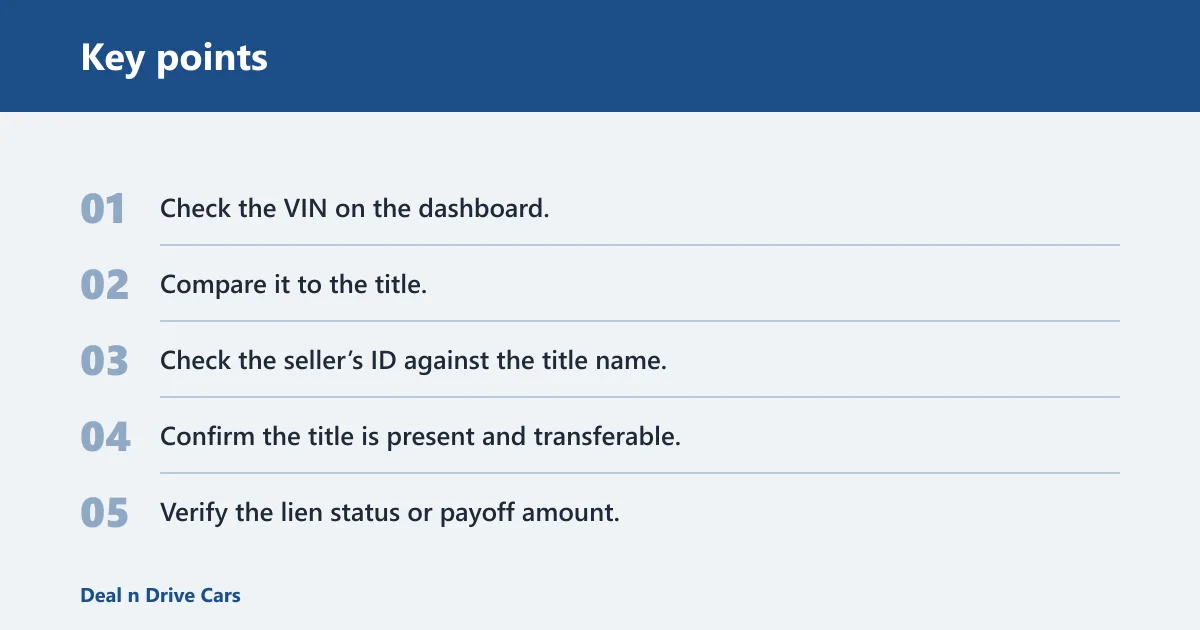
- Check the VIN on the dashboard.
- Compare it to the title.
- Check the seller’s ID against the title name.
- Confirm the title is present and transferable.
- Verify the lien status or payoff amount.
- Sign the transfer paperwork.
- Release funds only after the documents are complete.
How to verify a cashier’s check before handing it over
Make the cashier’s check payable to the seller’s full legal name, then verify it with the issuing bank using a number you find independently, not the number printed on the check. Confirm the check details with the bank before releasing the title or vehicle keys. That is the point of the check.
Make the check payable to the right name
A cashier’s check should be made out to the seller by name. If the name does not match the title holder, pause the deal. A buyer should not accept a nickname, a business name, or a handwritten correction unless the issuing bank confirms it in a way that the branch can document.
Call the issuing bank using a verified number
Do not rely on a phone number printed on the check, because a forged check can print a fake call center number too. Find the issuing bank’s verified number separately, then ask the bank to confirm the cashier’s check details, including amount, payee, and status.
Confirm funds before releasing the title
Funds should be verified before the title moves. That is the exact order that prevents a last-minute reversal. If the bank cannot confirm the check, the seller should keep the car and the buyer should keep the money.
What paperwork should you get when you pay a private seller?
At closing, get the signed title transfer, a bill of sale, and an odometer disclosure statement. These should be signed at the bank with the payment handoff. After that, complete any local DMV steps quickly and submit a release of liability where your state requires it.
Signed title transfer
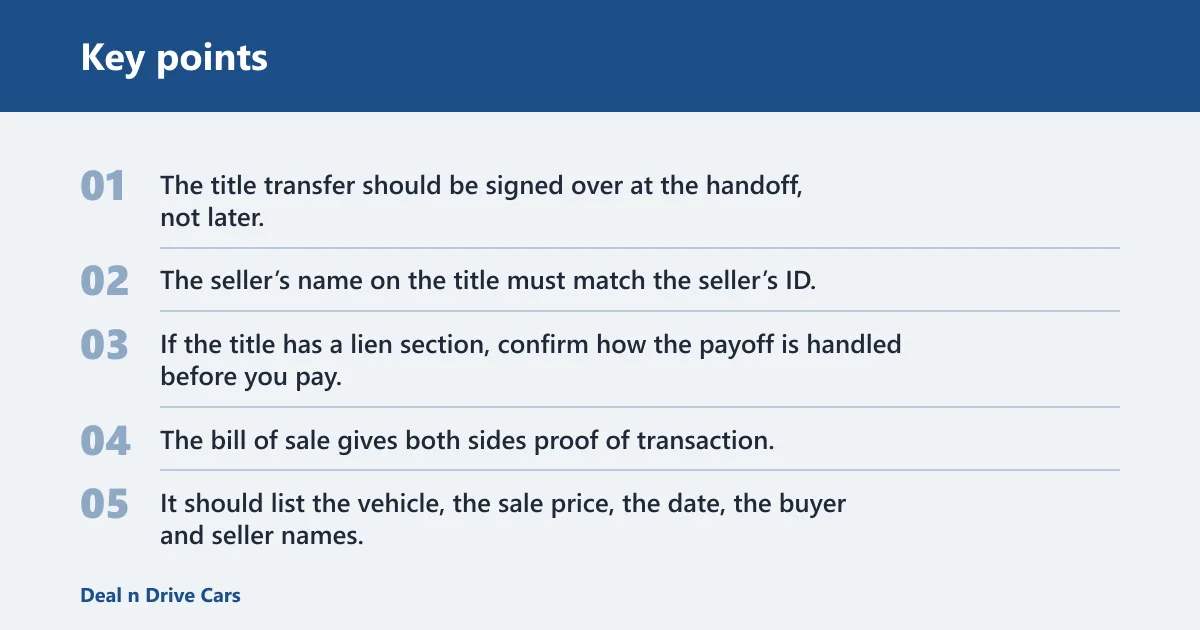
The title transfer should be signed over at the handoff, not later. The seller’s name on the title must match the seller’s ID, and the transfer should be complete before funds are released. If the title has a lien section, confirm how the payoff is handled before you pay.
Bill of sale
The bill of sale gives both sides proof of transaction. It should list the vehicle, the sale price, the date, the buyer and seller names, and the VIN. Some platforms treat this as state-specific, so the document should still reflect local requirements, even when the form comes from a private-party service.
Odometer disclosure statement
The odometer disclosure statement documents mileage at sale and should be paired with the title and bill of sale. It matters because mileage claims can turn into title disputes later. A clean handoff includes all three documents, signed before the money leaves the buyer’s hand.
Release of liability and local DMV timing
After the sale, complete the release of liability and submit DMV paperwork as soon as your state requires. Do not leave the seller’s name attached to the vehicle longer than necessary. That step helps separate future tickets, tolls, and liability from the old owner.
What should you do if the seller won’t meet at a bank?
If the seller refuses a bank meeting, slow the deal down or walk away. A bank lobby gives you camera coverage, teller verification, and a controlled place to sign the title, bill of sale, and odometer statement. Without that setting, the fraud risk rises and the handoff gets harder to prove.
Acceptable alternatives
If a bank branch is not possible, use a licensed escrow service for a long-distance purchase or another controlled location only after you have already verified the title status and payment method. Even then, the same rule holds: no funds before title and identity checks are done.
When to stop the deal
Stop the deal if the seller rushes you, wants a deposit before signing, or asks for partial payment before the title is transferred. That is a common setup for a reversal or a title problem. A clean seller should be willing to follow the verification order.
How much cash is safe to carry when buying a car privately?
Cash is commonly used for smaller purchases, especially around the $1,000–$5,000 range, and it should be counted inside a bank lobby. Once a single cash transaction crosses $10,000, a Currency Transaction Report is required. Structuring withdrawals to stay below $10,000 is described as a federal crime.
That does not mean a buyer should avoid cash at every level. It means cash stops making sense as the price climbs, because risk, reporting, and counterfeit exposure rise with it. A cashier’s check or bank-verified funds are better for mid-priced and higher-value deals.
Can I use an escrow service for a private car purchase?
Yes. Escrow can help with long-distance private sales, especially when the buyer and seller are in different states. A licensed escrow service in the buyer’s state can hold funds until the buyer approves the deal, which lowers the chance of paying before the title issue is resolved.
When escrow is a better fit than cash
Escrow is most useful when you cannot meet at the seller’s bank, when the vehicle is expensive, or when the title paperwork needs extra time. It is slower than cash, but slower can be safer when the deal has distance, lien payoff, or identity questions attached to it.
How do I avoid scams when paying a private seller?
Match the VIN on the dashboard and title, check the seller’s ID against the title, and wait to pay until the paperwork is complete. That sequence blocks the most common scams: fake funds, swapped vehicles, missing titles, and sellers who disappear after receiving money.
Spot the common failure points
A seller who will not show the title, will not meet at a bank, or wants money before signing is pushing you toward risk. Another warning sign is a title that does not match the seller’s name or a VIN that does not match the car. Any one of those should pause the deal.
Use the handoff order every time
Verify identity first, then VIN, then title, then odometer disclosure, then bill of sale, then release funds. That order keeps the buyer from becoming the only person with risk at the end of the transaction.
Frequently asked questions
Should I use cash or a cashier’s check for a private car sale?
Use cash for smaller, low-risk purchases where you can count the bills in a bank lobby. Use a cashier’s check for mid-priced deals, but make it payable to the seller by full legal name and verify it with the issuing bank before you release the title or accept the car.
Can I use venmo, payPal, or zelle to pay for a car?
Those apps are poor fits for most private car purchases because of limits, fees, and transfer risk. They can move money before the title problem is solved, which leaves you with weaker protection than a bank-verified cashier’s check, cash counted in branch, or licensed escrow.
How do I verify a cashier’s check before handing it over?
Call the issuing bank using a verified number you found separately, then ask the bank to confirm the check amount, payee, and status. Do not trust the phone number printed on the check. Verify it before the seller signs over the title or hands over the car.