How to Find the Trade-In Value of My Car
To find your car’s trade-in value, match the exact trim, mileage, options, and condition to current market comps, then confirm the range with a dealer appraisal; a quote far outside that range is usually too high or too low. Skip that step, and you can leave money on the table or waste time arguing over a bad offer. This guide shows how to build a realistic trade-in range from vehicle data, comparable listings, and dealer appraisals.
Trade-in value basics
Trade-in value is the amount a dealer pays for your car, usually as credit toward another vehicle. It is not the same as private-party value, and it is not the same as retail price. Dealers price in reconditioning, lot time, market demand, and profit margin, so the number is usually lower than what a private buyer might pay.
Think in ranges. Your model year, trim, mileage, title status, service history, accident history, and visible wear all move that range up or down. A quote that ignores those details is a guess.
A dealer’s online estimate is only the starting point. The final offer can change after a physical inspection, a test drive, and document review.
What you’ll need
- VIN
- Exact trim level and engine or transmission details
- Current mileage from the odometer
- Title status, including clean title or any damage brand
- Accident history and ownership count
- Service records, if available
- Photos of the exterior, interior, tires, and dashboard
- Notes on warning lights, brake wear, and tire wear
- Any modification list, if the car is not stock
Step 1: Gather your vehicle details
Start with the exact car, not the general model. A base trim and a higher trim can price very differently, especially when factory options, engine changes, or transmission changes were added from the factory. Record the VIN if you have it, because many valuation tools use it to reduce trim and option mismatches.
Then record mileage, title status, accident history, and ownership count. Compare mileage with the model-year average for that vehicle, because higher mileage usually pushes trade-in value down. Add tire tread, brake wear, visible body damage, warning lights, and any mechanical issues. Suppose a midsize sedan has the right trim but 30,000 extra miles and a lit check-engine lamp; that condition gap matters more than a clean photo set.
Can you estimate trade-in value without a VIN?
Yes, you can get a rough estimate without a VIN, but the result is less precise. A non-VIN tool can still narrow the market range when you know the year, make, model, trim, mileage, and condition. That is enough for a first pass when you need a fast answer.
A VIN-based estimator is better when the car has multiple trims, option packages, or powertrain choices. It also helps with vehicles that have equipment differences that are hard to spot from the badging alone. If the car has a modified exhaust, aftermarket wheels, or a non-stock suspension, a VIN can help reveal what was factory equipment and what was added later.
Picture a pickup listed as “XLT” by a seller, but the VIN decodes to a different cab and towing package. The rough estimate can be misleading until the exact build is confirmed.
Step 2: Check market comps
Compare at least three views of value, such as private-party, retail, and dealer wholesale or trade-in. Private-party listings show what buyers ask for. Retail pricing shows what dealers ask on the lot. Wholesale or trade benchmarks show the lower end of what a dealer can pay and still recondition and resell the car.
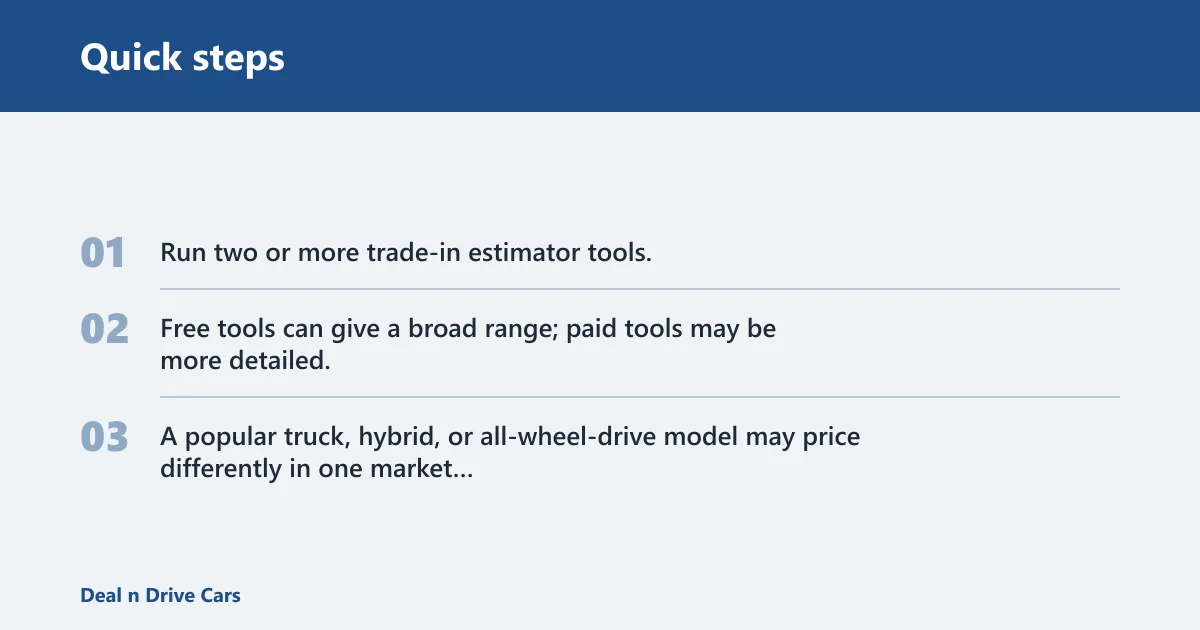
Run two or more trade-in estimator tools, then compare those results with local listings for the same year, trim, mileage, and drivetrain. Free tools can give a broad range; paid tools may be more detailed, but the best result still depends on accurate input. Local demand matters too. A popular truck, hybrid, or all-wheel-drive model may price differently in one market than another.
| Benchmark | What it shows | How to use it |
|---|---|---|
| Private-party | What an individual buyer may pay | Set the top end of the full value picture |
| Retail | What a dealer may ask on the lot | Check the margin between buy and sell prices |
| Dealer wholesale / trade | What a dealer can pay and still recondition the car | Anchor your likely trade-in range |
How does condition change the offer?
Condition can move the offer quickly because dealers price in repair cost, time, and risk. Exterior wear, torn upholstery, broken trim, stains, odor, fluid leaks, and mechanical noise all reduce value. Clean title status usually supports a stronger number, while salvage, rebuilt, flood, or other damage brands can reduce it significantly.
Tires and brakes matter because they are easy to inspect and expensive to refresh. Warning lights matter because they signal possible repair work or diagnostic time. A common first-timer mistake is polishing the paint and forgetting a low brake pedal or bald front tires; the dealer will spot those faster than the shine.
Service history also helps. A complete record set does not erase wear, but it can support confidence in the car’s upkeep.
Step 3: Get a dealer appraisal

Bring the car, keys, title, registration, and any service records for a physical appraisal. Dealers usually inspect the body, tires, brakes, interior wear, fluid leaks, warning lights, and road manners on a test drive. They may also review photos or documents before they see the car in person.
The final offer can differ from the online estimate if the inspection finds issues the estimator could not see. That is normal. Compare the dealer’s number with your estimated range, then ask which deductions were made and why. If the quote is far below your range, ask for a line-by-line reason for the gap.
- Gather the VIN, trim, mileage, title status, and history report.
- Run two valuation tools and note the trade-in range they return.
- Check local listings for the same year, trim, and mileage band.
- Get at least one dealer appraisal and record any deductions.
- Compare the final offer with the range, not with one online number.
Trade-in value worksheet
Use this worksheet to tighten your estimate before you visit a dealer. It helps separate the rough range from the final offer and makes it easier to spot a number that is too high or too low.
| Item | Your entry | Notes |
|---|---|---|
| VIN | Enter full VIN or note “not available” | Improves accuracy when available |
| Trim | Base, mid, or higher trim | Include engine and transmission differences |
| Mileage | Current odometer reading | Compare with model-year average |
| Title status | Clean, rebuilt, salvage, flood, or other brand | Damage history affects value |
| Tires | Good, fair, worn, or needs replacement | Show tread depth notes if known |
| Brakes | Good, fair, worn, or noisy | Note any vibration or warning light |
| Accident history | None or list event summary | Include body, frame, or airbag damage |
| Estimated range | Low to high value from comps | Use a range, not one number |
| Inspection deductions | Repair estimates or dealer deductions | Record the reason for each deduction |
| Final net value | Dealer offer after deductions | This is the number to compare |
Three-step estimate method
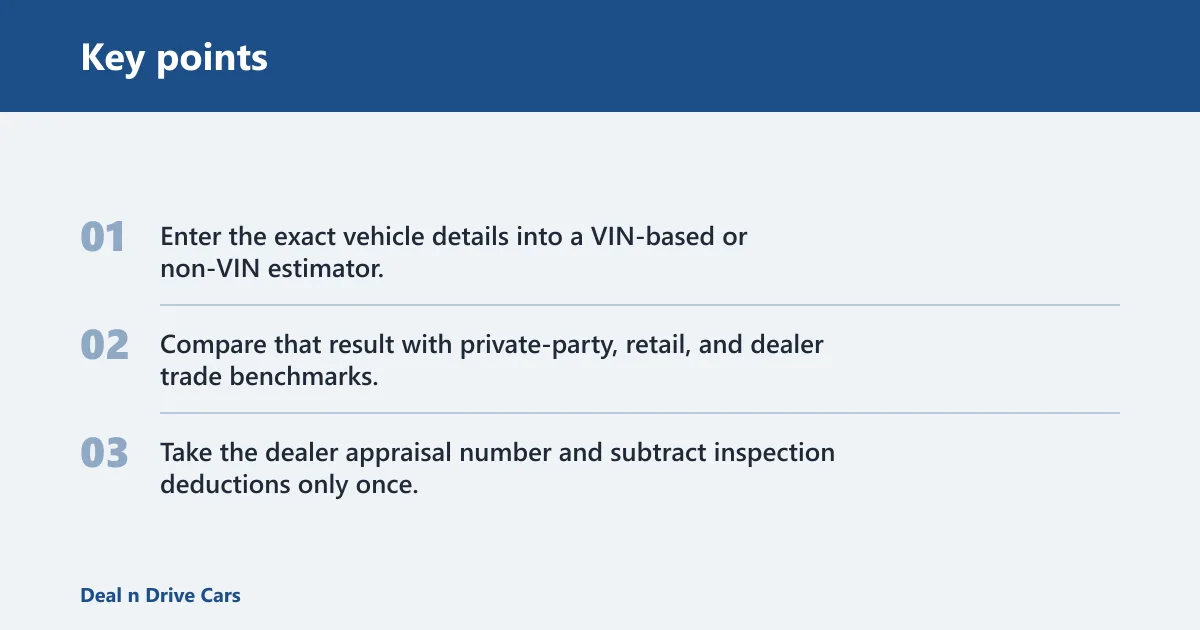
- Enter the exact vehicle details into a VIN-based or non-VIN estimator.
- Compare that result with private-party, retail, and dealer trade benchmarks.
- Take the dealer appraisal number and subtract inspection deductions only once.
Trade-in value car table
| Source | Estimated range | Inspection deductions | Final net value |
|---|---|---|---|
| Online estimator A | $12,400 to $13,200 | None yet | Not final |
| Online estimator B | $12,100 to $13,000 | None yet | Not final |
| Dealer appraisal | $12,300 to $12,900 | $600 for tires and brake wear | $11,700 to $12,300 |
Common mistakes
One estimate is not enough. Compare at least two tools and one dealer appraisal, or you may anchor on a number that is too high or too low. Another mistake is ignoring trim, history, or mileage because the car “looks good.” Dealers price the build sheet, not only the paint.
Do not skip repair and cleanup prep that affects inspection. Remove personal items, bring service records, and fix obvious safety items if the repair cost is lower than the likely value gain. If that does not pencil out, be ready for the deduction instead of arguing after the appraisal.
Also watch edge cases. Missing VINs, modified vehicles, accident history, and non-running cars often need manual review, and some online tools will not price them well. A non-running car may still have trade value, but it usually needs a dealer who can assess towing, repair, and resale risk directly.
How do I get the best trade-in value for my car?
Get the best realistic value by preparing the car, comparing multiple offers, and using the cleanest documentation you have. Wash the car, remove clutter, gather service records, and note every feature that adds value, including trim, factory options, and recent maintenance. Then compare the dealer’s number against your own range.
If the trade is weak, ask whether a private sale makes more sense. Private-party sales can bring a higher number, but they take more time and effort. Trade-in is often the faster route because the value can be applied toward another vehicle purchase in the same transaction.
If you are deciding between sale options, use the extra dealer paperwork, tax convenience, and time savings as part of the decision, not the only reason to accept the offer.
Frequently asked questions
How do I find the trade-in value of my car?
Start with your car’s exact trim, mileage, title status, and condition, then compare two or more valuation tools with local listings. Finish with a dealer appraisal, because the final number can move after inspection. A single online result is only a rough starting point.
How do I get the trade-in value of my car?
Use a VIN-based or non-VIN trade-in estimator first, then visit a dealer for an appraisal. Bring the title, registration, mileage, service records, and photos. The dealership’s final number should be judged against the market range, not against one tool alone.
How do I calculate the trade-in value of my car?
Use the vehicle’s exact details, compare private-party, retail, and dealer trade benchmarks, then subtract inspection deductions from the dealer’s offer. That gives you a working net value. It is more accurate to calculate a range than to force a single dollar figure.
Can I get a trade-in value without a VIN?
Yes. Enter the year, make, model, trim, mileage, and condition into a non-VIN estimator for a rough range. Use the VIN later if the car has multiple trims, option packages, or powertrain differences, since that usually tightens the estimate.
How does my car’s condition affect trade-in value?
Exterior wear, interior damage, brake wear, tire wear, warning lights, and accident history all affect the offer. Clean title status and documented service history usually support a stronger number. Dealers price in the cost to recondition the car before resale.
Is a trade-in estimate the same as the final offer?
No. An estimate is a starting range, while the final offer comes after physical inspection, a test drive, and document review. If the car has hidden damage, worn tires, or a title brand, the final number can be lower than the online estimate.