Sell Privately or Trade in: Which Pays More and Takes Less Work?
Trade in if the dealer’s offer sits within about $1,000 of your likely private-sale net; sell privately only when the gap covers your extra time, fees, and risk. Pick wrong and you can lose money to repairs, ads, delays, title mistakes, or a missed tax credit. This guide compares net proceeds, paperwork, safety, time, and tax effects so you can use a break-even test, not a guess.
This guide is part of our How to sell a car privately series.
| Decision factor | Sell privately | trade in | Winner |
|---|---|---|---|
| Headline payout | Usually higher when demand is strong and the car is priced against sold comps. | Usually lower because dealerships typically offer wholesale value, not private-sale value. | Sell privately |
| Time and effort | Listing, messages, showings, negotiation, title transfer, and payment follow-up take real time. | Often finished in a day with one dealership transaction and less admin. | trade in |
| Risk and failure points | Buyer no-shows, flaky offers, payment risk, and title issues can slow or derail the deal. | Dealer process is simpler, with less exposure to payment and meeting risk. | trade in |
| Tax treatment | No built-in tax offset from the sale itself. | May reduce taxable purchase price in many states. | trade in |
| Paperwork burden | Seller handles title transfer, bill of sale, release of liability, and state-specific steps. | Dealer handles most of the transfer work at the point of sale. | trade in |
Sell privately or trade in: the trade-off
Private sale usually puts more money on the table, but trade in usually cuts time, risk, and admin. The real question is not “which price is higher?” It is “which choice leaves more money after repairs, listing costs, travel, paperwork, and the chance of a failed deal?”
What each option usually pays
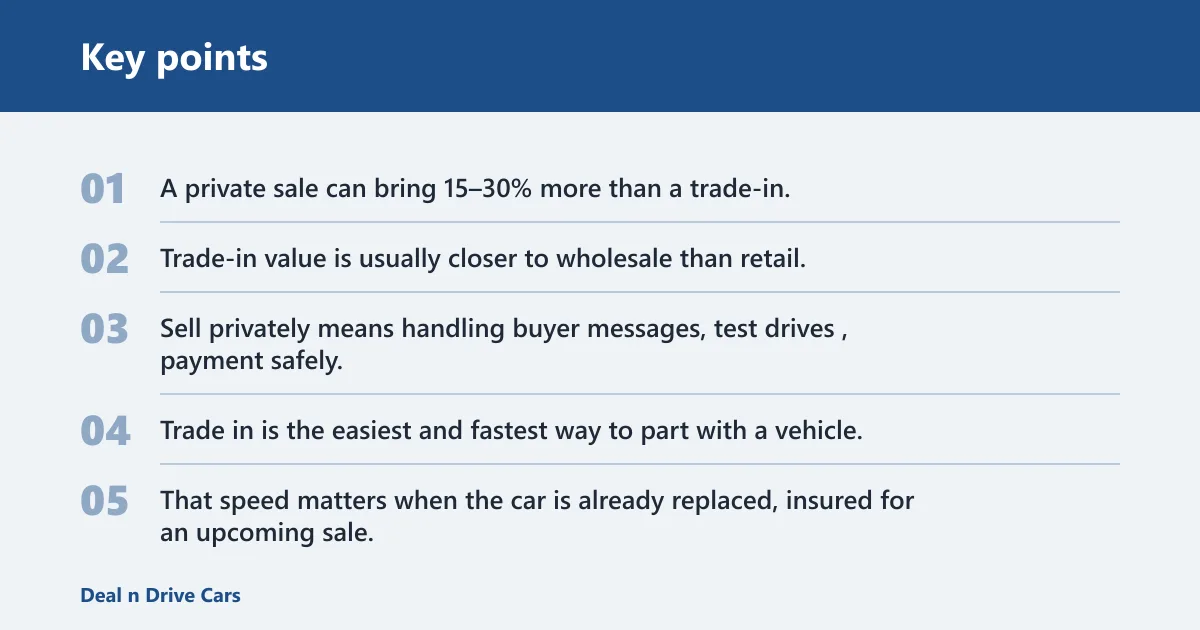
A private sale can bring 15–30% more than a trade-in, but that spread only matters if the car sells near the expected market price. Trade-in value is usually closer to wholesale than retail, because the dealer needs room to recondition, market, and resell the vehicle.
Where the extra work shows up
Sell privately means handling buyer messages, test drives, payment safely, and the paperwork yourself. Trade in is the easiest and fastest way to part with a vehicle, and it can be completed in a day. That speed matters when the car is already replaced, insured for an upcoming sale, or hard to keep around.
One-sentence decision rule
If the private-sale premium is too small to cover your friction costs and hassle, trade in. If the gap is wide enough that you still come out ahead after repairs, ads, travel, and a risk buffer, sell privately.
Sell privately or trade in: side-by-side comparison
The comparison that matters is net proceeds, not headline price. Start with the private-sale price you can defend using sold comps, subtract the costs needed to get the car sale-ready, then compare the remainder with the dealer’s offer and any tax savings tied to a trade-in.
Headline price versus net proceeds
Sell privately usually wins the price line. That advantage can shrink fast once you add detailing, minor repairs, listing costs, travel, and time spent answering messages or meeting buyers who never show.
Time to finish the sale
Trade in can be done in a day. Private sales can take weeks to complete, especially if the market is slow, the title is not clean, or the car sits in a narrow price band where buyers compare many similar listings.
Paperwork, payment, and tax treatment
Private sales usually involve title transfer, bill of sale, and state-specific requirements. Trade-ins can simplify the transfer and may offer tax savings in many states, which can narrow the gap between a lower offer and a higher private-sale headline price.
How much more can private sale pay?
A private sale can bring more money, but the number that matters is the amount above a dealer offer after costs. Use sold comps, not asking prices, because asking prices often sit above what buyers actually pay. Dealerships typically offer wholesale value, not private-sale value, so the gap can look larger than it really is.
Use sold comps, not asking prices
Search for vehicles like yours that actually sold, with similar mileage, trim, title status, and condition. A fair private-sale target is the market retail level for that exact mix, not the highest listing you can find.
Why trade-in offers sit near wholesale
Dealers need room for reconditioning, holding costs, and resale margin. That is why the offer often sits below what a private buyer might pay, even when both buyers value the car for the same reason: usable inventory.
What cuts into the private-sale premium
Repairs, detailing, ad fees, extra insurance days, fuel, travel to meet buyers, and a payment-risk buffer all reduce the headline advantage. Flaky buyers and no-shows can add more delay, which is a cost even if no invoice shows it.
Sell privately vs trade in worksheet
This worksheet turns the choice into a break-even test. Fill it with your best estimate, then compare the net advantage to the extra work you expect to do.
| Expected private-sale price | Dealer trade-in offer | Estimated private-sale friction costs | Net advantage |
|---|---|---|---|
| $18,500 | $16,900 | $700 | $900 |
| $12,000 | $11,200 | $650 | $150 |
| $7,800 | $7,200 | $400 | $200 |
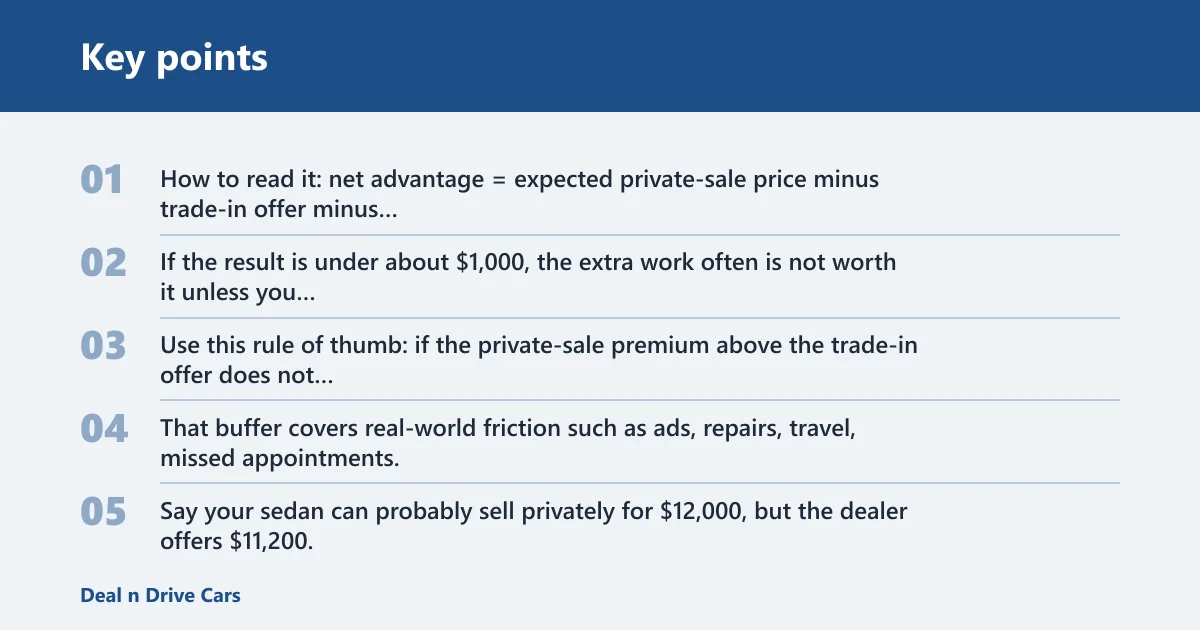
How to read it: net advantage = expected private-sale price minus trade-in offer minus friction costs. If the result is under about $1,000, the extra work often is not worth it unless you have plenty of time, no title issues, and a strong local market.
Break-even rule for extra effort
Use this rule of thumb: if the private-sale premium above the trade-in offer does not beat your friction costs by at least about $1,000, trade in. That buffer covers real-world friction such as ads, repairs, travel, missed appointments, and the risk that a buyer falls through near the finish line.
Say your sedan can probably sell privately for $12,000, but the dealer offers $11,200. If it needs $350 of detailing and another $300 in ads, fuel, and payment-risk buffer, the net advantage is only $150. In that case, the extra work is hard to justify.
What do you give up with a trade-in?
You usually give up some payout in exchange for speed, fewer buyer contacts, and less paperwork. In many states you may also give up the chance to maximize tax treatment through a separate sale, although trade-in tax savings can partly offset the lower offer.
Lower offer in exchange for speed
The lower offer is the main trade-off. A dealer is pricing the car as inventory, not as a retail sale to the next owner, so the number is usually below private-sale value.
Less paperwork and fewer buyer contacts
With a trade-in, the dealership handles much of the transfer process. That means fewer inquiries, fewer showings, and less risk of a buyer changing the terms after you have already invested time in the sale.
Possible sales-tax savings
Tax savings may reduce the amount of money you give up, because many states tax only the difference between the new vehicle price and the trade-in credit. In some places, taxes on the difference between the new vehicle price and the trade-in credit can narrow the gap enough to make a trade-in the better net deal.
How do you handle a private sale safely?
Meet in a public place, bring a witness if needed, and do not release the vehicle until payment clears. Cashier’s checks, escrow services, and verified electronic transfer can reduce risk, but the seller should still confirm the funds have cleared before handing over the keys.
- Meet the buyer in a public, well-lit location with phone service.
- Verify identity and confirm the buyer is serious before a test drive.
- Keep keys, title, and signed documents with you until payment is secure.
- Use a cashier’s check, escrow service, or cleared bank transfer.
- Complete the title transfer, bill of sale, and release of liability exactly as your state requires.
Payment safety matters because private sellers must handle payment, title transfer, and inquiries themselves. A common first-timer mistake is releasing the car on the promise that a check is “good” before the bank has confirmed the funds.
When does a trade-in win?
Trade in is often the smarter choice when time is short, the car is low value, or the market is weak. It can also win when the title is messy, the vehicle needs work, or tax savings close enough of the gap that the simpler path leaves you with similar net proceeds.
Low-value cars and fast timelines
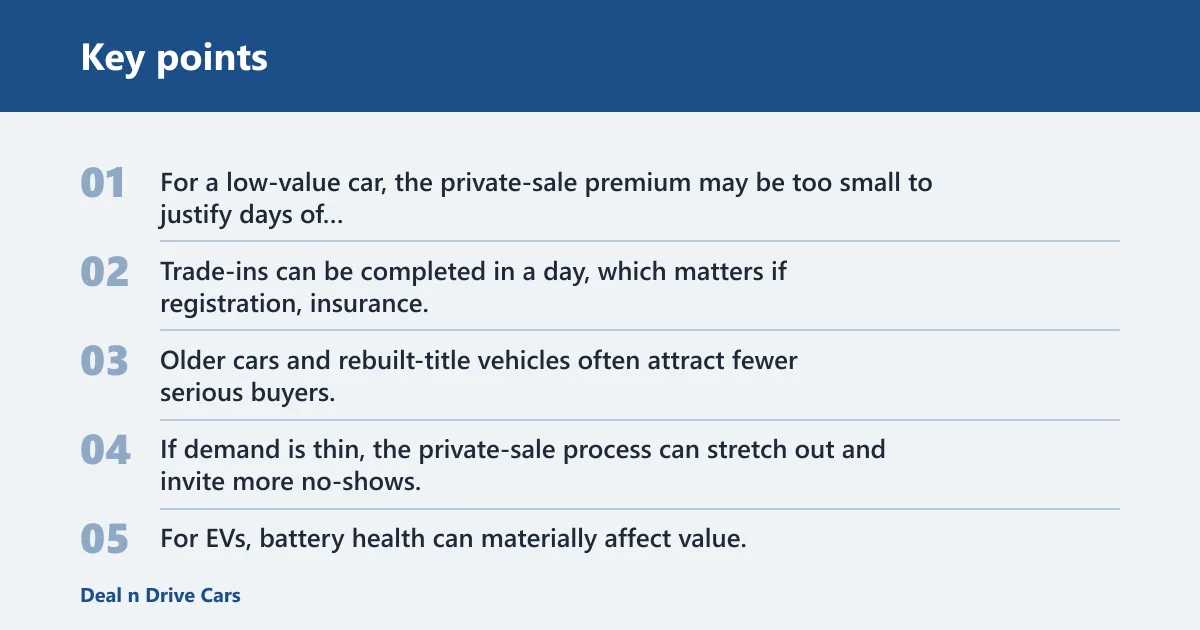
For a low-value car, the private-sale premium may be too small to justify days of messages and showings. Trade-ins can be completed in a day, which matters if registration, insurance, or a replacement purchase is already on a deadline.
Older cars, rebuilt titles, and weak demand
Older cars and rebuilt-title vehicles often attract fewer serious buyers. If demand is thin, the private-sale process can stretch out and invite more no-shows, while a dealer may still make a firm offer based on wholesale math and resale risk.
EVs and battery health paperwork
For EVs, battery health can materially affect value. Some EV owners can use a battery report to negotiate a higher trade-in value, and the same document can support a private-sale price when a buyer needs proof that range risk is lower than expected.
Suppose an EV has strong battery health documentation but the dealer’s first offer feels low. That report can counter a quick undervaluation, especially if the private market is also asking for proof before paying retail.
Choose Sell privately if… / Choose trade in if…
Choose Sell privately if the private-sale net stays clearly above the dealer offer after repairs, ads, travel, and a payment-risk buffer. It also makes more sense if you have time to answer inquiries, screen buyers, and manage the title transfer carefully.
Choose trade in if the offer is close to your likely private-sale net, if you want a one-stop transaction, or if tax savings in your state narrow the gap. It is also the better fit when the car is low value, the market is slow, or the title and paperwork are likely to become a hassle.
Frequently asked questions
Is it better to sell my car privately or trade it in?
It is better to sell privately only when the extra money survives real costs and risk. If the private-sale premium is small, trade in usually wins because it is faster, simpler, and can reduce tax in many states.
How much more can I get by selling privately?
A private sale can yield 15–30% more than a trade-in, but that figure is a starting point, not your net result. The final gap depends on repairs, ads, travel, buyer delays, and whether the car is easy to price against sold comps.
What do I give up if I trade my car in instead of selling it myself?
You usually give up some headline value. In exchange, you give up much of the work: listing, inquiries, showings, payment handling, and most of the paperwork. You may also give up a little flexibility on sale timing.
How long does a private car sale usually take compared with a trade-in?
A trade-in can be completed in a day. Private sales can take weeks to complete, especially if the car needs repairs, the market is slow, or buyers keep asking for more information before they commit.
What paperwork do I need for a private sale versus a trade-in?
Private sales usually involve title transfer, bill of sale, and state-specific requirements. Trade-ins typically keep the process at the dealership, so the seller handles less paperwork and fewer state-specific steps directly.
Do tax savings ever make a trade-in worth more overall?
Yes. Many states reduce the taxable purchase price when you trade in, which can offset part of the lower offer. If the tax savings plus the time you save exceed the private-sale premium, trade in can be the better net choice.