What Is the Safest Payment Method for a Private Car Sale?
For most private car sales, a bank transfer is the safest choice because it leaves a traceable record and can arrive through Faster Payments, often in minutes or hours. Some transfers still take 1-3 working days, so keep the car, keys, and paperwork with you until the money shows as received and available in your own account. A bill of sale and a strict release check cut the risk of fraud or a mistaken handover.
Bank transfer best practices for private sales
Bank transfer is the top choice for most private sales because you can see the payment in your account and keep a clear record of the deal. For higher-value cars, it gives the cleanest proof of payment without handling large amounts of cash or waiting for a cheque to clear.
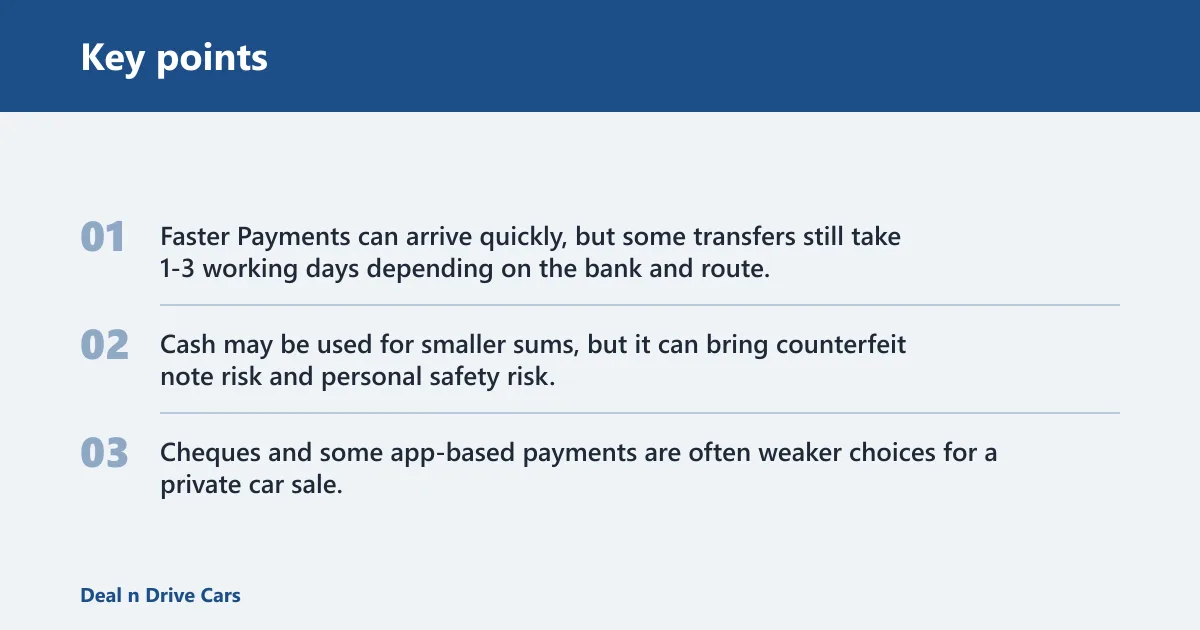
Timing still matters. Faster Payments can arrive quickly, but some transfers still take 1-3 working days depending on the bank and route. The safest rule is to wait until the money is shown as received and available in your own account before you release the car, keys, spare keys, or V5C details.
When another method may still be acceptable
A banker’s draft can be acceptable only if you verify it directly with the issuing bank, and only if the buyer is willing to wait while that check is made. Cash may be used for smaller sums, but it can bring counterfeit note risk and personal safety risk. Cheques and some app-based payments are often weaker choices for a private car sale.
How do the main payment methods compare?
Bank transfer is the best option for most sellers. Cash is fast in theory, but it brings note-checking risk and no built-in paper trail. Cheques clear slowly and can bounce. Payment apps may be limited by caps, fees, reversals, or disputes, so they are a poor fit for large private car sales.
Bank transfer
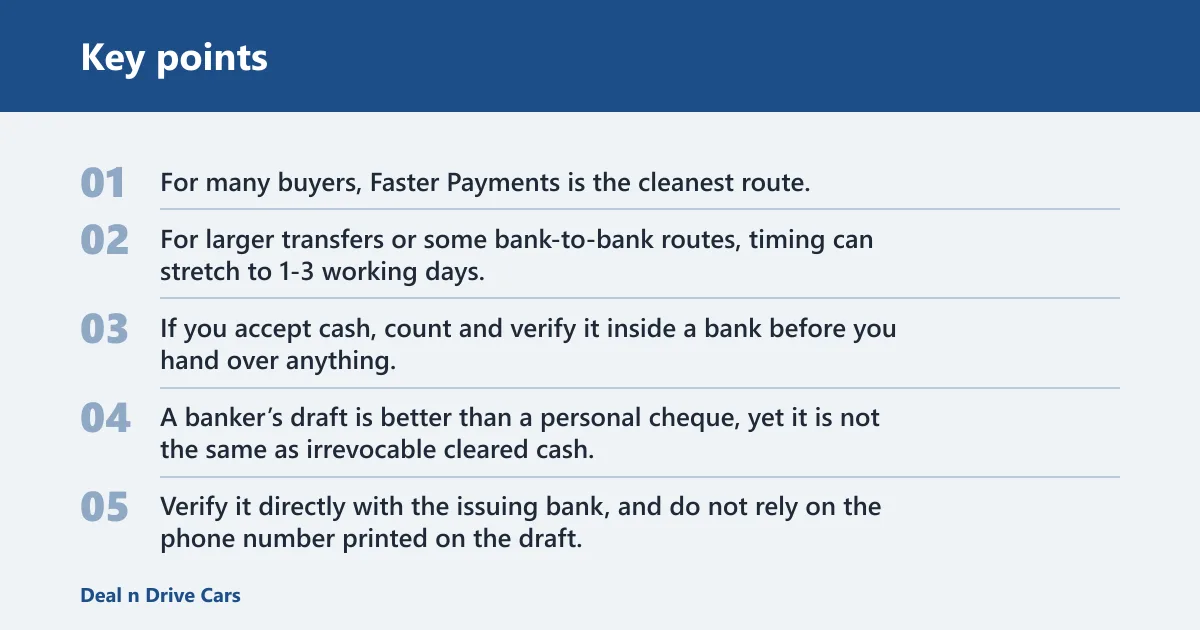
This is the most secure method for private car sales because it gives a traceable record and is usually visible in the account before handover. For many buyers, Faster Payments is the cleanest route. For larger transfers or some bank-to-bank routes, timing can stretch to 1-3 working days.
Cash
Cash can look simple, but it carries counterfeit note risk, no paper trail, and personal safety risk if you are carrying a large sum home. If you accept cash, count and verify it inside a bank before you hand over anything. Do not rely on a quick look in a car park.
Cheque and banker’s draft
A cheque is buyer-favoured, but it is a poor choice for a private car sale because it can bounce and may clear too slowly. A banker’s draft is better than a personal cheque, yet it is not the same as irrevocable cleared cash. Verify it directly with the issuing bank, and do not rely on the phone number printed on the draft.
Digital payment apps
Apps can be limited by transfer caps, fees, reversals, or disputes. Some app payments are linked to cards or wallets rather than a direct bank transfer, which can create a dispute route after handover. For large private car sales, they are not the first choice.
Suppose a buyer wants to pay £8,500 by app and asks to split it into two transfers. That is a warning sign. Split payments can make it easier to delay, dispute, or reverse part of the deal, and they may leave you with the car and only part of the money.
How do you verify payment before handover?
Check your own bank account, not a screenshot, message, or “sent” screen. The payment should show as received and available in the account you control. Once it is there, sign the bill of sale, hand over the keys, spare keys, and service history, then complete the V5C handover details.
-
Check the funds in your account.
Confirm the money appears in the live banking app or online account that you own. If the transfer is still pending or not visible, do not release the car. -
Match the amount exactly.
The payment should equal the agreed price. Do not accept “almost enough” with a promise to send the rest later. -
Verify the payer details.
Make sure the sender name and amount match the agreed sale. If the buyer used a bank transfer, keep the reference and transaction record. -
Sign the bill of sale.
Fill in the buyer name, address, agreed price, and date. This written record supports proof of payment and the ownership handover. -
Release the handover items.
Give the keys, spare keys, and service history only after funds are confirmed. Complete the V5C change-of-keeper details last.
Do not trust a screenshot of a transfer confirmation. Do not accept a partial payment as proof of the full sale. Do not hand over the V5C before payment is confirmed in your account, even if the buyer says the money is “on its way.”
Payment acceptance checklist

| Payment method | Red flags | Verification step | Clearance timing | Exact release point for keys/V5C |
|---|---|---|---|---|
| Bank transfer | Fake screenshot, wrong reference, pressure to release early | Check your live account until the money shows as received and available | Often minutes or hours via Faster Payments; sometimes 1-3 working days | Release keys and spare keys only after funds are in your account; complete V5C details after that |
| Cash | Counterfeit notes, large unexplained bundles, pressure to meet away from a bank | Count and verify inside a bank if you accept it | Immediate if genuine and counted correctly | Release keys only after the cash is counted and verified in a bank; then complete V5C details |
| Cheque | Slow timing, bouncing risk, buyer wants instant handover | Do not treat deposit as final; wait for bank confirmation | Slow, and not recommended for large private sales | Do not release keys or V5C until your bank confirms the funds are final |
| Banker’s draft | Draft looks genuine but cannot be verified, phone number printed on the draft only | Verify directly with the issuing bank using a known official number | Depends on bank verification | Release keys and V5C only after the issuing bank confirms the draft is valid; a draft check is not the same as irrevocable cleared cash |
| Digital payment app | Limits, fees, reversal risk, dispute claim, card-funded wallet | Confirm the payment in your bank, not just in the app | Can be instant, delayed, reversed, or disputed | Release keys only after settled funds are visible in your account |
If the buyer sends an overseas escrow link, asks for an overpayment with a refund, or relies on screenshot-only proof, refuse the method and restart with a bank transfer that shows in your own account.
What paperwork should you complete?
Use a bill of sale and keep the handover sequence tight. The document should list the buyer name, address, agreed price, and date. That gives both sides a written record and helps prove the sale if there is any later dispute about payment or ownership transfer.
Bill of sale details
Keep the wording plain. Include the car details, buyer name, buyer address, agreed price, and the date of sale. Both sides should sign it once payment is confirmed.
V5C handover timing
The V5C is the registration document used for change-of-keeper paperwork. It should not go over before payment is confirmed in your account. Hand it over only after the money is visible and the bill of sale is signed.
Keys, spare keys, and service history
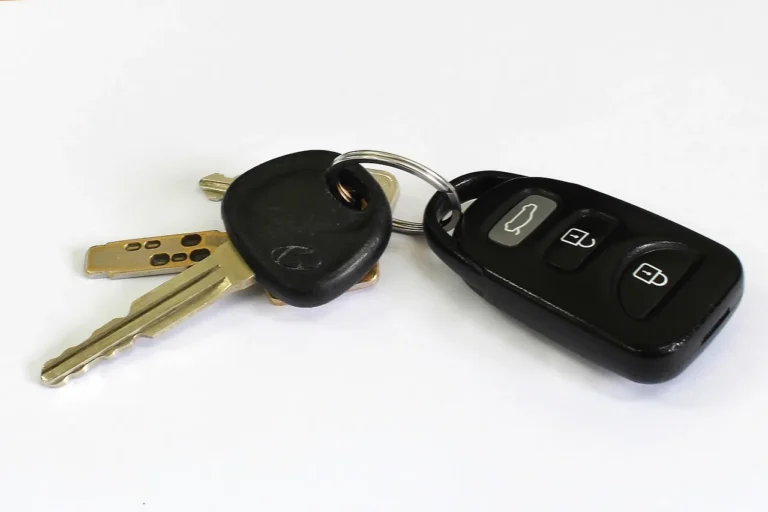
Give the main keys, spare keys, locking wheel nut key if you have one, and service history only after payment is confirmed. If you release them first, you lose control if the buyer delays or disputes the transfer.
Picture a buyer arriving with a banker’s draft and asking for the keys before calling the bank. That is the wrong order. The safer sequence is draft verification first, then the bill of sale, then keys, then V5C details. The same logic applies to test-drive safety: keep control of the process, keep the meeting sensible, and avoid pressure to hand over the car before checks are complete.
What if the buyer insists on cash, cheque, or an app?
The safest fallback is to slow the deal down until the payment method can be checked properly. If the buyer will not wait, that is a warning sign. A rushed sale is where fake notes, bounced cheques, and reversal attempts usually cause trouble.
| Buyer insists on | Safest fallback action |
|---|---|
| Cash | Meet at a bank, count and verify the notes there, and do not hand over the car until the cash is checked. |
| Cheque | Refuse same-day handover and ask for bank transfer instead; if you proceed at all, wait for full bank confirmation. |
| Payment app | Ask for a bank transfer to your account; if the app is a direct bank transfer, still wait until the money shows in your account. |
What should you do about outstanding finance?
Private sales involving outstanding finance can be risky or restricted depending on the agreement type and the lender’s process. Before you agree a handover, check the settlement figure, tell the buyer there is finance to resolve, and confirm what the lender requires. Some sales may be straightforward only once the finance is cleared; others may need the lender’s involvement before ownership can move cleanly.
Settlement figure
Ask the lender for the settlement figure before agreeing a handover time. That tells you what is still owed and whether the sale proceeds will cover it. If the figure has not been checked, pause the sale.
What to tell the buyer
Be clear that the car has finance or had finance, and explain how the settlement will be handled. The buyer should know whether the lender needs to be paid directly or whether the finance is already being cleared as part of the sale.
When to pause the sale
If the settlement figure is missing, if the lender has not confirmed the process, or if the payment method is weak, stop and reschedule. Do not let a buyer take the car before the finance position is resolved.
How should you protect yourself when accepting payment from a private buyer?
Use a bank transfer where possible, and keep every step on paper. Meet in daylight or at a bank if the amount is large. If anything feels rushed, stop. The buyer who pushes for instant release before the money is visible is the one to watch closely.
-
Agree the method first.
Confirm how the buyer will pay before you meet. That avoids last-minute pressure and lets you choose a bank branch or other controlled handover point. -
Check the money live.
Use your own banking app or online account. Do not rely on phone screenshots, email receipts, or promises that the transfer will “arrive soon.” -
Complete the bill of sale.
Write down the buyer name, address, agreed price, and date. Keep a signed copy. -
Release items in order.
Keys first after funds are confirmed, then spare keys and service history, then V5C details. That order keeps control until the transaction is real.
Frequently asked questions
What is the safest payment method for a private car sale?
For most private car sales, a bank transfer is the safest method because it is traceable and can show quickly in your account. Faster Payments may arrive within minutes or hours, though some transfers still take 1-3 working days. Do not release keys until the money is visible and available in your own account.
Should I accept cash for a private car sale?
Cash is not the best choice for a private sale because of counterfeit note risk, no paper trail, and personal safety risk when carrying a large sum. If you accept it, count and verify it inside a bank before handing anything over.
Is a bank transfer safer than cash when selling a car privately?
Yes. A bank transfer is safer than cash because it leaves a clear, traceable record and avoids the problem of fake notes. It also lets you confirm payment in your account before you give up the car, keys, or V5C details.
How do I know the bank transfer has cleared before handing over the car?
Check your live bank account and make sure the money is actually there, not just shown in a screenshot or message. Once the funds appear in your account and are available, sign the bill of sale and then hand over the keys, spare keys, and V5C details.
Can I accept a cheque or banker’s draft for a private car sale?
A cheque is a poor choice because it can bounce and clear slowly. A banker’s draft is better, but it can still be forged, so verify it directly with the issuing bank. Do not rely on the phone number printed on the draft, and do not treat verification as the same thing as cleared cash.
What should I do if the buyer wants to pay in cash?
Meet at a bank and count the money there. That reduces counterfeit note risk and gives you a safer place to verify the amount. Do not release the car, keys, or V5C details until the cash is checked.