How to Negotiate a Used Car Price Over Text or Email
To negotiate a used car price over text or email, name your target price, ask for the out-the-door quote, and get at least 3 dealer offers before you commit. Skipping that process can lead to hidden fees or cause a lower nearby offer to be missed. This guide gives you a repeatable text and email script, a dealer-comparison worksheet, and the exact replies to use when a quote is weak.
How remote car negotiation works
Remote negotiation works best when you force written quotes from the dealer internet sales department, then compare the same car on the same terms. The asking price is only the starting point. The out-the-door price is the number that matters because it includes taxes and fees, and it is the number that keeps payment talk from hiding extra costs.
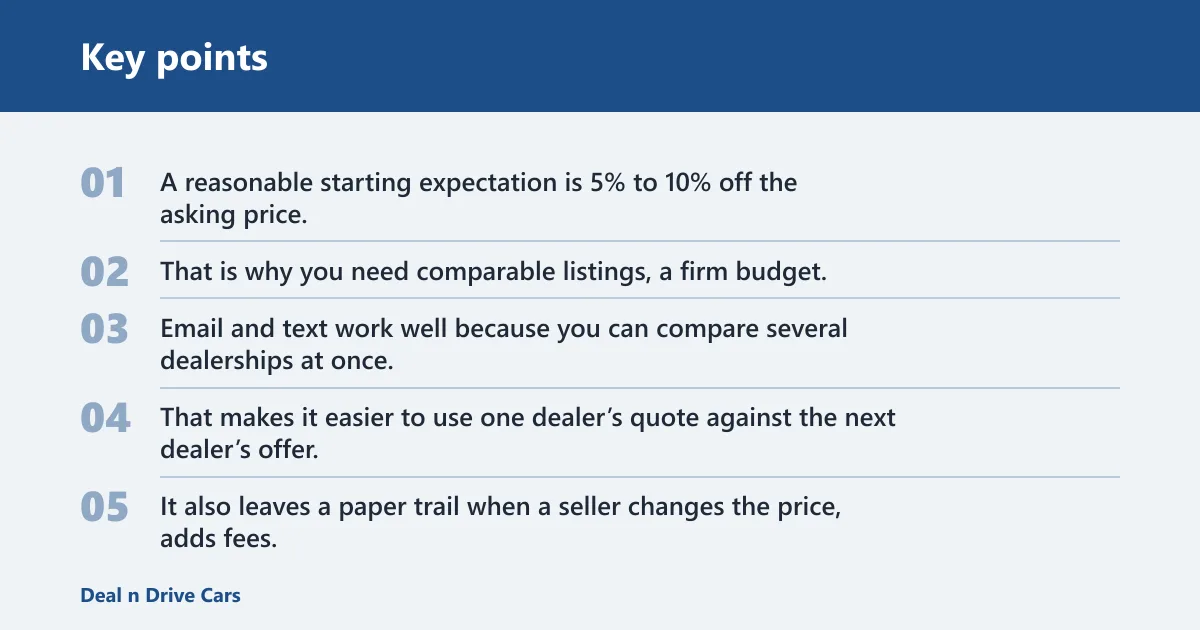
A reasonable starting expectation is 5% to 10% off the asking price, but there is no single percentage that applies to every used car. That is why you need comparable listings, a firm budget, and written replies that name the exact vehicle.
Why written offers give you leverage
Email and text work well because you can compare several dealerships at once. That makes it easier to use one dealer’s quote against the next dealer’s offer. It also leaves a paper trail when a seller changes the price, adds fees, or replies without the VIN.
Used-car shoppers can use Kelley Blue Book, Edmunds, and NADA guides as a starting point, then test those numbers against nearby comparable listings. The guide recommends finding at least three used vehicles you would consider buying and comparing them with similar vehicles within about a 100-mile radius.
Why the out-the-door number matters more than the sticker
The asking price often excludes documentation fees, advertising fees, preparation fees, and market adjustment fees. U.S. News says to negotiate the out-the-door price, not the monthly payment, because the payment can hide a longer loan term or extra products.
Some states limit certain fees by law, and some dealer fees may be negotiable. That is why every quote needs a breakdown, not a single payment number.
What you’ll need
- A target price range from Kelley Blue Book, Edmunds, and NADA
- At least 3 comparable vehicles you would actually buy
- Dealer listings from the internet sales department
- Pre-approved financing or a firm cash budget
- A quote tracker for VIN, price, fees, OTD total, mileage, trim, and expiration time
- A note on your walk-away number
Negotiation script pack

Use these messages as written, then swap in the car details. Keep them short. Long messages invite side conversations about payment, trade-in, or financing before you have the real price.
3 opening messages
- Opening 1: “Hi, I’m interested in the [year make model trim] on your site. Please send the VIN, mileage, full out-the-door price, and all fees in writing. If you can beat competing offers, I’m ready to move forward.”
- Opening 2: “Please quote your best out-the-door price for the [year make model trim] with VIN [VIN]. I’m comparing several dealers today, so I need the total price, fees, and an expiration time.”
- Opening 3: “Send your written best price for VIN [VIN]. If the quote is complete, I’ll compare it with two others.”
5 follow-up replies
- “What monthly payment do you want?” “Please quote the out-the-door price first. I’ll handle financing separately because the payment changes with term, rate, and down payment.”
- “That price is not negotiable.” “Understood. Please confirm the out-the-door total, VIN, and expiration time in writing so I can compare it with the other quotes I’m collecting today.”
- “We need you here in person.” “I’m comparing written offers first. If the car, VIN, and out-the-door price are a match, I can decide on a visit quickly.”
- “We can only discuss it after credit approval.” “Send the out-the-door quote first. I already have pre-approved financing and I’m comparing the vehicle price, not the loan terms.”
- “This unit has dealer-installed items already added.” “List each item and its cost separately, then send the final out-the-door number. If the add-ons are optional, remove them from the quote.”
When to ask for an expiration time
Ask for an expiration time after the dealer gives a complete written quote. A clear time limit stops the seller from changing the price after you use it to compare offers. Use a simple request: “Please confirm this quote is valid until [day and time].”
Set your offer target
Start with market value guides and then check similar listings that match the same model, year, mileage, trim, equipment, and condition. A common mistake is asking a seller to match a lower online price on a hatchback without accounting for the fact that the cheaper listing has higher mileage and no service records. They are not.
Pre-approved financing helps set a budget ceiling before the sales conversation starts. That keeps the focus on the out-the-door number instead of a monthly payment that gets stretched by a longer loan term.
Use a simple adjustment rule
If one car has 12,000 more miles than another, or it has fewer options, adjust your offer before you message dealers. Add or subtract one step at a time, then recheck the quote. Do not stack a mileage difference, a trim difference, and a fee difference into one guess.
Scenario example
Suppose two compact SUVs are the same model year, but one has about 41,000 miles and the other has about 54,000 miles. If the higher-mileage unit also has a lower trim, you should not use the better-equipped car as your anchor quote. That comparison will overstate what the cheaper vehicle is actually worth.
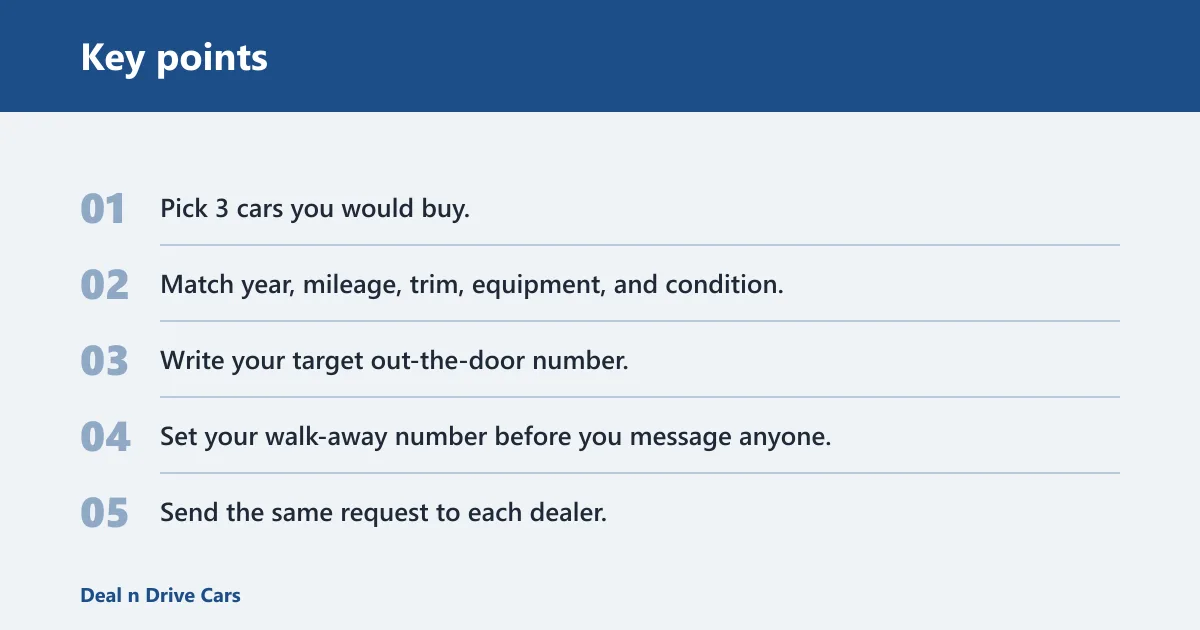
- Pick 3 cars you would buy.
- Match year, mileage, trim, equipment, and condition.
- Write your target out-the-door number.
- Set your walk-away number before you message anyone.
- Send the same request to each dealer.
Can you negotiate a used car price before seeing it in person?
Yes. Remote negotiation works best when the car is a dealer inventory unit with a VIN, a listed price, and a reachable internet sales department. It is less reliable when the seller refuses to send a breakdown, will not confirm the VIN, or keeps shifting the price after each reply.
What details to demand before you commit
Ask for the VIN, mileage, trim, total price, fees, add-ons, and expiration time. If the seller will not provide all of that, you do not have a real quote. You have a lead.
How to handle private sellers differently
Private sellers usually do not have dealer fees, but they also do not have standardized out-the-door paperwork. For a private seller, ask for the VIN, title status, service records, accident history, and whether the price includes any repairs or accessories. Keep the discussion on the vehicle condition and final cash amount.
Say your private-seller message like this: “Please confirm the VIN, title status, and your best cash price. I’m comparing it with dealer inventory, so I need the exact total before I drive over.”
Email works best when you keep every message tied to one VIN and one total number. Start with the best written out-the-door quote request, then reply only with the next dealer’s number and ask if they can beat it. That creates a simple bidding loop.
Ask for 3 written offers, and then use the strongest quote to press the others. CarCalcs says five to ten comparable listings strengthen negotiation leverage, but even three clean quotes can expose a weak offer fast.
How do you compare written offers?
Build an apples-to-apples table and do not compare quotes that leave out the VIN, mileage, or fees. If one dealer quotes only the selling price and another quotes the out-the-door total, the lower number is often the less useful quote. U.S. The same source says to focus on the out-the-door price because it includes the real total.
Quote comparison table template
| Dealer | VIN | Price | Fees | OTD total | Mileage | Trim | Expiration time |
|---|---|---|---|---|---|---|---|
| Dealer A | 1HGBH41JXMN109186 | $18,900 | $1,245 | $20,145 | 42,300 | EX | Today 5:00 PM |
| Dealer B | 1C4PJLCB4HW512344 | $18,450 | $1,890 | $20,340 | 40,900 | EX | Tomorrow noon |
| Dealer C | 5XYZTDLB7JG567821 | $19,100 | $1,050 | $20,150 | 43,100 | EX | Today 4:00 PM |
Flag fee differences, not just price differences
Compare documentation fees, advertising fees, preparation fees, and market adjustment fees line by line. U.S. The same source notes that these fees may be negotiable, and some states limit certain fees by law. A quote with a low price and a high market adjustment fee is not a better deal.
Picture two quotes for the same sedan. One dealer is $300 higher on price but $500 lower in fees. The lower-fee quote wins even before you talk about financing. That is why the total matters more than the sticker.
What if the dealer says the price is fixed?
Do not restart the whole conversation. Ask for the written out-the-door number, confirm the VIN, and ask whether any fees or add-ons can be removed. If the dealer still refuses, move to the next seller and let the quote compete without arguing about the label “fixed.”
How to respond without reopening the whole conversation
- Reply with the exact VIN you are discussing.
- Ask for the final out-the-door total in writing.
- Request a breakdown of documentation fee, market adjustment fee, and add-ons.
- Set a clear deadline for the quote if one was not given.
How to spot vague or incomplete answers
Watch for replies that say “best we can do” without a VIN, a fee list, or an expiration time. Watch for bait-and-switch messages that change the unit after you question the quote. If the numbers keep moving, the dealer is not giving you a clean comparison point.
Common mistakes
- Negotiating the payment instead of the full price. Ask for the out-the-door total first.
- Ignoring documentation fees and market adjustment fees. Get every fee in writing.
- Comparing vehicles that are not close enough. Match year, mileage, trim, equipment, and condition.
- Accepting a quote with no VIN. A missing VIN can hide a different unit.
- Accepting a quote with no expiration time. The seller can change the deal later.
- Stopping at one dealer. Use at least 3 dealer offers before you commit.
Save every quote in one thread and reply only in writing. That makes it much harder for a seller to shift from the quoted car to a different one with a different price.
Frequently asked questions
What if the dealer says the price is not negotiable?
Ask for the written out-the-door total anyway, then compare it with your other quotes. If the dealer will not move on price or remove add-ons, use the number as one data point and keep shopping. A fixed price is only useful if it is still competitive.
How to negotiate car price near me
Search nearby dealer listings, then compare similar vehicles within a 100-mile radius. Contact several dealers through text or email, because local competition works best when every seller knows you are comparing the same car against nearby alternatives. Research the car’s market value first by checking Kelley Blue Book, Edmunds, NADA, and three local listings for the same year, trim, mileage, and condition. Contact several dealers through text or email, not just one, so you can compare written out-the-door quotes side by side. Be willing to walk away if the quote stays high, the fee sheet is incomplete, or the seller will not match a better offer you already have.