What Paperwork Do You Need to Buy From a Private Seller?
You need the seller’s title, a bill of sale, photo ID, and any state release or emissions papers required for the sale; check the title first, then finish registration forms after payment. Missing or wrong paperwork can delay registration, trigger title problems, or leave you stuck with a car you cannot legally transfer. This guide separates the documents to check before you pay from the forms you complete after the sale.
What paperwork do you need before you pay?
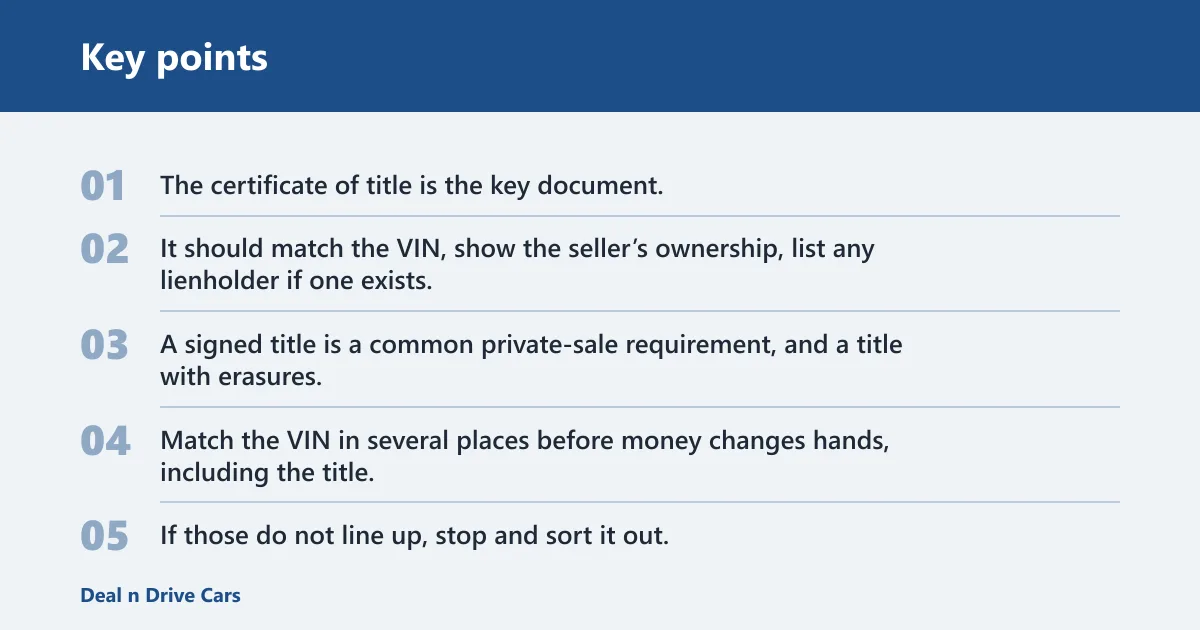
The certificate of title is the key document. It should match the VIN, show the seller’s ownership, list any lienholder if one exists, and include the required signatures. A signed title is a common private-sale requirement, and a title with erasures, white-out, crossed-out names, or unexplained corrections can be rejected.
Match the VIN in several places before money changes hands, including the title, the dashboard plate, the door label, and any supporting paperwork. If those do not line up, stop and sort it out. The ownership story should also make sense: the seller’s name, the title status, and any transfer path should line up without gaps.
Say your seller hands over a title in one name, but the dashboard VIN differs by a single digit. That is not a small typo. It can signal a clerical error, a replacement body part, or a bigger title problem that needs a state check before payment.
Private-sale paperwork matrix
| Document | Timing | Who provides it | What to verify | What can go wrong | Pass/fail |
|---|---|---|---|---|---|
| Certificate of title | Before payment | Seller | VIN matches, seller owns it, lienholder field is clear or explained, all required owners signed | Altered title, missing signatures, wrong VIN, hidden lien, title not transferable | [ ] Pass / [ ] Fail |
| Bill of sale | Before driving home | Buyer and seller | Vehicle, VIN, sale date, price, buyer and seller names | Weak backup if the title is basic, disputed sale details, missing payment record | [ ] Pass / [ ] Fail |
| Odometer disclosure | Before driving home | Seller, sometimes buyer signs too | Mileage at sale, date, vehicle covered by federal or state mileage rules | Odometer dispute, incomplete transfer packet, registration delay | [ ] Pass / [ ] Fail |
| Lien release | Before payment | Lender or seller with lender paperwork | Security interest satisfied; title or record no longer shows an open lien | Verbal promise only, unpaid lien, lender still claims the vehicle | [ ] Pass / [ ] Fail |
| State transfer forms | Before DMV registration | Buyer, sometimes seller | Correct state form set, tax fields, reassignment spaces, deadline | Wrong form, missed deadline, tax or registration rejection | [ ] Pass / [ ] Fail |
| Insurance proof | Before driving home | Buyer | Current policy or transfer document if your state or lender requires it | No legal drive-away coverage, registration block, lender issue | [ ] Pass / [ ] Fail |
Do you need a bill of sale for a private car purchase?
A bill of sale is often smart even when the title is the main transfer document. Some states require it, and it is useful backup when the title is basic, the sale gets disputed, or you need a clean record of the vehicle, VIN, date, price, and both parties.
What the bill of sale should include
Keep it plain and specific. It should name the vehicle, list the VIN, show the sale date and price, and identify the buyer and seller. If the state asks for extra language, use the state form or add the missing item before you pay.
Why it matters if the title is plain or disputed
If the title leaves out sale price or other details, the bill of sale helps prove the transaction later. It also helps if the title is basic, if the seller loses a copy, or if a dispute comes up about what was sold and when.
Picture a $6,400 private sale where the title is signed but the buyer later finds a damage claim tied to the date of transfer. A dated bill of sale with the VIN and price gives the buyer a cleaner record than a handshake or a text thread.
What should the seller bring to the meeting?
The seller should bring the signed title, any required reassignment sections, the odometer statement if applicable, and any lien release if a lender was involved. If the seller cannot produce the title or clear proof of ownership, stop before payment and verify the state process.
Signed title and any reassignment sections
The title should be completed exactly as the state form requires. If there are multiple owners, every required owner should sign. Check that the name on the title matches the person standing there or the authorized seller named in the ownership trail.
Odometer disclosure if the vehicle is covered
Mileage disclosure is required when applicable under federal or state rules. The mileage statement belongs in the handoff packet because it records the odometer reading at sale and helps prevent later fraud claims. Do not leave this to memory or a verbal statement.
Lien release if a lender was ever involved
If a lender appears on the title or record, a lien release is needed. Verbal reassurance is not enough. A release shows the security interest was satisfied, and the seller should bring the paperwork that proves the lender no longer has a claim.
What if the title is missing or has a lien?
A missing title is a major warning sign, not a routine inconvenience. If the title is lost, the seller should use the state’s replacement process before the sale moves forward. If a lien appears on the title or record, do not pay until the release is verified in writing.
Missing title warning signs
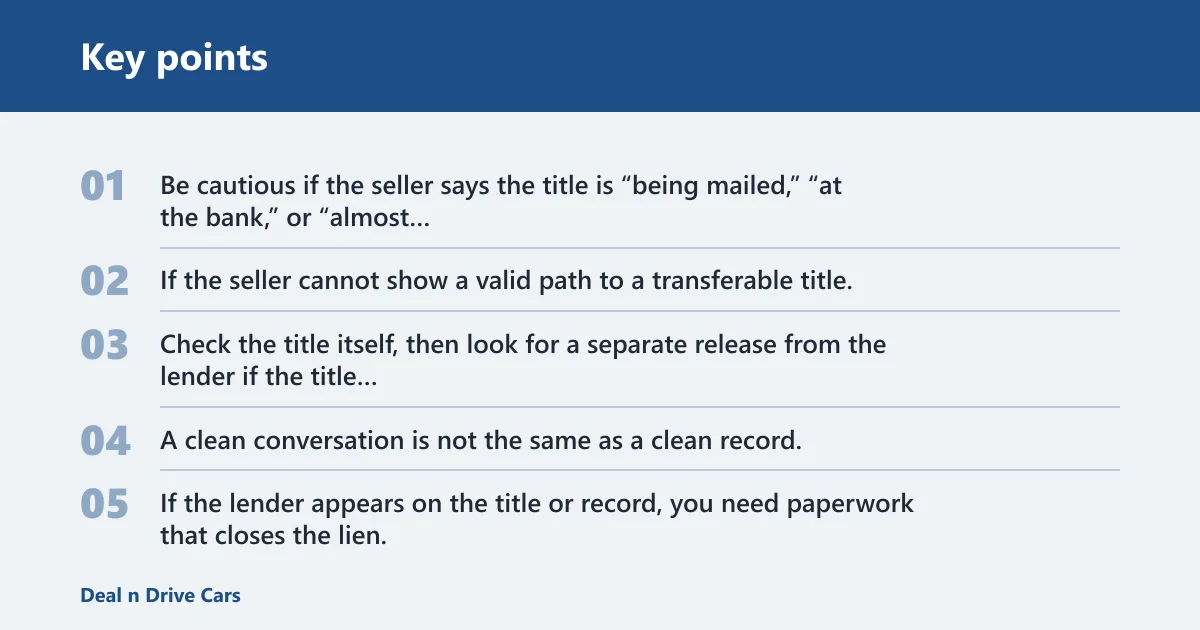
Be cautious if the seller says the title is “being mailed,” “at the bank,” or “almost here.” Those explanations can be true, but they also delay your ability to transfer ownership. If the seller cannot show a valid path to a transferable title, stop and confirm the state process first.
How to verify a lien release
Check the title itself, then look for a separate release from the lender if the title still shows a lien. A clean conversation is not the same as a clean record. If the lender appears on the title or record, you need paperwork that closes the lien.
When to stop and confirm the state process
Stop if the title has gaps, the signatures do not line up, or the seller cannot explain why the title and ownership story do not match. State DMV rules vary, and some states will reject paperwork that would be acceptable elsewhere. That is a reason to verify, not guess.
What state forms are usually required?
State DMV forms often cover transfer, tax, registration, and reassignment steps, and the exact packet varies by state. Deadlines also vary by state. California guidance cited in private-sale materials says transfer of ownership is required within 10 days, but buyers should check their own DMV rules before leaving the meeting.
Transfer forms and reassignment sections
Some states use a title transfer form, while others rely on a combination of title assignments and DMV paperwork. Reassignment sections matter when a dealer, estate, or intermediate owner appears in the chain. Use the form your state requires, not a generic printout from another state.
Tax and registration paperwork
Many states tie tax and registration to the same transfer packet. That may include a separate application, a tax declaration, or an emissions document in applicable cases. The goal is the same: get the vehicle legally in your name without returning for missing forms.
Deadlines that vary by state
Some states want immediate filing, while others allow a short window after the sale. Missing the deadline can mean extra fees or a rejected filing. The safest move is to ask the DMV or motor-vehicle agency what your state expects before you leave the seller’s house.
What should you keep after the sale?
Keep copies of the signed title, bill of sale, odometer disclosure, lien release, proof of payment, and any state forms you submitted. The guide recommends keeping clear photos or copies before separating the originals. Those records help if the sale is disputed, delayed, or questioned later.
Copies of the signed title and bill of sale
Make copies before the parties split up. If the title transfers in stages, a photo of both sides can matter. The same goes for the bill of sale, especially when it carries the VIN, price, and signatures that prove the deal happened as written.
Proof of payment
Keep the receipt, bank confirmation, cashier’s check record, or other proof showing money changed hands. If a dispute comes up, proof of payment helps connect the paperwork to the transaction. It also makes the handoff easier to explain if the DMV asks for supporting records.
Insurance proof and registration records
Hold onto the insurance proof you used to drive or register the car, plus any registration receipt or temporary permit. Current insurance may be needed before you drive away or before you register, depending on the state and lender. Keep the final registration with the sale file.
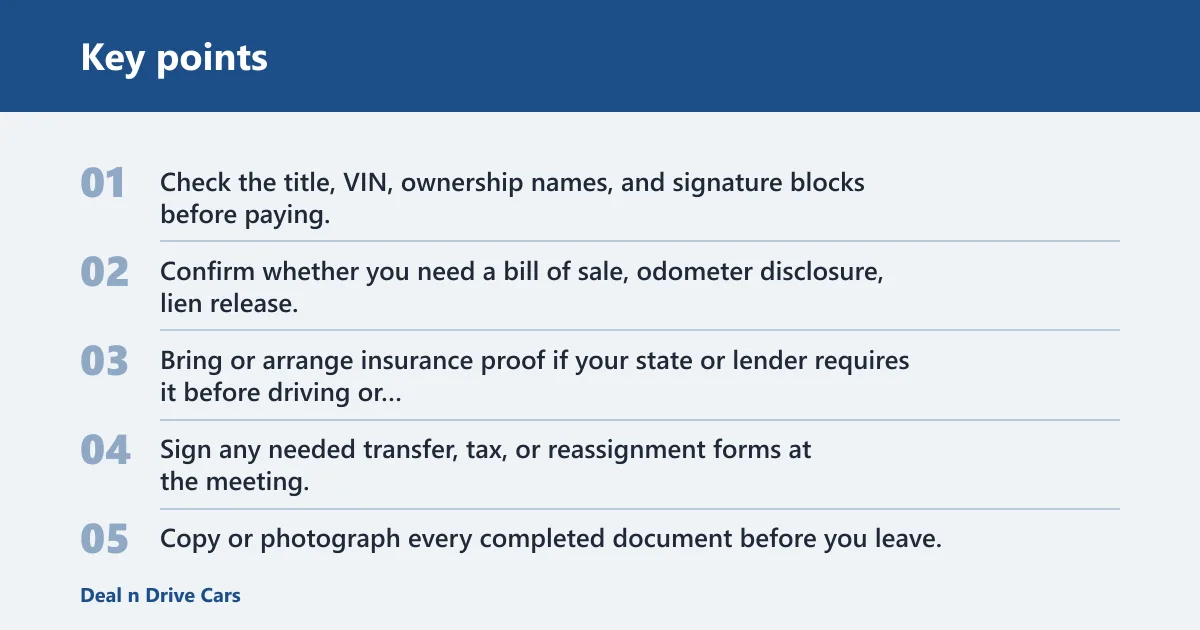
- Check the title, VIN, ownership names, and signature blocks before paying.
- Confirm whether you need a bill of sale, odometer disclosure, lien release, or emissions document in your state.
- Bring or arrange insurance proof if your state or lender requires it before driving or registering.
- Sign any needed transfer, tax, or reassignment forms at the meeting.
- Copy or photograph every completed document before you leave.
Frequently asked questions
What paperwork do I need to buy a car from a private seller?
Start with the title, because that is the core transfer document. You should also ask for a bill of sale, odometer disclosure if the vehicle is covered, and any lien release or state form your DMV requires. Verify everything before you pay, then finish registration after the sale.
How do I check whether the title is clean and transferable?
Compare the VIN on the title with the dashboard, door label, and supporting documents. Check that the seller name matches the ownership story, that all required signatures are present, and that no erasures or corrections appear. If a lien is listed, ask for a written release.
What if the seller doesn’t have the title?
Do not treat a missing title as normal. Ask the seller to use the state’s replacement-title process before you move forward. Without a valid title path, you may not be able to transfer ownership, even if the car runs well and the seller sounds convincing.
Do I need lien release paperwork if the car was financed?
Yes, if a lender appears on the title or record, you need a lien release. A verbal promise is not enough. The release shows the loan-backed claim has been satisfied, and it helps keep the DMV from rejecting the transfer or the lender from disputing ownership later.
Should I get insurance before buying from a private seller?
Usually yes, or at least confirm what your state or lender requires before driving away. Some states require proof of insurance to register or operate the vehicle after the sale. If you plan to drive it home, have the coverage ready before money changes hands.
What should I copy or keep after the sale is complete?
Keep copies or clear photos of the signed title, bill of sale, odometer disclosure, lien release, proof of payment, and any state forms you submit. Keep the insurance proof and final registration too. Those records are the backup if the transfer is questioned later.