What Is the Average Down Payment on a Used Car Today?
A typical used-car down payment is often around 10% to 20% of the price. At 20%, approval odds are usually strongest and the monthly payment is lowest. Put too little down and you often pay more interest, face a higher approval bar, and risk owing more than the car is worth. This guide breaks down realistic dollar targets by credit profile, explains how lenders judge used-car down payments, and shows the tradeoff between approval odds, monthly cost, and loan risk.
What is the average down payment on a used car?
For lender planning, a “typical” used-car down payment often means around 10% to 20% of the purchase price. That range is more useful than a single dollar figure because the cash target changes with credit strength, loan-to-value ratio, and vehicle price. Used-car loans also vary more than new-car loans, so the average works best as a planning range, not a rule.
What lenders mean by average
Average means the sum divided by the count. In other words, add the values, then divide by how many values you have. Averages help you summarize data, and the average formula is the sum of values divided by the number of values.
That definition matters here because “average down payment” can mean two different things: a percentage of price or a cash amount. A $2,000 down payment may be average on a $20,000 car, but unusually large on a $7,000 car. For buyers, percentage is the cleaner planning tool.
Why used-car loans are different
Used cars carry more lender risk because value drops are harder to predict, and some loans stretch over terms that outlast the car’s value faster than the borrower expects. That is why lenders often want a larger upfront stake on used inventory than on a similar new-car deal.
In basic average examples, CalculatorSoup shows an average of 16.75 from 16 values, Cuemath defines average as the sum of data values divided by the number of data points, and GeeksforGeeks says average is a way to represent a large amount of data with a single number. Those are math tools; the used-car question is a finance decision.
📊 CalculatorSoup shows an example average of 16.75 from 16 values. Source: Calculatorsoup.
How much should you put down on a used car?
A sensible target is 10% if your credit is solid and the loan fits your budget, and 20% if you want stronger approval odds, lower monthly payments, and less risk of being upside down. If credit is weaker, lenders often expect more cash or stronger reserves before they approve the deal.
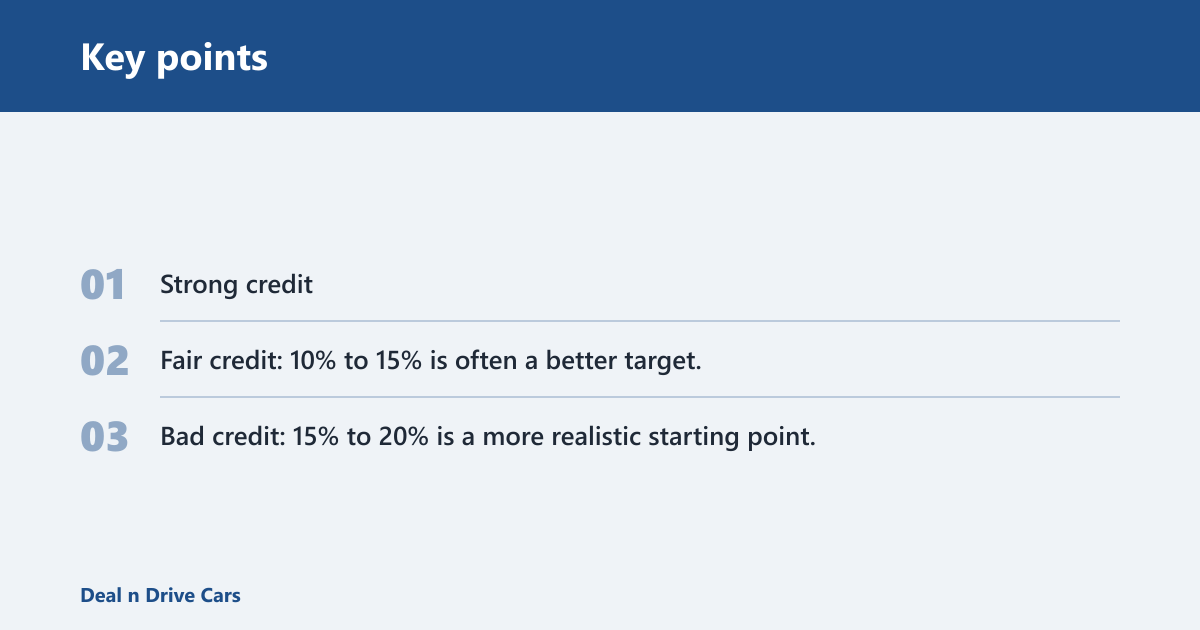
Practical targets by credit profile
- Strong credit: 10% can be enough for many used-car loans.
- Fair credit: 10% to 15% is often a better target.
- Bad credit: 15% to 20% is a more realistic starting point.
Those are planning targets, not approval promises. APR, term length, income, debt load, and the vehicle itself still matter. A lower-risk borrower may get offered better terms with less cash down, while a higher-risk borrower may be asked for more upfront cash or trade-in equity.
When 5% may be enough
Five percent can work on some used-car loans when the borrower has stronger credit, stable income, and a car priced well below the lender’s cap. It is more common when the vehicle is inexpensive and the loan-to-value ratio stays acceptable after taxes and fees are added.
Suppose a buyer chooses a $14,000 used car and puts 5% down. That is $700 before taxes and fees. It may be workable, but the approval picture gets tighter once the true out-the-door price is calculated.
When 10% to 20% makes more sense
Ten percent often feels like the practical minimum for many shoppers because it lowers the amount financed without draining savings. Twenty percent gives the lender a stronger cushion and usually cuts monthly cost more sharply. For older used cars, that cushion matters because resale value can move quickly.
How down payment changes loan-to-value ratio
Loan-to-value ratio, or LTV, is the loan amount compared with the vehicle’s value. A bigger down payment lowers LTV. Lenders care because lower LTV means less exposure if the borrower misses payments and the car must be sold or repossessed.
Why lenders watch LTV on used cars
Used-car values can move fast, especially on higher-mileage vehicles. If the loan starts too close to the car’s value, the borrower can become upside down early, meaning the loan balance is higher than the car’s market value. That creates more risk for both sides.
A 20% down payment on a $20,000 car lowers the loan amount to about $16,000, which would put LTV at roughly 80%. A 5% down payment leaves a much thinner cushion. That difference can affect whether a lender sees the deal as manageable or stretched.
How lower LTV reduces upside-down risk
Lower LTV does not remove risk, but it helps. If the car depreciates in the first year, a larger upfront payment makes it less likely that the balance will outrun the car’s value. That matters most on long terms and higher APR loans, where principal falls slowly.
What down payment does to your monthly payment
Down payment changes monthly payment by changing the principal. APR and term length then shape how expensive that principal becomes. A larger down payment usually lowers the payment because you finance less, but the size of the drop depends on rate and loan term.
Why the same car can have different payments
Two shoppers can buy the same used car and see very different payments. One may put 20% down and qualify for a shorter term. Another may put 5% down and stretch the loan to make the payment fit. Same car, different monthly result.
A simple way to think about it: less financed amount means less total interest charged over time. A lower APR also helps, but APR is tied to credit and lender risk. A down payment helps mainly by shrinking the balance the lender has to price.
Simple payment comparison across common terms
Picture a $18,000 used car with a 72-month loan. A buyer who puts 20% down borrows less than a buyer who puts 5% down, so the payment drops even before APR differences are added. That is why down payment is a payment lever, not just an approval tactic.
| Vehicle price | Down payment | Estimated loan amount | Estimated payment impact | Buyer profile it fits |
|---|---|---|---|---|
| $10,000 | 0% | $10,000 | Highest payment; highest risk of being upside down | Rare; only strong profile with special program or trade-in equity |
| $10,000 | 5% | $9,500 | Small payment drop; modest equity cushion | Strong credit, low fees, manageable out-the-door total |
| $10,000 | 10% | $9,000 | Clearer payment reduction and better LTV | Most fair-to-strong credit buyers |
| $10,000 | 20% | $8,000 | Lowest payment and strongest cushion | Buyers who want easier approval odds and lower monthly cost |
| $18,000 | 0% | $18,000 | Highest payment in the set; no equity cushion | Usually only if lender allows no money down |
| $18,000 | 5% | $17,100 | Small reduction in payment; still near full exposure | Strong credit with stable income |
| $18,000 | 10% | $16,200 | Noticeable payment relief and better approval profile | Good starting point for many used-car shoppers |
| $18,000 | 20% | $14,400 | Largest payment reduction and better upside-down protection | Shoppers who want the safest structure |
| $25,000 | 0% | $25,000 | Largest borrowed amount; more rate sensitivity | Usually limited cases only |
| $25,000 | 5% | $23,750 | Some relief, but still high exposure | Strong profile, lower fees, favorable APR |
| $25,000 | 10% | $22,500 | Meaningful reduction in monthly cost | Common target for used-car financing |
| $25,000 | 20% | $20,000 | Best cushion and the easiest structure to carry | Higher-risk vehicles or buyers who want a smaller payment |
Note: The table shows principal only. APR, term length, taxes, and fees change the final payment. A lender may quote a payment after adding all of those items, not just the car price.
Can you buy a used car with no down payment?
Some lenders offer zero-down used-car financing, but it is often limited to stronger credit, lower-risk vehicles, or special programs. No-down financing raises the amount financed, which pushes up the monthly payment and leaves less protection if the car’s value drops faster than the loan balance.
Why no-down deals can be expensive
No money down means the full amount, plus often taxes and fees, is rolled into the loan or paid at signing. That increases principal, which increases total interest over the life of the loan. It can also make it easier to owe more than the car is worth early on.
What lenders may look for instead of cash is strong credit, steady income, low debt-to-income pressure, and a vehicle that stays within their lending guidelines. If those pieces are weak, a down payment often becomes the thing that makes the deal work.
How much down payment do you need with bad credit?
Bad-credit auto loan borrowers often face higher upfront cash expectations because lenders see more payment risk. In many cases, a larger down payment or trade-in equity can help, but lenders may also want proof of cash reserves so the borrower can handle insurance, fuel, and repairs after signing.
Why cash reserves matter
A lender is not only asking, “Can this person make the first payment?” It is also asking whether the payment will still fit after taxes, title, registration, dealer fees, and regular ownership costs are added. A thin cash position can make an otherwise acceptable deal look fragile.
For bad-credit borrowers, 15% to 20% down is often a more realistic target. That does not guarantee approval. It does signal lower risk than a nearly full-value loan with no cushion.
Trade-in equity can help, but it is not the same as cash
Trade-in equity is the value of your old vehicle after the payoff on that vehicle is subtracted. It can count toward down payment, but it is not the same thing as cash in hand. If the trade has negative equity, it may reduce the benefit or even add to the loan balance.
Say your trade-in is worth $8,000 and the payoff is $5,500. The equity is $2,500. That can reduce the amount financed, but it may not replace the need for cash if the lender wants money down at signing.
What cash do you actually need at signing?
The quoted down payment is not always the full amount due at signing. Taxes, title, registration, and dealer fees are often separate from the down payment, and they raise the true cash needed to drive away. Out-the-door price is the better planning number because it includes purchase price plus those extra costs.
- Start with the out-the-door price, not the sticker price.
- Subtract any trade-in equity that the dealer confirms.
- Add the down payment the lender or dealer requires.
- Keep a reserve for insurance, title, and registration gaps.
That checklist helps avoid a common first-timer mistake: budgeting for the car alone, then finding the signing amount is higher than expected because fees and taxes were left out.
What is the average monthly payment on a used car?
There is no single average monthly payment that fits every used-car deal because the payment depends on price, down payment, APR, and term length. The right benchmark is your own loan structure. A smaller down payment usually means a larger payment, while a larger down payment lowers the financed balance.
A common way lenders estimate payment is to combine principal, APR, and term length into one monthly figure. That is why two buyers can see very different payments on the same used car. The car is only one variable.
What is the monthly payment on a used car?
The monthly payment on a used car is the loan amount spread across the term, plus interest priced through APR. Down payment lowers the amount financed, which usually lowers the payment. Longer terms can cut the monthly bill, but they often increase total interest and leave the loan upside-down longer.
Simple estimate logic
If you want a quick estimate, start with the out-the-door price, subtract cash down and trade-in equity, then compare the result across 48-, 60-, and 72-month terms. That gives a clearer answer than guessing from the sticker price alone.
Interest rate sensitivity matters too. A lower APR can make a modest down payment look much stronger, while a higher APR can erase part of the savings from putting cash down. Lenders use that risk signal when they price the loan.
Frequently asked questions
What is the average down payment on a used car?
The typical used-car down payment is 10% to 20% of the vehicle price. For many shoppers, 10% is a workable target, while 20% offers a stronger cushion, lower monthly cost, and better upside-down protection. The exact amount depends on price, APR, term, and credit profile.
What is a good down payment on a used car?
A good down payment is one that keeps the loan-to-value ratio reasonable and the monthly payment comfortable. For many buyers, 10% is a solid minimum and 20% is better if you want lower risk and a smaller balance. Stronger credit may get more flexibility, but the math still matters.
How much should you put down on a used car?
Start with 10% if your credit and income are stable, then move toward 20% if you want a safer loan structure or if the car is older or more expensive. If you are trying to preserve cash reserves, 5% may work in some cases, but it raises payment and LTV.
How much down payment on a used car with bad credit?
Bad-credit borrowers are often better off aiming for 15% to 20% down, plus enough cash to cover taxes, title, registration, and dealer fees. A larger upfront amount can improve approval odds, but it does not guarantee approval. Trade-in equity may help, though lenders may still want cash at signing.
Is $500 enough for a used car down payment?
$500 can be enough only on a low-priced used car or under a lender program that allows very small cash down. On a $10,000 car, that is only 5%, and the payment may still be high once fees and taxes are added. It is better to check the out-the-door amount first.
Can you buy a used car with no down payment?
Yes, some buyers can, but zero-down used-car financing usually goes to stronger credit profiles or specific lender programs. No down payment means a larger loan amount, a higher monthly payment, and more upside-down risk. Lenders may ask for trade-in equity or stronger income instead of cash.
Does a bigger down payment lower your monthly car payment?
Yes. A bigger down payment lowers the amount financed, which usually lowers the monthly payment. The size of the drop depends on APR and term length. If you borrow less and keep the same term, your payment falls; if you shorten the term too, the payment falls more slowly.
Does a down payment lower your used car interest rate?
Not automatically. A down payment can signal lower risk, which may help a lender view the deal more favorably, but APR still depends on credit score, income stability, vehicle age, and lender policy. Think of the down payment as a risk reducer, not a rate guarantee.