Can You Get a Car Loan with a 500 Credit Score?
Yes, you can get a car loan with a 500 credit score, but approval usually means subprime terms and a higher payment. A poor fit can leave you upside down fast or push the total cost beyond the car’s value. This guide explains approval odds, likely rates and down-payment needs, and when buying now still makes sense.
Is 500 a subprime score?
VantageScore 4.0 is commonly reported to run from 300 to 850. It is below the 501-600 subprime band and far below the 661 start of prime. FICO uses a different scale, but 670 or higher is usually treated as good.
Where 500 sits in credit ranges
On the VantageScore 4.0 scale, deep subprime covers 300 to 500, subprime runs 501 to 600, near prime is 601 to 660, prime is 661 to 780, and super prime is 781 to 850. So 500 is not merely weak credit. It is at the bottom of the deep subprime tier.
How 500 compares with lender benchmarks
Many auto lenders commonly want scores of about 661 or higher for standard-rate programs. That is not a hard cutoff, but it does mean a 500 score usually moves you out of the main pricing tier and into a stricter approval path with more proof required.
Why deep subprime changes lender options
A 500 score may still qualify for an auto loan, but the lender will usually look harder at income, debt, job stability, and the vehicle itself. A longer loan, an older vehicle, or a thin payment history can quickly shrink the options. Higher rates are the main tradeoff.
What lenders may approve you?
There is no specific minimum credit score required to get an auto loan. Banks, credit unions, online lenders, dealerships, and auto finance companies can set their own floor, so approval depends on the lender and your full profile, not one number alone.
How lender type changes the odds
Credit unions may be more flexible on total relationship and payment history, but they still underwrite the loan. Online lenders can be quick and may price risk tightly. Dealership financing can widen access, though some deals land in high-cost tiers. Auto finance companies often work deeper into subprime than traditional banks.
Which non-score factors can help or hurt approval?
Income matters because the lender wants to see enough room to handle the payment after housing, food, insurance, and existing debts. Debt-to-income ratio, job stability, down payment, vehicle age, and payment history all matter too. A lower score can sometimes be offset by a stronger cash position or a cheaper car.
Suppose your score is 500, your rent is current, and you have six months of steady pay stubs. A lender may still ask for proof of insurance, recent bank statements, and a larger down payment before considering the deal. That is common when the file needs extra support.
What APR and payment should you expect?

Expect a wide rate range. In Experian’s published context, the average VantageScore for new auto loan applicants was 751, and the deep subprime average rate was 16.11% in Q2 2026. For used auto loans, the average applicant score was 688, and the deep subprime average rate was 21.62% in Q2 2026.
What those numbers mean for a 500 score
A 500 score sits in deep subprime, so a borrower often lands near the high end of the price spectrum, especially without a down payment. Lender, term length, vehicle age, and the rest of the file all change the final offer. A stronger profile can pull the rate down, but a 500 score still signals extra risk.
How rate changes affect monthly payment
Here is the payment impact on a 60-month loan using simple examples. The figures are estimates, not promises, and they are meant to show how fast a higher APR changes the monthly bill. New-car payments are shown against a higher loan amount because new vehicles usually cost more.
| Scenario | Likely approval friction | Estimated APR band | New car payment impact | Used car payment impact |
|---|---|---|---|---|
| No down payment | High. Expect tighter scrutiny, more proof of income, and fewer lender choices. | About 16.11% to 22% for new; about 21.62% to 28% for used | About $617 to $691 on a $25,000 loan | About $494 to $561 on an $18,000 loan |
| Small down payment | Moderate to high. A smaller cash stake may help, but some lenders still want more cushion. | About 15.5% to 21% for new; about 20.5% to 27% for used | About $567 to $635 on a $23,000 loan | About $439 to $499 on a $16,000 loan |
| Moderate down payment | Moderate. More cash can reduce lender risk and lower the financed amount. | About 15% to 20% for new; about 19.5% to 26% for used | About $517 to $581 on a $21,000 loan | About $385 to $438 on a $14,000 loan |
Those payment ranges show the real issue: a 500 score affects both approval odds and affordability. A car that is “approved” can still be a bad fit if the payment leaves too little room in the budget. That is where borrowers get trapped in a loan that is technically possible but hard to live with.
Loan readiness checklist

Before you apply, check the parts of the file that lenders actually verify. A 500 score does not end the conversation, but a weak application often needs more documentation, more cash down, or a cheaper vehicle to get to “yes.”
| Readiness item | What to have ready | Why it matters |
|---|---|---|
| Income | Recent pay stubs, bank statements, or proof of other stable income | Shows you can cover the monthly payment |
| Debt-to-income ratio | A payment that fits beside rent, cards, and existing loans | Helps the lender judge repayment capacity |
| Down payment | Cash for a larger upfront payment if possible | Reduces the loan amount and the lender’s risk |
| Vehicle choice | A lower-priced, older, and easier-to-resell car | Older loan balances are often smaller and easier to justify |
| Payment history | On-time housing, utility, and card payments | Signals that you pay on schedule |
| Credit report | Clean reports with errors disputed before applying | Removes mistakes that can depress the score or confuse underwriting |
A common first-timer mistake is shopping the car first and the financing second. If the payment target is set before the lender reviews income and debt, the deal can fall apart late in the process. Start with the monthly number you can actually carry.
- Check all three credit reports for errors and disputes.
- Pay every bill on time for the next several months.
- Lower revolving balances where possible before applying.
- Save a down payment and keep it documented.
- Choose a cheaper vehicle if your budget is tight.
- Bring proof of income, residence, and insurance to the lender or dealership.
Can you get a new car loan with a 500 credit score?
Yes, but new-car approvals can be harder at 500 because the loan amount is usually larger and the lender takes on more depreciation risk. That combination can push the file toward a stricter approval review, a larger down payment request, or a higher APR than the same borrower might see on a used car.
Why used cars can widen the options
A used car often means a smaller loan amount, which can make the monthly payment easier to fit inside a subprime budget. Some lenders also prefer shorter balances on older vehicles. That can help if you are trying to keep the payment down while working with a 500 score.
When a smaller loan amount helps
If the target loan is smaller, the lender may see less risk even when the score is weak. That does not erase the deep subprime label. It can, however, make the file easier to approve than a larger new-car loan with little or no money down.
Should you buy now or wait?
Buying now can make sense if the car is necessary for work, school, or family logistics and you can support the payment after insurance and fuel. Waiting may make more sense if the payment would stretch the budget, the down payment is still thin, or the reports contain fixable issues that could lift approval odds over the next few months.
When buying now makes sense
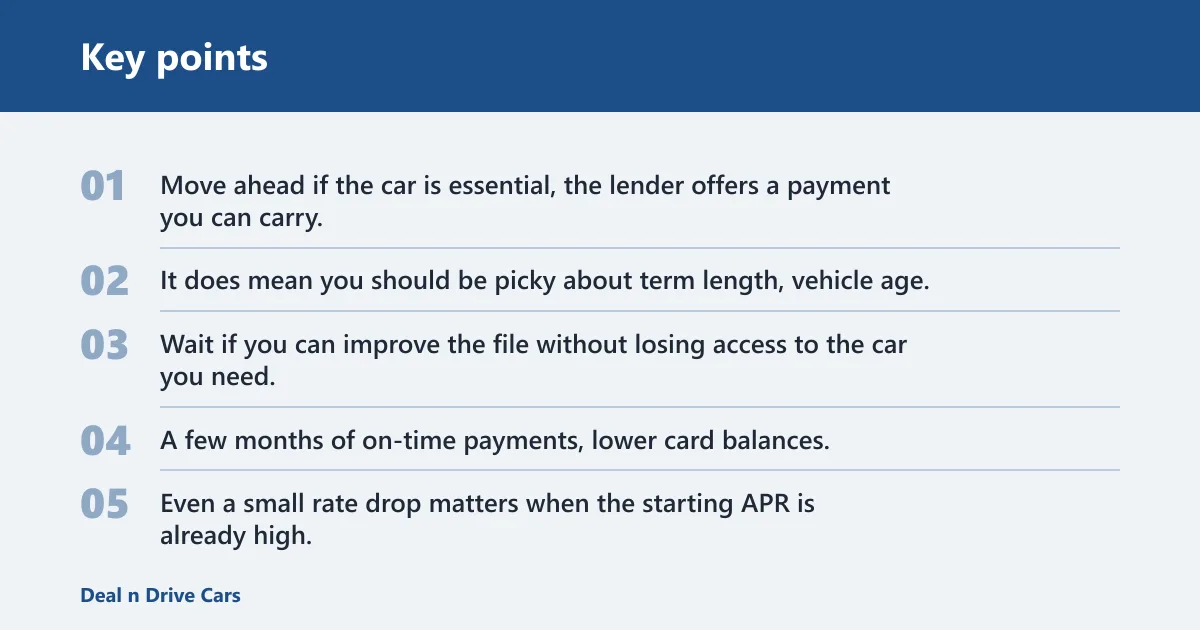
Move ahead if the car is essential, the lender offers a payment you can carry, and you have a realistic down payment. A 500 score does not block every deal. It does mean you should be picky about term length, vehicle age, and the all-in cost of the loan.
When waiting is smarter
Wait if you can improve the file without losing access to the car you need. A few months of on-time payments, lower card balances, and a larger down payment can change the shape of the offer. Even a small rate drop matters when the starting APR is already high.
Picture a buyer with a 500 score, $2,500 saved, and a reliable job that started eight months ago. Waiting three months to reduce card balances and add another $1,000 could move the deal from “barely manageable” to “workable,” especially on a used car with a shorter loan.
Frequently asked questions
Can you get a car loan with a 500 credit score?
Yes. There is no specific minimum credit score required to get an auto loan, and a 500 score may still qualify. The catch is that many lenders treat 500 as deep subprime, so the offer often comes with a higher APR, more documentation, and a smaller loan window.
What kind of car loan can I get with a 500 credit score?
You are more likely to see subprime or deep subprime terms, often through credit unions, online lenders, dealerships, auto finance companies, or some banks. The exact loan depends on income, debt, vehicle age, and down payment, not score alone. Used cars often fit these files better.
What APR should I expect with a 500 credit score?
There is no single rate, but deep subprime benchmarks help set expectations. Experian’s Q2 2026 averages were 16.11% for new auto loans and 21.62% for used auto loans in the deep subprime range. A 500-score offer can land around those bands or higher.
Is 500 credit score considered subprime or deep subprime?
It is deep subprime on VantageScore 4.0. So a 500 score sits at the bottom of the deep subprime range, below the subprime band.
What can I do to improve my approval odds before applying?
Check your credit reports for errors, pay bills on time, lower revolving balances, and save for a larger down payment. Those steps can improve both approval odds and the payment you are offered. A cheaper car and proof of steady income can also help.
Should I wait and improve my credit before buying a car?
Wait if the payment would strain your budget or if you can improve the file in 3 to 6 months. Buy now if the car is necessary and the payment is realistic after insurance and fuel. The decision should be based on affordability, not only approval odds.