How to Get Help with a Used Car Down Payment
To get help with a used car down payment, start with trade-in equity, a co-borrower, or lender aid; use the cheapest option you qualify for, and avoid expensive cash advances. Bad choices can add fees, raise your APR, or leave you upside down on the loan from day one. This guide ranks each option by speed, approval odds, and long-term cost.
Where the cash comes from and what it costs
A down payment is the cash portion you pay at signing, before the lender funds the rest. It lowers the amount financed, which can cut total interest over the loan term and may reduce the monthly payment. For used cars, 10% is a common benchmark for a down payment, and 20% can give a stronger cushion many buyers want. Some lenders also allow 0% or set their own minimums.
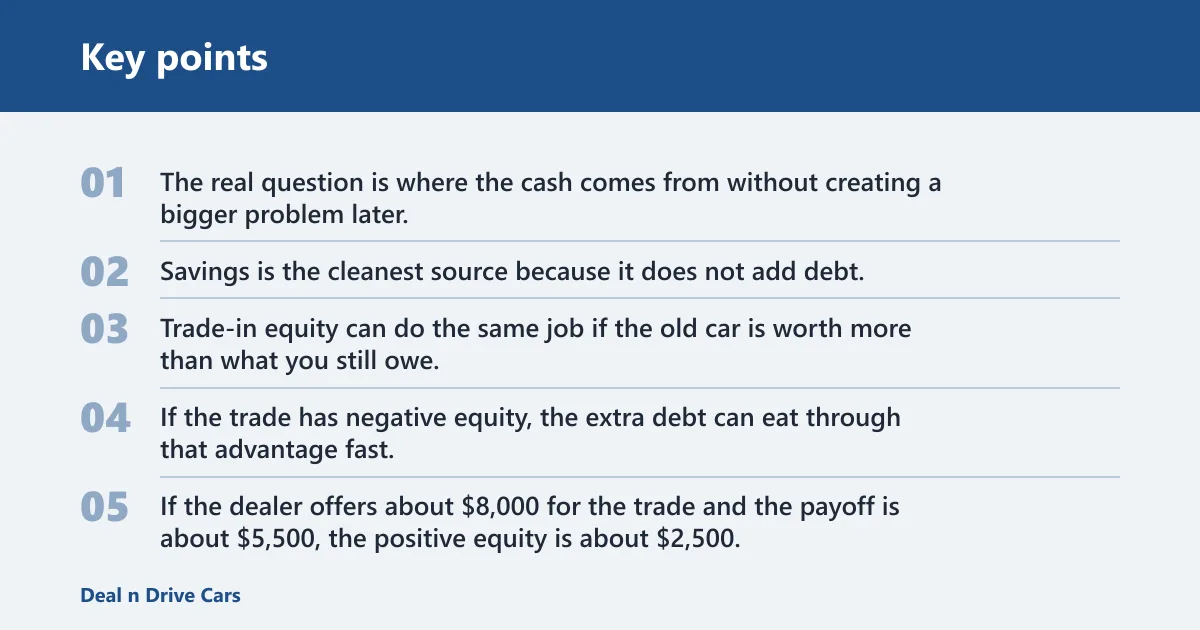
The real question is where the cash comes from without creating a bigger problem later. The main sources are savings, trade-in equity, lender programs, dealer cash or rebates, personal loans, and co-borrower help. Each one trades speed against cost.
Savings and trade-in equity
Savings is the cleanest source because it does not add debt. Trade-in equity can do the same job if the old car is worth more than what you still owe. If the trade has negative equity, the extra debt can eat through that advantage fast.
Trade-in equity offsets cash due at signing. If the dealer offers about $8,000 for the trade and the payoff is about $5,500, the positive equity is about $2,500. That amount can cover part or all of the down payment, title fees, or taxes, depending on the deal structure.
Lender programs and zero-down financing
Some lenders allow 0% down financing, and CIBC says it offers financing up to 100% of a new or used vehicle’s cost. CIBC also says its used-vehicle loans can run up to 8 years, the vehicle can be up to 10 years old, the loan minimum amount is $7,500, and approval is guaranteed for 30 days at a fixed rate. Terms like these are useful, but they are not universal.
Zero down can help a buyer who needs to hold onto cash reserves. It also means the loan starts larger, so the monthly payment and total interest usually rise. A longer term can lower monthly payments, but it increases total interest.
Dealer cash, rebates, and co-borrower help
Dealer contributions and manufacturer-style rebates can reduce the amount due at signing. That is not the same as a cash down payment, but it can fill the same gap on paper. Co-borrower help is different: the added borrower may strengthen approval odds and improve terms, which can make the upfront cash easier to handle.
Dealers may also steer buyers toward on-the-spot financing applications. That can work well if the paperwork is ready and the car fits the lender’s age and mileage rules. It can backfire if the deal depends on a rebate tied to a specific lender or if the payment only works because the term is stretched too far.
Can I get a used car loan with no down payment?
Yes, some buyers can. Zero-down approval is most likely when the borrower has strong credit, steady income, modest existing debt, and a car that fits the lender’s age and price limits. Bad-credit and first-time buyers can still qualify in some programs, but they are more likely to face a required down payment or tighter terms.
When zero down is most likely
Good-credit borrowers are the best fit for zero-down offers because the lender has more confidence in repayment. Credit-union and captive-finance programs may also be more flexible if the car is newer, the loan amount is within policy, and the income documents are clean. Some subprime programs still allow low cash down, but the cost usually rises elsewhere.
What lenders check before approving
Expect the lender or dealership to ask for proof of income, residence, insurance, and identification. The car itself matters too: age, mileage, loan-to-value ratio, and the requested term all affect approval. A lender can refuse 0% down even when the borrower is otherwise approved, especially if the used car is older or the payment is already stretched.
Why zero down can raise long-term cost
When you finance the full price, the loan amount is larger from day one. That can mean more interest, more months underwater, and less room to absorb early depreciation. If the rate is also higher, the cost gap gets wider.
Say your budget allows a $400 monthly payment. A larger down payment can keep the loan amount smaller and may let you stay inside that cap without extending the term. If you skip the down payment, the payment can still fit, but only by borrowing more or taking a longer term.
How do you use a trade-in toward the down payment?
A trade-in can cover part of a used-car down payment when it has positive equity. The dealership applies that equity against the amount due at signing or rolls it into the deal structure. If the trade has negative equity, the unpaid balance can be added to the new loan, which can erase the benefit.
Positive equity versus negative equity
Positive equity means the trade is worth more than the payoff amount on the current loan. Negative equity means the payoff is higher than the trade value. Positive equity helps you reduce what you pay up front; negative equity does the opposite unless you pay the shortfall in cash.
How the trade-in offsets cash due at signing
The dealer usually subtracts the payoff on the old loan from the trade value. If the result is positive, that amount can count toward the down payment, taxes, fees, or both. This is one reason trade-in appraisal and loan payoff details should be checked before you agree to the new contract.
When rolling old debt backfires
Rolling negative equity into a new used-car loan raises the amount financed and can push the loan-to-value ratio higher. That makes it easier to end up upside down again. A common first-timer mistake is trading too early on a car that still carries several thousand dollars of negative equity, then extending the new term just to make the payment work.
How do you get dealer or lender help?
Dealer and lender help usually comes from rebates, cash contributions, or a financing program that reduces the money you need at signing. The fastest path is often an on-the-spot dealer application paired with a lender program already tied to the car. Approval depends on credit profile, income, the vehicle, and the paperwork you bring.
Dealer cash contribution and rebates
Dealer cash can reduce the amount due at signing, and rebates may do the same if the program applies to the vehicle and buyer. These offers can be useful when cash is tight, but they often come with conditions. The dealer may require a specific lender, a shorter window, or a particular stock unit.
Keep an eye on the payment math. A rebate that reduces the down payment need but forces a longer term can leave you paying more interest later. The discount only helps if it lowers the total cost, not just the amount handed over today.
Credit-union or lender assistance programs
Credit unions and lenders sometimes allow lower cash down, especially for members or borrowers with cleaner credit files. Some programs are designed for newcomers, thin-file borrowers, or buyers with no prior auto history. Subprime financing is also possible, but the lender may require a higher rate, more documentation, or a larger down payment.
Auto Credit Express cites Edmunds data showing average used-car down payments of $3,993. It also says a down payment can range from 0% to 20%, and bad-credit buyers may need around 10% or $1,000. Auto Credit Express recommends around 20% down on a car loan. Experian says 20% is recommended for new cars and 10% for used cars.
Documents dealers usually ask
- Bring proof of income. Recent pay stubs, bank statements, or tax returns help the lender verify that the payment fits your budget. Without them, approval can stall even if the car and rate look reasonable.
- Bring ID and residence proof. A driver’s license, insurance information, and a current utility bill or lease help complete the file. Dealers often need these before final contract printing.
- Bring trade and payoff details. If you are using a trade-in, bring the loan payoff amount and registration information. That lets the dealer calculate whether the equity covers part of the down payment.
- Ask about age limits early. Some lenders cap used vehicles at a certain age or mileage. CIBC says its used-vehicle loans can include vehicles up to 10 years old, but not every lender uses the same rule.
Help decision table
This table compares the six most common ways to get help with a used-car down payment. The right choice depends on how fast you need approval, how much cash you can bring, and whether you want to keep borrowing costs low.
| Help option | Best for | Fastest approval path | Upfront cash needed | Hidden cost | Biggest risk |
|---|---|---|---|---|---|
| Savings | Buyers who want the lowest cost and have cash reserved | Use cash at signing after loan approval | Whatever you choose to contribute | Opportunity cost if cash sits idle, but no loan fees | Draining the emergency fund too far |
| Trade-in equity | Owners with positive equity in the old car | Dealer appraisal plus payoff check | May be $0 if equity covers the gap | Possible appraisal gap and fees if equity is overstated | Negative equity rolling into the new loan |
| Lender zero-down financing | Good-credit buyers who need to preserve cash | Online or dealer application with income documents | $0 | More interest over time because the loan amount is larger | Starting with little or no equity |
| Dealer rebate/cash back | Shoppers eligible for a specific vehicle program | Apply through the dealer while the car is in stock | Can reduce the cash due at signing | May require a specific lender or term | Accepting a worse financing deal to capture the rebate |
| Personal loan | Borrowers with a short cash gap and strong repayment ability | Bank or credit-union approval before the car purchase | Usually none at signing, since the loan funds the gap | Separate interest rate and payment on top of the auto loan | Two debts instead of one |
| Co-borrower help | Applicants who need stronger credit or income on paper | Joint application with full documents from both borrowers | Can lower or remove cash due at signing | Shared legal responsibility for the loan | Damage to the other borrower if payments slip |
How much should you put down?
If you can afford it without emptying your savings, a larger down payment is usually better. A 0% option can work for a strong borrower or a buyer who needs to preserve cash, but 10% is the common used-car benchmark and 20% is the stronger target when the budget allows. Lenders may set higher or lower minimums based on credit and vehicle age.
Zero percent option
Zero down is helpful when the buyer has no spare cash or needs to keep money in reserve. The tradeoff is a larger loan amount and potentially more interest. It can be the right move if the monthly payment still fits and the lender’s terms are reasonable.
10% used-car benchmark
The same source says 10% is recommended for used cars, and Auto Credit Express says bad-credit buyers may need around 10% or $1,000. This amount can make approval easier and reduce the amount financed without demanding a huge upfront outlay. It is a practical middle ground for many buyers.
20% benchmark and lender minimums
The same source recommends around 20% down on a car loan, and Experian says 20% is recommended for new cars. A larger down payment can lower the monthly payment and total interest, but it should not wipe out the cash cushion you need for repairs, insurance, and living expenses.
A precise payment estimate depends on borrowed amount, term length, and interest rate. A simple calculator works like this: the higher the amount financed and APR, the higher the monthly payment; the longer the term, the lower the monthly payment but the higher the total interest. That is why a 72-month loan can feel easier month to month while costing more overall than a shorter term.
What if you are short on cash?
If you cannot cover the full down payment right now, start with the cheapest option that preserves your budget. A co-borrower or lender program may be less expensive than a personal loan. If the only way to get the car is to strip your emergency fund, that deal is usually too tight.
Personal loan tradeoffs
A personal loan can fill a down-payment gap fast, but it adds a second monthly bill. That can be useful for a small shortfall and a short repayment period, especially if the auto loan rate is much better than the personal loan rate. It gets expensive if the personal loan stretches for years.
Co-borrower help and joint applications
A co-borrower can improve approval odds and sometimes reduce the down payment requirement. This works best when both borrowers have stable income and clean payment histories. It also creates shared liability, so missed payments affect both credit files.
Protecting your emergency fund
A down payment should not empty the account you rely on for repairs, rent, or medical bills. If using savings would leave you exposed, compare a smaller down payment with a slightly higher payment before borrowing extra money. The cheapest loan is not the best loan if it leaves you unable to handle the next expense.
Frequently asked questions
How do I get help with a used car down payment?
Start with the cheapest source you already have: trade-in equity, savings, or a lender program that allows low cash down. If that is not enough, ask the dealer whether a rebate or cash contribution applies, then compare that against a co-borrower or a small personal loan. Focus on the full cost, not only the amount due today.
Can I use a trade-in to cover a down payment on a used car?
Yes, if the trade has positive equity. The equity can offset part or all of the amount due at signing. If the old loan balance is higher than the trade value, the negative equity can reduce or eliminate the benefit unless you pay the difference in cash.
What if I can’t afford the full down payment right now?
Use the smallest-cost option that keeps the deal safe: trade-in equity, a lender program, or a co-borrower. If those do not cover the gap, consider a smaller down payment rather than forcing a long loan term or a separate high-cost loan. Keep enough cash back for emergencies.
How do I put down payment on car when I buy from a dealer?
Bring the agreed cash, proof of income, ID, and any trade-in paperwork. The dealer applies the down payment at signing, then subtracts any trade equity or rebate from the amount due. Read the contract closely so fees, add-ons, or a longer term do not erase the benefit.
Can a bigger down payment help lower my monthly used car payment?
Yes. A bigger down payment lowers the amount financed, which usually lowers the monthly payment and total interest. The tradeoff is that more cash leaves your pocket at signing, so the right amount depends on whether you need to protect your emergency fund.