Used Car Down Payment Calculator: How to Estimate Yours
A good used car down payment calculator starts at 10% of the car’s price, then adds taxes, fees, and any negative equity. If your monthly payment is tight, aim closer to 20%. A low estimate can leave you with higher payments, more interest, and little room for lender fees. This guide gives you a worksheet to estimate a realistic down payment from budget, trade-in value, APR, and dealer fees.
This guide is part of our Used car down payment: how much should you put down? series.
What counts as a down payment?
A down payment is cash paid up front. It reduces the amount financed, which can lower the monthly payment and the total interest cost. Keep it separate from the drive-off amount, since that total can also include taxes, title, registration, and other fees.
That difference matters. You can put 10% down on the vehicle price and still need more cash at signing if the dealer collects fees or state tax upfront. If fees are rolled into the loan, the cash due today is lower, but the loan balance is higher.
How do you estimate your used car down payment?
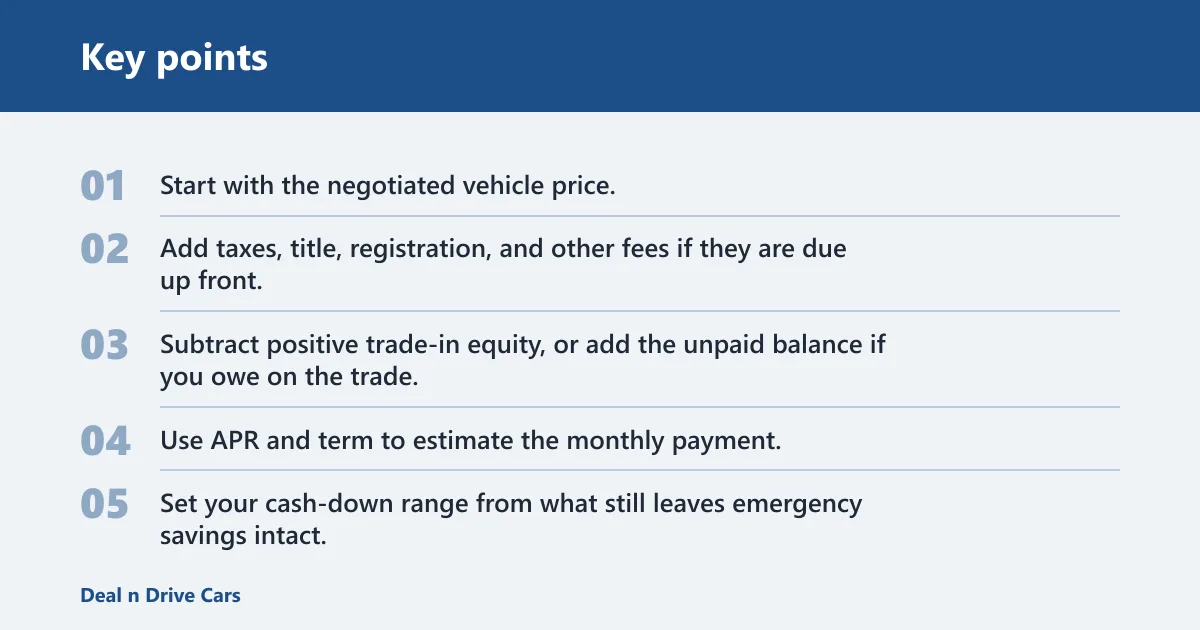
Start with the seller’s asking price or negotiated price, then add expected taxes and fees. Next, subtract any trade-in equity. After that, compare the result with your budget and the lender quote so the number reflects what you can actually bring to the deal.
Use the estimate as a range, not a fixed answer. A calculator can include down payment amount, trade-in value, sales tax rate, and fees, and it can also show estimated monthly payment, total interest cost, and total loan payments. That is more useful than a one-size-fits-all rule.
Work backward from a monthly budget
Suppose you want a payment near $375 a month. That target is not enough by itself, because APR and term change the payment materially. Enter the price, APR, and term first, then see what down payment brings the payment back to your target range.
If the payment comes out too high, you can adjust the down payment, choose a lower price target, or compare terms from multiple lenders. Prequalification or preapproval is the cleanest way to estimate a realistic APR before you commit to a vehicle.
Used car down payment estimator
| Vehicle price | Expected taxes/fees | Trade-in or equity adjustment | Recommended cash down range |
|---|---|---|---|
| $8,000 | $900 | $0 | $800 to $1,600 |
| $18,000 | $1,600 | +$2,000 trade equity | $1,800 to $3,600 |
| $22,000 | $1,850 | -$1,500 negative equity | $3,700 to $6,000 |
Read the table as a planning tool. The low end is a minimum cash-down target that may still fit the budget. The high end is closer to a stronger offer when you want less borrowed, less interest, and more protection against rolling fees into the loan.
- Start with the negotiated vehicle price.
- Add taxes, title, registration, and other fees if they are due up front.
- Subtract positive trade-in equity, or add the unpaid balance if you owe on the trade.
- Use APR and term to estimate the monthly payment.
- Set your cash-down range from what still leaves emergency savings intact.
How do APR and loan term change the number?
APR is the interest-rate input, and it can change both the monthly payment and total interest. A longer term lowers the payment but raises total interest over time. A shorter term does the opposite, which is why the same car can fit one budget and miss another by a wide margin.
A calculator with an amortization schedule is useful here because it breaks principal and interest out over time. It can also show total loan payments and total interest cost, which helps you compare terms and shop lenders with a clearer view of the real cost.
How to use lender quotes
Prequalification or preapproval gives you a realistic APR range before you buy. That makes the down payment estimate more reliable, because a quote at 7% APR and 72 months will generally not produce the same payment as 11% APR and 60 months.
Fewer surprises show up at the dealer when the financing range is already known. The calculator can show lenders after you enter loan amount, term, and credit score, so you can compare offers using the same vehicle price and fee assumptions.
Can you use a trade-in as part of the down payment?
Yes, if the trade has positive equity. The appraised value can offset the purchase price and reduce how much cash you need to bring. But if you still owe money on the trade, that unpaid balance can shrink the benefit or even increase the amount financed.
The calculator supports adding trade-in value and any loan balance still owed. That matters because a trade-in does not always reduce the new loan by the full appraised amount. The payoff comes first, and only the remaining equity helps the deal.
Positive equity
If the trade is worth more than the payoff, the difference can act like part of your down payment. For example, an appraised value of about $12,000 against an $8,500 payoff leaves about $3,500 in equity. That equity can reduce the cash you need at signing or lower the amount financed.
Negative equity
If you owe more than the trade is worth, the shortfall has to be handled somewhere. It may be paid off in cash, added to the new loan, or rolled into the deal if the lender allows it. That raises the amount financed and can increase the monthly payment.
A common first-timer mistake is treating trade-in value like a clean deduction even when there is still a payoff balance. That makes the down payment look smaller than it really is. Always ask for the payoff figure, not just the trade estimate.
How much should I put down on a used car?
A practical target is 10% down on a used car, which is the benchmark NerdWallet recommends. If you cannot afford that target, put down as much as you can without draining savings or emergency funds. No single minimum fits every lender or every credit profile.
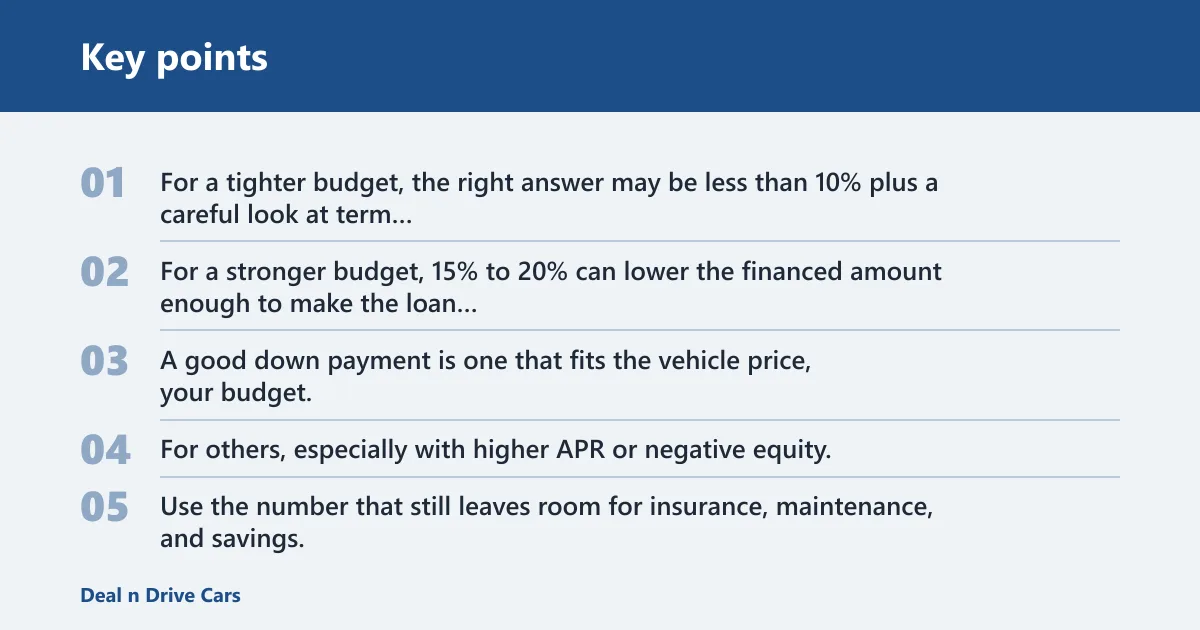
For a tighter budget, the right answer may be less than 10% plus a careful look at term length and fees. For a stronger budget, 15% to 20% can lower the financed amount enough to make the loan easier to carry and cheaper over time.
What counts as a good down payment on a used car?
A good down payment is one that fits the vehicle price, your budget, and the lender quote without leaving you cash-poor after signing. For some buyers, 10% is workable. For others, especially with higher APR or negative equity, a larger amount is the safer choice.
Use the number that still leaves room for insurance, maintenance, and savings. The best figure is not the largest possible check; it is the amount that keeps the loan affordable after fees and taxes are accounted for.
Can I put down less than 10% on a used car?
Yes, some buyers do, but lender rules vary by credit profile, vehicle age, loan term, and lender. Putting down less than 10% can still be workable if the payment fits and the car price is modest. The tradeoff is a higher balance and often more interest.
If cash is tight, use the calculator to test the smallest down payment that still leaves an emergency cushion. That is better than emptying savings for a larger down payment that creates a different financial problem later.
What fees should I include when estimating my car down payment?
Include title, registration, and other fees, along with sales tax if your state collects it at signing. The calculator can include title, registration and other fees as optional inputs, and it can also show a sales tax rate. Those items belong in the estimate whenever they affect drive-off cash.
Keep the purchase-price down payment separate from the total drive-off amount. A quote that seems manageable at the sticker price can become much larger once tax and fees are added, especially if the lender does not roll them into the loan.
Roll fees into the loan or pay them upfront?
Rolling fees into the loan lowers cash due today, but it raises the amount financed and usually increases total interest. Paying them upfront increases the drive-off amount, but it keeps the borrowed balance lower. The better choice depends on your cash cushion and the lender’s structure.
Worked examples for common used-car scenarios
These examples keep one variable at a time and use simple estimates, so you can see how the pieces move. The exact payment will still depend on APR, term, lender fees, and whether taxes are collected upfront or rolled into the loan.
Low-price used car example
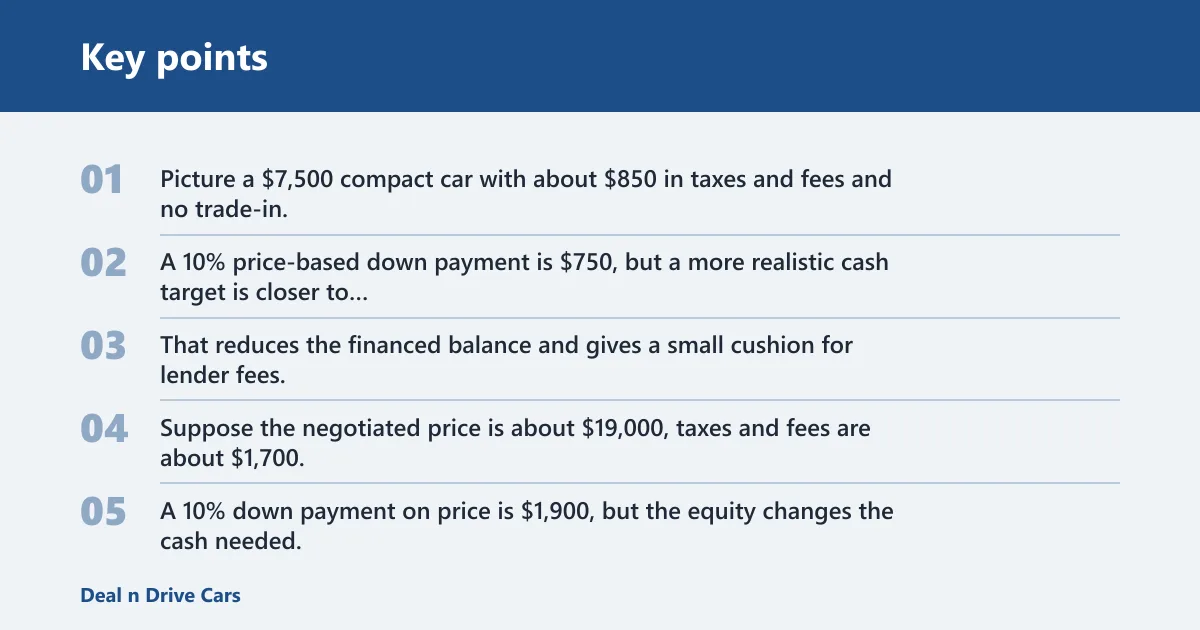
Picture a $7,500 compact car with about $850 in taxes and fees and no trade-in. A 10% price-based down payment is $750, but a more realistic cash target is closer to $1,500 because taxes and fees can add to the drive-off amount. That reduces the financed balance and gives a small cushion for lender fees.
Mid-price used car example
Suppose the negotiated price is about $19,000, taxes and fees are about $1,700, and your trade has about $2,500 in positive equity. A 10% down payment on price is $1,900, but the equity changes the cash needed. A practical cash range is about $2,000 to $4,000, depending on APR and term.
Negative-equity trade-in example
Say your trade is worth about $10,000 but the payoff is about $12,200, leaving about $2,200 in negative equity. If the next used car is priced at about $24,000 with about $2,000 in taxes and fees, the extra payoff pushes the cash need higher. In that case, a realistic down payment range can move toward $4,000 to $6,500.
That higher number is not a penalty from the calculator. It is the result of paying off the old loan while starting the new one, which means the new financing has to absorb more than the car price alone.
How does a down payment change my monthly car payment?
A larger down payment lowers the amount financed, so the monthly payment usually falls. It also reduces the balance that accrues interest, which can cut total interest cost over the life of the loan. The effect is strongest when APR is high or the term is long.
That is why the same cash amount can matter more on one loan than another. If you move from 72 months to 60 months, the payment may rise, but the total interest often falls. If you keep the term long and add a larger down payment, you can offset some of that cost.
What happens if I can’t afford the recommended down payment?
If you cannot afford the target, put down as much as you can without draining savings or emergency funds. Then test a shorter term, a lower price, or a different lender quote. A lower down payment is not automatically wrong, but it should be intentional, not forced by guesswork.
If the estimate only works by emptying your cash reserves, the deal is too tight. In that case, reduce the vehicle price, compare lenders again, or wait until you can cover more of the fees and taxes up front.
Frequently asked questions
How do I calculate a used car down payment?
Start with the seller’s asking price or negotiated price, then add taxes and fees and subtract any trade-in equity. Use APR and loan term to estimate the payment, then set the cash-down range from your budget. Preapproval helps because it gives you a more realistic rate to plug into the calculator.
Can I use my trade-in as part of the down payment?
Yes, but only the equity portion helps. If your trade is worth more than the payoff, that extra value can reduce the amount financed or the cash you need at signing. If you owe more than the trade is worth, the shortfall reduces or cancels that benefit.