Can You Get a Trade-In Value Without a VIN?
Yes, you can get a trade-in estimate without a VIN, but expect a rougher number until you add the VIN or exact trim details. Missing it can swing the estimate by hundreds or even thousands of dollars if the car’s engine, drivetrain, or trim is misidentified. This guide shows what to enter instead, how accuracy changes, and when to stop and find the VIN first.
What you’ll need before you start
- Model year, make, and model name
- Trim level, if you know it
- Mileage, from the odometer or service records
- Condition details, including damage, wear, and repairs
- Options and packages, such as navigation, leather, towing, or sport equipment
- ZIP code or region, since local pricing can vary
- Paperwork that may confirm details: registration, title, insurance card, maintenance records
These inputs matter most when a VIN is missing. A VIN can decode the exact year, make, model, trim, and options, but a rough estimate still starts with the basics: year, make, model, mileage, condition, and region.
Trade-in value is the amount a dealership is willing to pay as part of a purchase or lease. It is usually lower than private-party value, and final dealer numbers can change after inspection.
📊 iSeeCars says every passenger vehicle sold in the U.S. since 1981 has a unique 17-character VIN. Source: How To Get an Accurate Car Value Using a VIN.
Can you get a trade-in value without a VIN?

Yes. A VIN is not strictly required for a rough trade-in estimate, and some tools can price a vehicle from year, make, model, trim, mileage, options, and condition alone. Without VIN-based decoding and history checks, the number is less exact, so use it as a starting point.
A VIN is a 17-character identifier. For every passenger vehicle sold in the U.S. since 1981, it is the unique code that ties the car to exact equipment and history signals. iSeeCars notes it is easiest to find through the windshield on the driver-side dash, and it also appears on the door jamb, title, registration, and insurance card.
What the missing VIN changes
Without the VIN, the estimator may not know the exact trim, factory options, or hidden history items. That matters because condition and mileage are primary value drivers, and accident repairs, maintenance gaps, title brands, flood damage, fire damage, and odometer issues can change value beyond basic year-make-model matching.
When to stop and find the VIN first
Pause if the car has a higher trim, swapped parts, major repairs, a branded title, or you are unsure about the engine or drivetrain. In those cases, a VIN-based check is worth the extra minute because it can keep a bad estimate from becoming your negotiating anchor.
How to get a trade-in estimate without a VIN

Start with the exact year, make, and model, then add the closest trim you can confirm, accurate mileage, honest condition notes, and your ZIP code. That gives a tool enough structure to produce a rough estimate even when the VIN is unavailable.
- Enter the exact year, make, and model. Do not guess a similar model year if you can avoid it.
- Choose the closest trim you can confirm. Base versus upgraded trim can change value materially.
- Add mileage and honest condition details. Mileage is one of the primary value drivers.
- Include only the options you know. Leave unknown packages blank rather than filling in likely equipment.
- Compare the result with dealer offers. Use the estimate as a negotiation starting point, not a final number.
MotorTrend says a VIN is not necessary to get a car value estimate. It also says its estimator needs model year, make, model name, trim level, mileage, and options, and it provides both private-party sale and dealership trade-in estimates. The tool is free to use, which makes it practical for a first pass. (motortrend.com)
Say your compact SUV has 88,000 miles, cloth seats, and no sunroof. If you leave the trim blank, the estimate may drift toward a base model and miss a higher-value package that changes the number.
Use this VIN-free trade-in estimate checklist
When the VIN is missing, order your inputs from most important to least important. The more of these you can verify, the less uncertainty the estimate carries.
| Input | Why it matters | Confidence impact if missing |
|---|---|---|
| Model year | Sets the age bracket and base pricing range | High |
| Make and model | Identifies the vehicle family being valued | High |
| Trim level | Base and upgraded trims can change valuation materially | Very high |
| Mileage | One of the primary value drivers | Very high |
| Condition | Wear, accidents, maintenance, and visible damage affect dealer pricing | Very high |
| Options and packages | Equipment such as towing, leather, or navigation can move value | Medium to high |
| ZIP code or region | Local market pricing affects trade-in offers | Medium |
Use this checklist before you request the estimate. If trim or mileage is missing, stop and confirm it first. If condition is uncertain because of body damage or warning lights, gather photos and service records before submitting the vehicle for appraisal.
Why the VIN changes the number
The VIN lets a valuation tool decode the exact year, make, model, trim, and factory equipment. It also supports a vehicle history report that can surface accident, flood, fire, title, and odometer issues. That extra data can move value well beyond what year, make, model, and mileage alone can show.
What to do if trim or options are unknown
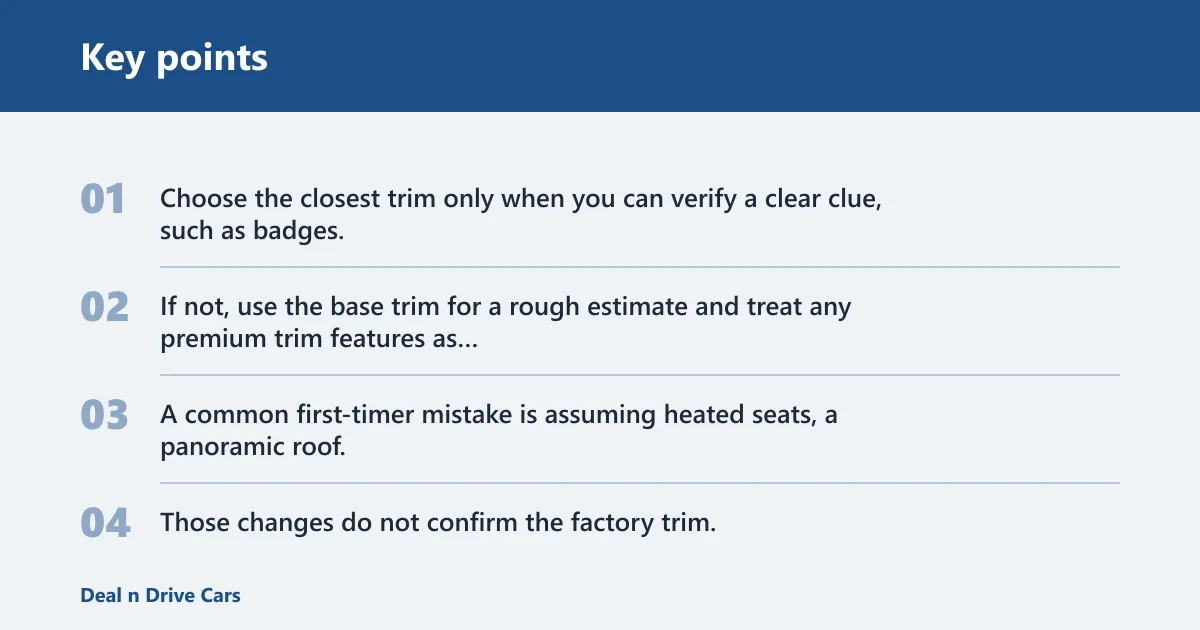
Choose the closest trim only when you can verify a clear clue, such as badges, a window sticker, service paperwork, or a build sheet. If not, use the base trim for a rough estimate and treat any premium trim features as upside, not fact.
A common first-timer mistake is assuming heated seats, a panoramic roof, or a tow package are “probably there.” Suppose a midsize pickup has a swapped grille and aftermarket wheels; that may not clearly confirm the factory trim. Those changes do not confirm the factory trim, and the wrong trim choice can distort the estimate fast.
How accurate is a trade-in estimate without a VIN?
It is accurate enough for planning, but not enough to treat as a final offer. Without a VIN, the estimate may miss exact trim, factory options, or history items that a dealer can confirm later. Market trends and local pricing still matter, so two ZIP codes can produce different numbers.
MotorTrend says Black Book data updates used vehicle values daily, which is one reason online estimates can move with the market. The estimate may also differ from the dealer’s actual offer after inspection, because a dealer can adjust for condition, tires, warning lights, repainting, or history findings.
Rough estimate versus dealer appraisal
A rough online estimate is a planning number. A dealer appraisal is a purchase decision. Apple notes that some trade-in programs evaluate the device after it is received and verified, which is a useful reminder: submitted details can be adjusted once the item is checked in person. Cars work the same way.
How much accuracy you lose without a VIN
You lose the ability to decode exact equipment and many history signals. That matters most on vehicles where one trim step, one package, or one accident record can change the trade-in figure enough to affect a deal. The estimate is still useful, but the confidence band is wider.
Can you trade in a car if it’s not registered?
Usually yes, but registration problems can slow the deal. Dealers care most about proof that you own the vehicle, whether the title is clear, and whether the paperwork matches the car. Registration is helpful, but it is not always the deciding document.
If the registration is missing or expired, bring the title, a valid ID, any lien release, and service records. If the title is not in your name, or there is an unpaid lien, the dealer may need extra time to verify ownership before making a final offer.
What paperwork to bring instead
Bring the title, bill of sale if available, insurance card, current or previous registration, and any loan payoff details. If the VIN is still unknown, these documents may also help confirm the exact vehicle and reduce the chance of a trim mismatch.
Common mistakes to avoid
The biggest errors are simple: guessing the wrong trim, underreporting mileage, hiding damage, and treating an online estimate as a final offer. Missing title or history issues can also change the number after inspection, especially if the car has accident repairs, branded title history, or warning lights.
- Guessing the trim: use paperwork or badges before you pick a version.
- Entering rounded mileage: put the odometer reading as accurately as possible.
- Skipping condition details: note dents, tires, glass, leaks, and warning lights.
- Using the estimate as a promise: the dealer can revise after inspection.
- Ignoring history issues: flood, fire, title brand, or odometer problems can reduce value.
Picture a sedan with 72,400 miles and a replaced front bumper. If the bumper repair hid deeper accident damage, the online number can look strong while the dealer later lowers the offer after a closer check.
Frequently asked questions
What information do I need to get a trade-in estimate?
Use the model year, make, model name, trim level, mileage, condition, options, and ZIP code. If you can also find the VIN, the estimate gets more specific because the tool can decode factory equipment and history signals that basic inputs cannot capture.
Is a VIN required for an accurate car value estimate?
No, but it is the best way to improve accuracy. A VIN lets the estimator identify the exact vehicle and check history items that can affect value. Without it, the result is still useful, but the dealer may adjust it after inspection or verification.
Can I get a Blue Book value without a VIN number?
You can get a Blue Book-style estimate without a VIN if the tool accepts year, make, model, trim, mileage, and condition. That number should be treated as an estimate, not an official quote, because trim and history details can still change the result.
What if I don’t know my trim level or options?
Start with paperwork, badges, the door-jamb sticker, or the original window sticker if you have it. If you still cannot confirm the trim, use the closest verified version and note unknown options separately. A guessed premium trim can inflate the estimate unfairly.